News
Guardian Buddha Offerings Guide 2026: How to Honor Your
You've been sitting for thirty minutes this morning — breath, body, the familiar texture of your mala between your fingers. The practice is solid. But there's a specific relationship you may not have fully explored yet: the one with your birth year guardian deity.
Not as a concept. As a practice. Specifically, as an offering practice. In Tibetan and East Asian Buddhist traditions, each of the eight Chinese zodiac groupings corresponds to a specific Buddha or Bodhisattva — your bensheng fo, the deity of your birth year.
And honoring that deity through targeted, correct offerings is one of the most direct, underutilized practices available to a committed practitioner. This guide covers what to offer, when, how to set an altar, and how a guardian buddha pendants collection piece can function as a portable altar when your cushion is three time zones away.
Guardian Buddha Offerings Honor is but there's a specific relationship you may not have fully explored yet: the one with your birth year guardian deity.
What the Guardian Buddha Relationship Actually Is
Let's clear something up immediately, because it matters for how you practice.
The guardian Buddha system — known in Chinese as bensheng fo (本命佛) and in Japanese esoteric Buddhism as the honzon system — is not astrology in the Western sense. It does not predict your personality or your fate.
It is a devotional and meditational framework that assigns a specific awakened being as a focal point for your practice based on the year of your birth within the twelve-year Chinese zodiac cycle.
The system took root in Esoteric Buddhism (Vajrayana and Mikkyō) through the Amoghavajra transmission during the Tang dynasty (8th century CE), which wove Indian tantric Buddhism together with Chinese cosmological frameworks. The eight deities correspond to the eight directions and the eight trigrams of Chinese cosmology, but the core logic is Buddhist: each deity embodies a specific quality of awakened mind, and by cultivating a relationship with that deity, you are cultivating that quality in yourself.
Here is the full correspondence table:
- Rat (1948, 1960, 1972, 1984, 1996, 2008): Thousand-Armed Guanyin (Avalokiteśvara) — compassion, responsiveness
- Ox (1949, 1961, 1973, 1985, 1997, 2009): Akashagarbha Bodhisattva — boundless wisdom, memory
- Tiger (1950, 1962, 1974, 1986, 1998, 2010): Akashagarbha Bodhisattva — same as Ox
- Rabbit (1951, 1963, 1975, 1987, 1999, 2011): Manjushri (Wenshu) — discriminating wisdom, clarity
- Dragon (1952, 1964, 1976, 1988, 2000, 2012): Samantabhadra (Puxian) — action, vow, practice
- Snake (1953, 1965, 1977, 1989, 2001, 2013): Samantabhadra — same as Dragon
- Horse (1954, 1966, 1978, 1990, 2002, 2014): Mahasthamaprapta (Dashizhi) — strength, concentration
- Goat (1955, 1967, 1979, 1991, 2003, 2015): Akashagarbha Bodhisattva — same as Ox/Tiger
- Monkey (1956, 1968, 1980, 1992, 2004, 2016): Vairocana (Dari Rulai) — totality, the ground of all
- Rooster (1957, 1969, 1981, 1993, 2005, 2017): Amitabha (Amituofo) — boundless light, pure land
- Dog (1958, 1970, 1982, 1994, 2006, 2018): Amitabha — same as Rooster
- Pig (1959, 1971, 1983, 1995, 2007, 2019): Amoghasiddhi — fearlessness, accomplishment
The misconception most practitioners carry is that this is a passive relationship — you were born in a Dragon year, so Samantabhadra is somehow watching over you automatically. That's not really how it works.
The relationship is activated and deepened through practice. Specifically, through offerings, recitation, and visualization. The deity doesn't need your flowers. You need the act of offering — the intention behind it, the repetition, the discipline of showing up at your altar each morning.
That distinction is everything.
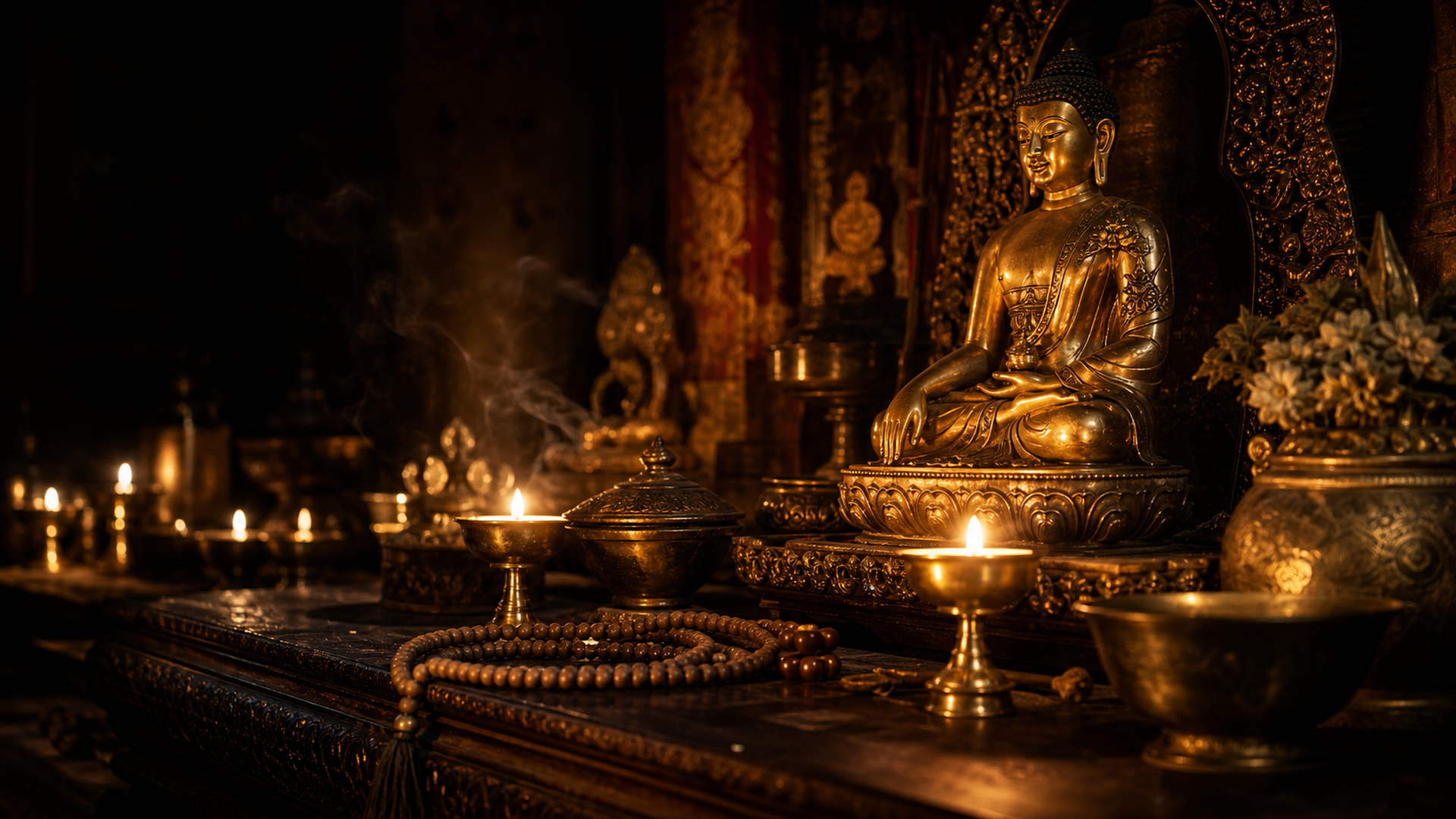
Alt text: Tibetan Buddhist altar with fresh white flowers, butter lamp, and incense arranged before a Guanyin statue
Why This Matters Specifically in 2026

2026 is the Year of the Horse, beginning February 17th. If you were born in a Horse year (1954, 1966, 1978, 1990, 2002), you are entering your ben ming nian — your birth year.
In Chinese Buddhist tradition, your birth year is considered a period of heightened karmic activity. Not cursed, not blessed by default — heightened. The energy is more responsive, which means both difficulties and practices carry more weight.
But even if you weren't born in a Horse year, 2026 brings a specific energetic context worth understanding. The Wood Fire transition (we move from Wood Snake in 2025 to Fire Horse in 2026) carries qualities associated with speed, visibility, and volatility.
Those on a path of sustained inquiry who have been in a plateau — and if you've been sitting for seven or more years, you know exactly what that plateau feels like — will find this a favorable year to deepen devotional practices that you may have intellectualized rather than embodied.
Here's what that looks like in real life:
If you're a Rabbit (Manjushri): You may be working through a significant decision — a career pivot, a relationship crossroads, a question about what your practice is actually for. Manjushri's quality is discriminating wisdom (prajna), the capacity to cut through confusion.
An active offering practice to Manjushri in 2026 isn't superstition — it's a daily reminder to orient toward clarity rather than rumination.
If you're a Dragon or Snake (Samantabhadra): Samantabhadra's domain is the ten great vows — the commitment to practice not only for your own liberation but for all beings. If your practice has become somewhat self-focused (this happens; it's not a moral failure), 2026 is a good year to reinvigorate the bodhicitta dimension.
Samantabhadra offerings are about renewing vow.
If you're a Rooster or Dog (Amitabha): The Wood Snake year of 2025 may have brought some of the classic Amitabha themes into relief — impermanence, the question of what you're moving toward. If you have aging parents, or if you've been sitting with grief in any form, Amitabha practice in 2026 has a particular resonance.
The offerings to Amitabha are about light — literally and metaphorically.
If you're a Horse (Mahasthamaprapta) entering your ben ming nian: This is your year to be especially deliberate. Mahasthamaprapta — whose name translates roughly as "arrived at great strength" — is associated with the power of mindfulness and nenfo (recollective practice).
The traditional advice for ben ming nian is to increase merit-generating activities: more offerings, more dana, more service. Not from fear, but from the recognition that the channel is more open.
For practitioners working with the full 2026 guardian Buddha framework, the offering practice is the most tangible daily anchor you can add to an existing meditation schedule without restructuring your whole practice.
Walk into any functioning monastery in Taiwan, Hong Kong, or the Tibetan exile communities in Dharamsala or Bylakuppe, and you'll see this practice in action. The offering tables in front of specific deity shrines — arranged with fresh water bowls, incense, and sometimes silk scarves — are maintained daily by practitioners who understand that the physical act of placing something beautiful before an image of awakened mind is itself a training in non-grasping, in generosity, in attention.
Specific Offerings for Each Guardian Buddha — The Actual Practice
This is the section most guides skip, defaulting to vague language about "making offerings" without telling you what to actually put on the altar. Here is what each deity traditionally receives, drawn from both Tibetan and Chinese Buddhist liturgical sources.
Guanyin (Thousand-Armed Avalokiteśvara) — For Rat Year Practitioners
Guanyin's iconographic colors are white and pale blue. Her element is water. Her mantra is Om Mani Padme Hum.
Preferred offerings:
- White flowers — specifically white chrysanthemums, white lotuses, or white gardenias. Not mixed arrangements. The purity of a single white flower in a small vase is more aligned with Guanyin's quality than an elaborate mixed bouquet. Change them before they wilt.
- Fresh water — seven small water bowls arranged in a row is the Tibetan standard. The water should be clean, poured fresh each morning, and poured out (not down the drain — onto a plant or outside) each evening.
- Willow branch — in Chinese iconography, Guanyin often holds a willow branch. A small willow cutting in water on the altar is traditional.
- Light — a white candle or a ghee lamp. Electric candles are acceptable if fire is genuinely not possible, but the real thing carries more presence.
What to avoid: Red flowers (associated with passion and Mars energy, not aligned with Guanyin's compassion field), meat offerings of any kind, heavily scented synthetic incense.
Best offering time: Dawn. Guanyin practice is traditionally associated with the early morning hours (approximately 5–7 AM). If you're already sitting at this time, add the offerings before you sit.
Manjushri (Wenshu Pusa) — For Rabbit Year Practitioners
Manjushri's color is golden yellow or saffron. His right hand holds the flaming sword of wisdom; his left holds the Prajnaparamita sutra. His mantra is Om Ah Ra Pa Tsa Na Dhih.
Preferred offerings:
- Books and texts — placing a dharma text on Manjushri's altar is one of the most traditional offerings. It doesn't need to be an antique Tibetan pecha. A copy of the Heart Sutra, the Diamond Sutra, or any dharma book you're currently studying is appropriate. The offering is symbolic: you are placing wisdom itself before the embodiment of wisdom.
- Light — Manjushri is strongly associated with illumination. A bright lamp (ghee lamp or beeswax candle) is the primary offering. Some practitioners use multiple lamps to represent the dispelling of ignorance.
- Yellow or orange flowers — marigolds, yellow chrysanthemums, or saffron-colored flowers.
- Incense — sandalwood is traditional. The smoke rising is associated with the rising of wisdom through the obscurations of mind.
Best offering time: Morning, specifically before any intellectual work. If you're in a profession that requires clear thinking — which, if you're reading this, you probably are — making Manjushri offerings before a difficult meeting or a complex project is a practice in orienting your intellect toward clarity rather than cleverness.
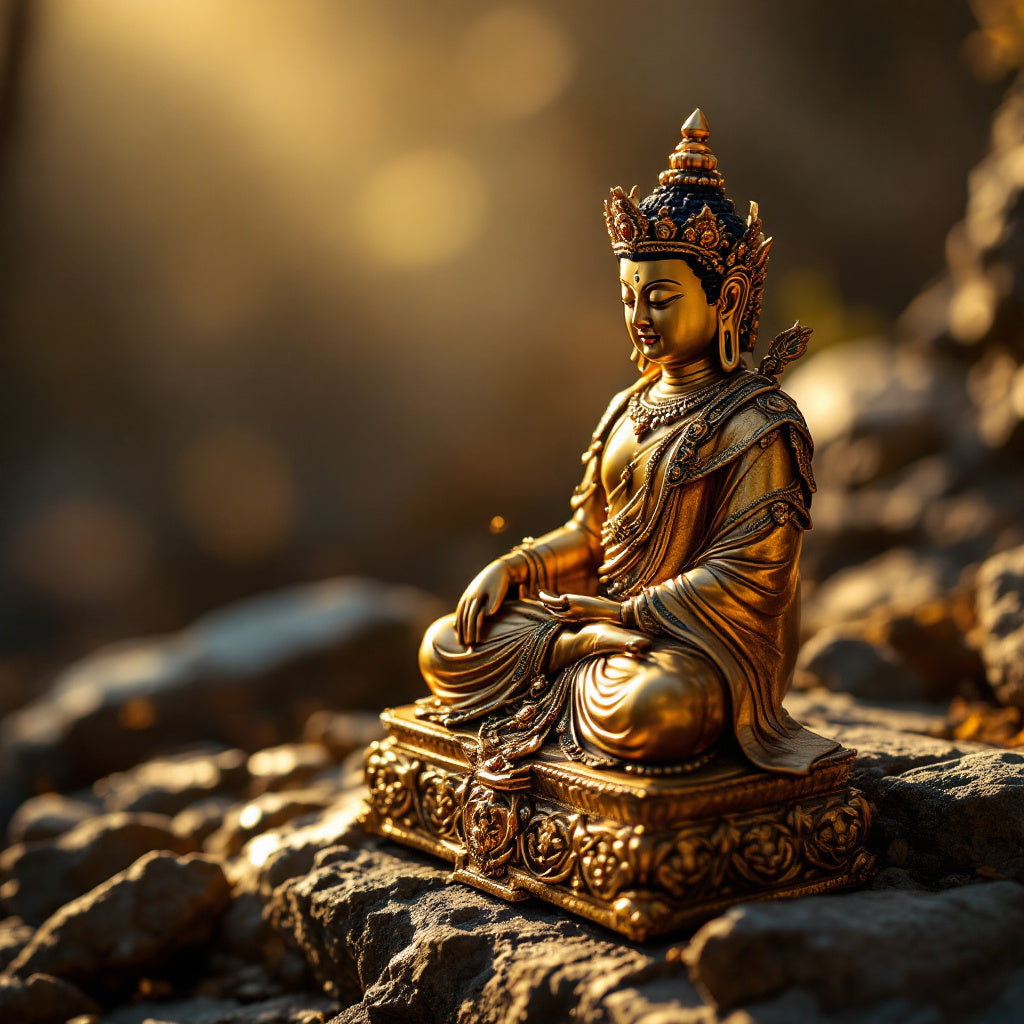
Alt text: Close-up of a Manjushri pendant in sterling silver beside an open dharma text and a lit ghee lamp on a wooden altar
Samantabhadra, Amitabha, Vairocana, and the Others — Condensed Offering Guide
Samantabhadra (Dragon/Snake): Six-sense offerings — something for each of the six senses. Flowers (sight), incense (smell), food (taste), music or a bell (sound), smooth stones or fabric (touch), and a dharma text (mind). Samantabhadra's ten great vows include offering to all Buddhas throughout all space and time, so the gesture of a complete sensory offering reflects his domain.
His color is white; his element is space.
Mahasthamaprapta (Horse): Purple lotus flowers if available; otherwise deep blue. A lamp that burns continuously if possible — this deity's quality is the unbroken power of recollection. Writing out the nembutsu or a short dedication of merit and placing it on the altar is a fitting offering.
His element is earth; his quality is strength that doesn't force.
Akashagarbha (Ox/Tiger/Goat): Sky-blue flowers, open space on the altar (don't crowd it), and a mirror — reflecting boundless space. Akashagarbha's name means "womb of space" or "treasury of the sky." The offering aesthetic is spaciousness. Less is more. A single blue flower, a clean mirror, a lamp.
Amitabha (Rooster/Dog): Red lotus flowers — specifically red, not pink. Amitabha's iconographic color is deep red (the color of the setting sun, of the western direction). A lamp with red glass. The recitation of Namo Amituofo while arranging offerings.
Sunset is the traditional offering time for Amitabha, corresponding to the western direction of his Pure Land.
Vairocana (Monkey): White flowers, a mirror to represent the mirror-like wisdom (adarsha-jnana), and if possible, an image or symbol of the Dharmadhatu. Vairocana is the central Buddha of the five-Buddha mandala; offerings to him have a quality of totality — you're not offering one thing, you're offering everything.
A full set of seven water bowls plus flowers, incense, lamp, and food is appropriate.
Amoghasiddhi (Pig): Green offerings — green plants, green apples, jade-colored objects. Amoghasiddhi's element is wind; his direction is north; his quality is the wisdom of accomplishment. Offerings that represent completion and action: a completed project, a fulfilled commitment written on paper and placed on the altar.
How to Choose an Authentic Guardian Buddha Piece for Your Practice

If you've been practicing for a decade, you already know the difference between a piece that carries presence and one that's decorative. But it's worth being specific about what to look for, because the market for Buddhist jewelry has expanded enormously and the range of quality is equally enormous.
Iconographic accuracy: Each guardian Buddha has specific hand gestures (mudras), held objects (attributes), and seated or standing postures that are not interchangeable. A Manjushri without his sword and sutra is not Manjushri — it's a generic bodhisattva figure.
When you're looking at authentic guardian buddha jewelry, check that the iconography matches the deity's traditional depiction. We work with artisans in our Kathmandu atelier who trained in traditional thangka painting before moving into metalwork — they know the difference between Guanyin's thousand-armed form and her standard standing form, and why it matters.
Material integrity: Sterling silver (925) and solid gold are the appropriate metals for devotional pendants. Gold-plated brass is acceptable for a budget piece but will not hold the same energetic quality over years of daily wear and contact.
For stone elements — turquoise, coral, lapis lazuli — ask about the source. Tibetan turquoise from the Yushu region of Qinghai has a specific matrix pattern that's recognizable once you've seen it. We've encountered dyed howlite passed off as turquoise in markets across Lhasa and Kathmandu, so verification matters.
Blessing and consecration: A piece that has been through a proper rab-ne (consecration ceremony) in Tibetan tradition, or a kai guang (eye-opening) ceremony in Chinese Buddhist tradition, carries a different quality than an unconsecrated piece.
We have our guardian deity pendants blessed during the full moon puja at Kopan Monastery in Kathmandu — a ceremony that includes the insertion of mantras and sacred substances into sealed pendant backs where the design allows.
This is not marketing language. You can ask us for the specific ceremony date and the presiding lama's name.
Sizing for daily wear: A pendant you'll actually wear every day should sit between 25mm and 40mm. Smaller than that and the iconographic detail is compromised; larger and it becomes an object you leave at home.
The weight should be substantial enough to feel present without pulling on your neck during a full day of work. Our artisans cast in lost-wax process, which allows for detail at smaller scales than die-stamped pieces.
If you're a Dragon-year practitioner, our deep get into the 1988 Dragon guardian Buddha practice for 2026 covers the specific Samantabhadra iconography in detail. For Rooster-year practitioners, the 1993 Rooster year guide addresses Amitabha specifically.
One criterion that often gets overlooked: does the piece feel right to sit with? Before purchasing, if at all possible, hold the piece during a short sit. Five minutes. Notice whether your attention is drawn toward it in a helpful way or whether it's simply decorative.
A well-made, properly consecrated piece tends to anchor attention rather than distract it. That's a subjective assessment, but after years of working with practitioners, we've found it's one of the most reliable quality indicators available to you.
How To Use It Day To Day — Daily Practice Structure
Here is a concrete daily practice structure that integrates guardian Buddha offerings without requiring you to rebuild your existing practice from scratch.
Morning (10–15 minutes before your main sit):
- Refresh the water bowls on your altar — pour out yesterday's water, rinse the bowls, refill with clean water. This is not a chore. Do it slowly. The act of pouring clean water is itself a practice in attention and care.
- Light incense and your lamp.
- Replace any wilted flowers.
- Stand or sit before the altar and recite your deity's mantra seven, twenty-one, or one hundred and eight times. You don't need a specific count to start — even seven repetitions done with full attention yields more than 108 done mechanically.
- Offer a short dedication: "May this practice benefit all beings, and may I embody the qualities of [deity name] in my actions today."
Activating your pendant as a portable altar:
This is where a handcrafted guardian deity pendant becomes genuinely useful for a practitioner who travels or works in environments where a physical altar isn't possible.
The activation process is straightforward:
- Place the pendant on your home altar for at least seven days before beginning to wear it daily. Let it absorb the incense, the lamp light, the mantra recitations.
- On the eighth day, hold the pendant in your joined palms and recite your deity's mantra 108 times. This is a basic form of the Tibetan rab-ne process adapted for lay practice, used in monasteries across the Kathmandu Valley since the 15th century.
- From that point forward, when you touch the pendant during the day — in a meeting, on a flight, in a difficult conversation — you are making contact with your altar. The touch is a micro-practice: a breath, a recollection, a return.
Evening practice (5 minutes):
- Before bed, sit briefly before your altar.
- Pour out the water bowls (onto a plant or outside — not down the drain, which is considered disrespectful in both Tibetan and Chinese Buddhist household traditions).
- Extinguish the lamp if it's a real candle.
- Recite your deity's mantra seven times.
- Dedicate the merit of the day's practice.
On your birthday and on the new moon: These are considered more potent days for guardian Buddha practice. On these days, increase your mantra count to 1,000 if possible, make a more elaborate offering (fresh fruit, a new flower), and if you have a specific aspiration for the year, write it on paper and place it on the altar for the day.
Alt text: Practitioner's hands holding a sterling silver Amitabha pendant over a small home altar with red lotus flowers and a lit lamp at dusk
Common Questions
Does my guardian Buddha change if I've taken refuge and have a yidam?
No — and this is a question worth sitting with carefully. Your yidam (personal practice deity assigned by a qualified lama in Vajrayana tradition) and your birth year guardian Buddha are different relationships serving different functions.
Your yidam is your primary tantric practice deity, assigned based on your karmic propensities and your teacher's assessment. Your guardian Buddha is more like a familial relationship — the deity associated with the energetic field of your birth year.
They don't conflict. Think of it this way: you can have a primary meditation teacher and still maintain a respectful relationship with other teachers in the lineage. The guardian Buddha practice is a devotional and merit-generating practice; your yidam practice is your primary vehicle for inner shift.
If you're unsure how to integrate them, ask your teacher directly. Most Vajrayana teachers in the Tibetan tradition are familiar with the Chinese zodiac guardian system and can advise on integration.
I was born near Chinese New Year — which year am I?
This is genuinely important and often gets glossed over. The Chinese New Year falls between January 21st and February 20th depending on the year. If you were born in January or early February, you may be the previous zodiac year rather than the calendar year you were born in.
For example, if you were born on February 10th, 1988, the Year of the Dragon didn't begin until February 17th, 1988 — so you would actually be a Rabbit, not a Dragon. The fix is simple: look up the exact start date of the Chinese New Year for your birth year.
There are reliable tables available through the Hong Kong Observatory and through academic Chinese calendar resources. Don't guess. Getting this wrong means you've been working with the wrong deity correspondence, which isn't harmful but isn't maximally useful either.
Is it appropriate for a Western practitioner to work with this system?
This question comes up often, and it deserves a direct answer. The guardian Buddha system has been practiced by lay Buddhists across East and Southeast Asia since at least the Tang Dynasty in the 7th century.
It is not an ethnically exclusive practice — it's a Buddhist practice that happens to have been transmitted primarily through Chinese and Japanese cultural contexts. If you have taken refuge in the Three Jewels, or if you have a sincere and respectful relationship with Buddhist practice, working with this system is appropriate.
What's not appropriate is treating it as exotic decoration or as a personality quiz. Approach it as you would any other Buddhist practice: with sincerity, with some study of the actual tradition, and ideally with guidance from a teacher who knows the system.
The offerings guide above is drawn from traditional liturgical sources, not invented for Western consumption.
How do I know if my pendant has been properly blessed?
Ask specifically. A legitimate consecration ceremony will have a date, a location, a presiding lama or monk's name, and a description of the ritual performed. "Blessed by monks" with no further detail is not sufficient — it may be true, but it's unverifiable.
What you're looking for is something like: "Blessed during the Mahakala puja at Kopan Monastery on [date], presided over by [name], including the recitation of the [specific mantra] 10,000 times and the insertion of mantra scrolls." We provide this documentation with every piece from our Buddhabelief's zodiac guardian collection because we believe you have the right to know exactly what you're working with.
If a seller cannot or will not provide this level of detail, that tells you something.
Can I make offerings if I don't have a dedicated altar space?
Yes, absolutely. The altar is a support, not a requirement. If you live in a studio apartment, share space with a non-practitioner partner, or travel frequently, you can maintain a minimal offering practice. A small wooden box or tray that you bring out each morning, place a single flower and a small candle on, make your recitations, and then put away — this is a complete practice.
The Tibetan tradition has a long history of practitioners maintaining practice under constrained conditions. Milarepa practiced in caves with nothing but a cotton robe. The form adapts; the intention is what matters. The pendant practice described in the "How to Actually Use It" section above was developed precisely for practitioners who can't maintain a permanent altar.
What if I miss days? Does the practice lose efficacy?
Missing days is not a moral failure and does not reset or negate your practice. This is worth saying clearly because the perfectionism that drives high-achieving practitioners (and if you're reading this, you probably know your own relationship with perfectionism) can turn a devotional practice into another performance metric.
The Tibetan approach to this is pragmatic: when you miss a day, you simply return the next day. You don't add extra recitations to "make up" for missed days in a punitive spirit. You can make a slightly more elaborate offering when you return — a fresh flower, a longer recitation — as an expression of renewed commitment, but this is a gesture of care, not debt repayment.
The relationship with your guardian deity is not transactional.
Do the offerings need to be expensive?
No. A single flower from your garden, a glass of clean water, a candle stub — these are complete offerings. The Tibetan tradition is explicit on this point: the quality of your attention and the sincerity of your intention matter more than the monetary value of what you place on the altar.
Keep reading