buddhist-jewelry
Protection Jewelry: Complete Guide to Spiritual Defense
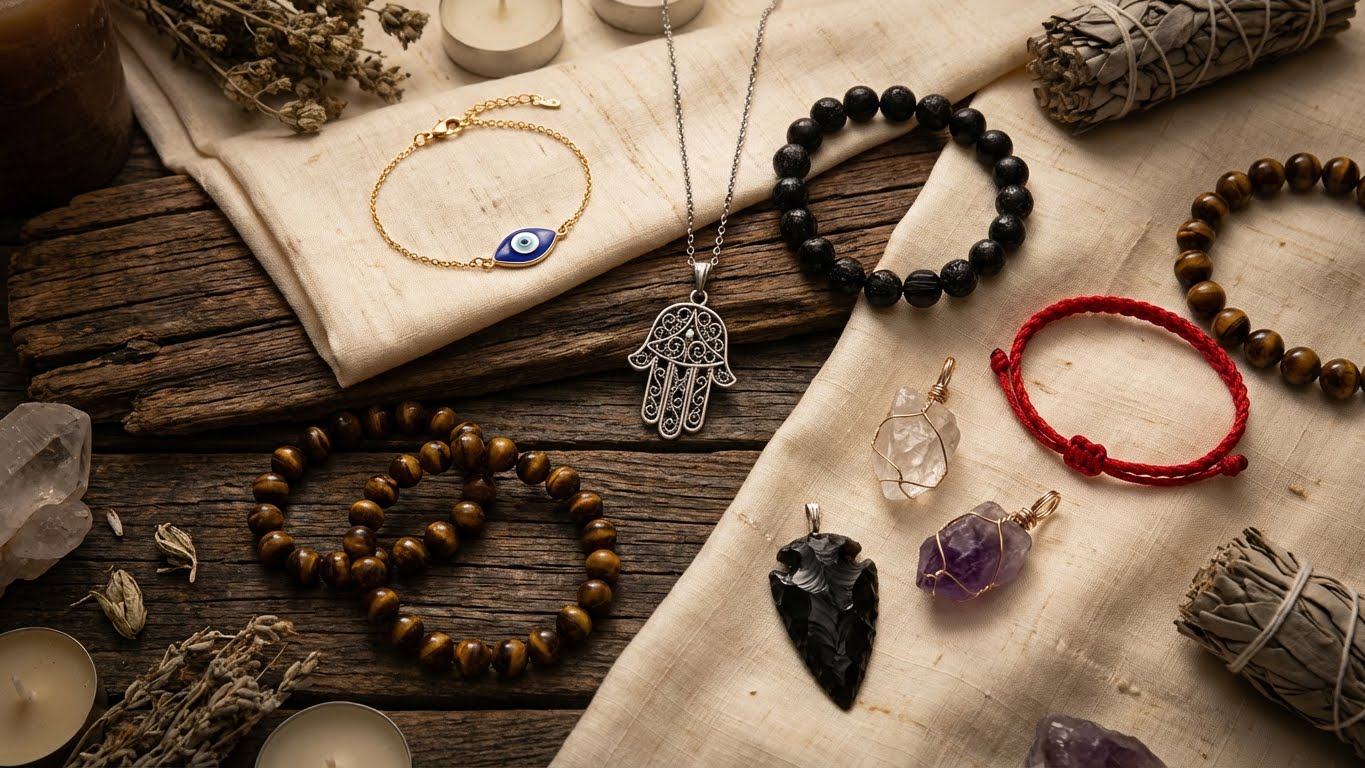
You feel it after certain conversations or after spending time in a crowded place—a subtle heaviness, a sense of being drained. It’s as if you’ve absorbed the static and stress from the world around you.
This isn't just your imagination; it's the experience of energetic porosity. In a life filled with constant interaction, digital noise, and the emotional states of others, maintaining your own spiritual and psychological equilibrium is a genuine challenge.
You may find yourself feeling ungrounded, anxious, or easily agitated without a clear cause. This is the moment when the ancient tradition of protection jewelry reveals its true purpose. It is not about superstition or warding off imaginary evils.
It is a profound practice of creating a sacred boundary, a tangible reminder of your own inner sanctuary and strength. It is a tool to help you walk through the world with intention, shielded not by a wall, but by a clear and resilient spirit.

What It Really Is: A Legacy of the Himalayas
To understand what protection jewelry truly is, you must look beyond modern interpretations and journey to the high plateaus of Tibet. Its origins are not in new-age crystal shops but are deeply woven into the fabric of Himalayan spirituality, predating even the arrival of Buddhism in the 7th century.
The early Bon traditions, the indigenous shamanic religion of Tibet, utilized talismans made from bone, specific woods, and uniquely patterned stones like Dzi beads to harmonize with the powerful elemental forces of the mountains, sky, and rivers.
These were not mere ornaments; they were vital tools for spiritual survival in a land where nature’s power was an immediate and constant presence.
When Buddhism was introduced, particularly the Vajrayana path brought by the great master Padmasambhava (Guru Rinpoche) in the 8th century, a powerful synthesis occurred. Instead of eradicating the old beliefs, Guru Rinpoche subdued and incorporated the local deities and spirits, transforming them into protectors of the Dharma, known as Dharmapalas.
This is the key to understanding Tibetan protection symbols. The fierce, wrathful imagery you see is not demonic; it represents the formidable power of enlightened compassion, a force strong enough to cut through ignorance and destroy obstacles to spiritual progress.
This philosophy became embedded in the objects people wore.
The creation of these objects became a sacred art, centered in monasteries like Samye, the very first Buddhist monastery in Tibet, and the great monastic universities of Sera and Drepung near Lhasa. Here, artisans and monks would craft Gau boxes—small, wearable shrines made of silver or copper, designed to hold sacred relics, medicinal herbs, or mantras written on scrolls.
These were not mass-produced. Each element was intentional. The metals were chosen for their conductive properties, the stones like turquoise and coral for their specific energetic qualities, and the enclosed mantras were painstakingly written and consecrated by a lama.
The object became a vessel, a microcosm of the monastery's spiritual power, carried by nomads, traders, and pilgrims across the treacherous Himalayan passes. It was their connection to the lineage, a portable field of protection and blessing.
What you see today is the living continuation of this unbroken tradition, where an object’s true value lies not in its material worth, but in the spiritual technology it contains.
The Deeper Meaning: Symbolism as a Spiritual Tool
Tibetan protection jewelry is a language spoken in symbols, each one a key to a closer level of consciousness. Wearing these pieces is not a passive act of hope; it is an active engagement with the principles they represent.
When you understand the meaning, the object transforms from a simple adornment into a potent spiritual ally that constantly reshapes your perception and reinforces your inner state.
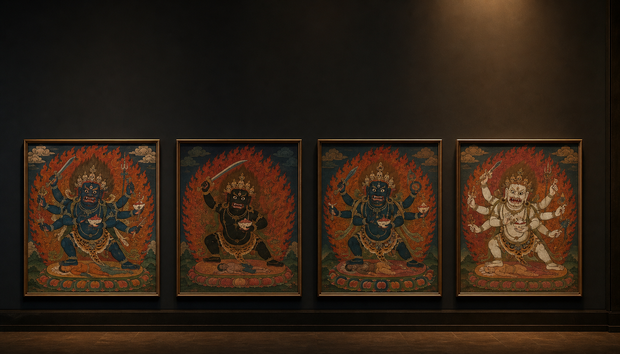
At the heart of this tradition are the protectors, the Dharmapalas. A figure like Mahakala, with his wrathful expression, crown of skulls, and flaming hair, can be intimidating to the uninitiated. But he is an emanation of Avalokiteshvara, the bodhisattva of compassion.
His ferocity is not directed at you; it is the fierce, uncompromising love that annihilates ego-clinging, doubt, and the internal and external forces that hinder your path to clarity. Wearing his image is a declaration of your intent to face your own shadows with courage and to transform negativity into wisdom.
It is a reminder that the greatest protection comes from taming your own mind.
The symbols themselves are active agents of transformation. The Vajra (or Dorje) is one of the most powerful. Representing both a thunderbolt and a diamond, it symbolizes the indestructible nature of mind and the irresistible force of truth.
To wear a Vajra is to align yourself with unwavering resolve and clarity. Similarly, the Endless Knot, with its interwoven lines without beginning or end, is a profound teaching on the interconnectedness of all phenomena and the eternal continuum of consciousness.
It protects you from the illusion of separation, fostering a sense of unity and compassion. These powerful symbols are central to the design of our handcrafted Tibetan amulets, each piece carrying a specific spiritual intention.
The materials chosen are as significant as the symbols carved upon them. Turquoise is not merely a blue stone; in Tibetan culture, it is considered a living entity, a sky-stone that breathes. It is believed to absorb negativity and even change color to warn the wearer of impending danger or illness.
Red coral represents the life force, vitality, and the preciousness of a human birth. Silver, associated with the moon, is seen as a conduit for purifying, calming energies. Even the humble Bodhi seed, from the species of tree under which the Buddha attained enlightenment, carries the imprint of that awakening.
Each bead rolled between your fingers is a connection to that profound moment of human potential realized. The jewelry is a complete system, a confluence of material, symbol, and intention designed to elevate and protect your spirit.
Real Benefits for Modern Life: Beyond the Mystical
While rooted in ancient spirituality, the benefits of wearing authentic protection jewelry are profoundly relevant to the challenges you face today. These are not abstract concepts but tangible aids for working through the psychological and energetic complexities of modern existence.
Think of these pieces less as remarkable charms and more as sophisticated tools for mental and emotional regulation.
One of the most immediate benefits is the creation of an energetic boundary. If you are an empath or work in a high-stress environment like healthcare, teaching, or customer service, you are constantly exposed to the emotional states of others.
It is easy to unconsciously absorb this stress, leading to burnout and emotional exhaustion. A protection amulet, such as one bearing the symbol of the Dorje or the image of a protector deity, acts as a psychic buffer.
It serves as a constant, subtle reminder of where your energy field ends and another's begins. It reinforces your intention to remain compassionate yet detached, to offer support without taking on the burden as your own.
It helps you maintain your sovereignty in emotionally charged situations.
These pieces also function as powerful anchors for mindfulness. In moments of rising anxiety or when your mind is lost in a spiral of worry, the physical sensation of the jewelry on your skin can pull you back to the present moment.
Touching the cool, smooth surface of a turquoise stone or the carved lines of a silver pendant can become a grounding ritual. It’s a sensory cue to take a deep breath, disengage from the frantic narrative in your head, and reconnect with your body and your immediate surroundings.
This simple act breaks the momentum of anxious thought patterns and restores a sense of calm and control.
Furthermore, this jewelry is a tool for cultivating inner resilience. Protection is not solely about defending against external forces; it's about strengthening your own core. When you wear a symbol of Mahakala, you are not only asking for external help.
You are consciously aligning with the fearless, compassionate, and powerful qualities within yourself. It is an affirmation of your own capacity to overcome self-doubt, procrastination, and negative self-talk. The amulet doesn't give you strength you don't have; it reminds you of the profound strength you already possess, encouraging you to meet life’s challenges with courage and a clear mind.
When you are ready to explore this practice, you can discover our diverse collection of sacred jewelry to find what resonates with your journey. — explore our protection jewelry collection for authentic pieces.

How To Spot the Real Thing Protection Jewelry
In a market flooded with mass-produced replicas, choosing an authentic piece of Tibetan protection jewelry is an act of discernment. An authentic item is more than an accessory; it is a spiritual instrument. The difference lies in intention, craftsmanship, and the energetic integrity of the materials.
Knowing what to look for ensures you are investing in a genuine tool for your practice, not only a hollow imitation.
First, consider the source and the maker. Authentic pieces often come from regions steeped in the tradition, such as Nepal, Tibet, or communities in India where Tibetan artisans have settled. They are typically crafted by individuals or families who have inherited this skill through generations.
These artisans are not only jewelers; they understand the sacred geometry and the precise iconography required. They know that a wrathful deity’s expression must convey fierce compassion, not simple anger. When you acquire a piece, ask about its origin.
Was it made with intention by someone who respects its spiritual significance? This connection to lineage is what separates a true amulet from a mere trinket.
Next, examine the materials and craftsmanship. Genuine Tibetan jewelry favors natural, potent materials. Look for real turquoise, which often has a matrix of darker veins, unlike the uniform, plastic-like appearance of dyed howlite. Feel the weight and coolness of genuine 925 sterling silver.
If a piece features mala beads, notice if they are hand-knotted. The small knot between each bead not only provides durability but also creates the perfect space for Japa (mantra recitation). The craftsmanship should show signs of human touch—slight variations that speak to its unique creation, rather than the flawless, sterile perfection of a machine.
These subtle details are marks of authenticity and care.
Finally, and most importantly, trust your own resonance. An authentic piece, imbued with positive intention and sacred symbolism, will have a certain presence or feeling. When you look at it or hold it, how does it make you feel?
You may be drawn to a particular symbol or stone without fully understanding why. This intuitive pull is often your own inner wisdom recognizing the energy or teaching you need at this moment. Don't rush the decision.
As you explore a curated collection of authentic pieces, take the time to observe which symbols and energies call to your spirit. The right piece will feel less like something you chose and more like something that was waiting for you.
How to Use Your Protection Jewelry
Acquiring a piece of protection jewelry is the first step. To truly activate its potential, you must engage with it as a sacred object and integrate it into your daily life. This involves a simple yet profound process of cleansing, consecrating, and wearing with mindfulness.
This transforms it from a passive object into an active partner in your spiritual well-being.
When you first receive your jewelry, it is essential to cleanse it energetically. The piece has traveled and been handled by practitioners, and it may carry residual energies from its journey. This is not a complicated ritual.
One of the most traditional methods is smoke cleansing. Light some dried juniper, sandalwood, or sage and allow the smoke to envelop the piece completely, holding the intention that all previous energies are being cleared and purified.
Alternatively, you can place the item on a bed of brown rice or sea salt overnight, as these are believed to absorb energetic impurities. For items with silver or certain crystals, leaving them in the light of a full moon for a few hours is a gentle yet powerful way to cleanse and recharge them.
After cleansing, the next step is to set your intention. This is perhaps the most crucial part of the process. Find a quiet moment where you will not be disturbed. Hold the jewelry in your hands at your heart center.
Close your eyes and take a few deep breaths to center yourself. Then, clearly and silently (or aloud), state your intention for the piece. Be specific. For example, "May this Vajra pendant be a constant reminder of my own indestructible clarity and strength," or "May this turquoise bracelet absorb any negativity directed towards me and help me maintain my peace." You are essentially giving the object its purpose.
You are programming it with your will and aspiration.
Finally, wear it with respect and mindfulness. This is not ordinary jewelry. It is best to avoid wearing it while bathing or sleeping, and it is traditionally considered disrespectful to take it into unclean places.
Each morning, as you put it on, take a moment to reconnect with the intention you set. Throughout the day, when you feel stressed, anxious, or ungrounded, let your touch on the jewelry be a conscious act.
Use it as a physical anchor to bring you back to your breath and your center. Remember to cleanse your piece periodically, especially if you have been through a particularly difficult experience. Just as you would wash a dirty cloth, you must regularly clear the energetic residue your amulet has absorbed on your behalf.
Explore our Tiger's Eye grounding bracelet.
Common Questions About Protection Jewelry
Can anyone wear Tibetan protection jewelry, or is it only for Buddhists?
Absolutely anyone can wear it. The power of these symbols is universal, speaking to qualities like strength, compassion, and wisdom that are inherent in all people. The key is not religious affiliation but respect and intention.
You don't need to be a Buddhist to benefit from a reminder of your own inner strength or to appreciate the beauty of the Endless Knot. As long as you wear the piece with a sincere and respectful intention, you are honoring its tradition.
It is an invitation for everyone to connect with these profound principles.
What does it mean if my protection bracelet breaks?
In many spiritual traditions, when a protection amulet or bracelet breaks, it is seen as a positive sign. The belief is that the piece has absorbed a significant energetic impact or blockage that was meant for you, and in doing so, it has fulfilled its purpose and sacrificed itself.
Rather than being upset, the appropriate response is one of gratitude. Thank the piece for its service and protection. It is recommended that you do not try to repair it. Instead, gather the pieces and return them to the earth, perhaps by burying them in your garden or a natural place, completing the cycle.
How do I know which symbol or deity is right for me?
This is a deeply personal choice, and intuition is your best guide. Start by looking at the symbols and reading about their meanings. Which qualities are you seeking to cultivate in your life right now?
If you need courage to face a challenge, the fierce compassion of a protector like Mahakala or the unwavering resolve of the Vajra might resonate. If you are working on opening your heart, a piece with the mantra Om Mani Padme Hum would be more appropriate.
Often, you will find yourself repeatedly drawn to a specific image or stone. Trust that attraction; it is your inner wisdom guiding you to the medicine you need.
Is it okay to wear multiple protection items at once?
Yes, it is perfectly acceptable, but do so with intention rather than for pure aesthetics. Think of it as creating a team of spiritual allies. A common and powerful combination is wearing a mala for mantra practice and an amulet or Gau box for protection.
The key is to avoid energetic "clutter." Choose pieces whose energies feel complementary to you. For instance, pairing a grounding stone like black obsidian with a high-resonance symbol like the Kalachakra sigil can create a balanced and potent field of support.
If wearing multiple pieces feels chaotic or overwhelming, it's a sign to simplify.
Should I let other people touch my protection jewelry?
It is generally best to limit how much others handle your sacred jewelry. A protection piece attunes to your personal energy field and your specific intentions over time. When someone else touches it, they can inadvertently leave their own energetic imprint on it, which can dilute or interfere with its purpose.
If someone does handle it, especially if you feel their energy was heavy or disruptive, it is not a catastrophe. Simply make a point to perform a simple cleansing ritual—like passing it through incense smoke—to clear it and reaffirm your intention.
My turquoise pendant seems to have changed color. What does that mean?
This is a well-known phenomenon in Tibetan and other indigenous cultures. Turquoise is a porous phosphate mineral, meaning it can absorb oils from your skin, lotions, and elements from the environment, which can alter its hue.
Spiritually, this physical property is interpreted as the stone actively working for you. It is believed that the turquoise is absorbing negativity, illness, or an energetic attack, thereby protecting you. A change in color is seen as a sign that your amulet is alive and actively engaged in its protective function.
It's a visible confirmation of the unseen work it is doing.
Your Next Step on the Path
You have now journeyed through the history, symbolism, and practice of Tibetan protection jewelry. You understand that these are not mere ornaments, but potent tools for cultivating inner fortitude and maintaining spiritual balance in a complex world.
They are tangible links to a lineage of wisdom, designed to awaken the qualities of strength, clarity, and compassion that already reside within you. This knowledge is the foundation, but the true transformation begins with experience.
The next step is to move from the intellectual to the intuitive. It is to find the piece that speaks to your unique journey and your present needs. This is a personal and sacred choice.
Allow yourself to be guided by a sense of connection, by the feeling that a particular symbol or stone is meant for you. This is how a simple object becomes a cherished ally. We invite you to find the piece that calls to you and begin the practice of wearing your intention.
Keep reading