
buddhist-jewelry
Tibetan Bracelet Meaning: Your 2026 Guide to Protection

It's 10 PM. The blue light of your phone illuminates your face as you scroll, one more email check, one more glance at a perfectly curated life on Instagram. A familiar wave of anxiety washes over you — a mix of burnout from the day and a quiet, persistent question: "Is this it?" You feel a longing for something tangible, something real to hold onto amidst the digital noise.
This feeling, this search for a quiet anchor in a loud world, is where the journey into the true meaning of authentic Tibetan bracelets often begins. It's not about finding a remarkable fix, but about finding a physical reminder of the calm and strength you already have within you.
The Foundation: What a Tibetan Bracelet Really Is
You've likely seen them. On the wrist of a yoga teacher, peeking out from the sleeve of a barista, or featured in a beautifully styled photo online. They're often colorful, woven with intricate knots, or feature beads of wood, stone, and metal.
The common assumption? That a Tibetan bracelet is a kind of exotic good luck charm, a spiritual fashion accessory meant to ward off negative feelings. And while they can be beautiful, this view misses the heart of their purpose entirely.
The single biggest misconception is that the bracelet *does* something *to* you. The reality is, it's a tool to help *you* do something for *yourself*. It's not a passive amulet but an active instrument for mindfulness.
After spending years in the Himalayas, living and working alongside the artisans who craft these pieces, we've learned that every element is about intention. It's a wearable reminder. A quiet whisper to your subconscious throughout the day.
When you glance at it during a stressful meeting, it's not quietly striking in deflecting your boss's bad mood. It's reminding *you* to take a breath, to stay centered, to not let external chaos become internal turmoil.
The power isn't in the object itself, but in the relationship you build with it. We've watched practitioners in Lhasa return to their bracelets dozens of times daily—not out of superstition, but out of genuine practice.
Think of it less like a shield and more like a compass. A compass doesn't walk the path for you, but it constantly helps you reorient, reminding you which way is north. Similarly, your bracelet helps you return to your chosen intention—be it patience, compassion, or simply being present.
The materials themselves carry this intentionality. A bracelet made with yak bone beads isn't just rustic; it's a tangible reminder of impermanence, a core Buddhist teaching rooted in the Dalai Lama's own lineage teachings.
The famous red cord, often called a 'protection bracelet,' is tied with specific knots—typically nine or thirteen—while mantras are recited. The artisans in our Kathmandu atelier aren't just assembling components; they are weaving intention and centuries of tradition into each knot.
The meaning isn't just symbolic; it's embedded in the very creation of the piece.

Why This Matters (Especially in 2026)
Let's be honest. Your life is probably saturated with digital input. Your calendar is a series of back-to-back video calls. Your social life is maintained through texts and feeds. Your downtime is often spent streaming content.
We live in a world that is increasingly disembodied, and by 2026, this sense of digital saturation and the burnout it causes is only becoming more acute. The line between your work self, your social self, and your true self feels blurrier than ever.
This is precisely why a simple, tangible object like a Tibetan bracelet has become so resonant. It is an act of quiet rebellion against the intangible. It's an analog anchor in a digital storm.
It offers no notifications, requires no software updates, and has no battery to die. Its only function is to be present, with you—a string of semi-precious stones that has been hand-knotted using techniques passed down through Himalayan communities for generations.
Consider these scenarios, which might feel familiar:
- The Mid-Afternoon Slump: You're staring at a screen, 27 tabs open, feeling overwhelmed and unproductive. You've been scrolling for 15 minutes without realizing it, comparing your messy reality to someone else's polished highlight reel. You feel a slight pressure on your wrist. You glance down, see the bracelet, and it breaks the spell. It's a pattern interrupt. You close the laptop, take three conscious breaths, and stretch. You've been brought back to your body, back to the present moment.
- The Difficult Conversation: You're about to enter a conversation you've been dreading—with a partner, a boss, a family member. Your heart is racing. As you reach to open the door, your fingers brush against the beads of your bracelet. You pause. You remember the intention you set that morning: to listen with compassion, to speak your truth calmly. The physical touch grounds you, pulling you out of anxious future-thinking and into the present, ready to handle the situation with more grace.
- The Identity Question: You're contemplating a big life change. A new job? A move? Ending a relationship? The endless 'what-ifs' are paralyzing. In a moment of quiet, you find yourself twisting the bracelet on your wrist. It connects you to a closer part of yourself, the part that knows what you truly want, beneath the layers of societal expectation and fear. It becomes a touchstone for your own inner wisdom.
In a world that constantly pulls your attention outward, a Tibetan bracelet is a gentle, persistent invitation to turn your attention inward. It doesn't offer answers, but it creates the quiet space where you can begin to hear your own.
It's a commitment to your own well-being, worn on your wrist—a practice that will only deepen as the noise around us grows louder.
The Real Benefits: How a Tibetan Bracelet Actually Works
So, we've established it's not magic. How does a simple bracelet translate into tangible feelings of protection, balance, and spiritual connection? It works through the principles of mindfulness, intention, and neuro-association. You are essentially training your brain to associate the physical sensation of the bracelet with a desired mental state.
Here's how that breaks down.
Protection: A Shield for Your Mind
When we talk about protection in a Tibetan Buddhist context, we aren't usually talking about shielding you from physical harm. The real battles are fought in the mind. The 'protection' is against negative thought patterns, distraction, and the corrosive effects of stress and anxiety.
Your bracelet acts as a guardian at the gate of your mind.
How it works is simple conditioning. You consciously decide that this bracelet represents your intention to remain calm and centered. When you feel a wave of panic or anger rising, the bracelet on your wrist becomes a tactile alarm bell.
The feeling of the cord against your skin or the coolness of the stone beads becomes a trigger. It's a signal to pause before you react. In that pause, you have the power to choose a different response.
Instead of lashing out, you breathe. Instead of spiraling into anxiety, you ground yourself in the present moment. This is the essence of mental protection. The symbols incorporated into these pieces—like the endless knot or protective mantras carved into bone—carry meanings that practitioners in the Tibetan plateau have relied upon for centuries, a subject we explore more deeply in our guide to spiritual protection symbols.
Balance: Finding Your Center Amidst Chaos
Balance isn't a destination you arrive at; it's a constant act of adjustment. Like walking a tightrope, it requires moment-to-moment awareness. In your daily life, you're constantly pulled in different directions: the demands of work, the needs of family, your own personal goals, the pressure to keep up online.
It's easy to lose your footing.
A Tibetan bracelet serves as your balancing pole. It's a physical touchpoint that brings you back to your center of gravity. When you're feeling pulled in a million directions, the simple act of touching your bracelet can be deeply centering.
It's an invitation to check in with yourself: Am I breathing? Are my shoulders tensed up to my ears? Am I present in this moment, or am I worrying about the next ten things on my to-do list?
This practice of repeatedly returning to the present moment is the very definition of mindfulness. It helps you cultivate an inner equilibrium that isn't dependent on external circumstances being perfect. You can find your calm even when the world around you is not.
Spiritual Use: A Connection to Something Deeper
For those on a path of self-inquiry, a Tibetan bracelet is often the first step on a closer spiritual path. You don't need to be a Buddhist or have any experience with meditation to benefit.
It can simply be a symbol of your connection to your own inner values—kindness, patience, wisdom, and compassion.
Using the bracelet can be a simple, non-dogmatic daily practice. When you put it on in the morning, you can take a moment to set an intention for the day. For example: "Today, I will be patient with myself and others." Throughout the day, every time you notice the bracelet, it reinforces that intention.
It becomes a companion in your practice. For those who meditate, it can be used to count breaths or mantras, similar to a full mala with its traditional 108 beads. It's a way of carrying the peace of your practice with you long after you've gotten up from the cushion.
As you deepen this connection, our guide on Buddha bracelets offers a complementary perspective on how to integrate these tools into your daily life.
How to Choose an Authentic Tibetan Bracelet
working through the world of spiritual jewelry can be confusing. There are countless online shops selling mass-produced items labeled 'Tibetan' that have never been near Tibet or a practitioner's hands. Choosing an authentic piece isn't about snobbery; it's about honoring the tradition and ensuring the piece you wear carries the genuine intention with which these objects are meant to be created.
Here are a few things to consider when exploring a handwoven Tibetan bracelet collection.
First, consider your intention. What are you seeking more of in your life right now? Is it calm amidst work stress? Is it compassion in a difficult relationship? Is it the courage to make a change?
Let your intention guide your choice. You don't need to know the deep esoteric meaning of every symbol. Trust your intuition. Which piece are you drawn to? Often, the bracelet you feel a connection with is the one that holds the right presence for you at this moment.
Second, look at the materials and craftsmanship. Authentic pieces feel different. They aren't perfect in the way a machine-made item is. You might see slight variations in the knots or the color of the stones—perhaps one lapis lazuli bead slightly deeper indigo than its neighbor.
This is a sign of human hands and heart being involved. We've spent years building relationships with our artisans in Nepal, like Master Tenzin who leads our Boudhanath workshop since 2008. We know the hands that craft our pieces, and we know the care that goes into them.
Look for sellers who tell you about their artisans, not only their products.
Here are a few common types you'll find in our our Tibetan bracelet selection:
- The Woven Cord Bracelet: Often red, these are perhaps the most iconic. The knots themselves (like the Endless Knot or Vajra knot) are symbolic and tied while reciting mantras. A simple handwoven red string bracelet is a wonderful, accessible starting point for anyone new to this path, focused purely on protection and good fortune.
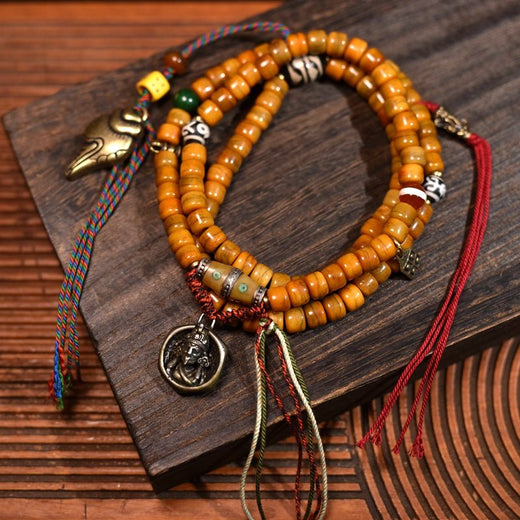
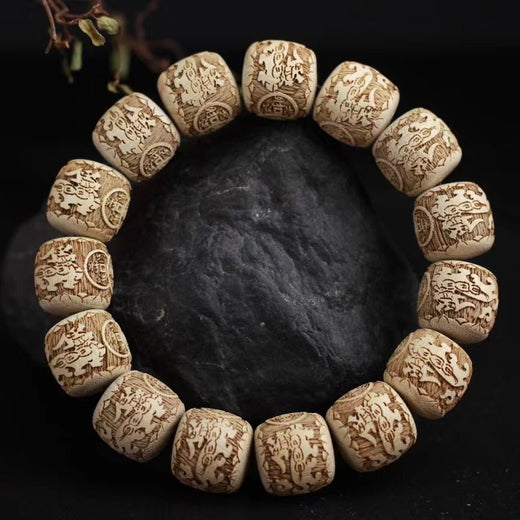
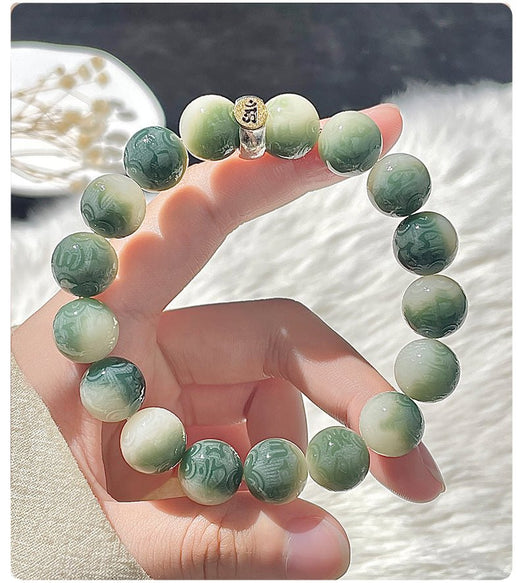
- Beaded Bracelets: These can be made from wood (like Sandalwood for calm), seeds (like Bodhi seeds for enlightenment), or stone. Each material has a traditional association—sandalwood from Nepal carries a subtle, grounding scent even years after carving—but again, let your personal connection be your guide.
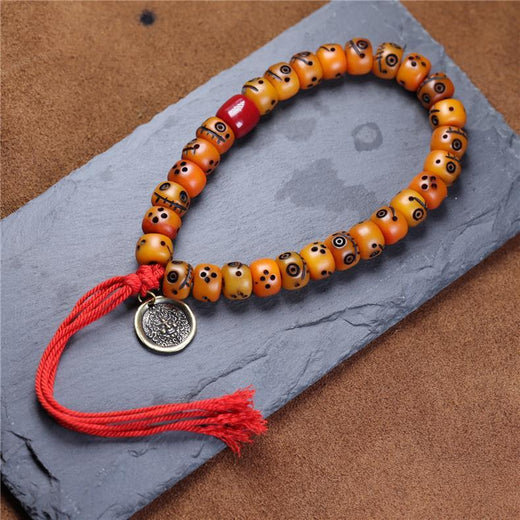
- Dzi Bead Bracelets: An authentic Dzi bead is a significant investment piece. These ancient agate beads, etched with quietly striking patterns, are highly prized in Tibetan culture as powerful protective talismans. A genuine Dzi bead bracelet is something you'll wear for a lifetime and pass down through generations.
- Metal Bracelets: Often made from silver, copper, or brass, these are typically engraved with the 'Om Mani Padme Hum' mantra. A Tibetan silver bracelet serves as a constant, beautiful reminder of the aspiration for universal compassion.
Ultimately, choosing a bracelet is a personal journey. The most authentic piece is the one that speaks to you and supports your path. As you deepen your practice, you may find yourself returning to add another piece to your collection, each one marking a chapter of your own unfolding.
Our complete guide to Tibetan bracelets delves even deeper into the nuances of selecting a piece that's right for you.

How to Actually Use Your Bracelet: A Simple Daily Practice
You've chosen a bracelet that resonates with you. It arrives, and you hold it in your hands. Now what? The most beautiful, authentic bracelet in the world is just a decoration if it sits forgotten in a drawer.
The real value comes from integrating it into your daily life. This doesn't require lengthy rituals or deep esoteric knowledge. It's about creating small moments of mindfulness.
Here's a simple practice you can start today:
- The First Wearing: Setting Your Intention. Before you put your bracelet on for the first time, find a quiet moment. Sit comfortably, close your eyes, and take three slow, deep breaths. Hold the bracelet in your hands. Think about what you'd like it to represent for you. Is it a reminder to be patient? A symbol of your own inner strength? A prompt to be more present? State your intention clearly in your mind, or even whisper it aloud. For example: "May this bracelet remind me to breathe before I react." Then, as you fasten it onto your wrist, do so with this intention in mind. You are not only putting on jewelry; you are making a quiet promise to yourself. This mirrors the practice Tibetan practitioners have maintained since the 11th century, when intention-setting became central to wearing sacred objects.
- The Daily Glance: Your Pattern Interrupt. Throughout your day, you will inevitably notice the bracelet on your wrist—while typing, drinking coffee, or driving. Let each glance be a mini-mindfulness bell. When you see it, use it as a trigger to check in with your body and mind for just a few seconds. Are you holding tension in your jaw? Relax it. Are your shoulders hunched? Let them drop. Is your mind racing? Take one single, conscious breath. This practice, repeated many times a day, can fundamentally shift your relationship with stress. It breaks the cycle of unconscious reaction and brings you back to the present. Those on a path of self-inquiry find this technique especially useful during work transitions or difficult conversations.
- The Conscious Touch: Grounding in a Crisis. When you feel a strong emotion—anxiety, frustration, fear—your mind can feel like it's spinning out of control. In these moments, consciously reach for your bracelet. Don't just glance at it; touch it. Feel the texture of the cord, the coolness of the beads, the smoothness of the metal. Focus all your attention on that physical sensation for 10-15 seconds. This is a grounding technique used in Tibetan monasteries, where monks touch prayer beads during meditation to anchor awareness. It pulls your attention out of the chaotic story in your head and into the physical reality of the present moment, giving you the space to calm your nervous system.
- Caring for Your Companion: Treat your bracelet with respect, as you would any meaningful object. Take it off before showering or swimming to preserve the materials—the cord fibers and natural stone beads are vulnerable to prolonged moisture. When you take it off at night, place it somewhere special, like a small dish on your nightstand, rather than just tossing it on the counter. This small act reinforces its significance as a dedicated tool for your well-being. You are honoring both the craftsmanship and your own commitment to practice.
Common Questions About Tibetan Bracelets
Do I need to be a Buddhist to wear a Tibetan bracelet?
Absolutely not. This is one of the most common questions we hear, and the answer is a clear and welcoming no. While these bracelets come from a rich Tibetan Buddhist tradition, their core principles of mindfulness, intention, and compassion are universal human values.
You can think of it as a tool for personal growth, not a statement of religious affiliation. Wearing one is about your personal journey and your intention to cultivate more peace and awareness in your life.
It's an invitation, not a conversion. We see them as a bridge between a beautiful ancient culture and anyone in the modern world seeking a bit more grounding.
Which wrist should I wear my bracelet on?
In many spiritual traditions, the left hand is considered the 'receiving' hand, as it's closer to the heart. Wearing a bracelet on your left wrist is thought to help you receive the positive presence or intentions you wish to cultivate—like calm, compassion, or protection.
The right hand is seen as the 'projecting' or 'giving' hand. Wearing a bracelet here might be for when you want to project or share a certain quality with the world. However, we always say the most important rule is to trust your intuition.
Wear it on the wrist that feels most comfortable and natural to you. The connection you build with the bracelet is far more important than any rigid rule.
What does it mean if my bracelet breaks?
If a woven bracelet that you've worn for a long time suddenly breaks, there's a beautiful traditional interpretation. It's believed that the bracelet has absorbed all the negativity it was meant to and has now fulfilled its purpose.
Rather than being a bad omen, it's seen as a positive sign that it has successfully protected you. It marks the end of a cycle and an opportunity for a new beginning with a new intention.
It's also a powerful lesson in impermanence, a central theme in Buddhist thought since the Buddha's earliest teachings. Everything is temporary. When a bracelet breaks, you can thank it for its service and let it go with gratitude.
How are these bracelets actually blessed?
This is an important question, as the term 'blessed' can sound vague. For us, it's a very specific process. It's not a mystical incantation. The blessing is an infusion of positive intention. For certain pieces in our collection, this involves taking them to a place of deep spiritual presence, such as the sacred stupa at Boudhanath in Kathmandu, where pilgrims circumambulate the 36-meter dome daily.
The items are held by monks from a local monastery, like the monks from Sera Monastery who we have a relationship with, as they perform their daily chants and recite mantras. The sound resonance and focused, compassionate intention of the monks are believed to purify the objects and imbue them with positivity.
It's about connecting the piece to an authentic, living spiritual tradition.
Can I wear my Tibetan bracelet in the shower or to sleep?
We generally recommend taking your bracelet off before showering, swimming, or doing anything that involves harsh chemicals. Water can weaken natural cords over time and tarnish metals like silver or brass. As for sleeping, it's a matter of personal comfort.
Some people find it comforting to wear their bracelet to bed, while others prefer not to. There's no strict rule. The most important thing is to care for the physical materials of your bracelet so that this meaningful companion can stay with you for as long as possible.
Treating it with care is another form of mindfulness and respect for the object and its purpose.
What's the difference between a Tibetan bracelet and a full mala?
Think of the bracelet as a more portable, everyday version of a mala. A traditional mala has 108 beads and is used as a tool for counting mantras or breaths during a formal meditation practice.
It's like a spiritual abacus. A Tibetan bracelet serves a similar purpose but in a more subtle, integrated way. It's not typically used for a full 108-count meditation, but rather as a constant reminder of your practice and intention as you move through your day.
It carries the essence of the mala—mindfulness, intention, connection—out of the formal meditation setting and into every moment of your life.
Your Journey, Your Anchor
As we move further into 2026 and beyond, the need for grounding and genuine connection—both with ourselves and with something meaningful—will only grow. The digital noise isn't going away. The pressures of modern life won't vanish quietly.
The real question is, how will you choose to navigate it all? How will you remember to come back to yourself when the world tries to pull you away?
A Tibetan bracelet is not the answer, but it is a beautiful question worn on your wrist. It's a question that asks, "Am I present? Am I being kind to myself? Am I breathing?" It's a quiet, steadfast companion for your personal journey.
It's a small, tangible piece of a tradition refined across the Himalayan valleys since the 11th century, reminding you that peace isn't something you have to find out there, but something you can cultivate right here, within.
If you feel ready to find a companion for your journey, we invite you to explore our collection of traditional Tibetan protection bracelets. Find the one that speaks to the path you're walking right now.
Keep reading