
News
000 Angel Number Meaning: Buddhist View

The 000 angel number is best read as a prompt to pause at a threshold. In Buddhist terms it points to emptiness (shunyata) — not a void to fear, but the open space where something new can begin.
Important context: Angel numbers are a modern numerological idea, not a traditional Tibetan Buddhist doctrine. This guide uses Buddhist teachings on emptiness as an interpretive lens rather than claiming a historical Buddhist meaning for 000.
You glance at your phone: 10:00. You grab your coffee and notice the receipt total: $10.00. You drive home and the car in front of you has a license plate ending in 000. At some point you stop dismissing it as coincidence and start genuinely wondering — what is this trying to tell me?
Here's the thing about 000: most of what you'll find online treats it like a cosmic text message — "the universe is calling!" — which is exciting for about ten minutes and then leaves you exactly where you started.
What we want to offer you instead is something older and, we think, more genuinely useful. Tibetan Buddhism has been sitting with the meaning of zero — of emptiness — for roughly 1,500 years.
That tradition has a lot to say about what it means to stand at the threshold of nothing, and why that's actually the most hopeful place you can be. Explore our angel number jewelry collection as you read — sometimes a physical anchor helps these ideas land.
What Does the 000 Angel Number Mean?
Let's clear something up first, because it matters for everything that follows.
000 is not a warning. It's not a sign that something is about to go wrong, or that you need to urgently change course before some cosmic deadline. Many practitioners online frame angel numbers as slightly anxious prompts — hurry up, pay attention, don't miss this window — and 000 in particular gets interpreted through that lens because three zeros can feel like a void, like absence, like something missing.
That reading comes from a Western discomfort with zero that goes back centuries. Zero was actually a controversial concept in European mathematics well into the medieval period — some scholars resisted it because "nothing" felt philosophically threatening.
If zero means nothing, and nothing is bad, then three zeros must be very bad indeed. That's the cultural baggage, not the symbol's actual meaning.
In Buddhist philosophy — specifically in the Madhyamaka tradition articulated by the philosopher Nagarjuna around the 2nd century CE — emptiness (shunyata in Sanskrit, stong-pa nyid in Tibetan) is not a negative state.
It is the fundamental nature of reality. To say something is "empty" in this tradition means it is empty of fixed, independent, permanent existence. It doesn't mean it doesn't exist. It means it exists dependently, relationally, and therefore it is not trapped in a single form.
It can change. It can become.
The Heart Sutra includes the statement form is emptiness, emptiness is form. Its concluding mantra, which begins gate gate paragate, is a separate passage, not the Sanskrit wording of that statement. Here, the comparison between zero and emptiness is an editorial reflection on dependent existence, not a Buddhist teaching about the sequence 000.
Without emptiness, nothing could happen at all.
So when you map 000 onto this framework, something shifts. Three zeros aren't three absences stacked on top of each other. They're three affirmations of the same truth: you are standing in a field of pure potential.
Nothing about your situation is locked in. The slate isn't blank because something was erased — it's blank because it was always meant to be written on.
The angel number tradition, which became widely popularized through Doreen Virtue's work in the 1990s and early 2000s, arrived at a similar conclusion through a different route. In that framework, 000 represents the infinite, the Alpha and Omega, the point before all beginnings.
The comparison here is editorial. Modern angel-number interpretations and Buddhist discussions of emptiness have different histories and should not be treated as the same doctrine.
For our purposes — and for yours, if you're reading this because something in your life feels genuinely unresolved — the most useful takeaway from both traditions is this: 000 is not asking you to figure out your next move.
It's asking you to get comfortable with not knowing yet. That discomfort you feel in the open space? That's actually the feeling of possibility. You've just been taught to read it as threat.
If you want to go deeper on how Buddhist numerology intersects with the angel number tradition more broadly, our complete guide to angel numbers and Tibetan Buddhist numerology covers the full landscape.
Why 000 Feels So Loud in 2026

A reader may become interested in 000 during a period of transition. That is a possible personal context, not a verified search trend or a sociological explanation for why the number is noticed.
Interest in a number does not identify a reader's age, education or stage of life. The examples below are hypothetical situations, not a profile established from audience research.
They've done the things they were supposed to do. They got the job, or the relationship, or the apartment. And now they're sitting with a quiet but persistent feeling that the map they were given doesn't quite match the territory they're standing in.
Work and personal transitions can make uncertainty feel pressing. This article does not use an unverified survey ranking to diagnose a reader or explain why a number appears to them.
It created a prolonged in-between state that those working through their thirties are still working through. You might be in that state right now.
The in-between is exactly where 000 lives.
When Your Career Feels Like a Reset Button
Maybe you left a job, or you're thinking about leaving one. Maybe the career path that made sense at 22 feels genuinely wrong at 29, and you don't yet know what's right. The temptation in that space is to fill it as fast as possible — to research, to plan, to commit to something just to stop feeling the uncertainty. 000 showing up repeatedly during this period is worth sitting with rather than rushing past.
The Buddhist reading here is direct: you're being invited to tolerate the open field a little longer, because forcing a premature form on formless potential often just creates more work for your future self.
When a Relationship Is at a Threshold
Relationships have their own version of the void. The moment before a difficult conversation. The space after a breakup where you don't know who you are without that person. The strange limbo of being with someone and genuinely not knowing if this is the person. 000 in these contexts isn't telling you to stay or go.
It's pointing at the fact that the answer already exists somewhere inside you — it's just obscured by the noise of anxiety and social expectation. Emptiness, in the Buddhist sense, isn't the absence of the answer.
It's the spaciousness required to actually hear it.
When You're Starting Something New
This is the most straightforward reading of 000, and it's the one that feels genuinely energizing once you stop being nervous about the zeros. If you're beginning a creative project, a spiritual practice, a new city, a new chapter — 000 is the number of that exact moment.
A new beginning can be a useful editorial theme. The Japanese Zen term shoshin, often rendered beginner's mind, belongs to a different context; this comparison does not establish a Tibetan teaching about 000.
The student who arrives knowing nothing is capable of learning everything. The one who arrives knowing everything has already closed most of the doors.
The 2026 Context Specifically
We're in a period of pronounced collective uncertainty — economically, technologically, politically. AI is reshaping entire industries faster than most people can track. Remote work norms are still settling. The financial calculus of major life decisions (housing, family, career pivots) looks different than it did five years ago.
In that environment, the appeal of a symbol that says "you are standing at the beginning of something, and that's okay" is not trivial. It's actually quite grounding.
The Tibetan Buddhist response to collective uncertainty has historically been to return to practice — to the breath, to the mala, to the simple physical act of counting and returning. Not because practice solves external problems, but because it stabilizes the mind that has to navigate them.
If 000 is showing up for you right now, consider it an invitation into that kind of stability. Our guide to angel numbers from a Tibetan perspective explores this stabilizing function in more depth.
How 000 Actually Works — Three Dimensions of the Symbol
The Cognitive Dimension: Interrupting the Loop
People notice patterns, and a familiar sequence can attract attention once it has become interesting to them. Recognizing 000 does not establish a message, a statistical anomaly or a particular brain mechanism.
You can choose to pause and observe what is happening around you. That is a personal reflective use of a noticed pattern, not evidence that the sequence treats anxiety or works by the same mechanism as a Buddhist meditation practice.
The Symbolic Dimension: The Circle That Contains Everything
Zero is a circle. This is not incidental. The circle is one of the most universal symbols across human cultures — the Tibetan khor lo (wheel of dharma), the Zen enso, the ouroboros of alchemical tradition, the medicine wheel of Indigenous American traditions.
The circle has no beginning and no end. It contains everything within it and excludes nothing.
In Tibetan Buddhist iconography, the endless knot (dpal be'u) — one of the Eight Auspicious Symbols — represents the interconnectedness of all phenomena, the way cause and effect weave together without a traceable starting point.
It's not quite a circle, but it carries the same quality of boundlessness. When Tibetan artisans carve this symbol into silver or brass for jewelry, they're not decorating — they're encoding a philosophical statement about the nature of reality into a wearable object.
Three zeros amplify this. They're not only one open circle — they're three, stacked, reinforcing each other. In numerology, the number 3 carries its own significance (creation, expression, the trinity of body-speech-mind in Tibetan practice).
Three zeros together suggest not only emptiness but fertile emptiness — the kind that produces rather than simply being absent.
The Practical Dimension: What You're Actually Being Asked to Do
This is where a lot of angel number content drops the ball, so let's be direct.
000 is not asking you to wait passively for the universe to fill in the blanks. Shunyata in Buddhist practice is not an excuse for inaction — the tradition is actually quite emphatic about this.
The bodhisattva ideal, which is central to Tibetan Mahayana Buddhism, involves actively engaging with the world for the benefit of all beings. Emptiness is the ground; compassionate action is what you build on it.
So the practical invitation of 000 is something like this: stop trying to force the next chapter before you've finished absorbing the current transition. Sit with the open space long enough to feel what's actually true for you — not what you think you should want, not what looks good, not what reduces anxiety fastest.
What's actually true. Then act from that place.
If you're looking for a physical practice to anchor this kind of inquiry, our 000 angel number necklace was designed with exactly this intention — a daily reminder to return to the open space rather than flee it.
How to Choose an Authentic 000 Piece

If you're drawn to marking this period with something physical — and there's a long tradition across cultures of doing exactly that — it's worth understanding what makes one piece meaningfully different from another.
The jewelry market for angel numbers has expanded rapidly over the past few years, and the quality range is enormous. At one end, you have mass-produced pieces stamped in factories with no connection to the tradition they reference.
At the other, you have pieces made by artisans who actually practice within the tradition, using materials chosen for their symbolic resonance, blessed through specific ritual processes.
Here's what we look for, and what we'd suggest you look for:
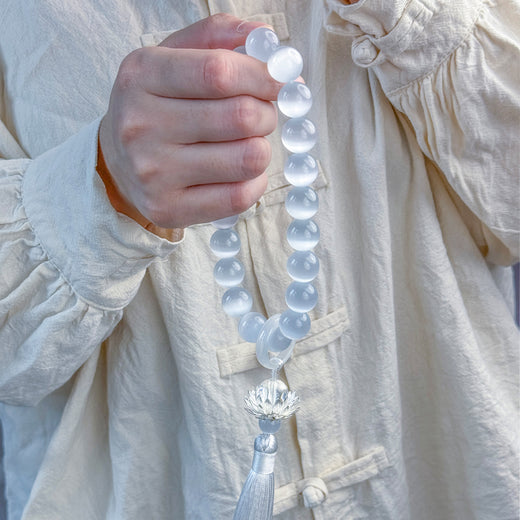
Material integrity. For a 000 piece specifically, we lean toward clear or white stones — clear quartz, white howlite, or moonstone — because their visual quality mirrors the concept: transparent, luminous, containing everything and nothing simultaneously.
Clear or pale materials can be an editorial visual association with the open shape of zero. That styling choice does not establish an ancient 000 tradition, a gemstone's actual identity or a product's ritual history.
Wearability and finish: Compare the confirmed metal and surface finish with your intended use and the supplied care instructions. A plated finish does not have one universal lifespan, and appearance alone does not identify the metal.
When a piece comes from that context, it carries something that's genuinely difficult to manufacture: the accumulated intention of a community that has been working with these symbols as living practice, not as aesthetic trend.
Consecration belongs to particular religious contexts. If a ceremony is claimed for a piece, its record should identify the eligible item or batch, the occasion and the organization involved. A 000 motif does not supply that evidence.
A number motif and an account of a ritual are separate matters. Use only a documented item- or batch-specific record if a ceremony statement is made.
Wearability. A piece you never wear because it's too delicate or too statement-making isn't serving its purpose. The best 000 jewelry is something you can wear daily — to work, to yoga, to brunch — without it feeling out of place or fragile.
Simple pendants and thin stacking bracelets tend to work better for this than large statement pieces.
Browse our sacred number jewelry to see how these criteria translate into actual pieces. If you're not sure which number resonates most for you right now, our angel number calculator guide can help you figure out where to start.
How to Actually Work With 000 — Daily Practices
The following are optional contemporary reflections using a pause, an intention or a journal. They are not a lineage-specific Buddhist practice manual, a treatment or a promise about what noticing 000 will do.
The Three-Breath Reset
When you notice 000 — on your phone, a receipt, a timestamp — don't scroll past it. Stop for three conscious breaths. This is it. That's the whole practice.
Three breaths sounds trivially simple, and it is, which is why it actually works. In Tibetan shamatha practice, the breath is the primary anchor because it's always available, always present, and always in the now.
A short pause can be a personal reflective choice. It does not demonstrate a guaranteed change in the nervous system or replace support for persistent distress.
If you want to extend this: on the exhale of the third breath, silently ask yourself — what's actually true right now? Not what you're worried about. Not what you should be doing. What's actually, observably true in this moment.
A casual pause should not be presented as a substitute for formal Dzogchen, Mahamudra or another lineage practice. Those contexts require their own teaching and should not be inferred from an angel-number motif.
Morning Intention Setting With Your 000 Piece
If you have a 000 pendant or bracelet, try this before you put it on each morning. Hold it in both hands for about thirty seconds. Don't think about anything specific — just hold it, feel its weight and temperature against your skin, and let your mind be quiet.
Then set one intention for the day. Not a goal, not a task — an intention. Something like "I'll stay curious today" or "I'll notice when I'm forcing" or simply "I'll be present."
This practice has roots in the Tibetan concept of gom — habituation, or the gradual familiarization of the mind with a quality through repeated practice. You're not trying to achieve enlightenment before breakfast. You're just building a small, consistent habit of returning to intention.
Over weeks, that accumulates into something real.
Journaling the Open Space
Once a week — Sunday evenings work well for those on a path of self-inquiry — take ten minutes to journal specifically about what feels unresolved or uncertain in your life right now. Not to solve it.
Just to name it. Then write one sentence about what might be possible if that uncertainty resolved in a direction you haven't considered yet.
This is an optional contemporary journaling exercise: write about more than one possible next step without treating any of them as a prediction. It is not a named Tibetan lineage practice established by this article.
Looking back at a journal can show how your thinking and circumstances changed. It does not establish that noticing a number caused an outcome.
Related guide: the 999 angel number and spiritual closure
Your Journey From Here
If you've read this far, you're probably not only casually curious about a number. Something in your life is genuinely open right now — a question you haven't answered, a chapter that hasn't started, a threshold you're standing at without quite knowing which way to step.
That's not a problem to solve. It's a moment to inhabit.
Not knowing what comes next can be uncomfortable. In this article, that experience is a prompt for personal reflection, not a report of the author's training with Tibetan teachers or an instruction attributed to an unnamed lineage.
The mind that can tolerate that discomfort — that can sit in the open space without rushing to fill it — begins to recognize what was always there beneath the noise.
This is where the practice actually begins. Not in the monastery courtyard at dawn, though that matters. Not in the texts or the rituals, though those too have their place. It begins here, in your own life, in the exact moment you stop pretending you have all the answers.
Before choosing a piece, review its actual material, dimensions and making information. Do not assume individual monk blessings, certificates or a named artisan source unless the exact item or batch has supporting records.
The pieces we've shared — the symbolism, the materials, the lineage — they're not meant to be collected like information. They're meant to be worn, carried, and lived with. They're meant to remind you, on the days when the threshold feels too wide, that others have stood exactly where you're standing now.
What happens next is between you and your own unfolding.
Material, origin and ceremony details vary by product. Use the individual listing and request supporting records before relying on a particular workshop, artisan or temple claim.
Questions About 000
Is 000 a traditional Tibetan Buddhist teaching?
Angel numbers are a modern numerological idea. This article uses an analogy with emptiness as an editorial reflection; it does not establish a historical Buddhist doctrine about the sequence 000.
Does repeatedly seeing 000 predict an event?
Noticing a pattern is not evidence that a particular event will occur. You may choose to use it as a reminder to pause, while keeping decisions about work, relationships and money grounded in practical information.
Is seeing 000 the same as calculating a number from my birthday?
No. One begins with a sequence you notice; the other applies an explicit digit-reduction method to a date. The calculator displays its arithmetic, and neither method verifies the other interpretation.
What does the comparison with emptiness mean here?
The article compares the open shape of zero with a reflection on change and dependent existence. This is an analogy, not a claim that Buddhist emptiness means a cosmic force must deliver the future you want.
Does a 000 pendant need a particular stone or ceremony?
No universal rule is established here. Choose by design and confirmed materials; any ceremony or origin claim needs evidence for the exact item or batch, not just the number on the pendant.
Keep reading