
buddhist-jewelry
Authentic Tibetan Bracelet: A Practitioner's Guide for 2026
You’ve sat with your breath for years. You’ve read Pema Chödrön, you understand the essence of anatta, and your daily meditation is as ingrained as your morning coffee. Yet, lately, you've hit a plateau.
The practice feels… quiet. Not in a peaceful way, but in a flat, disconnected way. You're looking for a tangible reminder, a physical anchor to carry from the cushion into your life, but the online marketplace is a bewildering flood of plastic beads and empty promises.
You're not looking for a fashion accessory; you're seeking a genuine tool for practice. This guide is for you, offering a clear path to finding truly authentic Tibetan bracelets that resonate with the depth of your commitment.
The Foundation: What an Authentic Tibetan Bracelet Really Is
Let's clear the air and address a common misconception. A genuine Tibetan bracelet is not merely 'spiritual jewelry'. That term has been diluted by mass-market factories producing trinkets with no history and no heart.
An authentic piece is better understood as a lineage object or a tool for practice. It represents a convergence of three essential elements: authentic material, intentional creation, and sacred blessing.
Think of it this way: a mass-produced bracelet is like a postcard of a mountain. It gives you a vague idea of the real thing, but it has no depth, no texture, no soul.
An authentic bracelet is a stone from that very mountain, shaped by a local artisan who knows its every contour, and blessed by monastics who have lived in its shadow for generations. It carries the resonance of place, person, and purpose.
For us, this distinction is everything. When we talk about our bracelets, we're talking about a chain of human connection. It starts with the yaks whose bones are respectfully gathered in the high plateaus above 4,000 meters, or the Bodhi trees whose seeds are patiently harvested from the groves near Bodh Gaya.
It continues in our Kathmandu atelier, where Master Tenzin guides artisans who have learned their craft from their parents and grandparents. Their hands don't just assemble beads; they weave intention and generations of devotion into every knot.
This is fundamentally different from a product designed in a corporate office and churned out by a machine. The former is a living tradition on your wrist; the latter is an empty symbol. Recognizing this difference shapes everything that follows in your search.
Why This Matters for Your Practice in 2026
In a world increasingly saturated with artificial intelligence, fleeting digital connections, and relentless demands on your attention, the need for tangible, grounding anchors has never been more acute. For a committed practitioner like you, an authentic object isn't an escape; it's a bridge.
It's a way to integrate the clarity of your morning sit with the complexity of your afternoon board meeting or a difficult conversation with your aging parents.
Here's how this plays out in the specific challenges you might be facing:
working through the Practice Plateau: Every long-term practitioner hits a wall. The initial insights have been integrated, and the path ahead can feel like a long, featureless plain. During these times, motivation can wane.
A blessed, handcrafted bracelet serves as a potent re-minder—literally, something that brings your core intention back to mind. The simple, physical sensation of the beads against your skin—whether it's the smooth warmth of a 108-bead mala or the textured grip of Bodhi seeds—can be a non-verbal cue, a gentle nudge back to the present moment, back to your vows, back to the simple act of being aware.
It's a support system you wear, a quiet ally in your commitment when internal resources feel low.
Embodying the Dharma Off the Cushion: You understand karma and compassion intellectually. The real challenge is embodying these principles when you're cut off in traffic or working through tense family dynamics. An authentic bracelet acts as a touchstone.
A deliberate, mindful touch of a Bodhi seed bead before responding to a provocative email can be the pause that allows wisdom to arise over reaction. It's a physical link to your highest aspirations, helping to close the gap between what you know in meditation and how you act in the world.
Our complete guide to Buddha bracelets explores this integration in greater detail.
Finding Meaning in a High-Stakes Career: Your work is demanding and, at times, can feel disconnected from your spiritual life. You're looking for a way to infuse your professional life with a sense of purpose.
A piece crafted with genuine intention by an artisan in Kathmandu's Thamel district is a constant, subtle statement against the disposable and the superficial. It's a connection to a different value system—one based on patience, lineage, and devotion.
It reminds you that it's possible to build things that last, whether it's a company, a relationship, or your own inner peace. It's an investment in an object that will be with you in 20 years, a a sign of enduring values in a transient world.

The Three Pillars of Authenticity: How It Really Works
So, how do you distinguish a true lineage object from a clever imitation? It comes down to three verifiable markers. These are the details we obsess over, and they are the things you should look for. Generic claims of 'high quality' are meaningless without this substance.
1. The Artisan's Hand: Reading the Knots and Weave
The first sign of authenticity is in the knotting. Mass-produced bracelets often use simple, loose knots or elastic bands that are quick to assemble and quick to break. A genuine Tibetan bracelet is hand-knotted with precision and intention.
The artisans in our Kathmandu atelier use techniques passed down through generations—some of our senior craftspeople learned from their grandmothers in the 1970s. Look for the 'endless knot' (shrivatsa), a symbol of the interconnectedness of all things and the Buddha's endless wisdom.
Notice the tension: each knot should be firm and evenly spaced, securing the beads so they don't knock against each other. This isn't just for durability; the process of tying these knots is a meditative practice in itself.
The artisan is often reciting mantras as they work, infusing the cord with positive intention. When you hold one of these pieces, you can feel the human touch—the slight, perfect imperfections that a machine can never replicate.
This is the difference between a soulless product and a piece from a handwoven Tibetan bracelet collection.
2. The Soul of the Stone: Material Provenance and Honesty
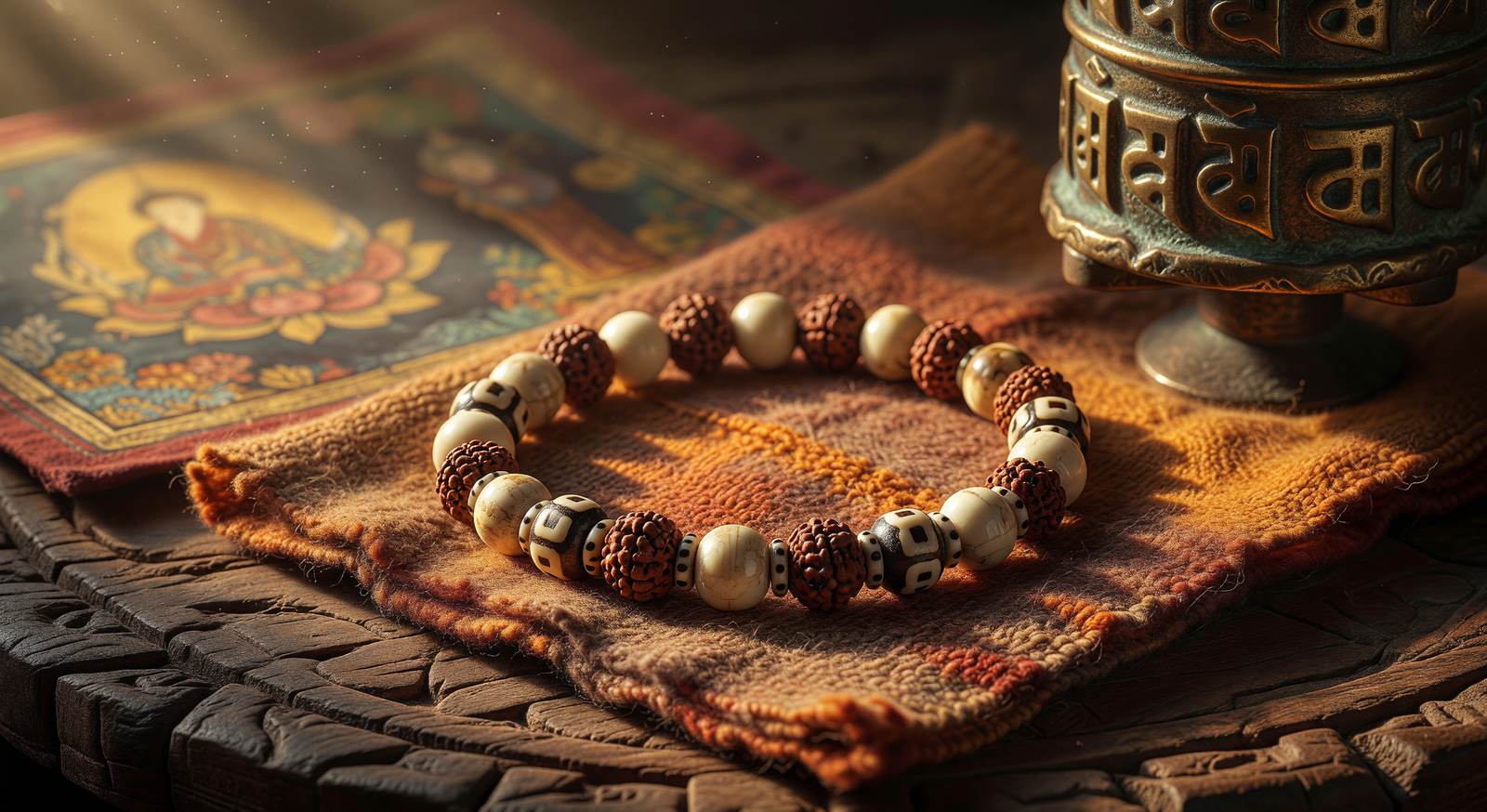
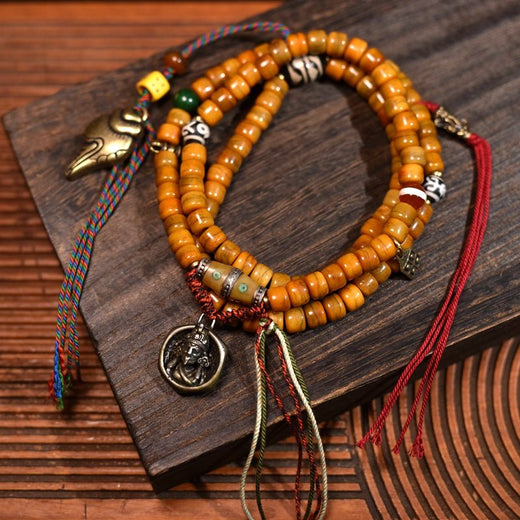
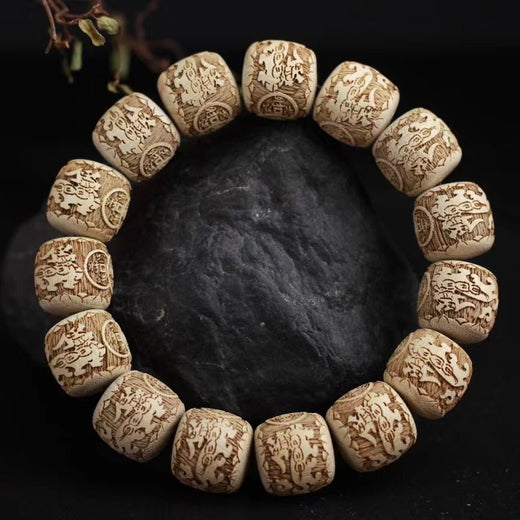
The materials are the body of the bracelet, and their origin is their spirit. A real Tibetan bracelet uses materials with deep cultural and spiritual significance, sourced from the Himalayan region. This could be yak bone, a powerful reminder of impermanence (anicca); Bodhi seeds from the Ficus religiosa tree, under which the Buddha attained enlightenment; or genuine turquoise, treasured in Tibet for its protective qualities.
The market is flooded with fakes. White howlite is dyed blue and sold as turquoise. Plastic is molded and painted to look like amber or Bodhi seeds. How can you tell? Real Bodhi seeds have unique, subtle variations in color and small, natural pores; fakes are perfectly uniform.
Real turquoise has a cool, dense feel and often contains a matrix of other minerals; fakes feel light and plasticky. We've spent years building relationships with suppliers in the Himalayas to ensure our materials are not only genuine but also ethically and sustainably sourced.
One of our primary turquoise sources has been operating in Leh since 1989, maintaining strict ethical standards. This is a non-negotiable part of our process.
3. The Consecrated Intention: Verifying the Blessing Ceremony
This is perhaps the most crucial and most abused element. Any seller can stamp 'blessed by monks' on a product. For a practitioner, this claim requires scrutiny. A genuine blessing, or rabné in Tibetan, is a specific ritual performed by qualified monastics.
It's not a remarkable incantation; it's a ceremony to consecrate an object, clearing its previous energies and infusing it with the positive intention of the Dharma. At Buddhabelief, our malas and bracelets are brought to our partner monasteries, such as Sera Monastery.
There, the monks perform a 49-day puja, a cycle of prayers and mantra recitations, over the items. The objects are placed on the altar and absorb the energy of this intensive practice. We believe in transparency.
We document this process and can speak to the specifics of the ceremony—which monastery, what kind of puja. When you are considering a piece, ask the seller for these details. If they can only give you a vague answer, it's a red flag.
The blessing is the final, vital step that transforms the bracelet from a well-made craft into a true support for your practice. Many powerful protection symbols derive their true efficacy from this consecration.
How to Choose Your Authentic Tibetan Bracelet
Choosing a bracelet is an intuitive process, but it should be informed by knowledge. Now that you understand the markers of authenticity, you can select a piece that aligns with your specific practice needs and intentions. Here's a simple framework to guide you.
First, check for the three pillars:
- Craftsmanship: Look closely at the photos. Can you see the texture of the knots? Do they look tight and uniform? Read the description. Does it mention the specific knotting technique used—whether it's the tight spiral knot favored in Bhaktapur or the looser weave common in Lhasa workshops?
- Materials: Does the seller specify the origin of their materials? Do they offer details that distinguish their Bodhi seeds from the Bodhi trees near the Mahabodhi Temple in Bihar, or their turquoise from the mines of Tibetan Plateau sources, from fakes? Be wary of generic descriptions like 'natural stone'.
- Blessing: Is the blessing process described in detail? Do they name the monastery—Sera, Ganden, Drepung—or the type of ceremony performed? Transparency is the hallmark of authenticity.
Second, consider your intention:
Different materials and symbols carry different energies and reminders. While these are not charms that work through superstition, they can serve as powerful focal points for your practice.
- For Deepening Meditation: A bracelet made from Bodhi seeds is the classic choice. Its purpose is singular: to support you in your journey toward clarity and awakening.
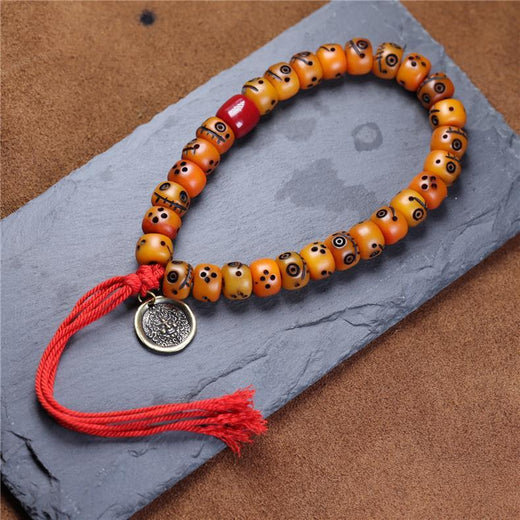
- For Protection and Strength: Look for bracelets featuring Dorje knots, Dzi beads, or materials like black onyx. These are traditional traditional Tibetan protection bracelets, intended to help clear obstacles and strengthen your resolve in challenging situations.
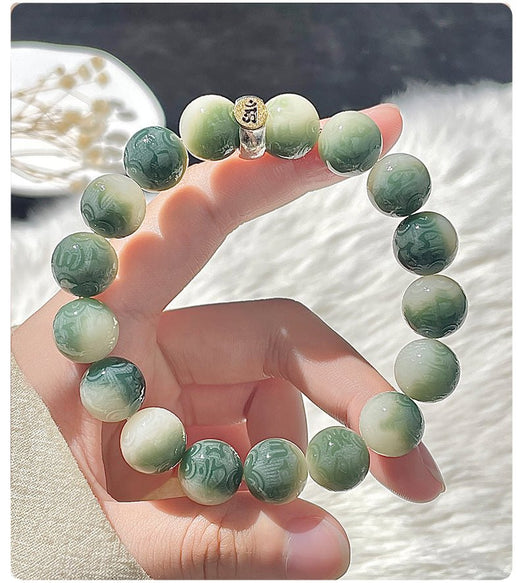
- For Cultivating Compassion: A bracelet with rose quartz or sandalwood can be a gentle reminder to open the heart, especially when dealing with difficult relationships or practicing loving-kindness (metta).
- For Remembering Impermanence: A yak bone bracelet is a direct, visceral reminder of the transient nature of all things. For a seasoned practitioner, this is not a morbid symbol but a potent tool for cultivating non-attachment.
Ultimately, the right piece will feel right to you. It will be an investment in an object that not only looks beautiful but also serves as a meaningful, daily companion on your path. Explore our selection of Himalayan artisan bracelets with this framework in mind.

How To Use It Day To Day in Your Daily Practice
Acquiring an authentic bracelet is the first step. Integrating it into your life is where its true value unfolds. This is not about passive wearing; it's about active engagement. Here are a few practical ways to weave your bracelet into the fabric of your day.
1. The Morning Intention Ritual: Don't just throw your bracelet on with your watch. Take a moment. Before you put it on, hold it in your palm for three conscious breaths. As you fasten it, state a clear intention for the day.
It could be simple: "Today, I will practice patience." or "Today, I will listen with compassion." This small ritual transforms the act of accessorizing into a moment of mindfulness, setting the tone for the hours ahead.
2. The Tactile Anchor During Meditation: On days when your mind feels particularly scattered—the infamous "monkey mind"—the bracelet can be a powerful anchor. Instead of focusing solely on the breath, you can bring your awareness to the physical sensation of the beads on your skin.
Feel their texture, their temperature, their weight. This tactile focus can be less abstract than the breath and can be especially effective at grounding you in the present moment when your thoughts are pulling you into the past or future.
3. The Mid-Day Pause Button: The space between the meditation cushion and your daily life is where the practice truly lives. Use your bracelet as a physical cue to bridge that gap. Before entering a stressful meeting, subtly touch the bracelet.
Before responding to a difficult email, roll one of the beads between your thumb and forefinger. Let this simple action be a pause button—a moment to take one conscious breath before you speak or act.
This is how the bracelet becomes a tool for active mindfulness, not only a passive symbol.
4. Respectful Care: How you care for the bracelet is an extension of your practice. Avoid wearing it in water, as this can weaken the cord over time—most practitioners keep theirs dry except during formal practice sessions.
At night, instead of tossing it on your dresser, place it on your altar or a clean, dedicated space. This act of respect reinforces its significance as a sacred object, a support for your spiritual journey.
This complete guide to Tibetan bracelets offers more detailed care instructions.
Common Questions from Committed Practitioners
Is a blessed bracelet really more 'powerful' than a regular one?
This is an excellent question. It's helpful to move away from the idea of 'power' as if it were a battery. A blessing (rabné) doesn't imbue the bracelet with mystical properties. Rather, it consecrates the object, aligning its purpose with the Dharma through the focused intention of experienced practitioners.
Think of it like this: an unblessed instrument can still make music, but a finely tuned instrument in the hands of a master resonates with greater clarity and purpose. The blessing tunes the bracelet to the frequency of practice.
Its effectiveness still depends entirely on you and your own intention. It's a support, a catalyst—not a substitute for your own effort.
How can I tell real Bodhi seeds from plastic fakes?
There are a few key indicators. Real Bodhi seeds are natural products, so they will have slight variations in size, shape, and color. They often have tiny, dark dots which are the remnants of the seed's vascular system—this is a good sign.
Plastic fakes are perfectly uniform, almost sterile in their sameness. Real seeds have a subtle, organic texture, while plastic feels smooth and artificial. A simple test is the 'hot pin' test (be very careful): touch a heated pin to an inconspicuous spot.
Plastic will melt and smell of chemicals; a real seed will char and smell like burnt wood or leaves. We only use authentic seeds harvested from the Bodhi tree groves near Kathmandu, and you can see this natural variation in our pieces.
What's the practical difference between a wrist mala (bracelet) and a full 108-bead mala?
A full 108-bead mala is a formal tool for mantra recitation practice. Its primary function is for counting, allowing you to complete a full round of 108 repetitions without breaking your concentration. A wrist mala, or Tibetan bracelet, is more of a constant companion and reminder.
While you can certainly use it to count shorter sets of mantras, its main purpose is to be a tangible, wearable connection to your practice throughout the day. It's the piece you wear to the office or during family time, serving as that touchstone to bring mindfulness into every moment, whereas a full mala is typically used during your formal sitting practice in your shrine room or meditation space.
How do I know the blessing is real and not only a marketing story?
Your skepticism is healthy and warranted in today's market. The key is transparency and specificity. A seller who is genuinely partnering with a monastery will be able to provide details. Ask them: Which monastery?
What is the name of the head lama? What specific puja or ceremony was performed? When did it take place? At Buddhabelief, we can tell you that our pieces are blessed at Sera Monastery during a 49-day cycle of prayer conducted each spring.
We have a long-standing relationship with the monastic community there, and our pieces receive the Tara blessing ritual specifically. Vague answers like "blessed by monks in Tibet" are a major red flag. Authenticity is rooted in verifiable details, not only romantic stories.
What if the string on my bracelet breaks? Is that a bad omen?
Quite the contrary. In the Tibetan tradition, a cord breaking is often seen as a positive sign. It can signify that the bracelet has absorbed a great deal of negative karma or obstacles on your behalf, essentially fulfilling its purpose.
It's also a direct, real-world lesson in impermanence (anicca). Everything is subject to change and decay, even our most cherished objects. Rather than a bad omen, see it as a milestone. It's an opportunity to mindfully have the piece re-strung, perhaps setting new intentions for the next chapter of your practice.
It marks the end of one cycle and the beginning of another.
Can I wear my Tibetan bracelet on the same wrist as my smartwatch?
From a practical standpoint, you can. However, from a practice perspective, it's worth considering the symbolism. A smartwatch constantly pulls your attention outward with notifications, data, and distractions. A Tibetan bracelet is designed to draw your attention inward, toward stillness and intention.
Wearing them together can create a kind of energetic dissonance. Those on a path of self-inquiry often choose to wear their bracelet on their non-dominant wrist, separate from their watch, to create a dedicated space for this sacred object.
It becomes a reminder of a different way of being, a counterbalance to the digital world's constant demands.
Your Journey Forward
Finding an authentic Tibetan bracelet in 2026 is about more than buying a piece of jewelry. It's a conscious choice to seek out the genuine in a world of imitations. It's an investment in a tool that can support and deepen a practice you've dedicated years to building.
It's a tangible link to a lineage of artisans and monastics who hold the Dharma in their hands and hearts.
A bracelet will not solve the challenges of your practice or your life. It won't make the plateau disappear or simplify complex relationships. But it can be a faithful companion on that journey. It can be the quiet, constant reminder on your wrist—perhaps worn against skin warmed by prostrations or meditation sessions—that pulls you back to your intention, back to your breath, back to the present moment—the only place where your practice truly exists.
When you choose a piece that is crafted with integrity, made from honest materials like hand-carved bone or genuine semi-precious stone, and consecrated with sincere intention by practitioners who understand what they're blessing, you are not only acquiring an object.
You are welcoming a story, a lineage, and a blessing into your life. You are choosing a support that will be with you for the next decade of your path, through retreats and daily sits alike.
We invite you to explore our Tibetan bracelet selection and find the piece that resonates with your journey.
Keep reading