News
Buddhist Symbols and Meanings: 9 Key Signs
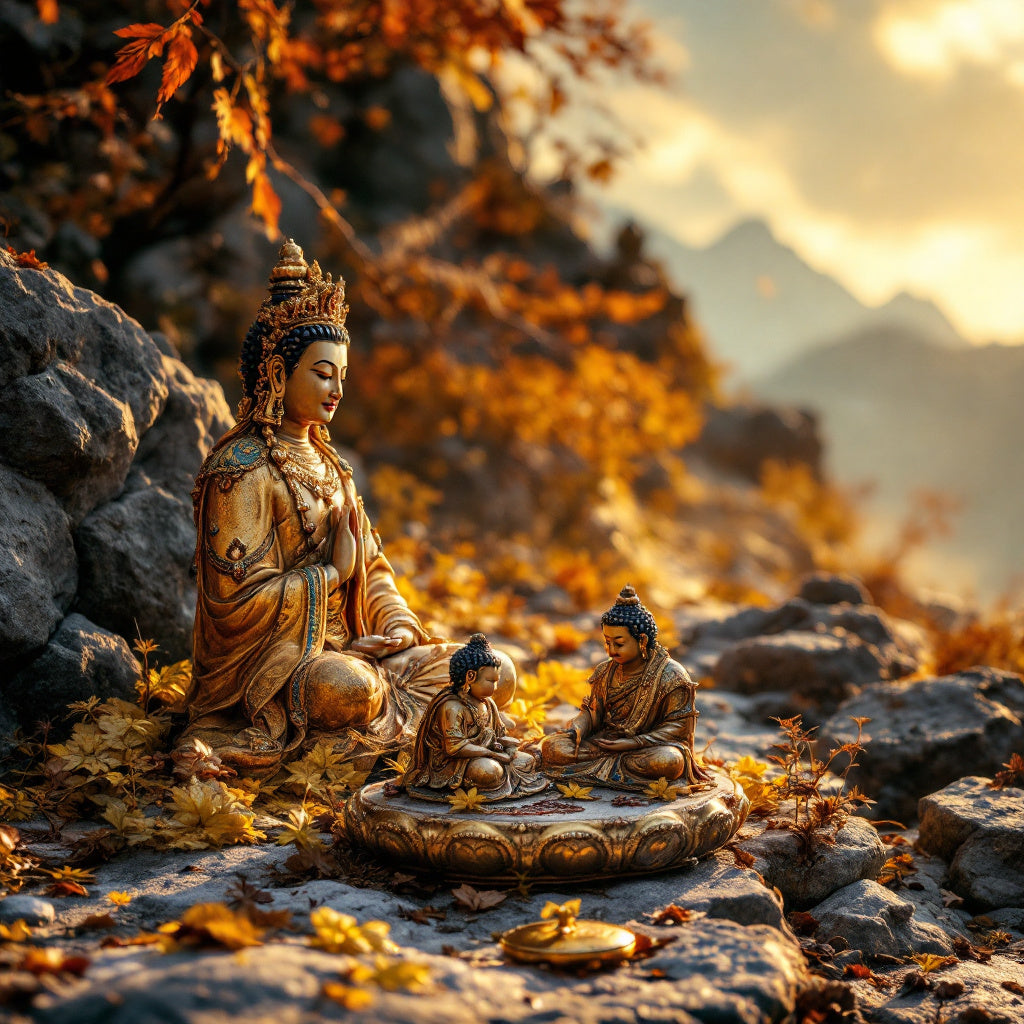
Buddhist symbols are visual forms that communicate teachings through images such as the lotus, endless knot and Dharma Wheel. Their meanings include purity, interdependence, ethical practice and awakening. Interpretations vary by Buddhist tradition and context, so they should be treated as cultural and religious symbols rather than guaranteed sources of luck or protection.
You've seen the symbols a hundred times — on a mala bracelet at the yoga studio, tattooed on someone's wrist at the coffee shop, printed on a tote bag at the airport gift shop.
And maybe you've wondered what they actually mean beyond a short social-media caption. The same Dharma Wheel can be used as decoration or understood as a reminder of the Buddha's teachings, depending on its context and the person engaging with it.
This guide is for the second kind of curiosity. We're going through nine significant Buddhist symbols — what they mean in actual practice, how they're used in ritual, and what you need to know before you wear one.
Explore our protection jewelry collection alongside this guide if you want to see these symbols in their wearable form.
What Are Buddhist Symbols and Meanings?
Buddhist symbols are not simply logos or branding. In Tibetan Buddhist practice, images and ritual objects can support teaching, recollection, visualization and ceremony. Their role depends on the tradition and practice context; displaying or wearing a symbol does not by itself produce a guaranteed result.
Different Buddhist objects have different names and uses. Pratima can refer to an image, while tsakli are ritual cards and thangka are painted or textile images. A shared religious setting does not make these objects interchangeable.
The Endless Knot is often interpreted through ideas of interdependence. Its linked lines can serve as a visual reminder of that teaching, rather than evidence that an object itself produces a spiritual effect.
Within Tibetan Buddhist traditions, Om and other forms can be understood through teachings about enlightened body, speech and mind. That is a religious interpretation, not a statement about an imagined monk's opinion or proof of a particular object's consecration.
That's a significant difference. And it's not meant to make you feel like you need a theology degree to wear a mala. It's meant to give you a more honest relationship with what you're holding.
The Eight Auspicious Symbols — known in Tibetan as Tashi Tagye — form the core visual vocabulary of Tibetan Buddhism. They appear on monastery walls, on offering bowls, on the robes of high lamas, and yes, on jewelry.
They are: the Parasol, the Golden Fish, the Treasure Vase, the Lotus, the Conch Shell, the Endless Knot, the Victory Banner, and the Dharma Wheel. Beyond these eight, symbols like Om, the Vajra, the Dorje, the Endless Knot, and the Eye of the Buddha carry their own distinct ritual histories.
We'll cover the most practically relevant ones here — the ones you're most likely to encounter, most likely to be drawn to, and most likely to want to understand before they become part of your daily life.
As you deepen your practice, our guide to ancient protection symbols gives useful context for how these forms function across traditions.
Why Understanding These Symbols Matters More Right Now
There's a specific kind of exhaustion that's become very common. You're competent at your job, you have a social life, you probably have a meditation app on your phone that you open three times a week when the anxiety gets loud enough.
And still, something feels thin. Like you're moving through your days efficiently but not quite anchored to anything.
This is the exact moment when those on a path of self-inquiry start reaching for symbols. Not because they've suddenly become religious, but because symbols are one of the oldest human technologies for making the invisible visible.
For giving form to something you can't quite name but can feel.
The risk — and this is worth saying plainly — is that without any context, a symbol becomes just an aesthetic. You wear the Endless Knot because it photographs well. You buy an Om pendant because it feels vaguely peaceful.
And that's fine, genuinely. But you're leaving most of the value on the table.
Here's a concrete example. Say you're going through a period of real uncertainty — a relationship that might be ending, a job that doesn't fit anymore, a general sense of standing at a crossroads.
You might be drawn to the Dharma Wheel. Most sources will tell you it represents the Buddha's teachings. That's accurate but incomplete. The Dharma Wheel — Dharmachakra in Sanskrit, Chökhor in Tibetan — represents the moment the Buddha gave his first teaching at Deer Park in Sarnath around 500 BCE.
The eight spokes represent the Eightfold Path. But here's what most decorative descriptions leave out: the wheel is specifically described as a weapon of truth in classical texts. It cuts through confusion. It doesn't gently suggest a better way of seeing.
It turns, and what was obscured becomes clear.
If you're wearing that symbol while sitting with genuine uncertainty, and you know that, it changes how you hold the object. It becomes a reminder not that things will be okay, but that clarity is possible — and that you have access to a path toward it.
Or take the Lotus. You've seen it everywhere, usually with a caption about rising from the mud. That's true. But in Tibetan iconography, the Lotus is specifically associated with Amitabha Buddha and the pure land of Sukhavati.
When a practitioner visualizes the Lotus in meditation, they're not thinking about personal growth. They're using it as a portal — a visual anchor for a specific state of mind that is already pure, already complete, not something being built toward.
The mud doesn't become the flower. The flower was always there. The mud just made it harder to see.
That reframe — from aspiration to recognition — is actually quite useful for the specific kind of self-doubt that comes from comparing your life to what you see on other people's feeds. You're not trying to become something. You're trying to remember what you already are.
This is why context matters in 2026 specifically. We are, collectively, very good at consuming spiritual aesthetics and very underpracticed at sitting with what they actually point to. These symbols were designed for the second thing.
As you move forward with your own practice, let the symbols guide you toward the deeper work they were always meant to support.

9 Buddhist Symbols and Their Meanings
Om, the Dharma Wheel, and the Vajra — Symbols of Awakening
Om (ॐ) appears in several South Asian religious traditions and scripts. In Tibetan Buddhist practice, it opens Om Mani Padme Hum, a widely recited mantra associated with Avalokiteshvara. This guide does not establish a global ranking of mantra recitation.
And its function there is specific: Om represents the body, speech, and mind of all Buddhas — purified. When you begin a mantra with Om, you are not saying hello to the universe. You are opening a channel.
You are aligning your own body, speech, and mind with the quality of enlightened awareness. It's less a greeting and more a tuning fork.
The written form of Om appears in Tibetan texts, mantras and sacred objects. When it is engraved on jewelry, the mark can be read as a reference to the mantra and its practice rather than proof that the object has been consecrated or carries a guaranteed effect.
The Dharma Wheel (Dharmachakra) — eight spokes, representing the Eightfold Path: right view, right intention, right speech, right action, right livelihood, right effort, right mindfulness, right concentration. The hub represents moral discipline. The rim represents meditative concentration holding everything together.
Two deer commonly flank the Dharma Wheel in reference to the Buddha's first teaching at Deer Park in Sarnath. This iconographic explanation does not require an exact historical year to be asserted here.
It is not decorative. It is instructional.
The Vajra (Dorje) is perhaps the most distinctly Tibetan of all Buddhist symbols. The word means both thunderbolt and diamond — indestructible and penetrating simultaneously. In ritual, a physical vajra is held in the right hand during certain ceremonies, paired with a bell (drilbu) in the left.
The vajra represents skillful means, compassion in action, the masculine principle of awakened awareness. It cuts through delusion the way a diamond cuts through stone — not by force but by its own inherent nature.
For a focused discussion of the symbol in prayer beads, continue with our Vajra mala beads guide.
The Endless Knot, the Lotus, and the Conch Shell — Symbols of Reality
The Endless Knot (Shrivatsa) has no beginning and no end. In Tibetan iconography it is sometimes called the Glorious Knot or the Mystic Knot, and it appears on the chest of Vishnu in Hindu tradition and on the body of the Buddha in Buddhist iconography — specifically at the heart center.
Its meaning is not simply "everything is connected." It represents the interdependence of wisdom and compassion — that these two qualities weave through and support each other endlessly, that you cannot have one without the other developing.
It also represents the dependent origination of all phenomena: nothing exists independently, everything arises in relationship. As an amulet, it is traditionally associated with auspiciousness and can serve as a reminder of interdependence; this is a symbolic interpretation rather than a promise of good fortune.
The Lotus (Padma) grows from muddy water and opens clean. In Tibetan Buddhism, the white lotus is associated with mental purity; the blue lotus with wisdom; the pink lotus with the historical Buddha; the red lotus with love and compassion.
The thousand-petaled lotus represents complete enlightenment. Crucially, in meditation practice, the Lotus is used as a visualization seat — deities are depicted seated or standing on Lotus thrones, which indicates they arise from samsara (the cycle of suffering) but are not stained by it.
When you use the Lotus as a focal point in meditation, you're not aspiring to grow. You're practicing the recognition that your essential nature is already unstained.
The Conch Shell (Dung Kar) is the symbol you're least likely to see on jewelry but most likely to hear in a monastery. The white right-spiraling conch is blown at the beginning of ceremonies to call practitioners to teaching.
Its sound is said to awaken those still sleeping in ignorance and to travel in all directions without obstruction. In iconography, it represents the proclamation of the Dharma — the Buddha's voice, teaching without preference or discrimination, available to all who can hear.
The right-spiraling direction is considered especially auspicious in Tibetan tradition, mirroring the clockwise circumambulation of sacred sites like Jokhang Temple in Lhasa.
The Eye of the Buddha, Dzi Beads, and the Victory Banner — Symbols of Protection
The Eyes of the Buddha — the wide, steady eyes painted on all four sides of Tibetan stupas (most famously at Boudhanath in Kathmandu) — are not decorative. They are understood to be the active, all-seeing awareness of the enlightened mind, present in the world, watching without judgment.
Between the eyes, where a nose might be, is the number one in Nepali script — representing the unity of all things. These eyes appear on amulets and pendants as a reminder that awareness is always present, even when yours isn't.
Particularly in moments of anxiety or overwhelm, practitioners use the image as an anchor: something is watching, something is steady, even when I am not.
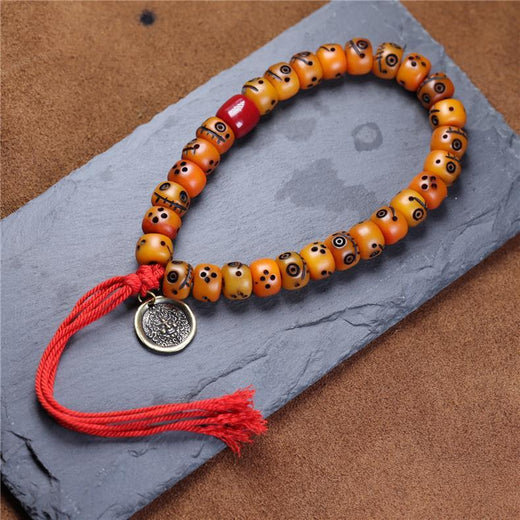
Dzi Beads are etched or patterned agate beads strongly associated with Tibetan material culture. Their precise origins and dating remain debated, so age should be supported by provenance rather than inferred from an eye pattern or a seller's story. Museum catalogues document ancient eye-like and banded agate beads across Asia, but that does not establish a date for every bead sold as Dzi today.
Dzi-style patterns can be created through several decorative processes on agate or other bead materials. A visible eye, stripe or wave pattern describes the design; it does not by itself establish an ancient date, ritual history or Tibetan origin.
Different eye patterns are assigned protective and auspicious meanings within Tibetan and commercial traditions. Treat descriptions such as “one-eye for focus” or “nine-eye for protection” as symbolic associations, not guaranteed outcomes or proof of age.
For more cultural context and practical questions to ask a seller, read our protection jewelry guide.
The Victory Banner (Dhvaja) is among the auspicious symbols discussed in Himalayan art. It expresses victory over obstacles in Buddhist teaching; it need not appear on every building for that symbolic meaning to be explained.
This is not a metaphorical battle in Tibetan understanding. Mara is described in detail across the Pali Canon and Tibetan texts as a real adversarial force. The Victory Banner says: that force was met, and it did not win.
As a wearable motif, a victory banner may remind someone of perseverance. That interpretation does not establish a force in the object or guarantee help with a particular difficulty.
How to Identify Authentic Buddhist Symbols on Jewelry and Objects
This is where it gets practical. The market for Buddhist-inspired jewelry is enormous, and differences between mass-produced and hand-finished pieces can include material disclosure, carving detail, construction and maker documentation.
Meaningful provenance should be supported by specific information rather than vague claims about lineage or blessings. Browse our Tibetan jewelry collection and check each product page for its stated materials and construction.
Here's what to look for:
Proportional accuracy. Buddhist iconographic systems have developed over centuries and can vary by tradition. Look for deliberate, legible rendering: evenly arranged spokes on a Dharma Wheel and a continuous, balanced path in an Endless Knot.
Tibetan-script and Devanagari renderings of Om differ. Both may occur in Buddhist contexts; script alone does not authenticate an object or establish a universal requirement for Tibetan Buddhist jewelry. Identify the actual inscription and its documented context.
Material integrity. Silver, copper, brass and gold appear in Buddhist objects and can carry different symbolic associations. Confirm the actual metal and finish rather than identifying them from the motif or color.
Construction and disclosure matter for any material. A design cannot certify a metal, and a material alone cannot prove an object's ritual history.
If the seller doesn't know, that tells you something.
Blessing and consecration. Rituals have meaning within particular Buddhist practices. A description of such a ritual is separate from evidence that a specific pendant or batch underwent it.
Neither the maker's intention nor an account of a ceremony establishes a material composition or guaranteed outcome. Keep devotional meaning separate from those product facts.
For a piece in this collection, consult the individual listing and the record for its exact batch before relying on any blessing statement. The collection label alone does not establish a ceremony.
Related reading and pieces: Tibetan protection amulets
Provenance transparency. Ask who made a piece, where and by which process. Tibetan Buddhist imagery can appear in different places; a motif alone does not prove a Himalayan workshop or exclude a different documented maker.
A named maker and a workshop history should be supported by records for the actual piece. Look for specific maker and process information rather than treating a motif or a regional story as proof of origin.
If origin is not documented, keep it unknown rather than inferring either a monastery or a factory.
When you're ready to deepen your understanding of how authentic symbols differ from commercial reproductions, our guide on symbols of strength in Tibetan tradition goes into useful detail on what to look for in specific symbol types.

How to Actually Use Buddhist Symbols in Daily Life
You don't need to be a practicing Buddhist to work with these symbols in a meaningful way. You do need to be intentional. Here's what that looks like practically. Explore our range of Tibetan-inspired jewelry for daily practice.
Choose one symbol to work with at a time. The temptation, especially when you're first drawn to this visual tradition, is to want all of it at once — the Om and the Endless Knot and the Lotus and the Dzi bead, all on one bracelet.
Resist this. Pick one symbol that genuinely resonates with something you're working through right now. If you're in a period of confusion and looking for clarity, the Dharma Wheel. If you're struggling with anxiety about the future, the Endless Knot.
If you're trying to reconnect with something essential in yourself, the Lotus. Work with that one symbol for thirty days before adding another.
Morning intention setting. Before you put on a piece of jewelry carrying a Buddhist symbol, hold it for thirty seconds. Not in a ritualized way that feels performative. Just hold it, breathe, and bring to mind what the symbol actually represents.
If you're wearing the Dharma Wheel, recall that it represents a complete path toward clarity — and that you're choosing to move in that direction today. This takes thirty seconds and shifts the entire day's relationship with the object.
Use the symbol as a pattern interrupt. When you notice yourself spiraling — the anxious loop, the comparison scroll, the 2am worry — touch the symbol physically. Use it as an anchor to return to what it represents.
This is actually the function that Buddhist amulets have served for practitioners in the Himalayan regions for centuries. Not magic. Not bypassing the difficulty. A physical reminder of something steadier than the current mental weather.
Learn the context. A symbol may be connected with a mantra or practice, but there is no single recitation rule for every image. Use an attributable public teaching or ask a qualified teacher rather than inferring permission from a pendant.
The Dharma Wheel is associated with the mantra of Shakyamuni Buddha: Om Muni Muni Mahamuni Shakyamuni Svaha. You don't need to recite these in formal practice. But knowing them, and occasionally reciting them while holding the symbol, deepens the relationship between you and the object in a way that is hard to describe but easy to feel.
Placement matters. In Tibetan Buddhist household tradition, sacred objects are kept above waist height — never on the floor, never in the bathroom, never under other objects. This is not obsessive rule-following. It's a basic form of respect that keeps your relationship with the object clear.
When you treat it as significant, it functions as significant. When it becomes clutter among other things, it loses its anchor.
Your Journey With These Symbols Starts Wherever You Are
You can begin with respectful study of an image and its sources. Studying art does not require a claimed travel history; formal religious practice may have different requirements.
Across Buddhist communities, symbols have helped communicate teachings in temples, manuscripts, ritual objects and everyday material culture. Their histories are not all the same, so a responsible reading begins with the tradition and object in front of you.
What they ask of you is simple: genuine curiosity and basic respect. Know what you're holding. Treat it accordingly. Let it do what it was designed to do — which is to point you, repeatedly and gently, back toward something steadier than your current anxiety, your current confusion, your current version of the story you're telling about your life.
In 2026, that pointing feels more necessary than it has in a long time. Not because things are uniquely terrible — they aren't, historically — but because the noise is louder, the comparisons are more constant, and the distance between how you look on the outside and how you feel on the inside has never been easier to maintain.
Symbols can offer a concrete point of attention: a mala used for counting recitations, a thangka studied as a teaching image, or a pendant worn as a personal reminder. The object's documented origin and actual use matter more than an invented story about its past.
For the spoken counterpart to these symbols, read the Buddhist Mantras complete guide.
Questions About Buddhist Symbols
Are the eight auspicious symbols the same as the nine subjects in this guide?
No. The eight auspicious symbols are a named group. This guide also discusses subjects such as Om, the vajra and Dzi beads, so its nine subjects are not a second version of that eight-symbol list.
What is the difference between a vajra and a dorje?
Vajra is the Sanskrit name and dorje the Tibetan name for the ritual implement discussed here. Its interpretation depends on the Buddhist practice and object being described.
Does an eye pattern prove that a Dzi bead is antique?
No. The visible pattern identifies a design, not an age, material, origin or ownership history. An antique claim needs documented provenance and qualified examination.
Does a Buddhist symbol show that a pendant was consecrated?
No. A symbol and a ceremony record are different evidence. If consecration matters to you, ask for a record that identifies the exact item or batch rather than relying on a collection-wide label.
Can someone study or wear a symbol without following a formal practice?
Respectful study and personal wearing are different from undertaking a lineage-specific ritual. Learn the depicted symbol and its context; consult a qualified teacher before treating a retail image as authorization for formal practice.

Keep reading