
buddhist-jewelry
Guardian Buddha Meaning: 8 Zodiac Protectors Explained
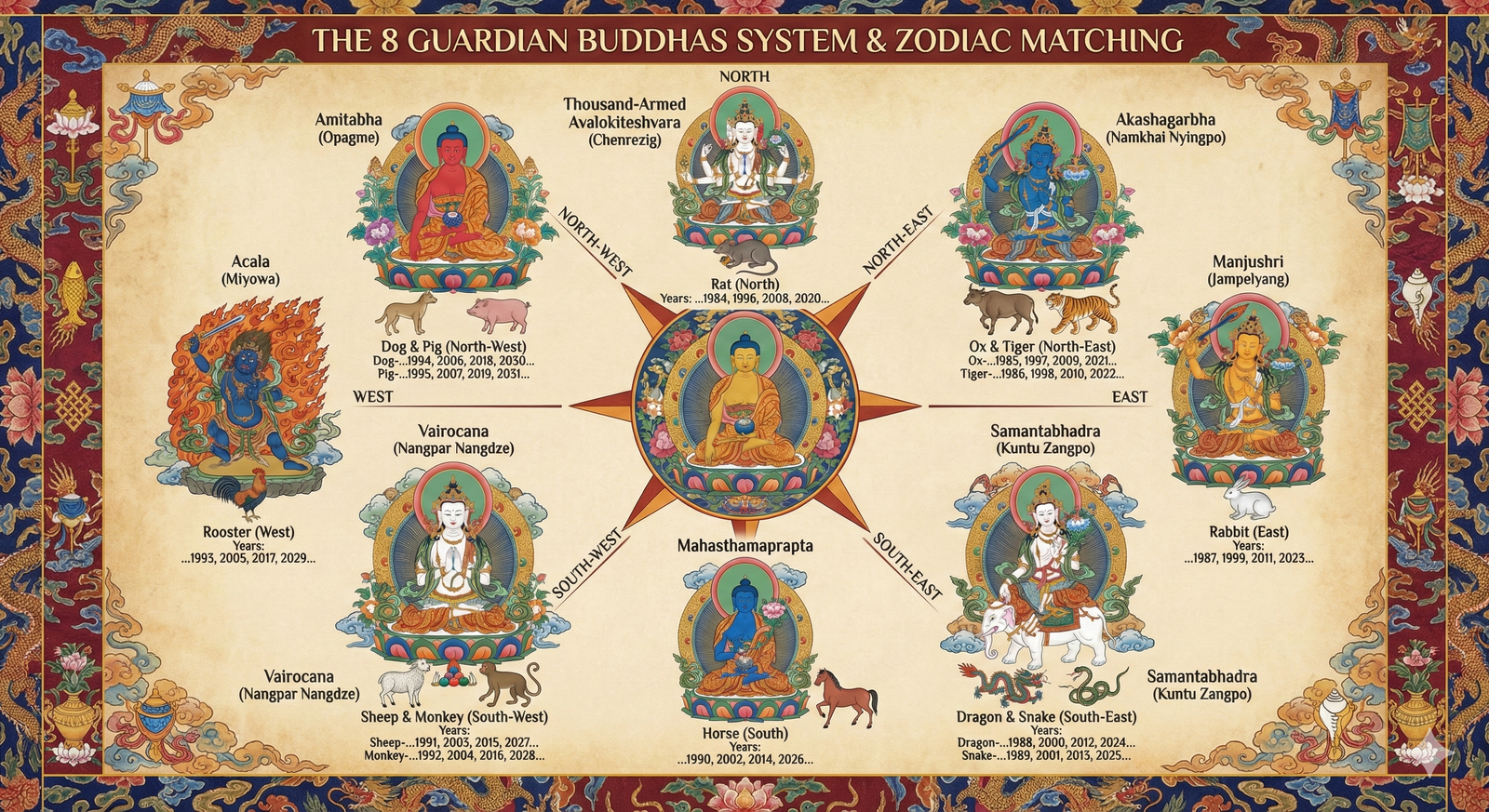
Updated July 2026. A Guardian Buddha is one of eight Buddhist figures commonly paired with the twelve zodiac animals in the East Asian practice known in Japan as the zodiac guardian deity or eto no mamori honzon. The chart connects a person's birth-year animal with a Buddha, bodhisattva or wisdom king.
What does Guardian Buddha mean? It means a Buddhist figure treated in this devotional tradition as a birth-year guardian and focus for prayer or reflection. The eight-to-twelve pairing is a regional popular tradition, not a universal Buddhist doctrine and not proof that an image can guarantee safety, wealth or a particular destiny.

The Eight Guardian Buddhas and Zodiac Signs
| Zodiac animal | Guardian figure | Japanese name | Recognizable attribute or role |
|---|---|---|---|
| Rat | Thousand-Armed Avalokiteshvara | Senju Kannon | Compassion expressed through many helping hands |
| Ox and Tiger | Akashagarbha Bodhisattva | Kokuzo Bosatsu | Wisdom and merit compared with boundless space |
| Rabbit | Manjushri Bodhisattva | Monju Bosatsu | Wisdom; often shown with a sword and scripture |
| Dragon and Snake | Samantabhadra Bodhisattva | Fugen Bosatsu | Practice and vows; often shown riding an elephant |
| Horse | Mahasthamaprapta Bodhisattva | Seishi Bosatsu | The power of wisdom; associated with Amitabha's retinue |
| Goat and Monkey | Vairocana Buddha | Dainichi Nyorai | The cosmic Buddha central to Japanese esoteric Buddhism |
| Rooster | Acala | Fudo Myoo | Immovable resolve; shown with a sword and lasso |
| Dog and Pig | Amitabha Buddha | Amida Nyorai | The Buddha of Infinite Light associated with the Pure Land |
This is the standard twelve-zodiac/eight-figure chart recorded by Japanese temples and reference services. Listings sometimes confuse Akashagarbha with Kshitigarbha, but they are distinct figures; Acala may also appear as Acalanatha or Fudo Myoo. Identify the actual figure by its attributes rather than the product title alone.
Is the Guardian Buddha System Traditional Buddhism?
The figures themselves are established Buddhist deities with their own scriptures, iconography and practices. The fixed pairing of eight figures with twelve zodiac animals is more specific: Japanese sources describe it as a popular custom of choosing a lifelong guardian image by birth year.
The National Diet Library of Japan's reference database records the standard eight-figure allocation and notes several historical ways of selecting a personal guardian image. Baisouji Temple states that the precise origin of the Eight Guardian Buddhas is uncertain, while reporting that the practice was known in Japan by around the Edo period. Kongohin Temple presents the same eight as both zodiac guardians and figures used in memorial observances.
Guardian Buddha vs Birth-Year Lookup
This page explains the meaning and identity of the eight figures. To find the correct zodiac animal for a specific date, use the separate Guardian Buddha by birth year guide. That distinction matters for people born in January or February because the Chinese zodiac year begins at Lunar New Year, not January 1.
For the animal cycle itself, including recent years and the New Year boundary, see the Chinese zodiac animals guide.
What Each Guardian Figure Represents
Thousand-Armed Avalokiteshvara is a form of the bodhisattva of compassion. The many arms visualize an ability to respond to suffering in many ways; they are not a promise that a pendant prevents accidents.
Akashagarbha is associated with expansive wisdom and merit. The name refers to a treasury or matrix as vast as space. Listings should not confuse Akashagarbha with Kshitigarbha, another bodhisattva with a different name and iconography.
Manjushri represents wisdom. A sword cuts through ignorance, while a scripture or lotus points to transcendent knowledge. Samantabhadra represents vows and practice and is commonly shown with an elephant.
Mahasthamaprapta represents the power of wisdom and appears with Amitabha and Avalokiteshvara in Pure Land imagery. Vairocana is a cosmic Buddha central to esoteric Buddhist systems; he is not simply a lucky deity for two zodiac signs.
Acala is a fierce wisdom king whose sword, lasso and flames represent the subduing of obstacles and delusion. Fierce imagery expresses immovable resolve rather than anger toward the wearer. Amitabha is the Buddha of Infinite Light associated with rebirth in the Pure Land.

Does a Guardian Buddha Guarantee Protection?
Devotees may pray before an image, carry an amulet or regard a guardian figure as a religious support. Those are faith-based uses. A seller should not turn them into testable guarantees that jewelry will stop illness, accidents, financial loss or "negative energy."
A wearable image can have a simpler observable role: it can remind the wearer of compassion, wisdom, vows or steadiness. That meaning depends on understanding and practice, not the price or material of the object.
How to Choose a Guardian Buddha Pendant
- Confirm the zodiac year: check the Lunar New Year date if the birthday falls in January or February.
- Verify the figure: compare the face, posture, implements and mount with reliable iconographic references.
- Check the material description: natural stone, treated stone, metal, plated metal, resin and wood require different care and should be named accurately.
- Separate craft from spiritual claims: handmade, antique, blessed and monastery-made are different claims that each need evidence.
- Read dimensions and photographs: fine details may be difficult to identify on very small carvings.
- Use a clear return policy: provenance and material transparency matter more than promises about energy.
Compare visible iconography and material details in the Thangka pendant collection. Product pages should identify the depicted figure rather than relying only on a zodiac label.
How to Wear and Care for the Image
There is no single wearing rule shared by every Buddhist school. If an image was received from a temple or teacher, follow that specific instruction. Otherwise, wear it securely and treat it according to its material and your own level of devotional meaning.
- Remove delicate jewelry before bathing, swimming, sleeping or strenuous work.
- Avoid perfume, chlorine and harsh cleaners on porous stones, plated metal and painted details.
- Store the piece dry and separately so the relief carving does not scratch other jewelry.
- Do not claim that moonlight, smoke or water is required to "activate" every Guardian Buddha image.
- For devotional objects, a clean shelf, pouch or altar space is a practical respectful choice.
Questions About Guardian Buddhas
What is a Guardian Buddha in this chart?
It is one of eight Buddhist figures paired with twelve zodiac animals in a popular East Asian birth-year guardian tradition. The figures include buddhas, bodhisattvas and a wisdom king rather than one identical kind of deity.
How do I find my birth-year association?
Find the animal for your complete birth date using the stated Lunar New Year convention, then use the chart. January and February birthdays need the exact boundary, not just the Gregorian year.
Which figure is associated with Dragon and Snake?
The chart pairs Dragon and Snake with Samantabhadra Bodhisattva, called Fugen Bosatsu in Japanese. Identifying an actual object still requires its iconography rather than the year label alone.
Is the chart universal Tibetan Buddhist doctrine?
No. The source discussion here describes Japanese and wider East Asian popular practice. Do not apply the same historical origin or devotional rule to every Buddhist lineage.
Must a guardian pendant be consecrated?
No universal rule is established by the chart. A specific religious practice may value consecration, but a retail blessing claim needs an item- or batch-specific record and is not a safety or outcome guarantee.
Sources
- National Diet Library reference database: lifelong guardian images
- Baisouji Temple: Eight Guardian Buddhas and zodiac pairings
- Kongohin Temple: guardian figures and mantra copying
- Nikkozan Rinnoji Temple: twelve-zodiac Eight Buddha prayer beads
Compare a related piece
For a wearable or display piece connected with this article's subject, view the Manjushri pendant for the Rabbit zodiac.
Check the product page for the available options, dimensions and current availability before choosing. A design's religious symbolism is not a guarantee of protection, results or consecration.
Born in January or February? Check your Chinese zodiac animal and year element by birth date before using a birth-year guardian table.
Keep reading