

buddhist-jewelry
Daily Meditation Routine Guide: Build Consistent Practi
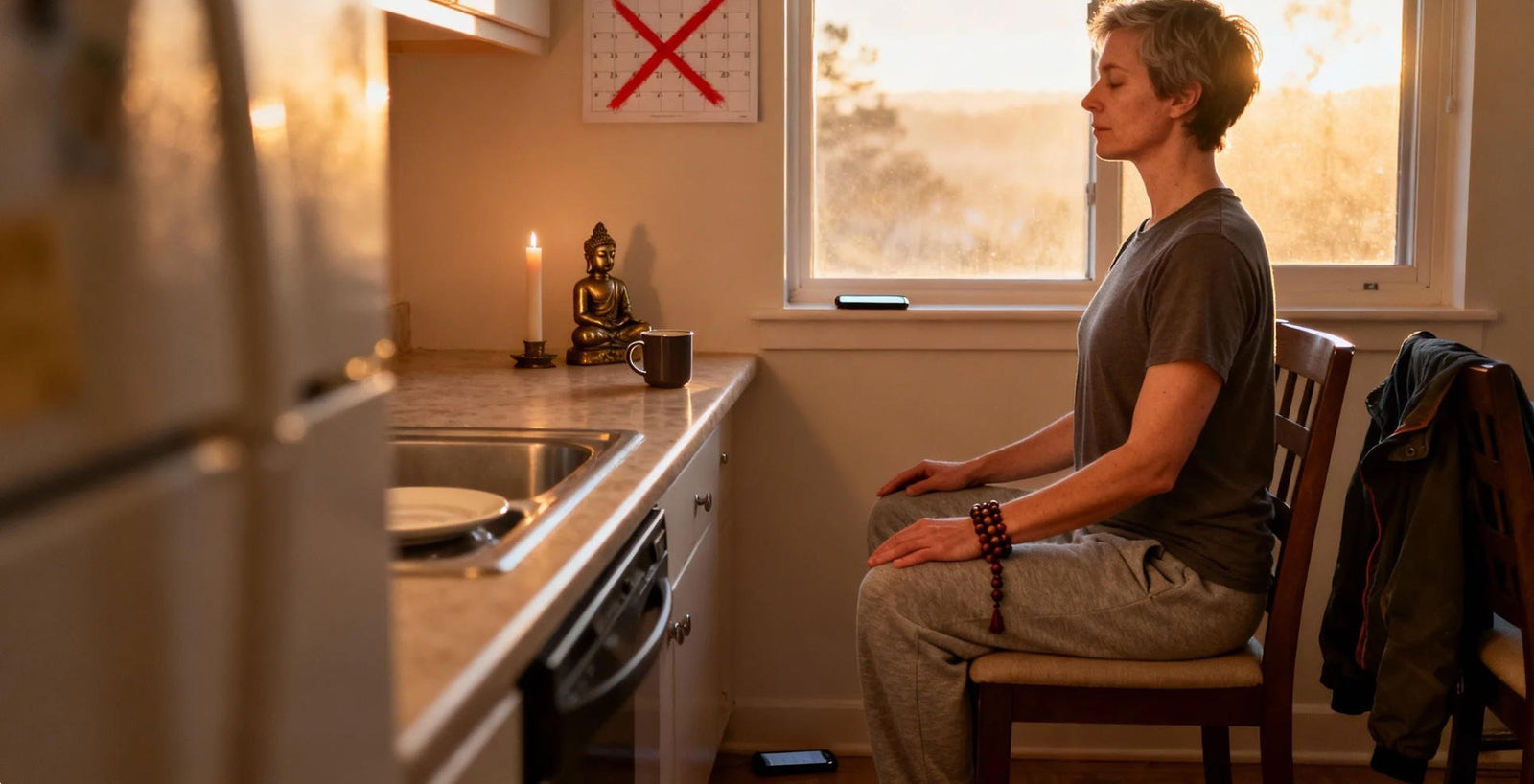
The intention arrives, often in a quiet moment—perhaps late at night when the house is still, or in the chaotic peak of the afternoon. You decide, “Tomorrow, I will meditate.” You imagine a space of calm, a brief respite from the relentless inner chatter and the pull of a thousand obligations.
Yet, when tomorrow comes, the intention dissolves. The urgent pushes out the important. The cushion remains empty. The quiet moment never seems to arrive on its own. This cycle of resolving to practice and then letting it slip away is a familiar friction for so many who feel the call for a closer connection with themselves.
You know there is a well of stillness within you, but the path to it feels overgrown and difficult to find. This guide is not about adding another demanding task to your day. It is about clearing that path, stone by stone, so you can finally walk it with confidence and establish a practice that holds you, rather than one you have to chase.

When our team was last in Dharamsala, we spent an
What a Meditation Practice Really Is
To build a consistent practice, you must first understand what you are building. In the West, meditation is often presented as a secular tool for stress reduction—a mental workout. While it does offer this benefit, its roots in the Tibetan tradition run infinitely deeper.
The Tibetan word for meditation is gom (སྒོམ་), which translates not to “emptying the mind” but to “becoming familiar with.” This single shift in understanding changes everything. Your goal is not to fight your thoughts into submission but to become intimately familiar with the nature of your own mind, with its clarity, its compassion, and its inherent wisdom.
This tradition of familiarization has a clear and profound history. When the great master Padmasambhava, also known as Guru Rinpoche, brought Buddhism to Tibet in the 8th century, he established the first monastery, Samye, a place designed as a physical mandala to represent the Buddhist cosmos.
It was here that the systematic practices of shamatha (calm-abiding) and vipashyana (special insight) were formally taught and integrated into the very heart of Tibetan culture. Shamatha is the practice of stabilizing the mind, of training the “monkey mind” to rest on a single point, like the breath. Vipashyana is the penetrating insight that arises from that stable mind, allowing you to see the true nature of reality—its impermanence and interdependence.
A daily routine is therefore not about achieving a blank state. It is a structured appointment to get reacquainted with yourself. It’s a process of letting the sediment in a jar of muddy water settle.
You don’t force the mud down; you simply provide the stillness for the water’s natural clarity to emerge. This clarity is known in some traditions as rigpa, or pristine awareness. Every session, whether it feels “good” or “bad,” is a step in this process of familiarization.
This journey of inner discovery can be profoundly supported by tangible reminders of the path, like those found in our collection of authentic Tibetan Buddhist items, which serve as anchors to your deepest intention.
The Deeper Meaning of a Daily Seat
Why do you return to the cushion each day? The answer lies in the profound spiritual architecture your consistency builds. Each session is a conscious act of cultivating Bodhicitta, the enlightened mind of compassion.
Before you even begin to watch your breath, the traditional approach is to set your motivation: “May this practice not only bring me peace, but may it be for the ultimate benefit of all sentient beings.” This transforms your personal self-care routine into a radical act of universal compassion.
You are not only calming your own mind; you are training to become a source of peace and stability for the world around you.
Through the direct observation of your own mind, you gain experiential wisdom of core Buddhist truths. You watch thoughts arise, linger, and dissolve, and you directly experience anicca, or impermanence. You see that they are not solid, permanent fixtures of a “self,” but fleeting weather patterns in the vast sky of your awareness.
This insight naturally loosens the grip of attachment and aversion. You no longer need to cling so tightly to pleasant thoughts or push away unpleasant ones, because you recognize their transient nature. This is the beginning of true freedom.
Furthermore, this steady observation begins to deconstruct the ego. You notice the constant narration, the “I” that is always judging, planning, and worrying. With consistent practice, you begin to see that this “I” is a fabrication, a collection of habits and stories with no solid, independent existence.
This is the insight into anatman, or no-self. It is not a nihilistic denial of your existence, but a joyful realization that you are far more vast and interconnected than the small, constricted self you mistook yourself to be.
Your daily practice is a laboratory for discovering these truths firsthand, moving them from intellectual concepts to lived realities. It is the sacred work of remembering the boundless, compassionate nature that has always been your essence.
Real Benefits for Your Modern Life
While the spiritual fruits of meditation are profound, the practice delivers tangible, transformative benefits that reshape how you navigate the pressures of your daily life. These are not vague wellness platitudes but specific, observable shifts in your cognitive and emotional landscape.
You are not only reducing stress; you are fundamentally upgrading your operating system.
One of the most significant changes is the development of cognitive resilience. Your brain has a natural alarm system, the amygdala, which triggers fight-or-flight responses. Modern life, with its constant pings and pressures, keeps this system on high alert. Shamatha practice directly strengthens the prefrontal cortex, the part of your brain responsible for executive function and emotional regulation.
This means you develop a greater capacity to pause between a stimulus (like a critical email or a traffic jam) and your reaction. Instead of being hijacked by anger or anxiety, you gain a precious moment of choice.
You don’t stop feeling stress, but stress no longer controls you.
You will also notice a dramatic enhancement in your attentional control. The mind’s tendency to jump from thought to thought is called kapicitta, the “monkey mind.” Every time you notice your mind has wandered from the breath and you gently guide it back, you are performing a rep for your “attentional muscle.” This cultivated focus spills over into every area of your life.
You listen more deeply in conversations, you can sustain concentration on complex tasks at work, and you become less susceptible to the fragmenting pull of digital distractions. You reclaim your most valuable resource: your own attention.
Finally, your practice cultivates what psychologists call emotional granularity. Instead of operating with blunt emotional labels like “good” or “bad,” you begin to recognize the subtle textures of your inner world. You can distinguish between disappointment and frustration, between quiet sadness and listless fatigue.
This precision is a superpower. It allows you to respond to your needs more skillfully. You learn to offer yourself compassion when you’re sad, or to seek rest when you’re tired, rather than reacting with a single, blunt tool.
You build a foundation of inner stability that permeates your entire life, and having a physical anchor, such as a piece from our handcrafted selection of spiritual jewelry, can serve as a potent reminder to return to this stability throughout your day.

How to Choose an Authentic Path
As you commit to a routine, it is vital to ensure your practice is grounded in an authentic tradition. An authentic path is not about rigid dogma, but about connecting to a stream of wisdom that has been tested and refined for centuries.
In Tibetan Buddhism, this wisdom is carried through distinct lineages, such as the Nyingma, Kagyu, Sakya, and Gelug schools. Starting your journey by seeking out teachers or centers affiliated with these lineages ensures you are receiving guidance that is both profound and safe. — explore our Tibetan jewelry collection for authentic pieces.
The role of a qualified teacher, or lama, cannot be overstated, especially as your practice deepens. While you can certainly begin basic breath meditation on your own, a teacher serves as an experienced guide who can clarify misunderstandings, help you navigate challenges, and provide specific instructions tailored to your mind.
They are not there to be worshipped, but to act as a clear mirror, reflecting both your potential and your obscurations. For a beginner, the most crucial advice is to start with the foundations: shamatha-vipashyana.
This is the bedrock upon which all other, more complex practices, such as visualization or mantra recitation, are built. Resisting the urge to jump into advanced techniques without this stability is a sign of true wisdom.
Your practice can also be enriched by authentic supports, or tendrel, which create auspicious connections. These are not mere decorations but functional supports for your practice. A proper 108-bead mala, for instance, is used to count mantras, focusing the mind and uniting body, speech, and mind in the practice.
The resonance of a hand-hammered singing bowl can help settle the mind at the beginning of a session and gently bring you out at the end. A thangka painting or a small statue on your altar serves as a visual representation of the enlightened qualities you wish to cultivate—a constant reminder of your highest potential.
When you're ready to find your own, we invite you to explore our mindfully curated collection of these sacred tools.
How to Structure Your Daily Practice
Creating a consistent routine is less about willpower and more about structure and gentle repetition. Here is a simple, authentic framework for a daily meditation session that you can adapt to your needs.
1. Prepare Your Space and Body: Choose a clean, quiet, and dedicated space, even if it’s just a corner of a room. This signals to your mind that this is a special time. Sit on a cushion, or gomden, that allows your hips to be slightly higher than your knees.
Adopt the seven-point posture of Vairochana: legs crossed comfortably, back straight like a stack of coins, hands resting in your lap with thumbs touching, shoulders relaxed, chin slightly tucked, jaw and tongue relaxed, and eyes gently open with a soft gaze directed towards the floor a few feet in front of you.
This posture is not about rigidity; it is designed to align the body’s subtle energies, fostering a state of relaxed alertness.
2. Set Your Motivation: Before you begin, take a moment to connect with your intention. Silently recall why you are practicing. A simple and powerful motivation is the cultivation of Bodhicitta: “I undertake this practice for the benefit of myself and all beings.” This broadens your perspective and infuses your session with purpose.
3. The Practice—Breath as Anchor: Gently bring your attention to the physical sensation of your breath. You can focus on the feeling of the air at the tip of your nostrils or the gentle rise and fall of your abdomen.
Simply rest your awareness there. Your mind will wander. This is not a failure. It is what minds do.
4. Working with Distractions: The core of the practice is what you do when you notice you’ve been distracted. Without any self-criticism, gently acknowledge the thought—you can even label it mentally as “thinking”—and then softly, kindly, guide your attention back to the breath.
This act of returning, over and over, is the practice itself. It is how you build the muscle of mindfulness.
5. Concluding and Dedicating: When your timer goes off, don’t immediately jump up. Sit for another moment, noticing how you feel. Then, dedicate the merit of your practice. This is a crucial final step.
You can say, “By this merit, may all beings be free from suffering and the causes of suffering.” This seals the positivity you’ve generated and directs it outward, completing the circle of compassionate intention.
Common Questions on the Path
My mind is too busy, I can't stop thinking. Am I doing it wrong?
This is the single most common concern, and the answer is a definitive no—you are not doing it wrong. Experiencing a busy mind is not a sign of failure; it is the very reason we practice.
The goal of meditation is not to forcibly stop your thoughts, which is impossible and only creates more tension. The goal is to change your relationship with them. Imagine your mind is the vast, open sky.
Thoughts, feelings, and sounds are simply clouds passing through. They are not the sky itself. Your job is not to get rid of the clouds, but to rest in your identity as the sky—spacious, aware, and undisturbed by what passes through it.
Each time you notice a thought and return to the breath, you are reinforcing this awareness. The "busyness" is the curriculum, not the obstacle.
How long should I meditate for each day?
Consistency is far more important than duration, especially when you are building a new habit. It is much better to meditate for five minutes every single day than for one hour once a week.
Start with a length of time that feels almost ridiculously easy—perhaps just three to five minutes. Set a timer, and when it goes off, you are done. This builds a sense of accomplishment and prevents the practice from feeling like a daunting chore.
As the habit becomes established and you begin to naturally want to sit for longer, you can gradually increase your time in five-minute increments. Listen to your own capacity. The practice should feel like a sanctuary you are building, not a prison you are entering.
What's the difference between mindfulness and Tibetan meditation?
This is an excellent question. Mindfulness, or the practice of paying attention to the present moment without judgment, is the absolute foundation of Tibetan meditation. It is the core of shamatha practice. However, the Tibetan Buddhist path incorporates this foundation into a much broader framework.
Beyond basic mindfulness, Tibetan meditation includes a vast array of methods designed to actively transform the mind. These can include analytical meditation (vipashyana), where you use reasoning to investigate the nature of self and reality; visualization practices (deity yoga), where you imagine yourself as an enlightened being to awaken those qualities within you; and mantra recitation, which uses sacred sound to purify the mind and connect with enlightened energy.
So, while mindfulness is the essential starting point, Tibetan meditation offers a complete and multifaceted path to full awakening.
Do I need a guru or teacher to start?
You can absolutely begin a foundational breath-awareness practice on your own using reliable resources like this guide or books from respected teachers. Establishing this basic discipline is a powerful and beneficial first step. However, as you wish to go deeper, particularly into the more complex and transformative practices of the Vajrayana path, the guidance of a qualified teacher (a guru or lama) becomes essential.
A genuine teacher provides crucial context, ensures you do not misunderstand the teachings, and grants the necessary transmissions or empowerments for certain practices. Think of it like learning a complex skill: you can learn the basics of an instrument from a book, but to become a virtuoso, you need an experienced instructor to correct your technique and guide your development.
Is it okay to feel uncomfortable or have difficult emotions come up?
Yes, it is not only okay, but it is a very common and often productive part of the process. Your meditation cushion is a safe container where things that have been suppressed or ignored in the busyness of daily life can finally surface.
You might feel restlessness, boredom, sadness, anger, or fear. The instruction is to meet these feelings with the same gentle, non-judgmental awareness you apply to your thoughts. Allow them to be there without needing to fix them or push them away.
Often, simply allowing an emotion to be fully felt, without adding a story to it, is what allows it to release its energy and pass. This is a profound process of purification. If, however, an emotion feels truly overwhelming, it is wise to open your eyes, shorten your session, and perhaps seek guidance from a teacher or therapist.
How do I use a mala in my meditation?
A mala is a beautiful and potent tool for focusing the mind, especially during mantra meditation. Traditionally, you hold the mala in your left hand, draped over your index finger. The left hand is associated with wisdom.
You use your thumb to pull each of the 108 beads towards you as you recite one repetition of your chosen mantra, such as the universal mantra of compassion, Om Mani Padme Hum.
The large bead at the end, known as the guru bead or stupa, represents the teacher or the state of enlightenment. You begin with the bead next to the guru bead and continue all the way around.
It is traditional not to cross over the guru bead; instead, when you complete a round, you flip the mala and go back in the other direction. This simple, tactile rhythm unites your body (the touch of the beads), your speech (the mantra), and your mind (the focus), creating a powerful, holistic state of meditation.
Your Next Step on the Path
You now have a map. You understand the profound origins of the practice, its deep meaning, and its practical application in your life. But a map is only useful when you take the first step.
That step does not need to be a giant leap. It can be a simple, five-minute commitment to yourself, made today. This is not another obligation to add to your list, but an act of profound compassion for your own mind and heart.
It is a declaration that you are worthy of peace, clarity, and inner freedom.
Your practice is a personal sanctuary you build moment by moment, breath by breath. To support you on this path, we have gathered authentic, handcrafted items that serve as powerful reminders of your intention. Discover the authentic tools that can help ground your journey and inspire you to return to the cushion, day after day.



Keep reading