News
Buddhist Mantras: Meaning, Pronunciation & Practice

Updated July 2026. A Buddhist mantra is a sacred sequence of syllables recited as part of practice. Mantras may be connected with a Buddha or bodhisattva, used with visualization, or counted on mala beads. They are not medical treatment and should not be presented as guaranteed ways to produce health, wealth or protection.
What is a Buddhist mantra?
A Buddhist mantra is a formula of sacred speech used to focus attention and support a specific contemplative practice. Meaning, pronunciation and practice context matter, but not every mantra is open for casual use; some Vajrayana practices require instruction or empowerment from a qualified teacher.
One widely recited open mantra is Om Mani Padme Hum, associated with Avalokiteshvara or Chenrezig, the bodhisattva of compassion. In 2024, the Dalai Lama described it as the six-syllable mantra of Avalokiteshvara and said that laypeople and monastics can recite it.
How to begin mantra practice
- Choose an open practice. Start with a mantra publicly taught for general recitation.
- Check the source. Use a teacher, monastery or established translation project rather than a social-media pronunciation clip with no lineage context.
- Learn slowly. Listen by phrase, repeat without strain and prioritize steady attention over speed.
- Set a modest count. Recite for a fixed time or use mala beads for counting.
- Close with intention. Connect the practice to compassion, ethical action or the quality represented by the mantra.
For the best-known six-syllable formula, continue with our Om Mani Padme Hum guide. For a counting tool, browse 108-bead malas.
The word mantra comes from Sanskrit: manas (mind) + tra (tool or instrument). In Tibetan the term is sngags (pronounced ngak), and in the Vajrayana context it carries a more specific meaning than the Sanskrit root suggests.
A mantra in Tibetan Buddhism is not a wish, not an affirmation, and not a resonance that "raises your frequency." That framing, however widespread it's become on wellness platforms, misses what the tradition actually teaches.
For detailed guidance on selecting your practice beads, see our complete mala beads guide.
Here's the distinction that matters for practice: in the Vajrayana view, a mantra is the speech aspect of an enlightened being's mind. When you recite Om Mani Padme Hum, you are not petitioning Chenrezig (Avalokiteshvara) from the outside.
You are, through recitation combined with visualization and correct motivation, cultivating the conditions for the qualities that Chenrezig represents — boundless compassion, the unity of method and wisdom — to arise within your own mind-stream.
In this explanation, mantra is approached as a practice rather than a request for a guaranteed outcome. Its context is best learned through attributable teachings rather than a seller's personal story.
This is why Tibetan teachers place such emphasis on the three requirements of mantra recitation:
- Correct motivation (kun long): Are you reciting for your own liberation only, or for the benefit of all sentient beings? The scope of your motivation directly shapes the scope of the practice's effect.
Visualization: Some mantra practices include a specific visualization, while public recitation can have a different context. Do not assume that every formula has the same requirements or that an imagined image substitutes for instruction.
- Pronunciation: Sanskrit and Tibetan recitation forms can differ. Follow the pronunciation taught for the particular text and practice, and ask the relevant teacher when uncertain. This guide does not establish that switching forms is universally disruptive or that every lineage uses the same phonetics.
A person may notice bodily sensations while reciting, but sensations are not evidence of a universal mechanism or a promised therapeutic result.
Different Buddhist teachings explain the relation between motivation, recitation and lineage in their own terms. Consult an attributable teaching rather than relying on an unverified personal teacher anecdote.
That's a more demanding explanation than "good resonance," but it's also a more honest one.
One more thing worth clarifying: dharani and mantra are related but not identical. Dharanis are longer protective or memory-aiding formulas, often found in sutras. Mantras in the Vajrayana sense are shorter seed-syllable or deity-invocation sequences used in sadhana practice.
You'll see both terms in this guide; we'll note which is which.

Why This Still Matters in 2026
You might reasonably ask: with AI meditation coaches, biofeedback headbands, and every major app offering "mantra mode," why does the traditional framework still deserve serious attention?
The honest answer isn't that technology is bad for practice. It's that technology tends to optimize for the measurable — HRV, cortisol, sleep latency — while mantra practice in the Tibetan tradition is oriented toward something the sensors don't capture: the gradual dissolution of habitual self-grasping.
Those are different projects. They can coexist, but they shouldn't be confused.
A practitioner may wonder how recitation relates to app-assisted meditation or to a routine that feels repetitive. This guide does not establish a 2026 trend, a measured practice plateau or a typical number of years before such questions arise.
A reader may have questions about how a practice develops over time. Those questions need personal, qualified guidance rather than an unattributed statement about what teachers have recently observed.
This is what Tibetan teachers mean by lineage blessing. It's not mystical in a vague sense; it's the accumulated weight of genuine practitioners having worn this path before you.
For practitioners facing the specific pressures of 2026 — the ambient anxiety of news cycles, the cognitive fragmentation of constant connectivity, the particular exhaustion of trying to be present in relationships while also being professionally effective — mantra offers something that breath-watching alone often doesn't: a positive object.
Instead of simply stepping back from thought, you're actively cultivating a specific quality. Om Tare Tuttare Ture Soha for protection and swift action. Om Vajrasattva Hum for purification after a day you're not proud of.
The specificity is the point.
If you're building or refining a daily practice structure, our daily meditation routine guide covers how to sequence mantra within a broader sitting practice — including how long to recite, when in the session it belongs, and how to handle the days when it feels mechanical.

The Ten Essential Tibetan Buddhist Mantras
What follows is not an exhaustive catalogue of Tibetan mantras — there are hundreds. These ten are the ones most relevant to those on a committed path: foundational enough to have broad application, specific enough to be used with real understanding.
For each mantra we give: Tibetan script, standard phonetic pronunciation (using the Wylie transliteration system as reference, with accessible phonetics for English speakers), the deity or principle it belongs to, and the appropriate practice context.
1. Om Mani Padme Hum — The Mani
Tibetan script: ཨོཾ་མ་ཎི་པདྨེ་ཧཱུྃ།
This mantra runs so deep it deserves its own page — read our full guide to Om Mani Padme Hum and what each syllable carries.
Phonetic pronunciation: Om Mah-nee Peh-meh Hung (Tibetan pronunciation) or Om Mah-nee Pod-meh Hoom (Sanskrit-closer form). In Tibetan practice, the final syllable is distinctly Hung, not Hum.
Deity: Chenrezig (Avalokiteshvara), the bodhisattva of compassion
Meaning: The most common translation — "the jewel in the lotus" — is technically accurate but incomplete. Dilgo Khyentse Rinpoche taught that the six syllables correspond to the six realms of existence and the six perfections (paramitas). Om purifies pride and the obscurations of the body, speech, and mind. Ma purifies jealousy. Ni purifies desire. Pad purifies ignorance. Me purifies greed. Hung purifies hatred.
The full mantra, recited with Chenrezig visualization, addresses all six root afflictions simultaneously.
Practice context: Universal — morning practice, walking meditation, informal recitation throughout the day. The Mani is the mantra you can recite anywhere without special empowerment, though receiving a Chenrezig empowerment (wang) deepens the practice considerably.
Prayer wheels can contain printed mantras. The number and contents depend on the actual object; this guide does not establish a count for a particular monastery or wheel.
2. Om Vajrasattva Hum — Purification
Tibetan script: ཨོཾ་བཛྲ་སཏྭ་ཧཱུྃ།
Phonetic pronunciation: Om Benza Satto Hung (Tibetan form). The Sanskrit Vajrasattva becomes Benza Satto in Tibetan pronunciation.
Deity: Vajrasattva, the buddha of purification
Meaning: Vajra = indestructible or diamond-like; Sattva = being or mind. This is the short form of the hundred-syllable Vajrasattva mantra. In Vajrayana practice, it's used specifically for purification of broken samaya (commitments) and general negativity accumulation.
The hundred-syllable Vajrasattva mantra appears in ngöndro purification practices in Tibetan Buddhist traditions. The count, visualization, commitments and order belong to the specific manual and lineage instruction; this guide does not prescribe one total for all practitioners.
Practice context: End of day, or after a session where you feel your practice was distracted or your conduct during the day was unskillful. Not a casual mantra — traditionally received with instruction on the Vajrasattva visualization (white body, holding vajra and bell, seated above your crown).
3. Om Tare Tuttare Ture Soha — Green Tara
Tibetan script: ཨོཾ་ཏཱ་རེ་ཏུཏྟཱ་རེ་ཏུ་རེ་སྭཱ་ཧཱ།
Phonetic pronunciation: Om Tah-reh Too-tah-reh Too-reh So-ha
Deity: Green Tara (Drolma in Tibetan), the female buddha of swift compassionate action
Meaning: Tare = she who liberates (from samsara); Tuttare = she who liberates from the eight fears (lions, elephants, fire, snakes, bandits, captivity, floods, demons — traditionally, and by extension, their psychological equivalents); Ture = she who liberates from illness and suffering; Soha = may the meaning be established (a dedication/sealing syllable, not a word of praise as sometimes taught).
Practice context: Particularly appropriate when facing obstacles, fear, or when you need to act quickly and skillfully. Tibetan practitioners recite Tara's mantra before travel, before difficult conversations, or when anxiety is high. Tara is considered the most accessible of the Vajrayana deities for beginners because her practice requires less elaborate visualization than, say, Vajrayogini.
Her green color represents the active, dynamic quality of enlightened compassion.
4. Om Ah Hung Benzra Guru Pema Siddhi Hung — Guru Rinpoche
Tibetan script: ཨོཾ་ཨཱཿཧཱུྃ་བཛྲ་གུ་རུ་པདྨ་སིདྡྷི་ཧཱུྃ། Many practitioners find that learning 108-bead mala practice guide deepens their mantra practice significantly.
Phonetic pronunciation: Om Ah Hung Benza Guru Pema Siddhi Hung
Deity: Padmasambhava (Guru Rinpoche), the 8th-century Indian master who brought Vajrayana to Tibet
Meaning: Om Ah Hung = the three vajras (body, speech, mind of all buddhas); Benza = indestructible; Guru = teacher; Pema = lotus (Padmasambhava's name); Siddhi = accomplishment, both ordinary and supreme; Hung = seed syllable of mind.
The Vajra Guru mantra is especially associated with Padmasambhava in Nyingma devotional practice. Teachings may discuss its significance in a degenerate age, but that is a religious framing, not a single historical date or a ranking of effectiveness established here.
Practice context: Central to Nyingma practice. Also widely used across all four schools as a general purification and blessing mantra. Particularly associated with removing obstacles to practice and to the welfare of the dying.
In Tibet, Guru Rinpoche's birthday (the tenth day of the fifth lunar month) is celebrated with large gatherings where this mantra is recited collectively.
5. Om Muni Muni Maha Muniye Soha — Shakyamuni Buddha
Tibetan script: ཨོཾ་མུ་ནི་མུ་ནི་མ་ཧཱ་མུ་ནི་ཡེ་སྭཱ་ཧཱ།
Phonetic pronunciation: Om Moo-nee Moo-nee Mah-ha Moo-nee-yeh So-ha
Deity: Shakyamuni Buddha, the historical Buddha
Meaning: Muni = sage or able one; Maha Muni = great sage. This is a direct invocation of the historical Buddha's qualities of wisdom and restraint. Its primary use is in practices focused on the historical Buddha's teachings — particularly Dharma study and transmission.
Practice context: Before Dharma study, before teaching, or as the foundation mantra in a practice that emphasizes the historical Buddha rather than a Vajrayana yidam. Also used in practices for the deceased. In monastic settings, this mantra opens many teaching sessions, grounding the practice in the Buddha's original insight.
6. Tayatha Om Bekanze Bekanze Maha Bekanze Radza Samudgate Soha — Medicine Buddha
Tibetan script: ཏདྱཐཱ། ཨོཾ་བྷེ་ཀ་ན་ཛྱེ་བྷེ་ཀ་ན་ཛྱེ་མ་ཧཱ་བྷེ་ཀ་ན་ཛྱེ་རཱ་ཛ་སམུདྒ་ཏེ་སྭཱ་ཧཱ།
Phonetic pronunciation: Tay-yah-tha Om Beh-kan-dzeh Beh-kan-dzeh Mah-ha Beh-kan-dzeh Rah-dza Sam-ood-gah-teh So-ha
Deity: Sangye Menla (Medicine Buddha, Bhaisajyaguru)
Meaning: Bekanze is a transliteration of the Sanskrit Bhaisajya — medicine, or that which removes suffering. Maha Bekanze = great medicine. Radza Samudgate = king who has arisen. The mantra invokes the Medicine Buddha's vow to eliminate illness — understood in Tibetan medicine as including mental and karmic illness, not only physical.
The Medicine Buddha is depicted in lapis lazuli blue, holding a myrobalan fruit (arura in Sanskrit), the cornerstone of Tibetan pharmacology.
7. Om Ami Dewa Hri — Amitabha Buddha
Tibetan script: ཨོཾ་ཨ་མི་དེ་ཝ་ཧྲཱིཿ
Phonetic pronunciation: Om Ah-mee Deh-wah Hree
Deity: Amitabha (Öpame in Tibetan), the buddha of boundless light, associated with the pure land of Dewachen
Meaning: Ami = boundless; Dewa = bliss/light; Hri = seed syllable of Amitabha.
Practice context: Recited for the dying and the dead, and in aspiration toward rebirth in Dewachen, Amitabha's pure land. Also a gentle daily practice for cultivating boundless, light-filled compassion. Widely used across all four Tibetan schools.
8. Om Ah Ra Pa Tsa Na Dhi — Manjushri
Tibetan script: ཨོཾ་ཨ་ར་པ་ཙ་ན་དྷཱིཿ
Phonetic pronunciation: Om Ah Ra Pa Tsa Na Dhi — the final Dhi is often repeated quickly at the end of a session.
Deity: Manjushri (Jampelyang), the bodhisattva of wisdom
Meaning: The syllables belong to a Manjushri practice context, associated with wisdom. Follow an attributable teaching for interpretation and recitation; this description is not evidence that repeating a syllable improves memory.
Practice context: Before study, writing, exams — any work that asks for a clear head. Students in Tibetan monasteries recite it to cut through dullness and confusion.
9. Om Vajrapani Hum — Vajrapani
Tibetan script: ཨོཾ་བཛྲ་པཱ་ཎི་ཧཱུྃ།
Phonetic pronunciation: Om Benza Pani Hung (Tibetan form).
Deity: Vajrapani (Chana Dorje), the bodhisattva who holds the vajra and embodies the power of all buddhas
Meaning: In Vajrapani devotional contexts, the invocation expresses enlightened strength and protection of the Dharma. References to overcoming obstacles are religious interpretations, not evidence of a calming or therapeutic effect from recitation.
Practice context: When you need courage, protection, or help shifting a stubborn obstacle. Often recited together with Chenrezig and Manjushri — compassion, wisdom, and power as a set.
10. Om Gate Gate Paragate Parasamgate Bodhi Soha — The Heart Sutra Mantra
Tibetan script: ཏདྱཐཱ། ཨོཾ་ག་ཏེ་ག་ཏེ་པཱ་ར་ག་ཏེ་པཱ་ར་སཾ་ག་ཏེ་བོ་དྷི་སྭཱ་ཧཱ།
Phonetic pronunciation: Om Gate Gate Paragate Parasamgate Bodhi Soha (soft "g", gah-tay).
Principle: Prajnaparamita — the perfection of wisdom at the heart of the Heart Sutra
Meaning: Often rendered "gone, gone, gone beyond, gone completely beyond — awakening, so be it." It points past every fixed idea into emptiness.
Practice context: After reciting the Heart Sutra, or whenever you want to seal a session with the view of emptiness. A fitting close to any practice.
Choosing Authentic Practice Tools for Mantra Work
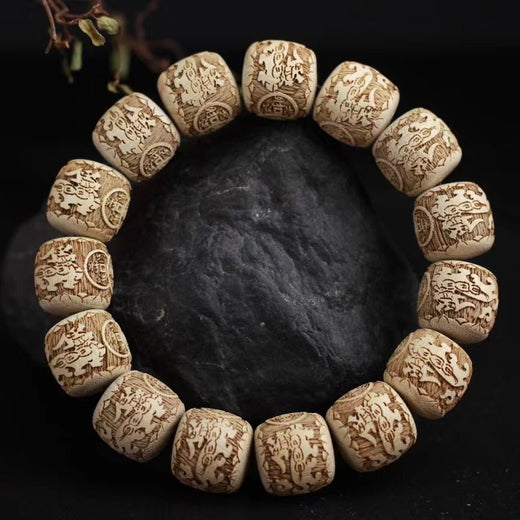
Mantra practice and mala beads are inseparable in the Tibetan tradition — not because you need a mala to recite, but because the mala serves a specific function: it allows you to count repetitions without engaging the counting part of your mind, freeing attention for visualization and breath coordination.
The question of authenticity matters here, and not only for sentimental reasons. A mass-produced plastic mala with 108 beads will count just fine. But the material of a mala carries meaning in Tibetan practice — different materials are associated with different deities and intentions, and this isn't arbitrary aesthetic preference.
Some practice texts discuss material symbolism. A specific historical date or universal material system needs a named textual source; this guide does not establish one.
Material associations differ among practice texts and teachers. Read the examples below as contextual themes, not a single authoritative correspondence table or a requirement to buy a particular material.
- Bodhi seed malas: Associated with Shakyamuni Buddha; appropriate for any general practice; considered the most universally auspicious material
-
Rudraksha malas: These beads appear in Hindu and some Buddhist practice contexts. Their use and meaning depend on the particular tradition. Product origin needs its own record, and a place name is not evidence of greater spiritual potency.
Related reading and pieces: rudraksha mala
- Sandalwood malas: Sandalwood appears in some devotional settings associated with peaceful practice. Fragrance may have ritual or personal meaning; it is not evidence that beads purify a person medically. Follow the exact practice instruction and confirm product composition separately.
- Crystal or clear quartz: Associated with Medicine Buddha and purification practices
- Bone or yak horn: Used in specific Chöd and wrathful practices — not recommended without a teacher's guidance
For practitioners building a serious mantra practice, we'd suggest exploring our Buddhist meditation accessories with this material correspondence in mind — choosing based on which mantra you're currently working with most consistently, rather than which mala is most visually appealing.
One practical note on mala care: in Tibetan practice, a mala used for mantra accumulation is treated as a sacred object. It doesn't go on the floor, isn't worn in bathrooms, and is ideally stored wrapped in cloth on your shrine or practice space. For dry surface maintenance between uses, see our mala and Bodhi bead care gloves; always follow material-specific care guidance.
This isn't superstition — it's a practice of treating your tools with the same intentionality you bring to the practice itself.
How to Actually Practice with Mantras
Knowing a mantra's meaning is the beginning, not the end. Here's how to structure a mantra session that actually works — drawn from standard Tibetan practice instructions rather than improvised from general mindfulness principles.
Before you begin: Take refuge and set bodhichitta motivation. This doesn't need to be elaborate. Even thirty seconds of genuinely orienting toward "may this practice benefit all beings, not only me" shifts the quality of what follows.
In Tibetan practice, this is non-negotiable — it's what distinguishes Mahayana practice from practice aimed solely at personal liberation.
Posture and breath: Sit comfortably for public study or an openly taught recitation, and do not strain the breath. Follow the relevant teacher's instructions for a formal breathing or visualization practice rather than using a general article to clear supposed energetic blockages.
A person's experience varies. A place, altitude or breathing exercise does not guarantee a particular state of attention.
The recitation itself: For an openly taught recitation, follow the relevant pronunciation and count without rushing or straining. A mala may help count repetitions. Duration depends on the formula and pace; 108 repetitions do not have one standard session length.
The number 108 appears throughout Buddhist cosmology — 108 defilements, 108 names of Buddha — so the repetition itself becomes part of the structure.
After you finish: Dedicate the merit. This takes another thirty seconds: "Whatever benefit arose from this practice, may it ripen for all sentient beings." This completes the cycle that began with bodhichitta motivation. You're not extracting spiritual benefit for yourself alone; you're participating in a lineage that extends backward to the Buddha and forward to beings you'll never meet.
Refuge, motivation, practice and dedication are important themes in Buddhist practice instructions. Their exact form belongs to the particular text and tradition, not one rule covering every manual or century.
For the visual side of these mantras and their associated icons, read the Buddhist Symbolism complete guide.
Sources and editorial scope
The retained links below provide starting points for mantra terminology and public teachings. They do not authenticate every product, prescribe one practice for all lineages or establish medical effects.
Questions About Buddhist Mantras
What is a Buddhist mantra?
A mantra is a formula of sacred speech used in a particular Buddhist practice. Its pronunciation, interpretation and use depend on the text and tradition; it is not simply a promise that repeating a sound produces a result.
Can I begin with Om Mani Padme Hum?
This guide identifies Om Mani Padme Hum as a widely taught recitation associated with Avalokiteshvara. Follow a reliable public teaching, and do not assume that the same permission extends to every mantra, visualization or protector practice.
Do all Vajrayana mantras require the same instruction?
No single rule covers every practice. Some have transmission or empowerment requirements. Ask a qualified teacher in the relevant lineage before beginning a practice whose requirements are unclear.
Do I need a particular mala material to recite?
A mala can help count repetitions, but its material is not proof of spiritual attainment or a required purchase. Check any practice-specific instruction separately from the physical specifications and care of a set of beads.
Are mantra meanings medical claims?
No. A description of a deity or a religious aspiration is not evidence that recitation or a product treats illness. Do not replace healthcare or other practical support with a claimed mantra effect.



Keep reading