
buddhist-jewelry
Eye Mala: An Authentic Guide to Spiritual Power
In the vast world of spiritual tools and accessories, few items carry as much historical weight and deep significance as the Phoenix Eye Bodhi Seed Mala. These are not merely strings of beads or aesthetically pleasing artifacts; they are potent conduits of intention, encapsulating profound cultural and spiritual meanings that have resonated through centuries of practice.
if you are a novice just beginning to explore the world of mala beads or a seasoned practitioner seeking to deepen your connection, understanding the story and spirit of these sacred objects can profoundly enhance your journey.
This guide is an invitation to looking closely at the heart of the Phoenix Eye Bodhi Seed Mala, to understand its power, and to learn how it can become an intimate companion on your path.
Let's start with the basics. Mala beads, often called prayer beads or japa beads, are a string of beads traditionally used in meditation and prayer. While they bear a superficial similarity to rosaries in Christianity, their function and symbolism are rooted in the ancient spiritual traditions of the East.
These beads are integral to practices within Buddhism and Hinduism, serving as a tactile guide for the mind during meditation and the recitation of mantras. Typically, a full mala consists of 108 beads, a number considered sacred in many Dharmic traditions for its deep mystical and mathematical significance.
You will also find variations with 27 or 54 beads—fractions of 108—designed for shorter practices or for being worn as bracelets. Each bead you touch represents a single recitation of a chant or prayer.
As your fingers move from one bead to the next, your mind and intention focus more sharply, creating a rhythm that stills the turbulent waters of the mind and facilitates a closer, more immersive meditation experience.
Each bead is hand-knotted by Tibetan artisans at monasteries in Nepal and Tibet, following centuries-old traditions passed down through generations of craftsmen.
When our team was sourcing in Kathmandu's bustling Th

The Ancient Roots of Mala Beads: A Journey Through Time
To truly appreciate your mala, you must first connect with its ancient lineage. The use of prayer beads is a practice that stretches back thousands of years, with its origins deeply embedded in the spiritual soil of India.
The term "mala" itself is a Sanskrit word meaning "garland," evoking an image of a sacred offering. The practice of using these beads for recitation is called "japa," which translates to "muttering" or "murmuring." Thus, a mala is often referred to as a "japa mala," a tool for the continuous, quiet repetition of sacred sounds.
The number 108 is not arbitrary; it is a thread that weaves through cosmology, astronomy, and human physiology. In Vedic cosmology, 108 is considered the basis of creation, representing the universe and the wholeness of existence.
Astronomically, the distance between the Earth and the Sun is approximately 108 times the Sun's diameter, and the distance between the Earth and the Moon is about 108 times the Moon's diameter. Within the spiritual body, yogic traditions identify 108 nadis, or focus points, that converge at the heart chakra.
In Buddhist teachings, it is said there are 108 earthly temptations or defilements (kleshas) that one must overcome to achieve enlightenment. When you complete a full round of 108 mantra recitations, you are symbolically engaging with this entire spectrum of existence, purifying these defilements with each sacred sound.
As Buddhism spread from India across the Himalayas into Tibet, and eastward into China and Japan, the japa mala traveled with it. In the rich, esoteric traditions of Tibetan Buddhism, the mala became an indispensable tool.
It was used not only for reciting mantras but also for complex visualization practices and for counting prostrations. The materials from which a mala was made also took on specific significance, with different woods, seeds, or stones being recommended for particular deities or types of practice—pacifying, enriching, magnetizing, or wrathful.
Among all these materials, one seed rose to a position of unparalleled reverence: the Bodhi seed.
What Makes the Phoenix Eye Bodhi Seed So Sacred?
The Phoenix Eye Bodhi Seed Mala is a specific and highly prized type of mala. Its sacredness begins with its connection to the very moment of the Buddha's awakening. The term "Bodhi" in Sanskrit means "enlightenment" or "awakened." It was under a Bodhi tree (*Ficus religiosa*) in Bodh Gaya, India, that Siddhartha Gautama sat in deep meditation, vanquished all worldly temptations and inner demons, and realized the ultimate nature of reality, becoming the Buddha.
Because of this direct link to the foundational event of Buddhism, the seeds from these trees and their relatives are considered incredibly precious, carrying the very presence of the Buddha's enlightened character.
However, the seeds known as "Phoenix Eye" come from a specific, rare tree, *Ziziphus budhensis*, found only in a few select areas of Nepal. These seeds are distinct due to the unique, naturally occurring eye-like pattern on their surface, which gives them their evocative name.
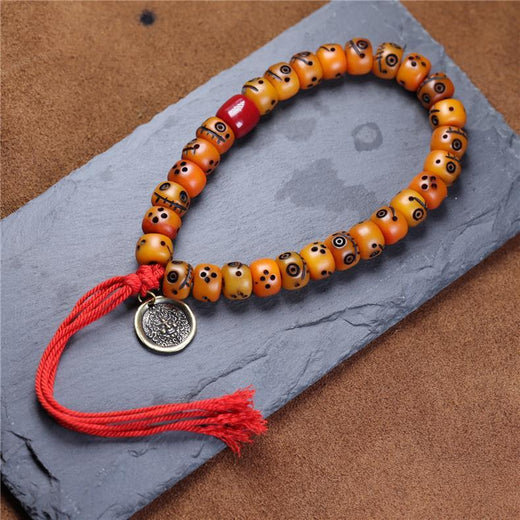
This small, intricate marking is not a carving or an embellishment; it is a gift of nature. The "eye" is seen as the wisdom eye of the Buddha, a constant, gentle reminder to remain aware, to see with clarity, and to cultivate insight (prajna).
It symbolizes the ever-present potential for awakening that resides within you.
The "Phoenix" part of the name adds another profound layer of meaning. The mythical phoenix is a universal symbol of renewal, resilience, and transformation. It is a creature that rises from its own ashes, reborn and more beautiful than before.
This narrative aligns perfectly with the Buddhist path. The journey to enlightenment is a process of transformation—of letting the old, conditioned self burn away in the fire of wisdom to allow a new, liberated consciousness to emerge.
Your Phoenix Eye mala serves as a powerful talisman for this process, reminding you that every challenge is an opportunity for rebirth and that even from the ashes of suffering, profound awakening can arise.
In Tibetan Buddhist lore, the great master Padmasambhava (Guru Rinpoche), who was instrumental in establishing Buddhism in Tibet, is said to have used Phoenix Eye Bodhi seeds for his practice. He prophesied that malas made from these seeds would be especially powerful for future practitioners in pacifying obstacles and accumulating merit.
This lineage and endorsement from such a revered figure have cemented the Phoenix Eye mala's status as one of the most cherished and effective tools for spiritual practice.
Choosing Your Phoenix Eye Mala: A Personal and Spiritual Decision
Selecting a mala is an intimate and intuitive process. It is not like buying a simple piece of jewelry; it is choosing a spiritual companion that will hold your intention, witness your struggles, and celebrate your progress.
The right mala will feel like an extension of your own intention.
If you are new to meditation, the sheer variety of options can feel overwhelming. Your first mala should be one that you feel a natural pull towards. Don't get lost in complex details. Instead, focus on the tactile sensation.
How do the beads feel as they roll between your fingers? Is the weight comforting? When you hold it, does it help quiet your mind? A well-crafted Phoenix Eye mala with smooth, consistently sized beads can be a wonderful starting point.
It provides a reliable rhythm for your mantra practice and its powerful symbolism can inspire you to remain dedicated. Explore our collection of authentic mala beads to see what draws you forward.
For the seasoned practitioner, choosing a new mala might be a more nuanced decision. You may have developed a specific practice or a connection to a particular deity. You might look for a mala with specific characteristics—perhaps smaller seeds for a more subtle feel, or larger ones for a more substantial presence during long retreat sessions.
You might pay closer attention to the guru bead, the larger bead at the end which symbolizes the teacher or the ultimate truth, and the tassel or counters attached to it. The patina of older, antique seeds might call to you, as they carry the blessings of previous practitioners.
Your choice becomes a reflection of the evolution of your own spiritual path.
When making your selection, consider these practical aspects:
- Seed Size and Shape: Phoenix Eye seeds can range from under 10mm to over 15mm. Smaller beads create a lighter, more portable mala, while larger beads are often easier to handle, especially for those with larger hands or during long recitations. The shape can also vary from round to slightly flattened.
- The Guru Bead: This 109th bead is the anchor of the mala. It signals the beginning and end of a cycle of recitation. It is a point of reverence, a moment to pause and express gratitude.
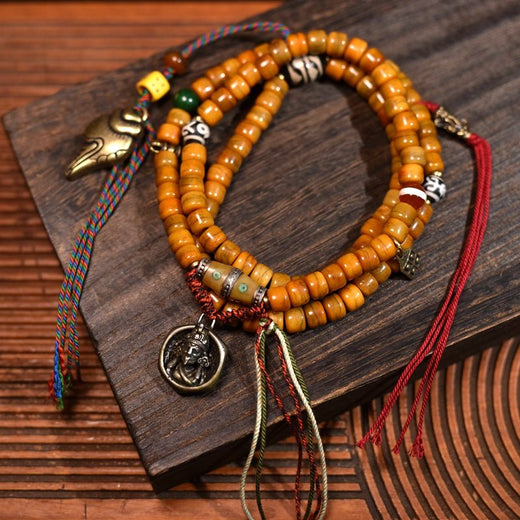
- Markers and Counters: Some malas have marker beads at positions 27, 54, and 81 to help you keep track during shorter sessions. Tibetan malas often feature attached counters—two smaller strings of 10 beads—used to count hundreds and thousands of mantra repetitions.
- Authenticity: Given their rarity and value, it is crucial to source your mala from a trusted provider. Authentic *Ziziphus budhensis* seeds have a unique texture, a clear and natural "eye," and a durability that ensures they will last a lifetime.

The Art of Practice: How to Use Your Mala for Meditation and Mantra
Once you have chosen your mala, the next step is to invite it into your practice and bring it to life with your intention and your breath. Using a mala is a beautiful, grounding ritual that anchors your meditation in a physical act, making it easier to focus a wandering mind.
First, find a comfortable and quiet space where you can sit undisturbed. You may wish to light a candle or some incense to sanctify your space. Hold your mala with reverence in your hands for a few moments.
Take a few deep breaths and set a clear intention for your practice. What quality do you wish to cultivate? Compassion? Clarity? Peace? Let this intention fill your heart.
The traditional method for japa meditation is as follows:
- Drape the mala over the middle finger of your right hand. The right hand is traditionally used as it is associated with pure and positive actions.
- Position your thumb on the first bead next to the large guru bead. The index finger, which is associated with the ego, should not touch the beads; keep it extended outwards.
- As you recite your chosen mantra, either aloud or silently, use your thumb to gently pull the bead towards you, moving to the next bead for the next recitation. Each bead receives one full recitation of the mantra.
- Continue this process, moving from one bead to the next, until you have traveled all the way around the mala and reached the guru bead again.
- If you wish to continue for another round of 108, do not cross over the guru bead. This is a sign of respect for the teacher or the ultimate reality it represents. Instead, simply turn the mala around 180 degrees and go back in the direction you came from.
Your choice of mantra is deeply personal. A universally powerful and accessible mantra from Tibetan Buddhism is "Om Mani Padme Hum." This is the mantra of Avalokiteshvara, the Buddha of Compassion. Each syllable helps purify a specific negative emotion: Om (pride), Ma (jealousy), Ni (desire), Pad (ignorance), Me (greed), and Hum (hatred).
By chanting it, you are invoking boundless compassion for yourself and all sentient beings. Another powerful mantra is that of Shakyamuni Buddha himself: "Om Muni Muni Mahamuni Shakyamuni Svaha," which invokes his enlightened wisdom and guidance.
Whatever mantra you choose, recite it with sincerity and focus, letting its feeling permeate your entire being.
The Living Mala: Caring for Your Bodhi Seeds and Cultivating Patina
One of the most beautiful aspects of a genuine Phoenix Eye Bodhi Seed mala is that it is a living object. Unlike malas made of stone or glass, these organic seeds will change and evolve with you over time.
Caring for your mala is an extension of your spiritual practice—an act of mindfulness and respect.
Because they are natural seeds, it is best to keep them away from water and harsh chemicals. If they need cleaning, a gentle wipe with a soft, dry cloth is usually sufficient. Over time, the seeds may feel a bit dry.
You can nourish them by applying a tiny amount of a natural oil like walnut or jojoba oil to a cloth and gently rubbing each bead. Do this very sparingly, as too much oil can make them sticky.
The true remarkable quality, however, lies in the patina. As you use your mala day after day, week after week, year after year, the seeds will begin to absorb the natural oils from your skin and the quiet presence of your practice.
They will gradually darken in color, transforming from a light tan to a deep, rich honey-brown, and their surface will become incredibly smooth and polished. This developing patina is a physical record of your journey.
It is a visual record of the thousands of mantras you have recited, the intentions you have set, and the devotion you have cultivated. Your mala transitions from being a mere tool to becoming a sacred artifact, imbued with your personal spiritual presence.
This transformation is a powerful reflection of your own inner change, making your mala an irreplaceable and deeply personal treasure. You can explore our entire collection of spiritual jewelry to find the piece that will accompany you on this transformative journey.
Beyond Meditation: Integrating Your Mala into Daily Life
While the primary function of a mala is for japa meditation, its purpose does not have to end when you step off the cushion. Integrating your mala into your daily life can serve as a powerful way to carry your practice with you, transforming ordinary moments into opportunities for mindfulness.
Wearing your Phoenix Eye mala as a necklace or wrapped around your wrist as a bracelet is a common practice. In this way, it becomes a constant, tangible reminder of your spiritual intentions. When you catch a glimpse of it or feel its weight against your skin, it can pull your awareness back from the distractions of the world to the core of your practice.
It is a touchstone for mindfulness, prompting you to take a conscious breath, to soften your heart, or to silently recite your mantra as you go about your day. Many practitioners find that wearing their sacred beads as bracelets offers a discreet yet potent connection to their path.
In moments of stress, anxiety, or frustration, you can simply hold your mala in your hand. Close your eyes and feel the smooth, cool surface of the beads. Roll one or two between your thumb and fingers, focusing entirely on the physical sensation.
This simple act of grounding can be incredibly effective at calming the nervous system and bringing you back to the present moment. It is a portable sanctuary you can access anywhere, anytime.
Over time, as your mala absorbs your intention and presence, it becomes more than a reminder; it becomes a source of strength and comfort. It is a personal talisman, a spiritual companion that has witnessed your journey.
It holds the mark of your devotion. In this way, the Phoenix Eye Bodhi Seed mala becomes a bridge between your formal spiritual practice and your everyday life, helping you to walk the path of awareness with every step you take.
Explore our vintage Yak Bone 108 mala.
Frequently Asked Questions
Why are there 108 beads on a mala?
The number 108 is considered sacred in many Eastern religions and spiritual traditions for a variety of reasons. It is said to represent the 108 defilements or worldly temptations one must overcome to achieve enlightenment.
Astronomically, the distances of the Sun and Moon from Earth are roughly 108 times their respective diameters. In yogic philosophy, there are 108 major energy lines (nadis) that converge at the heart chakra. Using a 108-bead mala is a way of honoring and connecting with these profound cosmic and internal realities.
Can anyone use a Phoenix Eye Bodhi Mala, or is it only for Buddhists?
Anyone can use a Phoenix Eye Bodhi Mala. While it has deep roots and specific significance within Buddhism, its power as a tool for focus, meditation, and intention-setting is universal.
The most important element is your sincerity and respect for the object. If you are drawn to its beauty and symbolism and use it with a genuine intention to cultivate peace, mindfulness, or compassion, it will serve you well, regardless of your spiritual affiliation.
What should I do if my mala breaks?
In the Buddhist tradition, a mala breaking is not seen as a negative event. It is often interpreted as a positive sign, symbolizing the breaking of a cycle of suffering or the completion of a karmic pattern.
It can signify a breakthrough in your practice. You can gather the beads and have the mala restrung, perhaps with a small ceremony or a renewed intention for the next phase of your journey.
It is an opportunity for reflection and renewal.
How do I know if my Phoenix Eye Bodhi seeds are real?
Authentic Phoenix Eye Bodhi seeds from the *Ziziphus budhensis* tree have distinct characteristics. They possess a natural, uncarved eye pattern, a unique texture that is neither too rough nor perfectly smooth, and a satisfying density.
Over time, they will develop a rich, dark patina through use. The best way to ensure authenticity is to purchase your mala from a reputable and knowledgeable source like Buddhabelief that honors the tradition and sources its materials ethically.
My mala is getting very dark and shiny. Is this normal?
Yes, this is not only normal but highly desirable! This darkening and polishing process is the development of the patina. It is a direct result of the seeds absorbing the oils from your skin and the energy from your dedicated practice.
A deep, lustrous patina is considered a beautiful sign of a well-loved and well-used mala. It is a physical a sign of your spiritual journey and the life you have infused into your sacred beads.
For deeper context on the tradition behind this practice, see prayer bead traditions on Wikipedia.
Keep reading