
buddhist-jewelry
Lucky Red String Bracelet Meaning: A Tibetan Guide for 2026
You're sitting at your desk, the blue light of the screen painting your face. An email notification pings. A Slack message pops up. Your phone buzzes with an Instagram alert. It feels like a thousand tiny threads are pulling at your attention, leaving you feeling scattered and overwhelmed.
You take a breath, but it's shallow. You glance down at your wrist, wondering if there's something simple, something tangible, that could serve as an anchor in this digital storm. You've seen the simple red string bracelet online, and you're curious.
Is it just a trend, or is there something more to it? This guide is for you. We'll explore the true, deep meaning behind these authentic Tibetan bracelets, moving beyond simple 'luck' into their role as powerful tools for grounding and protection.
The Foundation: What a Tibetan Red String Really Is
You've probably seen red strings on the wrists of celebrities or spiritual influencers and wondered about the real story. The most common misconception we encounter is that it's simply a good luck charm, something you wear to quietly attract fortune.
The reality, rooted in Himalayan wisdom passed down through the Gelug and Nyingma schools, is far more layered and grounded in lived practice.
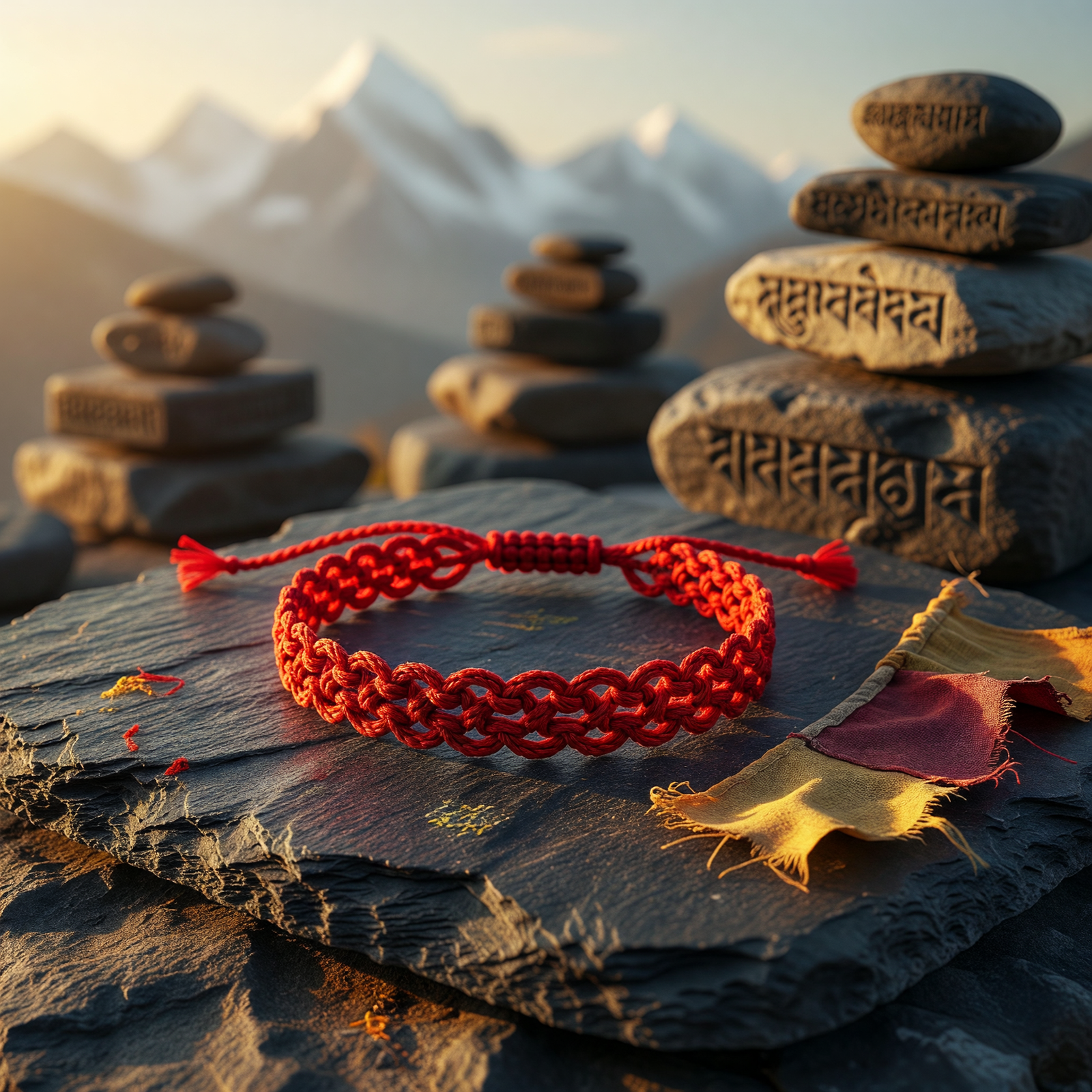
In Tibetan Buddhism, this isn't just a "lucky red string." It's known as a sungdi or srung skyud, which translates to "protection cord." Its power doesn't come from something external, but from two key elements: intention and blessing.
These cords are traditionally given by a Lama (a respected spiritual teacher) to a student or practitioner after a ceremony, an empowerment, or a long retreat. The Lama will spend days, sometimes weeks, reciting specific mantras—sacred sounds that embody enlightened qualities like compassion or wisdom—while holding or tying the cords.
This process infuses the simple string with the concentrated focus of the practice. When you receive one, you're not only getting a piece of thread; you're receiving a tangible connection to the lineage of that teaching and the accumulated positivity of that specific mantra.
Think of it this way: a guitar is just wood and wire. But in the hands of a master musician, it can create sounds that move your soul. Similarly, a red string is just a cord.
But when it has been part of a sacred practice, blessed by someone with deep realization like the monks from Sera Monastery who bless our malas, it becomes a conduit. It's a physical reminder of the qualities you wish to cultivate within yourself—like the unwavering compassion of Chenrezig or the fearless wisdom of Manjushri.
It's less about attracting external luck and more about awakening your own inner capacity for strength and clarity. The traditional Tibetan protection bracelets are, at their heart, tools for your own mind.
Alt text: Close-up shot of a Tibetan artisan's hands carefully tying an endless knot in a vibrant red string bracelet inside a workshop in Kathmandu.
Why This Ancient Practice Matters More Than Ever in 2026

It's easy to dismiss a simple string as irrelevant in a world of AI, virtual reality, and relentless productivity goals. But we believe that's precisely why it's more essential now than ever. As we navigate 2026, the pressures you face are unique.
The line between work and life has blurred into a permanent smudge on your screen, and the demand to be constantly 'on' is a recipe for burnout.
Let's look at the specific challenges you might be facing:
- The Burnout Epidemic: You're juggling deadlines, side hustles, and the pressure to build a personal brand. Your nervous system is in a constant state of low-grade fight-or-flight. A red string on your wrist becomes a physical, analog cue. When you feel that familiar wave of anxiety rising during a Zoom call, the simple act of touching the knot can be a circuit breaker. It's a non-digital notification from yourself, to yourself, reminding you: "Breathe. Come back to this moment. You are here." It's a tiny rebellion against the tyranny of digital urgency.
- The Crisis of "Too Many Options": You're told you can be anything, which often feels like you have to be everything. This creates a paralyzing sense of "what do I really want?" A red string can represent a single, clear intention. When you first put it on, you might set an intention like, "I will act with more compassion towards myself," or "I will trust my own path." Every time you see it, it's a quiet reaffirmation of that personal vow. In a world of infinite choices, it's an anchor to one meaningful commitment you've made to your own well-being.
- working through Relationships with Clarity: if you are wondering if you should commit or feeling the strain in a long-term partnership, relationships require immense presence and patience. The red string isn't a love spell. Instead, it serves as a reminder of your core values. When a difficult conversation arises, a glance at your wrist can remind you to speak from a place of kindness rather than reactivity. It helps you remember the person you want to be within that relationship, even when emotions are running high.
- The Trap of Digital Comparison: You scroll through perfectly curated lives on Instagram and feel a pang of self-doubt. It's a silent, constant erosion of self-worth. The red string is radically personal. Its story is yours alone. It wasn't bought for an algorithm or to impress anyone. It's a symbol of your inner journey, a private conversation between you and your highest aspirations. It grounds you in the reality of your own life, with all its beautiful imperfections, away from the highlight reels of others.
As you move through 2026, this small piece of cord—traditionally blessed by Tibetan monks and hand-tied with intention—becomes a powerful statement. It's a declaration that your inner peace is worth protecting, that your attention is sacred, and that you are committed to walking your own path with intention, one grounded moment at a time.
The Real Benefits: How a Blessed String Actually Works
So, how does a simple, blessed cord translate into tangible effects in your life? It's not about magic; it's about a subtle and consistent shift in your awareness. The benefits unfold through the interplay of your mind, your intention, and the spiritual presence infused into the bracelet.
We see it working in three primary ways.
A Shield for Your Mind (Protection)
The primary purpose of a Tibetan red string is protection. But it's crucial to understand what we're protecting against. It's not a force field against physical harm. Rather, it's a shield for your mind.
The biggest dangers we face daily are internal: the voice of self-doubt, the sting of a harsh comment, the anxiety that spirals from a single worry, or the distraction that pulls us away from what's important.
The blessed string acts as a constant, subtle reminder to be vigilant about what you allow into your mental space. When you see it, you're reminded of the strength and clarity you're cultivating. It's like having a gentle security guard at the door of your mind, helping you to notice and turn away negative thought patterns before they take root.
Those walking a path of genuine inquiry recognize this as the real work—not external protection, but the disciplining of attention. This aligns with the purpose behind many ancient Tibetan protection symbols, which are designed to bolster your inner fortitude.
An Anchor for Your Intention (Grounding)
Your mind will wander—that's what minds do. The challenge isn't to stop it from wandering, but to gently bring it back. The red string is your anchor. It's a physical, sensory touchpoint to the present moment.
Throughout your day, you might unconsciously touch it, feel its texture against your skin, or see its color in your peripheral vision. Each of these micro-interactions is an opportunity to return to your intention.
If your goal is to be more patient, feeling the string while you're stuck in traffic can be the reminder you need to take a deep breath instead of getting frustrated. If your intention is to be kinder to yourself, touching it after making a mistake can prompt a thought of self-compassion instead of self-criticism.
It grounds your highest aspirations in the physical reality of your day-to-day life, turning abstract resolve into lived experience. For more on this, you can explore our guide to wearing spiritual bracelets with intention.
A Connection to Lineage (Spiritual Power)
This is perhaps the most subtle, yet most powerful, aspect. The "spiritual power" of the bracelet doesn't mean it has supernatural abilities. The power comes from its connection to a lineage of practice and wisdom that stretches back to the 7th century, when Tibetan Buddhism first took root in the Himalayan plateau.
When a monk in our partner monastery near Boudhanath blesses these cords with the mantra of Chenrezig—reciting it 108 times or more—they are tapping into an unbroken stream of compassionate presence that has been cultivated by masters for generations.
Wearing the string is a way of plugging into that stream. You're not alone in your quest for peace and clarity. You are, in a small but meaningful way, supported by the accumulated wisdom and positive intentions of countless practitioners who came before you.
It's a feeling of being part of something vast, rooted in history, and genuinely kind. This connection provides a deep sense of support and encouragement, especially when you feel isolated or lost on your path.
Alt text: A woman wearing a simple red string bracelet on her left wrist, her hand resting on a laptop, symbolizing a moment of mindful pause during a busy workday.
How to Choose an Authentic Tibetan Red String Bracelet

When you decide to welcome a red string into your life, choosing an authentic one makes all the difference. A mass-produced red thread from a factory is just that—a thread. An authentic piece, however, is a vessel of intention and tradition.
Here's what to look for, so you can make a choice that feels right for your journey.
First, consider the source. The heart of these bracelets is the blessing. Ask yourself: who is making this, and where is it coming from? At Buddhabelief, we've spent years building relationships with artisans and monasteries in Nepal.
Our red strings are tied and blessed by monks in a genuine, traditional process that dates back to pre-Buddhist Himalayan practices. This isn't something that can be scaled up in a factory. It requires time, dedication, and a deep understanding of the tradition.
When you choose a bracelet, you should feel a connection to its story and the people who made it. You are not only a consumer; you are becoming a custodian of a small piece of Himalayan heritage.
Next, look at the craftsmanship. While the design is often simple, the quality speaks volumes.
- The Thread: Is it a sturdy, durable material that can be worn every day? It should feel comfortable against your skin but also strong enough to last through years of daily wear without fraying.
- The Knots: Often, these bracelets feature specific knots, like the endless knot (shrivatsa), which symbolizes the interconnectedness of all things and the endless nature of wisdom and compassion. The knots should be tied tightly and evenly, a sign of the care and mindfulness that went into its creation. Master Tenzin, who leads our Boudhanath workshop, often says the quality of the knot reflects the focus of the mind that tied it.
Finally, consider what form speaks to you. While the classic is a simple cord, there are variations that carry additional meaning.
- For pure, focused intention, a simple, handwoven red string bracelet is perfect. Its minimalism keeps the focus on the blessing itself.
- If you want to amplify a specific quality, you might choose a bracelet that incorporates a Dzi bead for grounding and strength.
- For a constant reminder of a specific teaching, a Tibetan silver piece engraved with a mantra like "Om Mani Padme Hum" carries real power in daily practice.
Choosing your bracelet is an intuitive process. Browse our Tibetan bracelet selection and see which one you feel drawn to. It's not about finding the "best" one, but the one that resonates with your personal intention and feels like a true companion for your path.
This is an investment piece—not in a monetary sense, but an investment in your own well-being. It's the piece you'll still wear in 20 years, its color faded but its meaning deepened.
Alt text: A flat lay of three different styles of Buddhabelief bracelets: a simple red string, one with a silver Om mani padme hum bead, and another with a small Dzi bead.
How to Actually Use Your Bracelet: A Daily Practice
Receiving your red string bracelet is just the beginning. Its real value unfolds in how you integrate it into your daily life. It's not a passive object; it's an active tool for mindfulness. Here's a simple guide to making it a meaningful part of your routine.
1. Setting Your Intention
When you first receive your bracelet, don't just quickly put it on. Take a quiet moment. Hold it in your hands. Close your eyes and take three deep breaths. As you exhale the third time, set a clear, simple intention for what you want this bracelet to represent for you.
It could be a quality you wish to cultivate ("May this remind me to be patient") or a form of protection ("May this guard my mind against self-criticism").
As you tie it on your wrist (traditionally the left, or "receiving" wrist), do so with this intention in mind. This small ceremony marks the beginning of your journey with the bracelet. You are consciously inviting its purpose into your life.
The knot itself—typically tied in three loops by a practitioner—becomes the physical anchor of that commitment.
2. The Micro-Practice of Touch
Throughout the day, your bracelet will be your anchor. The practice is simple: whenever you notice it, use it as a cue to return to the present.
- When you feel stressed: Instead of reaching for your phone, gently touch the knot on your bracelet. Feel its texture—the slight roughness of the cord, the way it sits against your skin. Take one conscious breath. That's it. This small act can interrupt the stress cycle and give your nervous system a moment of reset.
- Before a difficult task: Before you send that important email or walk into a tough meeting, glance at your wrist. Let it be a reminder of your inner strength and your intention to act with clarity and kindness.
- During moments of joy: Don't just use it for difficult times. When you're laughing with a friend or enjoying a beautiful sunset, touch the bracelet. This associates it with positive states, too, making it a reminder of the good in your life.
3. What to Do When It Breaks
Eventually, your bracelet will wear out and break. This is a very important moment. In the Tibetan tradition, this is not a bad omen. It is a sign that the bracelet has done its job.
It has absorbed the negativity it was meant to protect you from and has completed its purpose. Practitioners in the Kathmandu Valley have observed this for generations—a worn bracelet is considered a blessing, not a loss.
When it falls off, the practice is to pause and feel a sense of gratitude. Thank it for its service. Then, find a place in nature—under a tree, in your garden, or in a pot of a houseplant—and bury it.
This respectfully returns its presence to the earth. It signifies the end of one cycle and makes space for a new one to begin. You can learn more about the lifecycle and care of these sacred items in our complete guide to Tibetan jewelry.
Common Questions About the Tibetan Red String
Which wrist should I wear my Tibetan red string bracelet on?
In Tibetan Buddhist tradition, the left wrist is often recommended for wearing a blessed red string bracelet. The left side of the body is considered the 'receiving' side, associated with accepting blessings, positivity, and protection into your life.
When you wear it on your left wrist, you are creating an intention to draw in compassion, safety, and spiritual support. It's like opening a door for beneficial qualities to enter your personal presence.
The right side, conversely, is the 'giving' side, associated with projecting qualities outward. While there's no strict, unbreakable rule, wearing it on the left aligns with the traditional purpose of these sacred cords. Ultimately, the most important aspect is your personal connection and the intention you set.
If wearing it on your right wrist feels more natural or meaningful to you, that is perfectly fine. The bracelet is a tool for your practice, so let your intuition guide you.
Can I wear my red string bracelet in the shower?
Yes, you absolutely can. An authentic Tibetan red string bracelet is meant to become a part of you, a constant companion on your journey. We and the artisans who craft them in the Kathmandu Valley understand that life involves water.
They are typically made from durable, high-quality cord designed to withstand daily activities, including showering, washing hands, and even swimming. The blessing infused into the cord is not water-soluble; it's a spiritual imprint that isn't washed away.
In fact, wearing it continuously allows it to age with you, holding the presence of your life and experiences. It may fade or soften over time, but this is a natural part of its lifecycle.
Think of it like a well-loved pair of jeans—it becomes more yours with every wear. So, don't worry about taking it off. Let it live with you, and simply be mindful of it as you go about your day.
What does it mean when my red string bracelet breaks and falls off?
When a blessed red string bracelet breaks, it is not a sign of bad luck. In the Himalayan tradition, it's actually seen as a positive event. The belief is that the bracelet has fulfilled its purpose.
It has absorbed a significant amount of negativity or deflected a potential harm that was meant for you, and in doing so, it has become 'full.' The breaking of the cord signifies that its protective work is complete.
Instead of feeling anxious, the appropriate response is one of gratitude. Take a moment to thank the bracelet for its service and protection. The traditional way to dispose of it is with respect for the earth.
Find a place in your garden, a park, or even a potted plant, and bury the string in the soil. This returns its presence to the natural world. It marks the end of a cycle and opens the space for a new beginning, perhaps with a new intention and a new bracelet.
Do I have to be a Buddhist to wear a Tibetan red string bracelet?
Not at all. While the red string bracelet has deep roots in Tibetan Buddhism, its core principles of protection, mindfulness, and compassion are universal. You do not need to identify as a Buddhist to benefit from its meaning.
Think of it as a tool, not a religious mandate. It's for anyone seeking a tangible reminder to be more present, to cultivate inner calm, or to feel a sense of safety in a chaotic world.
The intention you bring to the bracelet is what gives it presence for *you*. if you are setting an intention for more patience, less anxiety, or simply to remember to breathe, the bracelet serves as your personal anchor.
We believe these tools of wisdom should be accessible to everyone, regardless of their spiritual path or background. It is a symbol of your commitment to your own well-being, and that is a journey open to all.
How is a Tibetan red string different from a Kabbalah red string?
This is an excellent question, as the two are often confused. While they look similar, their origins, blessings, and meanings are quite distinct. The Kabbalah red string, from Jewish mysticism, is traditionally made of wool and is worn on the left wrist to ward off the 'evil eye.' Its ritual involves being wrapped around the tomb of the matriarch Rachel in Israel.
In contrast, the Tibetan Buddhist red string, or *sungdi*, is a protection cord. The blessing involves the recitation of specific mantras, often for many days or weeks, infusing the cord with the presence of a particular deity or enlightened quality, like the compassion of Chenrezig (Avalokiteshvara).
The material is typically cotton or silk cord. So, the key difference lies in the spiritual technology: Kabbalah focuses on averting external negative forces (the evil eye), while the Tibetan approach focuses on cultivating internal strengths and connecting to a lineage of enlightened wisdom and compassion.
Both are powerful, but they come from different philosophical wells.
Can I buy a red string bracelet as a gift for someone else?
Yes, giving a blessed red string bracelet is a beautiful and meaningful gesture. It is considered an act of generosity and care, a way of wishing someone safety, well-being, and peace on their journey.
When you give one as a gift, you are extending the protective and positive intentions to another person. It's a wonderful way to support a friend going through a difficult time, celebrate a milestone, or simply show someone you are thinking of them.
You can even set a quiet intention for them as you give it. For example, you might silently wish for them to have strength during a challenging project or clarity in a confusing situation.
The act of giving with a pure heart adds another layer of positivity to the bracelet. It's more than an object; it's a shared hope for happiness and freedom from suffering.
Your Journey, Your Anchor for 2026
Your path is unique. The challenges you'll face and the joys you'll discover in 2026 and beyond are yours alone. In a world that constantly pulls you outward, the journey inward becomes the most essential expedition you can take.
It doesn't require a grand gesture or a dramatic life change. Often, it begins with a small, conscious step—a single breath, a moment of pause, a simple intention set while sitting before your altar or walking through your neighborhood.
A Tibetan red string bracelet is just that: a small, tangible first step. It is a quiet companion, a physical reminder of the peace, strength, and compassion that already exist within you. The crimson dye comes from madder root, a plant that has been used in the Himalayas for centuries.
It won't solve all your problems, but it will be there on your wrist, quietly encouraging you to meet each moment with a little more awareness and a little more heart.
As you move forward, let it be your anchor. Let it be the thread that connects you to your deepest intentions and to the lineage of wisdom that has sustained practitioners since the 7th century, when Buddhism first took root in Tibet.
If you feel called to begin this practice, we invite you to explore our handwoven Tibetan bracelet collection, each piece crafted and blessed with care by artisans and monks in the Himalayas.
Keep reading