
News
Buddha Bracelet Meaning, Benefits & Which Wrist to Wear
It’s 10 PM. You’ve finally flopped onto the sofa, phone in hand, scrolling past curated lives that seem so much more figured out. You see articles on burnout, on finding your purpose, on the next wellness trend that promises to fix everything.
It all feels loud and complicated. You might be wondering if there’s something simpler, something tangible you can hold onto that reminds you to just… breathe. Something that doesn't require a ten-day retreat or a new vocabulary.
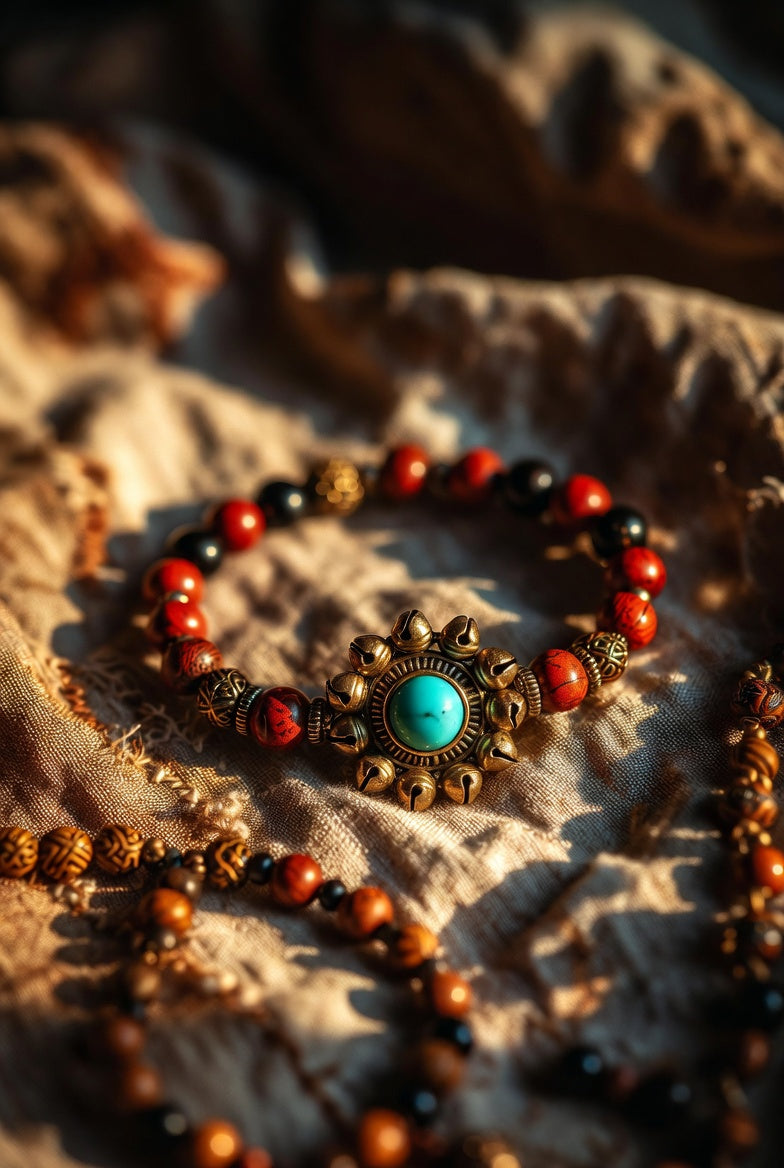
This is often the quiet moment when people start searching for the meaning behind a Buddhist bracelet, looking not for a magic cure, but for a quiet anchor in their day. It’s a journey we understand well, and it often begins not with a grand gesture, but with a simple, personal choice to wear a reminder.
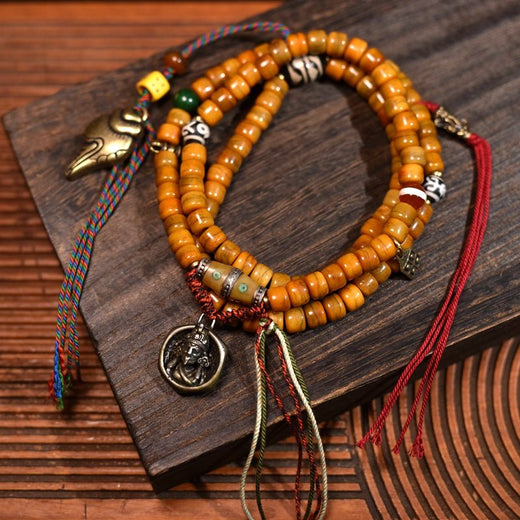
Our handwoven Tibetan bracelet collection is crafted with this very intention in mind.
The Buddhist bracelet meaning is a wearable reminder of one's personal intention—be it for mindfulness, compassion, or protection—serving as a physical touchpoint to interrupt anxious thoughts and return to the present moment.
The Foundation: What a Buddhist Bracelet Really Is
Let's clear the air. There's a common misconception, especially in the West, that a Buddhist bracelet is a kind of spiritual battery pack. You put it on, and—poof—instant calm, effortless focus, and a shield against all bad vibes.
We've spent years living and working alongside artisans and practitioners in the Himalayas, and we can tell you with a smile, it doesn't quite work like that.
A Buddhist bracelet isn't a magic charm. It's a tool. Think of it like a beautifully crafted hammer. The hammer itself doesn't build the house; you do. But a good hammer makes the work easier, more effective, and more intentional. Your bracelet is a tool for your mind.
In the Tibetan tradition, these bracelets, often called wrist-malas, are a deeply personal item. They are a condensed version of the 108-bead mala used for counting mantras during meditation—the same practice documented in texts from the 11th century onward.
But their purpose extends far beyond counting. It's about carrying your practice, your intention, into the world, off the meditation cushion.
The true meaning isn't something pre-infused into the beads that passively radiates into you. The meaning is co-created. It's a partnership between the object and you. The bracelet holds the potential, the story of its materials—whether semi-precious stones from the Tibetan plateau or hand-carved bone—the care of the artisan who made it, and the lineage of its tradition.
But you are the one who activates it by wearing it with intention, by using it as a reminder, by letting its physical presence on your wrist pull you back from the brink of a stress-spiral.
It's a commitment you make to yourself, and the bracelet is the beautiful, tangible symbol of that promise. It says, "I am working on myself. I am choosing awareness." And that is far more powerful than any remarkable thinking.
Why This Matters More Than Ever in 2026

You're working through a world that feels increasingly digital, abstract, and noisy. Your work might live entirely inside a laptop, your social life on a screen, and your newsfeed is a relentless firehose of information and outrage.
We are living through a sharp sense of disconnection—from the physical world, from each other, and often, from ourselves. By 2026, this feeling isn't going away; it's intensifying. The search for tangible, offline meaning is becoming a fundamental human need.
This is where a simple, physical object like a Buddhist bracelet finds its quiet relevance. It is an act of resistance.
- An Anchor in the Digital Storm: When you're 12 tabs deep into a work project and your phone is buzzing with notifications, your mind is scattered. Glancing at the bracelet on your wrist, feeling the cool weight of the stone or the smooth texture of the wood—perhaps a strand of rudraksha seeds or Tibetan turquoise—is a physical sensation. It doesn't ask for a click or a swipe. It just is. This small, sensory input is enough to break the digital spell, pulling your awareness out of the abstract cloud of data and back into your own body, in this present moment.
- A Commitment to Your Inner World: In a culture that prioritizes external validation—likes, promotions, social status—choosing to wear a symbol of your inner journey is a powerful statement. It's for you, not for an audience. It's a private conversation between you and your intentions. In an era of AI-generated content and deepfakes, this commitment to your own authentic, internal experience is a radical act of self-possession.
- A Connection to Human Hands: Most things you touch in a day are mass-produced by machines. An authentic bracelet is different. When you wear one of our pieces, you're wearing something that was tied, knotted, or beaded by the hands of a real person, like Master Tenzin in our Kathmandu workshop. You're connected to a lineage of craft that has been passed down through the Tibetan plateau for centuries. In a world of automation, this human connection is a rare and precious thing. It reminds you that you are part of a human story, not only a data point.
So, in 2026, wearing a Buddhist bracelet isn't about adopting an aesthetic. It's about choosing a strategy for staying sane, grounded, and human in a world that pulls you in a thousand other directions. It's a small, wearable piece of sanctuary.
The Real Benefits: How It Actually Works
So we've established it's not magic. Then what does a Buddhist bracelet *do*? The benefits are real, but they are practical, psychological, and participatory. It works because *you* work with it. Here's how we've seen it play out, both in our own lives and for those on a path of self-inquiry.
A Wearable Reminder for Mindfulness (The "Pattern Interrupt")
Your mind loves patterns. Unfortunately, many of them are unhelpful. You feel a pang of stress, and your mind immediately jumps to a well-worn track of anxious what-ifs. You get a critical email, and you spiral into self-doubt.
These are mental habits, neural pathways worn deep like trails in a forest.
A bracelet acts as a "pattern interrupt." It's a new, gentle signal in your sensory field. You're typing furiously, shoulders tensed up to your ears, and you catch a glimpse of the rich, dark wood on your wrist.
Or you're scrolling mindlessly, and the cool weight of the stone beads shifts. This tiny event is enough to break the trance. It's a tap on the shoulder from your higher self, saying, "Hey.
You there? Notice your breath. Unclench your jaw. You're spiraling."
It doesn't solve the problem that caused the stress, but it gives you a crucial two-second pause. In that pause, you have a choice. You can choose to take one deep breath. You can choose to not send that reactive email.
You can choose to step away from your desk for a minute. The bracelet doesn't force the choice, but it creates the space where a better choice becomes possible. This is the heart of mindfulness in daily life.
A Tool for Simple Meditation (Mantra & Breath)
You don't need a special cushion, a silent room, or a 30-minute time slot to benefit from meditation. Some of the most grounded practices are the ones you can do in 60 seconds at your desk, in your car before walking into the office, or in a bathroom stall when you're feeling overwhelmed.
Your bracelet is the perfect tool for this.
Here's a simple practice we teach people who get one of our bracelets:
- Touch the Guru Bead: Most wrist-malas have a distinct bead, often larger or with a tassel, called the Guru bead. This is your starting point. Hold it between your thumb and middle finger.
- Inhale and Move: Take a slow, deep breath in. As you do, use your thumb to slide to the next bead.
- Exhale and Say a Word: As you exhale, mentally say a word that you want to cultivate. It doesn't need to be a Sanskrit mantra. It can be "Calm," "Focus," "Let go," or "I am okay."
- Repeat: Continue this process, moving from bead to bead, for just 5-10 breaths. Inhale, move. Exhale, word.
This simple, tactile process does three things: it anchors your attention, it regulates your breathing (which calms the nervous system), and it reinforces a positive intention. It turns a moment of anxiety into a moment of practice.
The bracelet isn't just on your wrist; it's an active part of your wellness toolkit. For a closer understanding of how these sacred items function, our Tibetan bracelet complete guide offers more context.
The Power of Intention and Blessing
This is the part that can feel a bit abstract, but it's deeply important. When you choose a bracelet, you are setting an intention. You're telling yourself, "I want more peace," or "I need to feel more protected and grounded." That act of choosing is powerful.
Every time you look at the bracelet, it reinforces that intention.
Now, let's talk about blessings. This isn't a vague, spiritual-sounding marketing term for us. It's a specific process. For certain pieces in our collection, we work with monks from monasteries like Sera Monastery in Tibet or monastic communities in Boudhanath, Nepal.
A blessing, or "rabné" in Tibetan, involves a ceremony where the monks recite specific prayers and mantras, focusing their collective concentration and positive intention onto the objects. They hold the items and imbue them with the energy of that specific prayer—perhaps the mantra of Chenrezig for compassion, or Tara for protection.
Does this make the bracelet remarkable? No. But it does mean the bracelet carries a story. It has been held by hands dedicated to a life of peace and compassion. It has been in a space filled with the resonance of sacred sound.
When you wear it, you are connecting to that story, to that lineage, to that focused intention. It's a reminder that you are not alone in your journey; you are connected to a stream of practitioners, past and present, who have also sought a more conscious and compassionate way of living.
It adds a layer of meaning and resonance that a mass-produced item simply cannot have.
How to Choose an Authentic Buddhist Bracelet

When you're ready to choose a bracelet, you're not only picking an accessory. You're choosing a companion for your journey. The market is flooded with imitations, so knowing what to look for is key to finding a piece that will genuinely support your practice.
It comes down to three things: Material, Origin, and your own Intention.
1. Material: The Body of the Bracelet
The material isn't just for looks; in Tibetan tradition, each substance carries different energy and purpose.
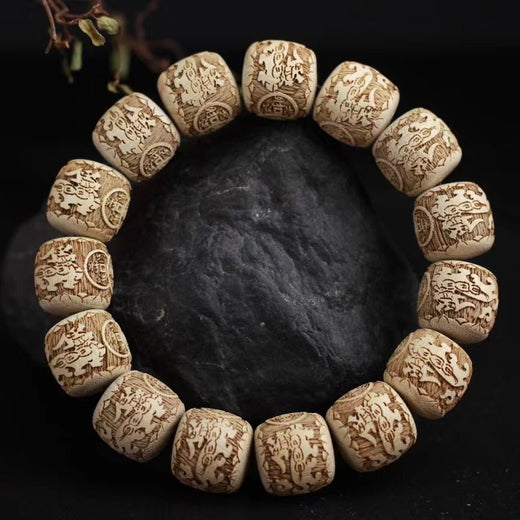
- Wood (Sandalwood, Rosewood): These are grounding and calming. Sandalwood, with its subtle, lasting fragrance, has been used since at least the 8th century in Buddhist monasteries to quiet the mind and enhance meditation. It feels warm to the touch and is excellent for anxiety and overthinking. It's a wonderful choice for a beginner's daily practice.
- Seeds (Bodhi, Rudraksha): Bodhi seeds are deeply significant, as the Buddha attained enlightenment under a Bodhi tree in Bodh Gaya around 500 BCE. Wearing them symbolizes the potential for your own awakening. They are lightweight and get smoother and darker with use, absorbing your body's oils and your practice's energy. Rudraksha seeds are associated with protection and clarity.
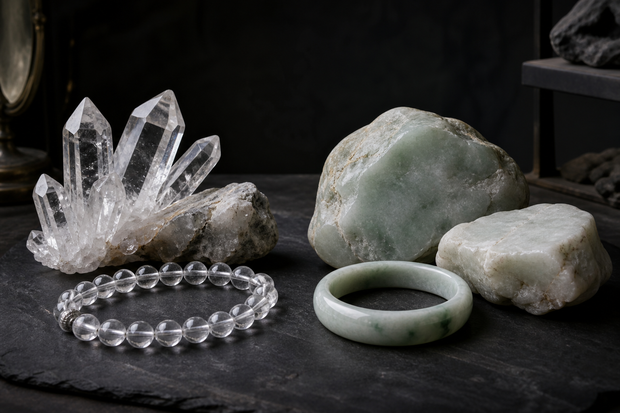
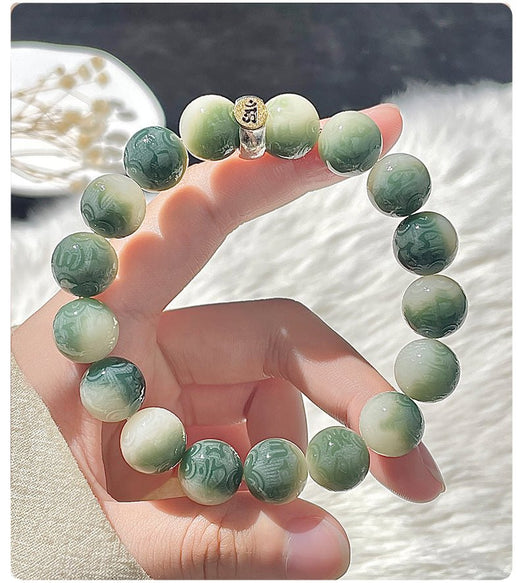
- Stone (Lava, Onyx, Howlite, Turquoise): Stones offer a sense of stability and strength. Lava stone is porous and grounding, often used with essential oils. Black Onyx is seen as a stone of protection, absorbing negativity. Howlite is a calming stone, said to reduce stress. Turquoise is a revered stone in Tibet for healing and protection—you'll see it woven into traditional Tibetan dress and prayer beads throughout the Lhasa region. These feel cool and substantial on the wrist.
- Bone (Yak Bone): A traditional material in Tibet, yak bone is a reminder of impermanence (anicca), a core Buddhist teaching. Contemplating impermanence helps reduce attachment and suffering. These bracelets are a powerful reminder to live fully in the present moment.
2. Origin: The Soul of the Bracelet
Where did your bracelet come from? Who made it? This is perhaps the most important question. A bracelet churned out by a factory has no story. An authentic piece is born from a tradition.
When you look at authentic Tibetan bracelets, you should ask where they are made. We've spent years building relationships with specific families and artisan groups in Kathmandu and the surrounding areas. For example, our handwoven bracelets are made by a community of women artisans just outside Boudhanath Stupa, providing them with a stable income that honors their skills and supports their families through the off-season months.
Knowing that your purchase supports these communities adds a layer of positive karma (cause and effect) to your piece.
Beware of vague claims. "Made in Asia" is not the same as "Hand-knotted by the artisans in our Kathmandu atelier under the guidance of Master Tenzin." Specificity is a hallmark of authenticity.
3. Intention: The Spirit of the Bracelet
Finally, what are you seeking? Let your needs guide you.
- For Protection & Grounding: Look towards a simple handwoven red string bracelet, a symbol of protection in Tibetan culture that's often blessed by monks at monasteries like Sera or Drepung. Or consider a bracelet made of Black Onyx or Lava Stone.
- For Calm & Anxiety Relief: Sandalwood is a classic choice. Howlite or Amethyst stones are also traditionally used for their soothing properties.
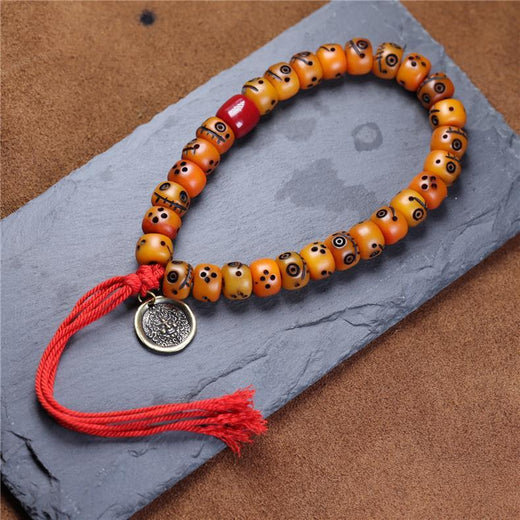
- For Spiritual Growth & Commitment: A Bodhi seed bracelet is a meaningful choice. For a serious practitioner or someone marking a significant life milestone, a Dzi bead bracelet is an investment piece. These ancient etched agate beads are highly prized in Tibet and are considered powerful spiritual talismans. An authentic Dzi—some dating back 2,000 years—is an investment piece that you'll pass down.
Choosing a bracelet is an intuitive process. Read about the materials, look at the designs, and see what you feel drawn to. Your intuition is often pointing you toward what you need most. For a full exploration of symbols, our guide on protection symbols and their ancient meanings can be very helpful.
How To Use It Day To Day: A Practitioner's Guide
You've chosen your bracelet. It arrives, and you hold it in your hand. Now what? The way you begin your relationship with your bracelet sets the tone for its role in your life. It's not about rigid rules, but about respectful and intentional use.
1. Setting Your Intention: A Simple First Ritual
Before you even put it on, take a moment. Find a quiet space. Hold the bracelet in both hands and close your eyes. Take three deep breaths. Think about why you were drawn to this piece.
What are you hoping to cultivate in your life? Is it more patience? Less anxiety? a closer connection to your spiritual side?
Silently (or out loud), state your intention for the bracelet. For example: "May this bracelet be a reminder to be kind to myself." Or, "May this be a tool to help me stay grounded when I feel overwhelmed." You are giving the bracelet its job.
This small, private ceremony marks the transition of the object from something you bought to something that is part of your personal path.
2. The Big Question: Which Wrist to Wear It On?
This is the most common question we get, and there's a lot of conflicting information online. Here is the practitioner's perspective, rooted in Tibetan Buddhist tradition and practical experience.
- The Left Wrist: The Receiving Hand. In Tibetan and broader Eastern traditions, the left side of the body is considered the "receiving" side. It's closer to your heart and is associated with receiving energy, blessings, and qualities you wish to absorb. If your primary intention is to cultivate inner states like calm, compassion, self-love, or peace, wearing your bracelet on the left wrist is the traditional choice. It's about drawing that energy inward for your own healing and growth.
- The Right Wrist: The Giving Hand. The right side is the "projecting" or "giving" side. It's associated with action, control, and how you express your energy in the world. If your intention is focused on protection from external negativity, or if you want to project confidence, strength, and share your compassion with others, the right wrist is more appropriate. Many of our traditional Tibetan protection bracelets are often worn on the right wrist for this reason.
The Real Answer: While this is the traditional guidance, let us be clear: the best wrist to wear it on is the one that feels right to *you*. If you're left-handed and a bracelet on that wrist gets in the way, wear it on the right.
The intention is more important than the rule. Don't let dogma get in the way of your practice. Try it on one wrist for a week, then the other, and see how it feels.
Your body knows.
3. Care and Respect
Because this is a tool for your practice, treat it with a little more care than regular jewelry.
- Water: It's best to take it off before showering or swimming. Water can weaken the cord over time, and chemicals can damage natural materials like wood and seeds used in traditional Tibetan bracelets.
- Sleep: This is a personal choice. Some find it comforting to wear at night; others prefer to give their skin a rest. If the bracelet is for protection, many practitioners do wear it while sleeping.
- Storage: When you're not wearing it, don't just toss it on a dresser. Place it on a small dish, a piece of cloth, or wrap it and put it in a pouch. Placing it on your meditation altar, if you have one, is ideal. This small act of respect reinforces its special purpose in your mind.
Common Questions About Buddhist Bracelets
As you start this journey, questions will naturally arise. Here are answers to some of the most specific and heartfelt questions we receive from practitioners and seekers exploring this path.
What's the best Buddhist bracelet for a beginner dealing with work anxiety under $80?
This is a great question because it's so real. For this specific need, we would guide you towards a Sandalwood wrist-mala. Sandalwood is renowned for its calming and grounding properties; its subtle, natural scent is known to soothe the nervous system.
It's not overpowering, but it's there when you need it. The warm, organic feel of the wood is a comforting tactile sensation during a stressful meeting or when staring at a daunting inbox. It's a classic, effective, and understated choice.
A simple, well-made sandalwood bracelet from an authentic source will typically fall comfortably within your budget, making it an accessible first step. It's not about flashy stones, but about a proven, gentle ally for your mind.
It meets your practical budget while delivering a genuinely effective spiritual and psychological benefit for workplace stress.
Can I wear my Tibetan protection bracelet in the shower or while I sleep?
Let's break this down into the practical and the intentional. Practically, we advise against wearing most bracelets in the shower. Water, especially hot water with soaps and shampoos, can degrade the cord over time, whether it's cotton, nylon, or elastic.
It can also cause wood beads to swell and crack, or tarnish any metal components. For sleep, it's a personal choice. If the bracelet is for protection, like a blessed red string, those committed to continuous spiritual practice often feel more secure wearing it 24/7.
However, if it's a heavier stone bracelet, it might be uncomfortable or get caught on bedding. Our advice: listen to your intuition. If it feels comforting and doesn't disturb your sleep, it's fine. If you feel it's better to place it respectfully on your bedside table to 'hold space' for you while you rest, that is also a powerful practice.
The key is to make a conscious choice.
How do I know if a Buddha bracelet is authentically blessed and not only a marketing gimmick?
This is a crucial question in an industry where spiritual terms are often used loosely. Authenticity comes down to transparency and trust. First, look for specificity. A vague claim like "blessed bracelet" is a red flag.
An authentic source will tell you *who* did the blessing, *where*, and ideally *how*. For example, we state when pieces are blessed by monks from Sera Monastery or our partner communities in Boudhanath. Second, look for a brand voice that is respectful and educational, not hyped.
We believe the blessing adds a beautiful layer of intention, but we are clear that the main power comes from *your* practice. Third, consider the source's overall mission. Are they focused on preserving culture and supporting artisans, or just on selling products?
True authenticity is holistic; it's in the sourcing, the craftsmanship, the storytelling, and the respect for the tradition. It's a relationship, not a transaction.
What is the difference between a sandalwood bracelet and one made of Bodhi seeds for a daily mindfulness practice?
Both are excellent choices, but they serve slightly different purposes. Think of Sandalwood as a 'calming agent.' Its primary function is to soothe, ground, and quiet a busy, anxious mind. Its gentle aroma is a form of aromatherapy that helps reduce stress in the moment.
It's perfect for someone whose main challenge is anxiety or overthinking. Bodhi seed, on the other hand, is an 'awakening agent.' Because the Buddha attained enlightenment under the Bodhi tree, the seeds represent the potential for enlightenment within all of us.
Wearing a Bodhi seed bracelet is a statement of aspiration and a commitment to your spiritual path. It's less about calming a single moment of anxiety and more about dedicating your life's journey to growth and wisdom.
As you wear it, the seeds absorb your oils and darken, representing the accumulation of your practice over time. So, Sandalwood for immediate calm, Bodhi for long-term aspiration.
I'm not a Buddhist, is it disrespectful for me to wear a Buddha bracelet for its calming benefits?
Thank you for asking this. It shows a wonderful sensitivity and respect. The overwhelming perspective from our teachers and friends in the Tibetan community is this: if you approach it with respect, sincerity, and a genuine desire for peace and well-being, it is not disrespectful.
Buddhism is not an exclusive club. The core teachings—on compassion, mindfulness, and wisdom—are universal human values. Using a tool like a bracelet to help you cultivate more peace in your life is a good thing, for you and for everyone you interact with.
The disrespect comes from trivializing the symbols—wearing them as a purely ironic fashion statement or completely ignoring their meaning. But you are clearly not doing that. You are seeking its benefits with an open heart.
That is the opposite of disrespect; it is the very essence of the path. You are welcome here.
My red string bracelet from Nepal broke. What does that mean and what should I do with it?
In the Himalayan tradition, when a blessed protection bracelet, like a red string (sungdi), breaks and falls off, it is not a bad omen. On the contrary, it is believed that the bracelet has done its job.
It has absorbed a significant amount of negativity or protected you from a potential harm, and in doing so, it has fulfilled its purpose and broken. The correct response is not panic, but gratitude.
Thank the bracelet for its service. Do not simply throw it in the trash. This would be disrespectful to the intention and blessing it carried. The proper way to dispose of it is to return it to the earth.
You can burn it (safely, of course) and scatter the ashes in your garden, or you can bury it somewhere in nature, like at the base of a tree. This returns its energy to the cycle of nature in a respectful way.
Then, you can get a new one, ready to begin its service to you.
Which wrist should a man wear a Dzi bead bracelet on for attracting positivity in his career?
For this specific intention—attracting positivity and success in a career—we would recommend the right wrist. The right hand, as the 'giving' or 'projecting' hand, is associated with your actions and influence in the world.
Wearing a powerful talisman like a Dzi bead on this wrist is believed to amplify the energy you put forth in your professional life, helping you overcome obstacles, attract opportunities, and project an aura of competence and confidence.
It's about actively shaping your path forward. While the left 'receiving' wrist might be for drawing in general luck, the right wrist is for manifesting that luck through decisive action and interaction with the world, which is key in a career context.
Ultimately, the Dzi bead works in partnership with your own effort and intention, and wearing it on the right wrist aligns it with your active pursuit of professional goals.
Your Journey Is Just Beginning
Choosing a Buddhist bracelet is not the end of a search; it's the beautiful beginning of a new relationship—with a tradition, with a community of artisans, and most importantly, with yourself. It's a small, tangible promise you make.
A promise to be more present. A promise to be kinder to your own mind. A promise to seek a quieter, more grounded way of being, even when the world is loud.
As you move through 2026 and beyond, this simple strand of beads can become a trusted friend. It will be there to anchor you during moments of stress, to accompany you in quiet moments of reflection, and to absorb the energy of your unique journey, becoming smoother and more a part of you with each passing day.
This is the piece you'll still wear in 20 years, not because of the trend, but because of the stories it holds and the peace it has helped you cultivate.
The path to a more mindful life is built one small, intentional step at a time. This could be your next step. We invite you to explore our Tibetan bracelet selection and find the piece that speaks to your journey.
Keep reading