
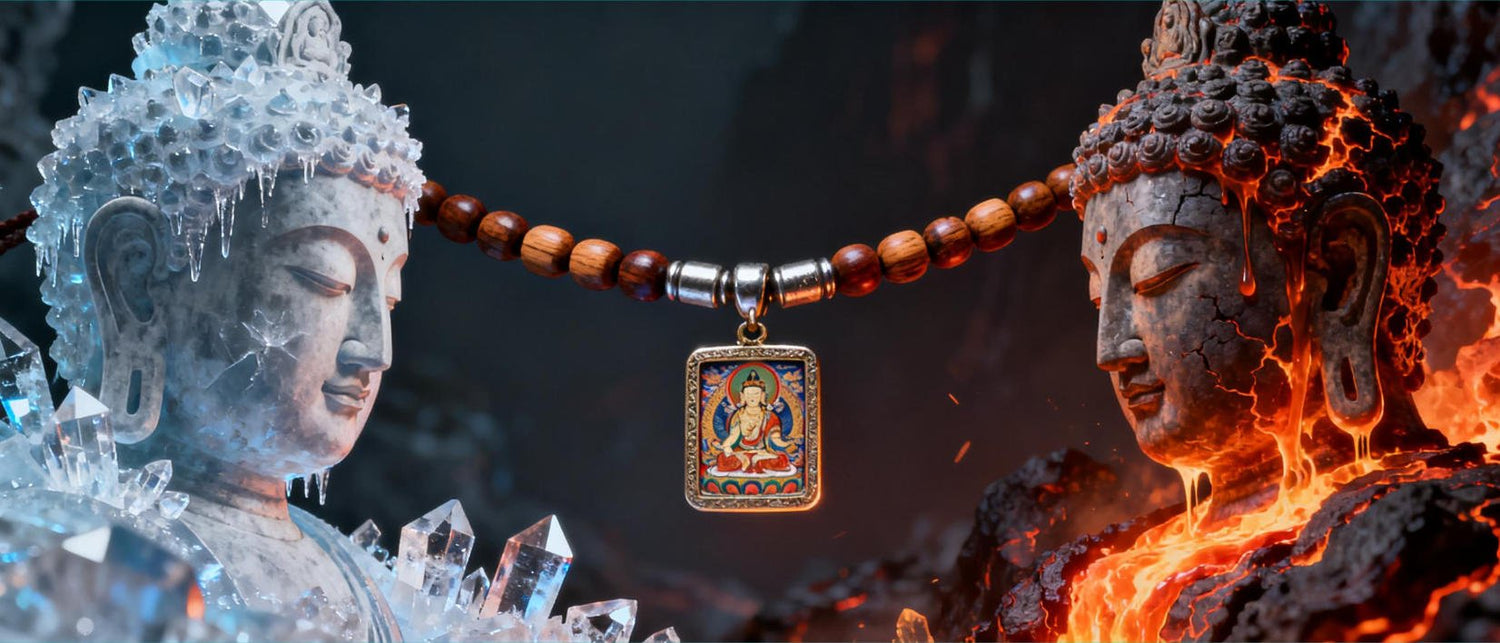
Spiritual Protection: The Unseen Shield for Your Journey
Walk through any ancient market in Lhasa, the heart of Tibet, and your senses are immediately flooded with the scent of juniper incense and the low hum of mantras. Amidst the vibrant textiles and gleaming butter lamps, you’ll see them—strings of deep-hued beads, small ornate metal cases called gaus, and intricately carved amulets.
You will notice them worn by nomads, merchants, and monks, not as simple decoration, but as a form of spiritual armor. For Tibetans, the idea that certain objects can deflect negative energy, obstacles, and misfortune isn’t superstition; it’s a profound science of spiritual protection, a sacred technology passed down through generations of masters.
This living tradition is the heart of Buddhabelief. We are honored to continue this lineage, ensuring its authenticity and power reach you in the modern world. Every piece in our collection labeled as a protection amulet is not merely an object of beauty.
It has undergone specific, time-honored rituals conducted by Tibetan monks. Through the focused power of mantra chanting, deep meditative visualization, and the invocation of enlightened beings, these objects are imbued with a potent, protective resonance.
They are transformed from simple artifacts into what practitioners call a sung-jor—a “guardian object,” a sacred companion for your life’s journey.
When our team visited the bustling market in Dharamsala last autumn
During our last sourcing trip to the bustling alleys of Dhar

The Ancient Roots of Energetic Armor: A Journey Through Tibetan History
The tradition of protective amulets in Tibet is as ancient and rugged as the Himalayan landscape itself. Long before the arrival of Buddhism in the 7th century, the region was home to the Bön tradition, an earth-based shamanic practice.
Bön practitioners were deeply attuned to the natural world, understanding that the mountains, lakes, and skies were inhabited by powerful local spirits and deities. They developed a sophisticated system of talismans and rituals to appease these spirits, seek their protection, and guard against malevolent forces.
These early amulets were often crafted from natural materials believed to hold potent energy, such as uniquely shaped stones, animal teeth, or rare metals.
When Buddhism traveled from India over the treacherous mountain passes, it didn't simply replace Bön; it engaged in a profound dialogue with it. The great master Padmasambhava, also known as Guru Rinpoche, was instrumental in this synthesis.
A powerful tantric yogi, he is said to have journeyed across Tibet, subduing the fierce local deities who resisted the new teachings. Instead of destroying them, he bound them by oath, transforming them into protectors of the Dharma and its followers.
This pivotal act integrated the pre-existing spiritual landscape into a Buddhist framework. The fierce deity Mahakala, for instance, became a wrathful yet compassionate protector, and the practice of creating objects to invoke his protective power became a central part of Tibetan Vajrayana Buddhism.
From this union, a unique and powerful amuletic tradition was born. Ancient meteoritic iron was forged into thogchags, or "sky-metal" amulets, believed to carry the power of the cosmos. The mysterious Dzi beads, with their distinctive "eyes," emerged as treasures of immense spiritual value, thought to offer divine protection.
The nomadic culture of Tibet also shaped the tradition. Because people were constantly on the move, they needed portable forms of sacred power. This led to the development of the gau, a personal shrine in a box, which could carry a practitioner’s most precious spiritual items, keeping them safe and close to the heart during long journeys across the plateau.
How a Physical Object Becomes a Sacred Shield: The Science of Consecration
You might hold a string of beads or a silver pendant in your hand and wonder: how can this tangible object truly offer intangible protection? The secret lies in the sacred and meticulous process of consecration, known in Tibetan as rabné.
This is where an ordinary object is infused with blessing energy, or chinlap, transforming it into a vessel of enlightened power.
Think of it like this: the amulet is a high-quality, perfectly crafted battery, inert on its own. The monk’s ritual is what charges it with a specific, potent energy. This charging process is far more than a simple prayer.
It is an intensive practice that can take days or even weeks. A qualified lama or a group of monks enters a state of deep meditation (samadhi), connecting with the essence of a specific enlightened being, such as the compassionate Tara or the powerful Mahakala.
They then engage in thousands, sometimes hundreds of thousands, of repetitions of the deity’s specific mantra. As they chant, they visualize the deity in radiant light, and with each syllable, they see that light streaming from the deity and absorbing into the object before them, filling it completely.
Sacred substances are also used to seal this blessing. The objects may be sprinkled with saffron-infused water, purified with the smoke of sacred herbs like juniper, and sometimes sealed with tiny, blessed pills known as rilbu.
In some cases, relics from past masters or blessed earth from a holy site are placed inside a gau. This entire process infuses the material object with the energetic signature of the enlightened mind—its qualities of fearlessness, clarity, and compassion.
The physical item becomes a stable anchor—a ten—for this intangible blessing. When you wear or carry a consecrated amulet from our authentic collection, you are not only carrying a piece of jewelry; you are carrying that charged field of protective energy with you.
It’s not about creating an impenetrable force field, but about consistently maintaining a higher, more stable resonance around you—one that makes it much harder for lower, draining, or chaotic energies to take hold.
The Guardian in Your Pocket: Types of Tibetan Protection Amulets
Tibetan protective talismans come in many forms, each with a unique history and purpose, designed to be kept close as a constant source of refuge and strength.
Gau Boxes: The gau is perhaps the most iconic Tibetan amulet. It is a small, portable shrine, typically made of metal like silver, copper, or brass, often adorned with auspicious symbols. The true power of the gau, however, lies within.
Inside, a practitioner might place a small, hand-painted image of their personal deity, a tiny clay sculpture (a tsa-tsa), or, most commonly, a tightly rolled scroll of paper filled with printed mantras. Sacred herbs, a pinch of soil from a holy place, or a tiny fragment of a revered lama’s robe might also be included.
For the Tibetan nomad or pilgrim, the gau was their monastery on the move, a constant connection to the Three Jewels—Buddha, Dharma, and Sangha—offering protection on perilous journeys.
Mala Beads and Bracelets: A string of 108 beads, known as a mala, is used for counting mantra recitations. But a consecrated mala is also a powerful tool for protection. Each time you use it for practice, you further deepen its energetic charge.
The materials themselves carry specific energies—bodhi seeds connect to the Buddha’s enlightenment, while rudraksha seeds are associated with the fierce, protective energy of Shiva (and in Tibetan Buddhism, Mahakala). Wearing a consecrated mala or bracelet around your wrist serves as a constant, tactile reminder of your practice and a subtle shield of positive energy that envelops you throughout your day.
Dzi Beads: Shrouded in myth, Dzi beads are ancient etched agate stones considered among the most powerful talismans in Tibet. Their origins are the subject of legends; some say they are gifts from the gods, petrified insects, or treasures revealed by great masters.
The "eyes" on the beads are believed to watch over the wearer, guarding against misfortune, warding off the evil eye, and attracting good fortune and health. Authentic ancient Dzi are incredibly rare and valuable, but the power of their symbolism is now incorporated into many modern protective designs.
Inscribed Pendants: Many amulets take the form of simple pendants, their power derived from the sacred syllables or symbols carved into them. A pendant featuring the mantra "Om Mani Padme Hum" continuously radiates the compassionate energy of Chenrezig (Avalokiteshvara).
Another might bear the Kalachakra symbol, a powerful emblem representing the universe's complex cycles and offering protection from negative astrological influences and worldly chaos.

Decoding the Sacred Geometry: Symbols That Speak to the Soul
Look closely at Tibetan protection amulets, and you’ll notice a recurring vocabulary of powerful symbols. These are not arbitrary designs for decoration. Each line, curve, and image is a form of sacred geometry, a visual mantra that reinforces the amulet’s purpose every time you see or touch it, communicating profound truths directly to your subconscious mind.
The Eternal Knot (Srivatsa): This beautiful, endless design of interwoven lines represents the fundamental interconnectedness of all existence. It symbolizes the infinite nature of the Buddha's wisdom and compassion. On a protective amulet, it signifies an unbreakable shield, wrapping the wearer in a continuous field of benevolent energy.
It reminds you that you are never separate from the web of life and that protection comes from aligning with this harmonious, universal flow.
The Vajra (Dorje): The Vajra, meaning "thunderbolt" or "diamond" in Sanskrit, is one of the most important symbols in Vajrayana Buddhism. It symbolizes the indestructible, diamond-like nature of the enlightened mind and the unshakable reality of emptiness.
As a weapon, it cuts through ignorance, delusion, and negativity with the swift, brilliant force of a lightning strike. An amulet bearing the Vajra symbol empowers you with spiritual strength, clarity, and the resolve to overcome inner and outer obstacles.
The Protective Eyes of the Buddha: Often seen looking out from all four sides of stupas in Nepal and Tibet, these two eyes—one representing wisdom, the other compassion—are a powerful symbol of constant vigilance.
The curly symbol between them, resembling a question mark, is the Sanskrit numeral one, symbolizing the unity of all things. Wearing this symbol is an invocation of the Buddha’s all-seeing presence, guarding you from harm in all directions and reminding you to look upon the world with both wisdom and an open heart.
Mantras Inscribed: Mantras are sacred syllables that are the very sound-form of an enlightened being's energy. Inscribing a mantra like "Om Ah Hum" (representing the purification of body, speech, and mind) or "Om Mani Padme Hum" on an amulet visually and energetically embeds its power into the object.
It becomes a source of continuous, silent prayer, ceaselessly radiating its purifying and protective resonance into your energy field and your environment.
Weaving Protection into Your Modern Life: Practical Guidance
In a world of information overload, constant demands, and unseen energetic influences, the need for a spiritual anchor is more relevant than ever. A consecrated amulet is a practical tool for working through the complexities of modern life with greater grace and resilience.
Imagine you work in a high-stress office environment. The constant pressure and difficult personalities can leave you feeling drained and agitated by the end of the day. Wearing a protective bracelet under your sleeve can act as your personal energetic boundary.
It serves as a subtle reminder to remain centered, helping you to not absorb the negativity around you. Many describe the sensation as "feeling lighter" or "less affected" by stressful situations.
If you are a frequent traveler, facing the uncertainty and chaos of airports and unfamiliar places, a gau or a pendant with a protective deity can be a source of immense comfort and perceived safety.
It becomes a focal point for your intention to have a safe and smooth journey, a connection to a source of stability amidst movement.
For those who are highly sensitive or empathic, constantly picking up on the emotions of others, a consecrated object can be a game-changer. It helps fortify your own energy field, allowing you to be compassionate without becoming a sponge for others' pain or anxiety.
When choosing your amulet, the most important guide is your own intuition. Browse through a collection and notice which symbol, color, or form you are drawn to. This attraction is often your own deep wisdom guiding you to the energy you need most at this time.
There is no "wrong" choice; the connection you feel is what begins the relationship between you and your guardian object.
To care for your amulet, treat it with respect as a sacred object. Avoid placing it on the floor or in unclean places like a bathroom. When you are not wearing it, keep it in a high, clean place, such as on an altar, a dedicated shelf, or in a special pouch.
To energetically cleanse and "recharge" it, you can gently pass it through the smoke of purifying incense like sandalwood or juniper. If your amulet breaks, it is traditionally seen as a sign that it has absorbed a significant negative impact, protecting you from its full force.
The proper way to retire it is to thank it for its service and return it to the elements, perhaps by burying it in a clean spot in your garden or a houseplant.
Beyond Superstition: The Psychology and Energetics of a Guardian Object
For the modern, rational mind, it's natural to question how this all works. The power of a consecrated amulet can be understood on two interconnected levels: the psychological and the energetic.
Psychologically, your amulet is a powerful physical anchor for your intention. It is a tangible, ever-present reminder of your connection to your own inner strength, your spiritual path, and the qualities you wish to cultivate, like courage and compassion.
In a moment of fear or anxiety, the simple act of touching your amulet can be a "pattern interrupt." It breaks the cycle of negative thought and brings you back to the present moment, reconnecting you with the feeling of being protected and supported.
It is a focal point for mindfulness, grounding you in a state of calm awareness.
On an energetic level, the principle of resonance comes into play. The consecration process imbues the amulet with a stable, high-frequency resonance—the specific resonance of a mantra or a deity's enlightened mind. Your own energy field, which can fluctuate wildly depending on your mood, health, and environment, is influenced by this steady resonance.
Like a tuning fork causing a nearby string to vibrate at the same frequency, the amulet helps your energy field to entrain with its higher, more coherent resonance. This doesn't build an invisible wall, but it does make your personal energy field stronger and more resilient.
It becomes less susceptible to being pulled down by chaotic or lower-frequency energies, such as anger, jealousy, or fear. You remain centered and unshaken, not because the negativity is blocked, but because your own resonance is too strong and stable to be easily disturbed.
Ultimately, a Tibetan protection amulet is a co-creation. It is a partnership between the lineage of blessing infused by the monks and your own faith, intention, and respect. It is a beautiful tool that empowers you to walk your path with greater confidence, peace, and the profound feeling of being watched over on your journey.
Frequently Asked Questions
- Do I need to be a Buddhist to wear a protection amulet?
- No, not at all. The protective and positive energies imbued in these amulets are universal. Qualities like compassion, strength, and clarity benefit everyone, regardless of their spiritual path. However, approaching the amulet with respect and an appreciation for its origins in Tibetan Buddhism will undoubtedly deepen your connection to it and enhance its effect in your life.
- How do I activate my new amulet from Buddhabelief?
- The wonderful thing is that every protection amulet from Buddhabelief has already been consecrated and activated by Tibetan monks. It arrives ready to work with you. To make it your own, you can personalize the connection by holding it in your hands, closing your eyes, and setting a clear intention for how you wish for it to support you. You can also gently blow on it and recite a simple, universal mantra like "Om Ah Hum" three times to align your body, speech, and mind with the object.
- Can I wear more than one amulet at a time?
- Yes, practitioners, especially in Tibet, wear multiple amulets. You might wear a mala bracelet for compassion and a pendant for overcoming obstacles. The most important thing is to listen to your own intuition. If wearing several pieces feels harmonious and empowering, that is perfectly fine. If it begins to feel energetically "busy" or overwhelming, it may be better to stick with the one or two that resonate most strongly with you at the current time.
- What happens if my amulet breaks?
- In the Tibetan tradition, a broken amulet is not seen as a bad omen. On the contrary, it is often believed that the object has just protected you from a significant negative event or energy by absorbing the impact itself, sacrificing itself in the process. The recommended practice is to respectfully thank the amulet for its service, wrap it in a clean cloth, and return it to the earth by burying it in a garden, a park, or even a potted plant.
- How do I clean my amulet physically?
- For physical cleaning, it is best to be gentle. Use a soft, dry cloth to wipe away any dust or oils. Avoid using harsh chemical cleaners, polishes, or submerging it in water for long periods, as these can damage delicate materials and are believed to disturb the consecrated energy (chinlap) within. For energetic cleansing, the preferred method is to waft the smoke from pure incense, such as sandalwood or juniper, over the object.


