God's Rites
Discovering the Enlightened Amitābha Buddha: Tibetan De
The day ends. You close the laptop, the glare of the screen fading but the mental noise lingering. You’ve pushed hard, strived, and achieved, yet a quiet, persistent question echoes in the silence of your home: Is this all there is? You’ve followed the scripts for success—the ambition, the relentless self-improvement, the constant motion. But this striving feels like trying to fill a vast space with handfuls of sand. The more you pour in, the more you realize the emptiness. There’s a deep yearning not for more, but for something different. A sense of peace that isn’t dependent on the next goal, a source of compassion that doesn’t run dry, a light that doesn't flicker with the changing winds of fortune. You sense there must be a path that isn't about grasping, but about receiving. A refuge. This feeling, this deep human longing for unconditional acceptance and boundless peace, is the very space into which Amitābha Buddha extends his light.

What It Really Is: The Sutras and Sanctuaries of Infinite Light
To truly understand Amitābha, you must journey back beyond modern interpretations to the foundational scriptures where his story unfolds. He is not a myth in the conventional sense, but a figure born from the Mahayana Buddhist sutras, primarily the Sukhāvatīvyūha Sūtra (The Sutra of the Land of Bliss), which exists in both a longer and shorter version. These texts, first translated into Chinese as early as 148 CE by the Kushan monk Lokakṣema, narrate a profound origin story. Long before our current age, there was a monk named Dharmākara. Witnessing the immense suffering of beings caught in the cycle of rebirth, he was moved by an unbearable compassion. Before the Buddha of his time, Lokeśvararāja, he made a series of 48 vows, each a promise to create a perfect realm for spiritual practice if he attained enlightenment.
These were not simple wishes. They were cosmic commitments. His 18th vow is the heart of his practice: if any being in any world sincerely wishes to be born in his land, puts their faith in him, and recites his name even ten times, they will be born there, unless they have committed one of the five heinous crimes. After eons of diligent practice and accumulating boundless merit, the monk Dharmākara fulfilled his vows and became the Buddha Amitābha, "The Buddha of Infinite Light." His pure land, Sukhāvatī, or the "Land of Ultimate Bliss," came into existence in the western quarter of the universe. It is described as a realm free from suffering, where the ground is soft gold, jewels adorn the trees, and the Dharma is taught not by a single teacher, but by the sounds of the wind, the birds, and the flowing water. It is the ultimate spiritual training ground.
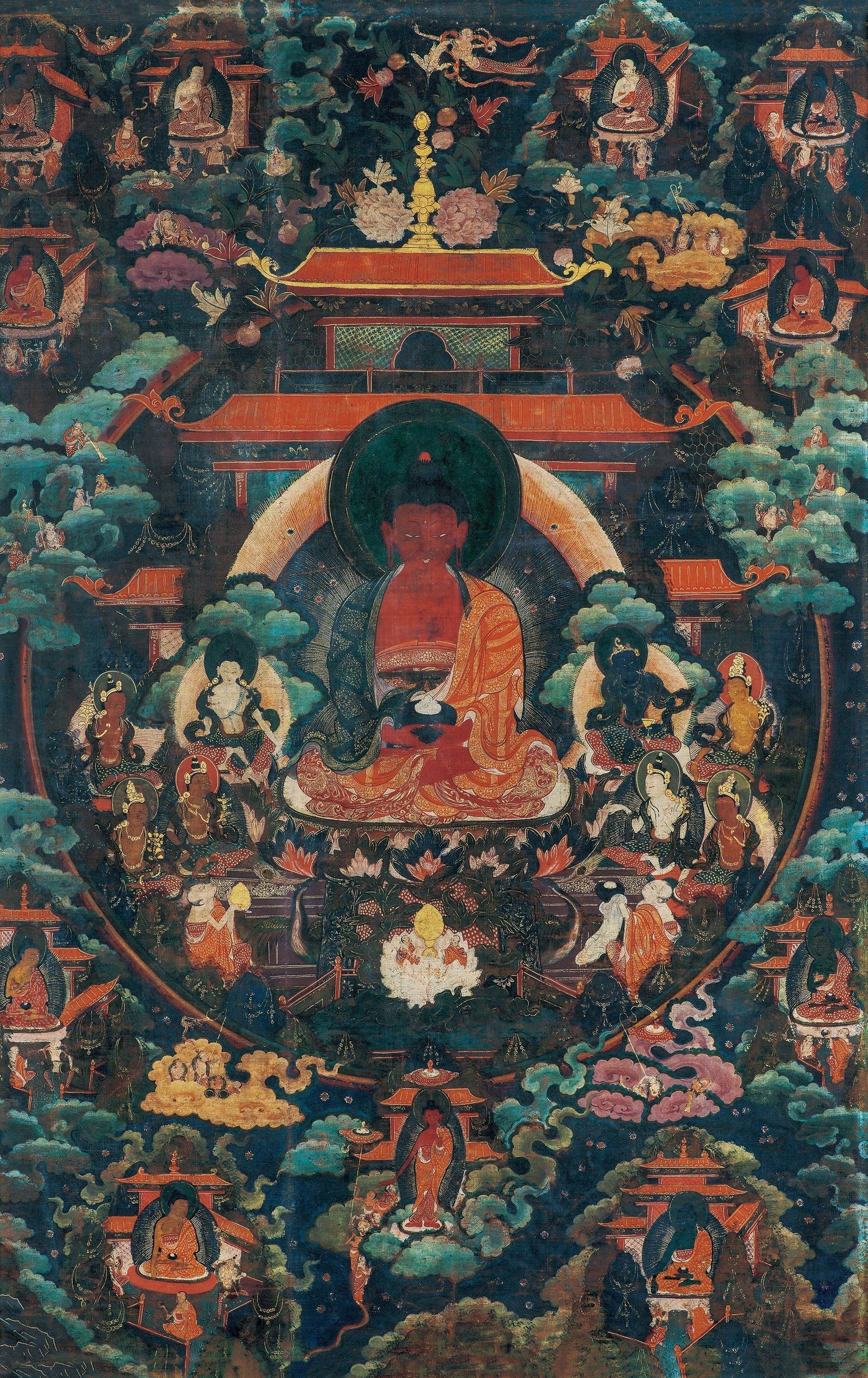
While the practice of devotion to Amitābha is most famously associated with Pure Land schools in East Asia, his presence in Tibetan Buddhism is ancient and profound. He is one of the Five Dhyani Buddhas, or Wisdom Buddhas, who represent five fundamental aspects of enlightened consciousness. Within this celestial mandala, Amitābha resides in the west and presides over the Padma (Lotus) family. This family represents the transformation of desire and attachment into discerning wisdom. Padmasambhava (Guru Rinpoche), the great master who firmly established Buddhism in Tibet in the 8th century, is considered an emanation of Amitābha. This connection is foundational to the Nyingma school. You can find powerful representations of Amitābha in the great monasteries of Tibet, such as the Jokhang Temple in Lhasa, where his image serves as a focal point for devotion, and in the practices of *phowa* (transference of consciousness at the time of death), where the practitioner visualizes merging with Amitābha's heart. The intricate details of his form, from his posture to the objects he holds, are faithfully preserved in **our collection of Guardian Buddha pendants**, each piece a small gateway to this vast tradition.
The Deeper Meaning: Symbolism of the Western Paradise
Every detail of Amitābha's depiction is a profound teaching, a map of the enlightened mind. To engage with his image is to engage in a form of visual Dharma, where color, gesture, and implement communicate truths beyond words. Your understanding deepens when you learn to read this sacred language.
His body is a radiant, glowing red, the color of the setting sun. This is deeply symbolic. The west, the direction he presides over, is where the sun disappears, representing the transition from life to death, or from the known to the unknown. Yet, this is not a color of ending, but of transformation. It is the color of love, compassion (karuṇā), and life force. It represents the warmth of a fire that does not consume but illuminates and purifies. Amitābha's red light transforms the poison of passionate craving and attachment into the wisdom of discernment. It doesn’t ask you to extinguish your longings but to redirect their powerful energy toward enlightenment. When you feel overwhelmed by desire, his image reminds you that this very energy, when purified, becomes a source of profound wisdom and compassion.
He sits in the full lotus posture (padmāsana), the ultimate symbol of stability and groundedness. This posture indicates that despite his cosmic nature, he is unshakably present and rooted in the reality of enlightenment. His hands rest in his lap in the *dhyāna mudrā*, the gesture of meditation. The right hand rests on the left, with the thumbs lightly touching to form a triangle. This mudra signifies perfect balance and meditative concentration, a state of mind that is both completely relaxed and intensely aware. It is an invitation for you to find that same inner stillness amidst the chaos of your daily life. The circle formed by the thumbs represents the perfection of the Dharma, with no beginning and no end.
Resting in his hands is an alms bowl filled with *amrita*, the nectar of immortality. This is not a literal promise of eternal physical life, but a symbol of the deathless nature of the enlightened mind. The nectar represents the teachings of the Dharma, which nourish the spirit and liberate one from the cycle of birth and death (samsara). By partaking in this nectar—by engaging with the teachings—you heal the wounds of ignorance and find a timeless peace that transcends your mortal existence. The bowl itself signifies that a Buddha is a spiritual monarch, yet remains a humble monk, a renunciate who holds the greatest treasure of all: the elixir of truth. This powerful symbolism is a core element you will find in any authentic representation, from grand monastery statues to the meticulously crafted **mindfully crafted Amitābha amulets** designed to be kept close to your heart.
Real Benefits for Modern Life: A Refuge from Inner Turmoil
Connecting with Amitābha is not an escape from your life; it is a profound way to engage with it from a place of greater strength, clarity, and compassion. The benefits are not abstract theological concepts; they are tangible shifts in your daily experience, addressing the specific challenges you face in a complex world.
One of the most immediate benefits is the cultivation of a refuge from anxiety and overwhelm. Your mind is constantly pulled in a thousand directions by deadlines, responsibilities, and an endless stream of digital information. This creates a state of perpetual, low-grade stress. The practice of reciting Amitābha's mantra—Om Ami Dewa Hrih—acts as a spiritual anchor. By focusing your mind on this sacred sound, you interrupt the cycle of anxious thoughts. It’s not about forcing your mind to be quiet, but about giving it a single, luminous point of focus. Each repetition is a conscious choice to align yourself with compassion and peace, creating a small sanctuary of calm that you can access anywhere, whether you're stuck in traffic or lying awake at night. This practice helps you build a resilient core of inner peace that is not dependent on external circumstances.
Amitābha's practice also offers a powerful method for working with strong emotions, particularly attachment and desire. Modern culture often tells you that happiness lies in acquiring the next thing: the better job, the new relationship, the perfect home. This creates a cycle of craving and disappointment. The Padma family, which Amitābha heads, is specifically concerned with transforming this grasping energy. When you meditate on his radiant red form, you are not suppressing your desires. Instead, you are bathing them in the light of discerning wisdom. You begin to see the transient and ultimately unsatisfying nature of worldly attachments. This doesn't make you cold or unfeeling; it makes you free. Your capacity for love and connection deepens because it is no longer based on neediness, but on genuine, unconditional compassion for yourself and others.
Perhaps the most profound benefit is in transforming your relationship with mortality. The fear of death, both for yourself and your loved ones, is a fundamental source of human suffering. In the Tibetan tradition, the practice of *phowa* is a direct application of Amitābha's grace. By familiarizing yourself with his presence, his mantra, and the visualization of his Pure Land, you are preparing your consciousness for its most important journey. You cultivate a deep trust that at the moment of transition, there is a boundless source of light and compassion waiting to receive you. This practice fundamentally reframes death from a terrifying end into a conscious, supported transition. This doesn't eliminate grief, but it removes the terror, allowing you to live your life with greater courage, purpose, and appreciation for the preciousness of each moment.

How to Choose Authentic: A Guide to Sacred Craftsmanship
When you decide to bring a representation of Amitābha into your life, such as a pendant or statue, you are choosing more than a piece of jewelry or decor. You are selecting a spiritual tool, a focal point for your practice, and a constant reminder of your highest aspirations. The authenticity and intention with which the piece is made matter deeply. An authentic piece carries the resonance of the tradition it represents.
First, consider the iconography. A true representation of Amitābha will display his key attributes with reverence and accuracy. Look for the Dhyana mudra, the meditation gesture with both hands resting in the lap. Ensure he is holding the alms bowl filled with the nectar of immortality. His posture should be the stable, full-lotus position. The expression on his face should be one of deep, serene compassion. A mass-produced trinket might approximate these features, but a mindfully crafted piece will capture the spirit behind them. The subtle details, the precision of the lines, and the overall feeling of peace it evokes are hallmarks of quality. When you look at **our selection of deity pendants**, you can see this commitment to iconographic accuracy in every design.
Next, evaluate the materials. In Tibetan tradition, the materials used for sacred objects are chosen for their purity, durability, and symbolic meaning. Precious metals like sterling silver or gold are often used because they are considered pure and lasting, reflecting the eternal nature of the Dharma. Gemstones are incorporated not just for beauty, but for their energetic properties. For Amitābha, stones with a red hue, such as carnelian, ruby, or garnet, are particularly auspicious as they resonate with his color of compassion and life force. An authentic piece will use high-quality, genuine materials, not cheap alloys or plastic imitations. The weight and feel of the object in your hand should convey a sense of substance and permanence. You can see a wide variety of these sacred materials used with intention across **our entire shop**.
Finally, consider the source and the intention behind the creation. Was the piece made by artisans who understand and respect the Buddhist tradition? Or was it produced in a factory with no connection to the spiritual meaning of the object? True sacred art is an act of devotion. Artisans who create these pieces often engage in their own practice, infusing their work with positive intention and mantra. This energetic imprint is palpable. When you choose a piece from a source dedicated to authentic Buddhist traditions, you are not just buying an object; you are supporting the preservation of this sacred lineage and connecting with a chain of blessings that stretches back for centuries.
How to Use It: A Simple Practice for Daily Connection
Your Amitābha pendant is a potent tool, a key that can unlock a space of profound peace within you. Using it effectively is not about complex ritual, but about simple, heartfelt intention. Here is a step-by-step guide to help you begin a personal practice and forge a meaningful connection with the Buddha of Infinite Light.
1. Create a Moment of Stillness: You don’t need an elaborate altar. Find a quiet place where you won’t be disturbed for a few minutes. It could be a corner of your room in the early morning, a park bench during your lunch break, or even in your car before you start the engine. Simply turn off your phone, close your eyes, and take three deep, slow breaths. Let each exhale release the tension of the day.
2. Hold and Connect: Take your Amitābha pendant in your hands. Feel its weight, its texture, its temperature. This physical sensation helps to ground you in the present moment. Holding your **sacred Buddhist amulet** serves as a bridge between the physical world and the spiritual quality you wish to invoke. Look at the image of Amitābha, noticing the details: his serene face, his meditative posture, his radiant form.
3. Set Your Intention: Silently or aloud, state why you are doing this practice. Your intention can be simple. Perhaps you seek peace from an anxious mind: "May I find refuge in your compassion." Maybe you are struggling with a difficult emotion: "May my attachment be transformed into wisdom." Or perhaps you are dedicating your practice to someone else: "May my loved one be free from suffering." A clear intention focuses your energy and opens your heart.
4. Visualize and Recite: Close your eyes and visualize Amitābha Buddha in front of you, or seated above the crown of your head. See him made of brilliant, ruby-red light. This light is warm, loving, and unconditionally accepting. Imagine this light pouring down, filling your entire body, dissolving all fear, pain, and negativity. As you hold this visualization, begin to recite his mantra: Om Ami Dewa Hrih. You can chant it aloud or repeat it silently. Let the sound vibrate through you. Don’t worry about perfect pronunciation; focus on the feeling of connection. Repeat it 7, 21, or 108 times if you have a mala, or simply for a few minutes.
5. Dedicate the Merit: Conclude your practice with a dedication. This is a crucial step that extends the positivity you’ve generated beyond yourself. You can say something like, "By the merit of this practice, may all beings be free from suffering and find their way to enlightenment. May all beings be touched by the infinite light of Amitābha." This act of generosity prevents the practice from becoming self-serving and magnifies its positive impact.
Common Questions About Amitābha Buddha
Is Amitābha the same as Amitayus?
This is an excellent and common question that touches on the sophisticated way Tibetan Buddhism understands the nature of a Buddha. While Amitābha and Amitayus are essentially the same enlightened being, they represent different aspects and appear in different forms. Amitābha, whose name means "Infinite Light," is typically depicted as a monk in simple robes, holding an alms bowl. This is his *Nirmanakaya* form—the manifestation body that appears in the world to teach. He represents the core essence of enlightenment. Amitayus, whose name means "Infinite Life," is his *Sambhogakaya* form—the body of celestial bliss. He is depicted as a crowned and jeweled bodhisattva, holding a vase of long-life nectar. Amitayus is specifically invoked in practices for longevity, healing, and overcoming life obstacles. Think of it this way: Amitābha is the ultimate source, the infinite light of wisdom, while Amitayus is the active expression of that light as boundless life force and vitality. They are two sides of the same enlightened coin.
Do I have to be a Buddhist to connect with Amitābha?
Absolutely not. The qualities that Amitābha embodies—infinite compassion, unconditional love, and boundless peace—are universal. They are not the exclusive property of any religion. You do not need to adopt a new belief system or undergo a formal ceremony to benefit from his practice. His 48 vows were made for all sentient beings who are suffering, without exception. If you approach the practice with a sincere heart and an open mind, you can connect with the energy he represents. Think of him as an archetype of profound refuge. When you recite his mantra or meditate on his image, you are calling upon the capacity for limitless compassion that exists within the universe and, ultimately, within yourself. The practice is an invitation, not a conversion.
What is the significance of the Pure Land, Sukhāvatī?
Sukhāvatī, the Pure Land of Bliss, is far more than a heavenly afterlife. In the Tibetan tradition, it is understood as a perfect environment for rapid spiritual advancement. Our world, or *samsara*, is filled with distractions, obstacles, and negative karma that make enlightenment incredibly difficult to achieve. Sukhāvatī, by contrast, is a realm created by Amitābha's boundless merit where these obstacles do not exist. There is no sickness, old age, or conflict. The very environment teaches the Dharma. The goal of being reborn there is not for eternal pleasure, but to attain enlightenment quickly and then return to other realms as a bodhisattva to help all beings. It is a celestial training ground, a spiritual accelerator. Meditating on the Pure Land inspires you to cultivate the qualities—faith, devotion, compassion—that will lead you there and, more importantly, transform your present life into a more compassionate and wise existence.
How does an Amitābha pendant work as a spiritual tool?
An Amitābha pendant functions on several levels to support your spiritual path. Firstly, it is a constant, tangible reminder—a practice of mindfulness in itself. In a world that constantly pulls for your attention, a glance at your pendant or the feeling of it against your skin can instantly bring you back to your intention for peace and compassion. Secondly, it is a focal point for meditation. Holding it or gazing upon it during your practice helps to concentrate the mind and makes the visualization of the deity more vivid and stable. Thirdly, it is a vessel for blessings. A properly crafted and consecrated amulet is believed to be imbued with the energy of the deity. It acts as a point of connection, a sacred link to the enlightened mind of Amitābha. It doesn't possess "magic" powers, but rather, it amplifies your own faith and focus, making your personal connection to Amitābha's grace more immediate and powerful. You can explore the beauty and spiritual resonance of **our curated collection of Guardian Buddha pendants** to find a piece that speaks to you.
Why is Amitābha associated with the western direction?
The association of Amitābha with the west is rich with symbolism. On the most direct level, it relates to the setting sun. Just as the sun sets in the west, Amitābha's practice is often associated with the end of life and the transition of consciousness. The setting sun's red glow mirrors his compassionate, ruby-red light, which guides beings through the darkness of the bardo (the intermediate state between death and rebirth). On a deeper psychological level, the west represents introspection, completion, and the harvesting of wisdom from life's experiences. While the east is the direction of beginnings and sunrise, the west is about looking inward, reflecting on one's journey, and preparing for transformation. Meditating on Amitābha in the west helps you to let go of the day's struggles and attachments, just as the sun lets go of the sky, and to find peace in a state of restful awareness.
What is the difference between Amitābha and Shakyamuni Buddha?
This is a key distinction for understanding the Buddhist pantheon. Shakyamuni Buddha, formerly the prince Siddhartha Gautama, is the historical Buddha of our specific world and time. He lived and taught in India around the 5th century BCE, and it is his life and teachings that form the foundation of Buddhism as we know it. He is the "founder" figure. Amitābha Buddha, on the other hand, is a celestial or transcendent Buddha. He is not a historical figure from our world but a fully enlightened being who presides over his own Buddha-field, or Pure Land. In the Mahayana framework, there are countless Buddhas throughout the cosmos. Amitābha is one of the most important of these, representing the specific enlightened quality of boundless compassion and discerning wisdom. While you might pray to Shakyamuni for inspiration based on his historical example, you connect with Amitābha to receive his grace and aspire to be reborn in his Pure Land. They represent different but complementary aspects of the path to enlightenment, with their depictions found throughout **our full collection** of sacred art.
Your Next Step on the Path of Light
You've now journeyed through the history, symbolism, and profound practice of Amitābha Buddha. You understand that he is more than a figure in a sutra; he is a living presence, a boundless source of refuge available to you at any moment. His path is not one of arduous striving, but of radical trust and acceptance. It is the path of opening your heart to a compassion so vast it can dissolve all fear and transform all attachment into wisdom. This is not a distant promise, but a present possibility. By inviting Amitābha into your life, whether through meditation, mantra, or a sacred object, you are taking a conscious step away from the noise of the world and toward the luminous silence of your own true nature. Let this be the beginning of a deeper relationship with the infinite light that resides both without and within. To carry a tangible reminder of this profound connection, we invite you to **explore our curated collection of Guardian Buddha pendants**.

Keep reading