Mahakala — A Complete Protector Guide
Mahakala: The Wrathful Protector Deity in Tibetan Buddhism (Complete Guide)
The air is thick with the scent of a thousand yak butter lamps, a heavy, rich aroma that clings to the ancient stone. You step from the blinding Lhasa sun into the cool darkness of a protector chapel at Drepung Monastery. Your eyes struggle to adjust. In the flickering gloom, a face emerges—contorted in a fearsome snarl, fangs bared, three eyes glaring from a face as black as the void. It’s surrounded by a halo of roaring flames. Your first, instinctual reaction is fear. It’s a primal jolt, a feeling that you’ve stumbled upon something dangerous and forbidden. A gentle laugh comes from your side. Your guide, a monk with a face creased by decades of smiles, gestures toward the terrifying figure. “He is not angry at you,” he says, his voice a low murmur. “He is angry at what hurts you.”
That single distinction—wrath directed at suffering itself, not at the sufferer—is the entire key to understanding Mahakala. He is not a demon to be feared, but a protector to be revered. His ferocity is the untamed, uncompromising compassion of an awakened mind, a love so powerful it refuses to coddle your ego or soothe your delusions. It is the love that cuts, that burns away confusion, that shatters obstacles with thunderous force. This is not the gentle embrace of a mother; this is the fierce shout of a guardian who will stop at nothing to keep you safe on your path. This guide will show you who Mahakala really is—his origins in the sacred tantras, the profound symbolism of his iconography, the power of his mantra, and why millions of Tibetan Buddhist practitioners consider him among the most potent and immediate protectors in existence.

Who Is Mahakala? Origins in Tantric Buddhism
To truly grasp the mahakala meaning, you must first look to his name. In Sanskrit, Mahākāla is a compound of two words: mahā, meaning "great," and kāla, which can mean "black" or "time." Thus, he is the "Great Black One" or the "Great Time," a name that points to his ultimate nature. His blackness is not the color of evil, but the color of the ultimate reality (Dharmakaya)—formless, all-encompassing, and beyond all concepts, like the infinite, empty space from which all phenomena arise. As "Great Time," he is the lord of time itself, transcending the linear progression of past, present, and future, reminding us that enlightenment is timeless.
Crucially, Mahakala is not a demon or a malevolent spirit. He is a Dharmapala, a "Protector of the Dharma." Dharmapalas are enlightened beings—often Buddhas or high-level Bodhisattvas—who have taken a specific vow to protect the Buddhist teachings, the institutions that uphold them, and the practitioners who follow them. They manifest in wrathful forms not out of anger, but as a skillful means (upaya) to pacify the most violent and stubborn obstacles that gentler methods cannot subdue.
His origins trace back to ancient India, where he was venerated as a fierce form of the Hindu deity Shiva, particularly in his form as Bhairava, the destroyer. When the great master Padmasambhava (Guru Rinpoche) brought Vajrayana Buddhism from India to Tibet in the 8th century, he encountered a landscape filled with powerful local spirits and deities. Rather than destroying them, Padmasambhava used his immense power to subjugate them, binding them by solemn oath to cease causing harm and instead serve as protectors of the newfound Buddhist doctrine. Mahakala was one of the most powerful of these deities to be converted. This transformation is pivotal: his destructive energy was not eliminated but redirected. Under vow, his wrath now serves the purpose of liberation, destroying not beings, but the forces of ignorance, hatred, and greed that bind them to suffering.
While he is an enlightened being, Mahakala is often categorized as a "worldly protector." This means he operates within the realm of cyclic existence (samsara) to provide immediate, tangible protection for practitioners. This is distinct from fully transcendent Buddhas and Bodhisattvas, whose blessings operate on a more ultimate level. Mahakala is the guardian at the gate, the one who clears the path of mundane and spiritual dangers so you can practice without hindrance. He appears in many forms, but the three most common in Tibetan Buddhism are the Six-Armed (Shadभुजा), Four-Armed (Chaturbhuja), and the two-armed Bernagchen ("Black Coat"), the special protector of the Karma Kagyu lineage. From Tibet, his practice spread to Mongolia, China (where he is known as Daheitian, 大黑天), and eventually Japan. In a fascinating cultural shift, the Japanese form, Daikoku-ten (大黒天), evolved from a fierce protector into one of the Seven Lucky Gods, a benevolent deity of wealth and prosperity, demonstrating how the potent energy of a deity can be interpreted and adapted across different cultures.
The Six-Armed Mahakala — A Complete Iconographic Guide
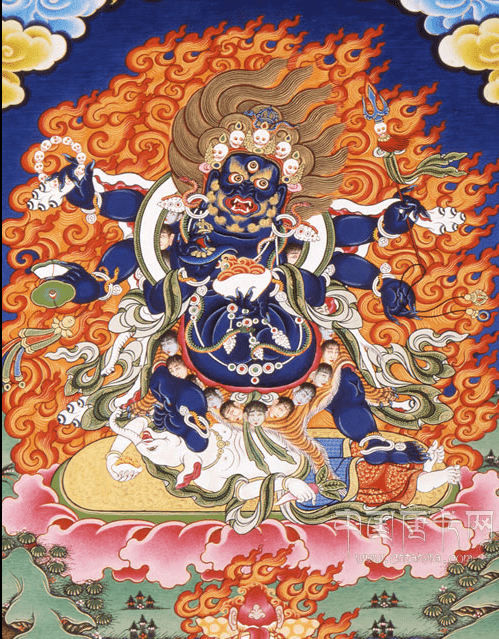
The most widely practiced form of the mahakala deity in Tibet, particularly within the Gelug, Kagyu, and Sakya schools, is the Six-Armed Mahakala (Tibetan: Gonpo Chakdrukpa). Every single detail of his appearance, from the color of his skin to the objects in his hands, is a profound symbol of enlightened activity. In Vajrayana art, there are no arbitrary choices; iconography is a visual language that communicates the deepest aspects of the Dharma. To understand his form is to understand his function.
His Form: The Body of Wisdom
- Color: His body is a deep, luminous blue-black, the color of a starless midnight sky. This represents his timeless, unchanging nature (Dharmakaya), the fundamental essence of mind that is empty of inherent existence yet luminously aware. It is the color of space itself, signifying that his wisdom is all-pervasive and unconstructed.
- Three Eyes: His three bulging eyes are not merely for seeing the physical world. They represent his ability to see the past, present, and future simultaneously, without confusion. The third eye, in the center of his forehead, symbolizes his direct perception of ultimate reality, a wisdom that transcends ordinary, dualistic perception.
-
Six Arms: The six arms of this Mahakala form are not monstrous; they are a direct representation of the Six Paramitas, or "perfections," which are the core practices of a Bodhisattva. In his wrathful manifestation, he shows that these perfections can be enacted with fierce, dynamic power:
- Generosity (Dāna)
- Ethical Discipline (Śīla)
- Patience (Kṣānti)
- Diligent Effort (Vīrya)
- Meditative Concentration (Dhyāna)
- Wisdom (Prajñā)
His Six Implements: Tools of Liberation
Each of his six hands holds a specific ritual implement, a tool for annihilating the causes of suffering.
- Curved Flaying Knife (Kartika): Held in his primary right hand, this crescent-shaped blade cuts through the root of all suffering: ego-clinging and self-grasping. It severs the attachments, aversions, and delusions that bind you to the painful cycle of rebirth.
- Skull Cup (Kapala): His primary left hand holds a skull cup filled with what appears to be blood. This is not a gruesome trophy but a symbol of transformation. The "blood" is the life-force of the egoic mind and its afflictive emotions. He holds them in the cup of wisdom, transforming these poisons into the nectar of enlightenment.
- Damaru (Ritual Drum): Another right hand holds a small, hourglass-shaped drum. Its sound represents the primordial vibration of reality, the sound of emptiness (shunyata) that awakens beings from the slumber of ignorance.
- Lasso or Noose (Pasha): Held in a left hand, this lasso does not harm. It captures and binds the negative forces, inner demons, and external obstacles that prevent your spiritual progress, rendering them powerless before they can cause damage.
- Trident (Trishula): This three-pronged spear, held in an upper right hand, symbolizes his complete mastery over the three realms of existence (desire, form, and formless realms) and his power to transform the three root poisons: ignorance, attachment, and aversion.
- Rosary of Skulls (Akshamala): Held in his final left hand, this is not a rosary for prayer but a symbol of his continuous, unceasing activity for the benefit of all beings, pulling them out of samsara one by one.
His Ornaments: Symbols of Mastery
- Crown of Five Skulls: The five skulls adorning his head represent the five aggregates (skandhas)—form, feeling, perception, mental formations, and consciousness—that make up the ordinary, unenlightened self. By wearing them as a crown, Mahakala signifies that he has transformed these five components of ego into the five wisdoms of a Buddha.
- Necklace of 51 Severed Heads: This fearsome garland represents the 51 mental events (as detailed in the Abhidharma), which in an ordinary mind create confusion and suffering. Mahakala has "severed" their power to cause harm and wears them as ornaments, showing his complete purification of the conceptual mind.
- Tiger Skin Loincloth: The tiger symbolizes anger and aggression. By wearing its skin, Mahakala demonstrates that he has not destroyed this powerful energy but has tamed, mastered, and harnessed it, using its force to overcome obstacles.
- Elephant Skin Cloak: The elephant represents pride and the delusion of a powerful, solid ego. Mahakala has "slain" this pride and wears its skin as a cloak, showing his complete freedom from self-importance.
His Posture: Active Compassion
The six armed mahakala stands in a dynamic, active posture. His left leg is bent, trampling upon a figure that represents the ego and self-grasping ignorance. His right leg is often slightly raised, indicating he is in constant motion, ever-ready to spring into action to protect practitioners. He is surrounded by a blazing halo of primordial wisdom flames. These flames do not burn you; they burn away the darkness of your ignorance, your doubts, and your fears, incinerating every obstacle on your path to awakening.
Mahakala in Daily Practice — Who Works With Him and Why
The practice of Mahakala is not undertaken lightly, but its purpose is deeply practical and compassionate. In Tibet, his invocation is a cornerstone of monastic life. Many great monasteries, such as Ganden Monastery, perform a Mahakala puja (a ritual of offerings and prayers) every single morning before any other practice begins. The protector is invoked first to clear the energetic space, to sweep away any spiritual or mundane hindrances that might disrupt the day's study and meditation. He is the guardian who ensures the sanctuary remains pure and conducive to Dharma practice.
For individual practitioners, Mahakala is called upon when facing serious, persistent, and overwhelming obstacles. His energy is sought for mahakala protection against a wide range of adversities. This includes:
- External Obstacles: Such as powerful enemies, legal troubles, financial ruin, or threats to one's physical safety.
- Internal Obstacles: Such as deep-seated addictions, crippling depression, overwhelming fear, or patterns of self-sabotage that feel impossible to break.
- Secret Obstacles: These are subtle spiritual hindrances, like pride in one's practice, attachment to spiritual experiences, or the arising of "wrong views" that lead one astray from the authentic path.
- Psychic Attack: In the Tibetan worldview, harm can also come from unseen negative energies or curses, and Mahakala is the ultimate defense against such forces.
It's crucial to understand what "protection" means in this Vajrayana context. It is not a form of divine magic where a deity swoops in and solves your problems for you. Rather, invoking Mahakala works on a deeper, karmic level. His practice helps to purify the negative karma that allows obstacles to ripen in your life. His energy strengthens your own inner resolve, clarity, and courage, empowering you to face your challenges directly. He doesn't make the storm disappear; he makes you the storm's master.
For those of us in the West, Mahakala's fierce energy is particularly relevant in situations where gentle approaches have proven insufficient. If you are a professional facing a ruthless adversary in business, an individual navigating a contentious legal battle, or a practitioner struggling with a powerful addiction that has resisted all other attempts at healing, Mahakala's practice provides a jolt of uncompromising power. He cuts through the compulsions, confusions, and external threats with surgical precision. However, he is not the deity to pray to for general good luck, finding a romantic partner, or getting a promotion. His domain is specifically the removal of severe obstacles and the protection of your spiritual integrity. To engage his energy is to ask for the most powerful form of help to clear the way, and you should be prepared for the profound changes that may bring. Wearing one of our protective wrathful deity pieces can serve as a constant, physical reminder of this powerful allegiance.

Mahakala's Mantra — How to Work With His Energy
A mantra is more than just a string of sacred syllables; it is the sonic embodiment of a deity's enlightened energy. To chant a mantra is to invoke the presence and qualities of that being within yourself and your environment. Mahakala's mantra is a powerful tool for cutting through negativity and establishing a profound connection with his protective power. While there are many mantras associated with his various forms, the most common root mantra is:
OM MAHAKALA HUM PHAT
An extended and widely used version, found within the Mahakala Tantra, is:
OM SHRI MAHAKALA HUNG HUNG PHAT PHAT SVAHA
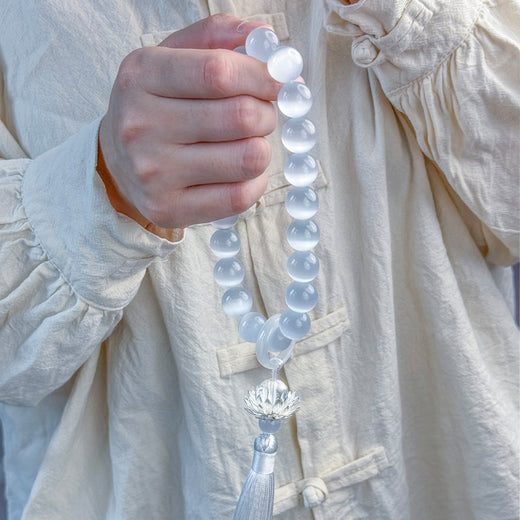
This is not a mantra to be recited casually while driving or checking your email. To work with it effectively requires focus, respect, and clear intention. Traditionally, you would sit in a quiet place, ideally in front of an image of Mahakala, and recite the mantra a full 108 times (one round of a mala, or prayer beads). As you chant, you engage in a specific visualization. You see Mahakala before you, black, fierce, and surrounded by his halo of wisdom flames. You see his implements ready to act. But as you look into his three eyes, you don't see blind rage. You see an expression of fierce, unwavering love—the look of a guardian who will do absolutely anything to protect what is most precious. You feel his power not as a threat, but as a shield around you, incinerating any negativity that approaches.
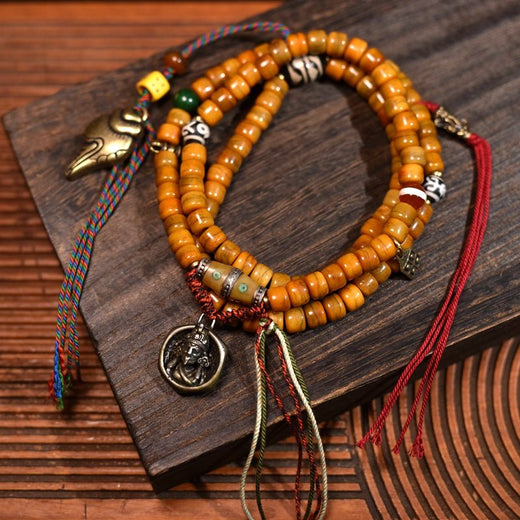
A physical anchor can dramatically deepen this practice. Wearing a Mahakala amulet or pendant creates a tangible, constant connection to his energy. In Tibetan Buddhism, such an item is known as a rten (pronounced "ten"), a "support object" for your practice. The image isn't just a piece of jewelry; it becomes a consecrated vessel for the deity's presence, a focal point for your visualization and mantra recitation. It acts as a constant reminder throughout your day of the protector's presence and your own commitment to a fearless path. You can explore our wrathful deity jewelry collection to find a piece that resonates with your practice.
What should you expect when you begin this practice? Don't look for lightning bolts or dramatic, Hollywood-style miracles. The effects are often more subtle, yet profound. You might notice that a legal issue that seemed hopelessly entangled suddenly finds a clear path to resolution. An adversary might unexpectedly back down. A compulsive habit you've battled for years might lose its grip. What once felt like an insurmountable threat may begin to feel manageable. Mahakala's energy works by strengthening your core and dissolving the conditions that allow obstacles to thrive.
Mahakala vs Other Buddhist Protectors — How to Choose
The Vajrayana Buddhist pantheon is rich with protector deities, and it can be confusing to know which energy is appropriate for a given situation. While all Dharmapalas serve the ultimate goal of protecting the Dharma, they have different specialties and functions. Understanding these distinctions can help you align your practice with the most effective support for your needs.
- Mahakala vs. Palden Lhamo: Palden Lhamo is the only female among the eight primary Dharmapalas and is considered the fierce protectress of Tibet, the Dalai Lamas, and major monasteries like Lhasa's Jokhang Temple. While both are intensely wrathful, her energy is often directed more toward protecting institutions, lineages, and high-level teachers. Mahakala, particularly the Six-Armed form, is more commonly invoked by individual lay and monastic practitioners for personal protection on their spiritual path. Think of Palden Lhamo as the protector of the nation's capital, and Mahakala as the personal bodyguard for its citizens.
- Mahakala vs. Dorje Shugden: This is a point of significant controversy in contemporary mahakala tibetan buddhism. Dorje Shugden is a protector deity whose practice arose within the Gelug school several centuries ago. However, His Holiness the 14th Dalai Lama has strongly discouraged his practice, viewing him as a sectarian spirit who creates disharmony within the broader Tibetan Buddhist community. In contrast, Mahakala is a universally accepted, "consensus" protector whose practice is honored and upheld across all major schools of Tibetan Buddhism—Nyingma, Kagyu, Sakya, and Gelug. For this reason, engaging with Mahakala is considered a safe and universally blessed practice, free from sectarian conflict.
- Mahakala vs. Guardian Buddha (Ben Ming Fo): The Guardian Buddhas, also known as Birth Year Protectors or Ben Ming Fo, are a completely different category of celestial support. As detailed in our guide to Guardian Buddhas, these eight Buddhas and Bodhisattvas offer a gentle, supportive, and lifelong blessing based on your birth year in the Chinese zodiac. Their energy is like a constant, warm light guiding your life. Mahakala is not a lifelong guardian in the same way; he is a specialist, a heavy-duty protector you call upon for specific, acute threats. They are not in competition; they are complementary. Your Guardian Buddha provides the baseline of auspicious energy, while Mahakala provides the active, fierce intervention when a serious crisis arises. You can explore our guardian buddha collection to find your personal protector.
So, when should you specifically choose to work with Mahakala? You turn to him when you face serious, tangible obstacles that gentler practices have failed to move. When you feel your path is actively blocked, when you are under direct attack (whether mundane or spiritual), or when your own inner demons are raging out of control, Mahakala's uncompromising energy is the most direct and powerful remedy.
Authentic Mahakala Jewelry — What to Look For
When you choose to wear an image of a deity as powerful as Mahakala, you are not simply choosing a piece of jewelry; you are choosing to carry a sacred symbol. Therefore, authenticity and iconographic accuracy are paramount. A piece that misrepresents the deity's form will not carry the same blessing or serve as an effective support for practice.
Here’s what to look for in a valid Mahakala pendant or amulet:
- Iconographic Accuracy: This is the most important factor. A pendant of the Six-Armed Mahakala must show six arms, not four or eight. It must depict his three eyes, the crown of five skulls, and his characteristic implements like the kartika and kapala. The details matter because they are the visual language of his function. A decorative, artistically altered interpretation, while perhaps beautiful, loses its connection to the traditional lineage and its specific energetic transmission.
- Artisanal Sourcing: At Buddhabelief, we source our pieces from artisans in Nepal and Tibet who have been trained in the strict iconographic canons of Tibetan thangka painting and statue making. They are not just metalsmiths; they are practitioners who understand the sacred geometry and symbolism they are working with. This ensures the piece is not just an object but a genuine representation of the deity.
- Resonant Materials: Traditionally, protector amulets are crafted from materials that resonate with their energy. Silver and bronze are common for metal pendants, as they are durable and hold the intricate details well. Black stone, such as obsidian, onyx, or black jade, is also highly prized for Mahakala amulets. The deep black color aligns directly with his nature as the "Great Black One," and these stones are themselves considered to have powerful protective and grounding properties.
- Respectful Wear: A Mahakala pendant should be worn with intention, close to the body, often on a cord or chain around the neck. It is not meant to be treated as casual fashion. When you are not wearing it, it should be kept in a clean, respectful place, perhaps on your personal altar or wrapped in a silk cloth.
- Blessing and Consecration: For a sacred object to become a true vessel of enlightened energy, it should ideally be blessed. The most powerful way is to have it consecrated by a qualified Tibetan Buddhist lama. If this is not possible, you can perform a simple home consecration by placing it on your altar, making offerings of light (a candle or lamp), incense, and pure water, and reciting Mahakala's mantra 108 times with the strong intention of inviting his wisdom presence to inhabit the object.
By choosing an authentic piece, you ensure that what you wear is not just a symbol of protection but an active conduit for it. Our collection of sacred protector jewelry is curated with these principles at its heart.
Common Questions About Mahakala
As a powerful and seemingly intimidating figure, Mahakala often inspires questions, especially from those new to Tibetan Buddhism. Here are answers to some of the most common inquiries.
Is Mahakala dangerous to work with for beginners?
Mahakala is not "dangerous" in the way a malevolent spirit would be. He is an enlightened being. However, his energy is incredibly potent and uncompromising. The "danger" lies not in him, but in an impure or selfish motivation of the practitioner. If you invoke him with a desire to harm others or for purely worldly gain, his energy can rebound in unexpected ways, as it is designed to destroy ego, not inflate it. For a beginner with sincere motivation—to protect their path and overcome genuine obstacles to practice—working with Mahakala is safe. The key is respect, humility, and the right intention.
Can non-Buddhists wear Mahakala jewelry?
Yes, but it should be done with understanding and respect. If you are drawn to Mahakala's energy of fierce protection and feel a connection to what he represents, wearing his image can be a powerful source of strength. However, it's important to honor the tradition he comes from. Treat the amulet as a sacred object, not just a fashion accessory. Understand that you are wearing a symbol of enlightened compassion in its most wrathful form, a commitment to fearlessly confronting what harms you and others.
What is the difference between Mahakala and Shiva?
This is a question about origins versus function. Mahakala originates from the Hindu deity Shiva, specifically his wrathful form, Bhairava. However, within Buddhism, he is a completely distinct entity. When he was bound by oath by Padmasambhava, he became a Buddha-Dharma protector. His purpose is no longer tied to the Hindu cosmology of creation and destruction but is solely dedicated to protecting the Buddhist teachings and its followers. He is an emanation of a Buddha or Bodhisattva (often considered an emanation of Avalokiteshvara, the Buddha of Compassion), who has taken on this form to serve a specific Buddhist purpose.
Why does Mahakala look so terrifying?
His terrifying appearance is a form of "skillful means." In our ordinary state, we are seduced by pleasant appearances and fearful of unpleasant ones. Mahakala's wrathful form is designed to bypass the conceptual mind's tendency to sugarcoat reality. His fierceness is a direct expression of his compassion's intensity. It's the face of a love that will not tolerate the poisons of ignorance, hatred, and greed that cause you to suffer. His appearance is terrifying only to the ego and the negative forces that wish to harm you; for a practitioner, his face is the ultimate symbol of safety.
Can I put a Mahakala image in my home?
Absolutely. An image of Mahakala, whether a statue, a thangka painting, or a framed print, is an excellent addition to a home altar or a dedicated meditation space. It should be placed in a high, clean, and respectful location where it won't be disturbed. You should avoid placing it on the floor, in a bathroom, or in a bedroom where sexual activity occurs. Having his image present serves as a constant source of protection for your home and a powerful support for your daily practice.
What's the best time to work with Mahakala's energy?
Traditionally, the most powerful time to perform Mahakala practice is at dawn, during the liminal space between the deep darkness of night and the full light of day. This transitional time is considered a period when the veil between worlds is thin and protector energies are most accessible. However, you can and should call upon him any time you are in great need. In moments of acute fear, danger, or when facing a critical obstacle, reciting his mantra with one-pointed focus is always appropriate and effective.
Invite the Protector In
Let’s return to that dark chapel in Drepung Monastery. The Western practitioner, whose fear has now dissolved into awe, looks at the fierce face of Mahakala again. She no longer sees a monster. She sees the monk's words made manifest: "He is angry at what hurts you." She sees the ultimate guardian, a love so profound it is willing to appear terrifying to protect the fragile flame of awakening within her. Mahakala Meaning
Today, she wears a small silver Mahakala pendant under her shirt. It is not a fashion piece or a casual talisman. It is a private vow, a daily reminder that fierce compassion is still compassion, and that she has an unwavering ally on her path. The obstacles of life still arise—the difficult colleagues, the financial worries, the moments of self-doubt. But now, they don't seem to linger as long. They don't have the same power to derail her. It feels as if a great, dark wind is at her back, clearing the path ahead. This is the gift of Mahakala: not a life free from challenges, but the unbreakable courage to meet them, and the profound certainty that you are never, ever walking your path alone. Explore our Mahakala pendant collection and invite this fearless protector into your life.