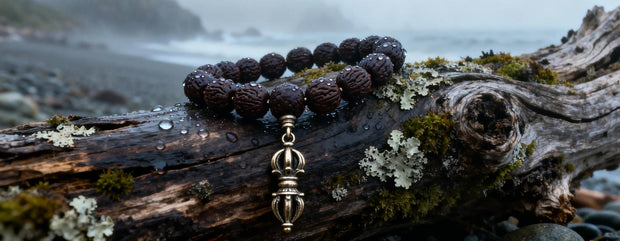
108 beads
Mala Beads Guide: 108, 54, 27 Counts & Materials

The first time you truly see a mala, it changes your perspective. You might have seen them at a yoga studio or on social media, draped elegantly around a wrist. But to see one in its natural habitat—circling the Boudhanath stupa in Kathmandu, held in the weathered hands of a Tibetan elder chanting Om Mani Padme Hum—is to understand it’s not only jewelry.
This guide explains the bead counts, materials, care needs and practice uses that help readers choose a mala without relying on vague spiritual claims.
We’ll walk you through everything you need to know, from the deep meaning of the beads to choosing from an authentic mala beads collection that honors this lineage.

A mala is a string of prayer beads — traditionally 108, but also 54, 27 or 21 — used to count mantras or breaths, so your hands keep the count while your mind stays on the practice.
What Mala Beads Actually Are (Beyond the Trend)
Before we get into the details, let's establish a foundational truth: a mala is not only a necklace. In the West, it's often mistaken for a fashion accessory, but in the Himalayan traditions of Tibet and Nepal, its purpose is far more profound.
At its core, a mala, or *japa mala* in Sanskrit, is a string of beads used to count mantras, breaths, or prostrations during meditation. Think of it as a spiritual abacus. Each bead you touch is a physical anchor for your focus, pulling your wandering mind back to the present moment, back to your intention.
A traditional Tibetan mala has a specific structure that supports this purpose. It isn't just a random string of beads. Let’s break down its anatomy:
- The Beads: Typically 108 in number, these are the primary counters. As you recite your mantra, your thumb moves from one bead to the next, creating a steady, rhythmic cadence for your practice. The material of these beads is deeply significant, which we'll explore later.
- The Guru Bead (or Sumeru Bead): This is the larger, often decorative bead at the bottom of the mala, just before the tassel. It is not counted among the 108. The Guru Bead represents the teacher, the teachings, or the ultimate reality. When you reach it during your meditation, it’s a moment to pause, reflect, and give thanks. It signals the completion of one round of 108 repetitions.
- The Tassel or Knot: The tassel, common on many malas, symbolizes the roots of the lotus plant, representing our connection to the divine and the potential for enlightenment. It also serves a practical purpose, helping to anchor the mala and complete the flow of energy. Some authentic Tibetan malas end in a protective knot instead of a tassel, like the endless knot, symbolizing the interconnectedness of all things.
- The Knots: This is a detail that separates a true practitioner's mala from a mass-produced accessory. In our handcrafted Tibetan malas, a tiny, tight knot is tied between each bead. This serves two vital functions. First, it creates the perfect amount of space, allowing your fingers to move easily from one bead to the next. Second, it secures the mala; if it ever breaks, you won't lose all 108 beads. A mala without knots is often a sign of rushed, inauthentic production.
With regular use, a mala can become personally meaningful: its surface develops wear, and the familiar bead count supports a consistent practice routine.
The Complete Guide to Bead Counts — 108, 54, 27, 21 and Why They Matter
The number 108 is the most recognized and sacred count for a full mala, but you'll often see variations like wrist malas with fewer beads. These numbers aren't arbitrary; each carries its own significance and serves a specific purpose in practice.
Understanding these counts deepens your connection to the tool you're using.
108 Beads: The Sacred Standard
Why 108? This number is profoundly significant across multiple spiritual and scientific traditions. While there are countless interpretations, some of the most respected reasons in the Buddhist tradition include:
- Desires and Defilements: It is said there are 108 kleshas, or defilements of the mind (like greed, anger, and ignorance), that prevent us from achieving enlightenment. Each repetition of a mantra is a step toward purifying one of these defilements.
- Cosmic and Human Connection: The diameter of the Sun is approximately 108 times the diameter of the Earth. The distance from the Sun to the Earth is about 108 times the diameter of the Sun. In yogic traditions, there are said to be 108 major energy lines (nadis) that converge to form the heart chakra.
- The Sanskrit Alphabet: The classical Sanskrit alphabet has 54 letters, each with a masculine (Shiva) and feminine (Shakti) aspect, totaling 108.
A full 108-bead mala is the standard for a dedicated seated meditation practice. Completing a full round provides a sense of accomplishment and allows for a deep, immersive session. If you want to explore this topic further, our guide on why 108 beads are used in mala practice offers a comprehensive look into the numerology.
54 Beads: The Half Mala
A mala with 54 beads is simply half of a 108-bead mala. It's used for shorter meditation sessions. To complete a full round of 108 repetitions, you simply go through the mala twice. This size is practical for those with limited time or for practices that require a specific number of repetitions that is a multiple of 54.
It's less common but serves as a bridge between a full mala and a smaller wrist mala.
27 Beads: The Quarter Mala for Your Wrist
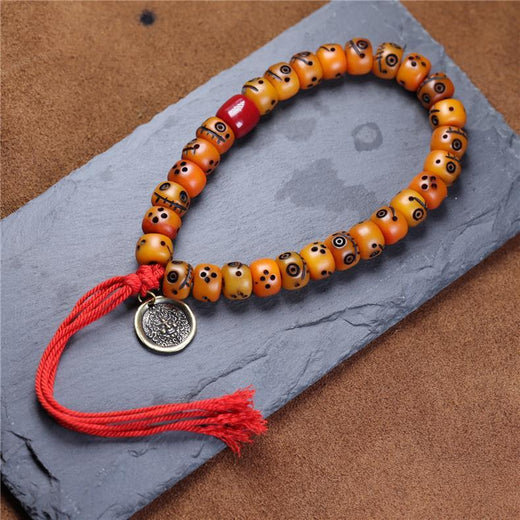
This is the most common count for wrist malas. As a quarter of 108, it allows you to complete a full round of mantras by making four passes over the beads. Wrist malas are exceptionally practical.
You can wear them throughout the day as a constant reminder of your intention. They are perfect for "on-the-go" practice—counting breaths while waiting in line, reciting a calming mantra in traffic, or during a short break at work.
They keep your practice accessible and integrated into your daily life.
21 Beads: For Specific Practices
You may also encounter malas with 21 beads. This number is often associated with specific deity practices, most notably for the Bodhisattva Tara. Tara has 21 different emanations or forms, and practices dedicated to her often involve reciting mantras 21 times.
A 21-bead mala is a specialized tool for practitioners engaged in these specific sadhanas (spiritual practices). Seeing one is a sign of a mala made with deep traditional knowledge.
Choosing a bead count isn't about right or wrong; it's about what supports your life and your practice. A full 108 prayer beads is ideal for your meditation cushion at home, while a 27-bead wrist mala can be your steadfast companion out in the world.
Materials That Matter — Sandalwood, Rudraksha, Bodhi Seed, Yak Bone, Crystal
The material of your mala is not merely an aesthetic choice. In Tibetan Buddhism, different materials are believed to possess unique energetic properties that can support specific intentions and practices. The wood, seed, or stone you choose becomes an active participant in your meditation.
At Buddhabelief, we source materials that have been used by practitioners for centuries, understanding that authenticity in substance is as important as authenticity in craft.
Sandalwood: The Scent of Serenity
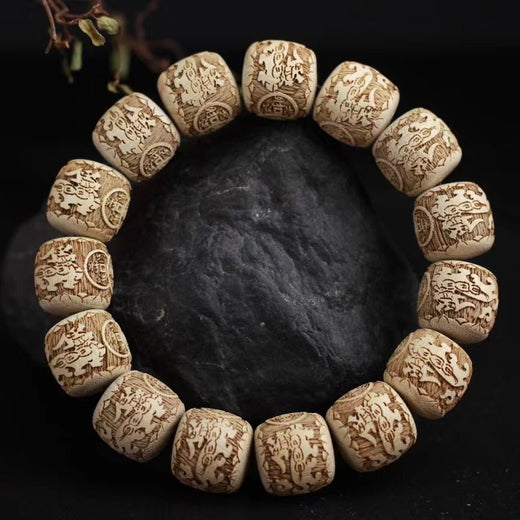
Sandalwood is one of the most traditional and cherished materials for malas. Its distinct, soothing fragrance has a powerful effect on the mind, promoting calmness and clearing away distractions. In meditation, the scent acts as an olfactory anchor, helping you to return to a state of peace.
Materials and construction vary by item; browse the current mala collection and verify the listed wood, bead count and cord details on the product page.
Rudraksha Seeds: The Tears of Shiva
Though more closely associated with Shaivism in Hinduism, Rudraksha seeds are widely used by Buddhist yogis and practitioners in the Himalayas. The name translates to "Tears of Rudra" (an epithet of Shiva). Legend says that upon seeing the suffering of the world, Shiva shed a tear that grew into the Rudraksha tree.
The dried seeds are considered powerful tools for protection, concentration, and healing. They have a unique texture and are known for their ability to shield the user's energy field. The number of faces, or *mukhis*, on a seed is said to determine its specific properties.
Bodhi Seed: The Seed of Enlightenment
This is perhaps the most significant material for a Buddhist practitioner. "Bodhi" in Sanskrit means "enlightened" or "awakened." It was under a Bodhi tree (Ficus religiosa) that Prince Siddhartha attained enlightenment and became the Buddha.
Bodhi-seed malas are associated with awakening because the Buddha attained enlightenment beneath a bodhi tree. Commercial mala seeds come from related plant species rather than the original tree. With regular handling, natural seeds absorb skin oils and gradually develop a darker patina. See this 108-bead bodhi seed mala as a current material example.
The resulting patina reflects handling and age. Our in-depth bodhi seed mala guide explains the history and material in more detail.
Yak Bone: The Reminder of Impermanence
In the high plateaus of Tibet, the yak is an essential part of life. Using yak bone for malas is a powerful practice in mindfulness of impermanence (*anicca*). It serves as a constant reminder of the transient nature of life and the reality of death.
This is not meant to be morbid, but rather to inspire you to practice with urgency and to live each moment fully. It's a core tenet of Buddhist philosophy. Crucially, the bone used in authentic Tibetan malas comes from yaks that have died of natural causes.
It is an act of respect, using every part of the animal that has sustained the community. This practice is a world away from the commercial bone trade and reflects a deep reverence for the cycle of life and death.
Crystals and Gemstones: For Specific Energies
While traditional malas often use wood or seeds, gemstones and crystals are also used for their specific energetic qualities, often associated with particular deities or intentions:
- Lapis Lazuli: Its deep blue color is associated with the Medicine Buddha and is used for healing practices.
- Turquoise: A protective stone highly valued in Tibetan culture, believed to guard against negativity and promote well-being.
- Rose Quartz: Used for practices related to loving-kindness (*metta*) and compassion (*karuna*), helping to open the heart chakra.
- Clear Quartz: An amplifier of energy, used to clarify intention and enhance focus during any type of practice.
When you choose a material, you are choosing a partner for your practice. Consider what quality you wish to cultivate—peace, protection, wisdom, or compassion—and let that guide your selection.

How to Use Mala Beads for Meditation (Step-by-Step Practice)
Using a mala for meditation, or *japa* practice, is a beautifully simple yet profound technique. It transforms an abstract mental exercise into a tactile, multi-sensory experience. Your fingers, your breath, and your voice all join in a unified act of mindfulness.
Here is a traditional Tibetan method for using your mala.
Step 1: Find Your Seat and Set Your Intention
Before you begin, find a comfortable and quiet place where you won't be disturbed. Sit in a relaxed, upright posture, either on a cushion on the floor or in a chair.
Close your eyes and take a few deep breaths to center yourself. Hold your mala in your hands and set an intention for your practice. What quality do you wish to cultivate? Peace? Compassion?
Clarity? Your intention is the seed of your meditation.
Step 2: Choose Your Mantra
A mantra is a sacred sound, word, or phrase that you repeat. It can be in Sanskrit, like the universal compassion mantra Om Mani Padme Hum, or it can be a simple affirmation in your own language, such as "I am at peace" or "Let go." The sound and resonance of the mantra are what help to focus the mind.
Choose one that resonates with your intention.
Step 3: Hold the Mala Correctly
Drape the mala over your right hand. The traditional method is to have the beads rest on your middle finger. The thumb is used to count by pulling each bead towards you.
The index finger is generally not used to touch the beads, as it is associated with the ego. The ring finger and pinky finger can simply rest naturally.
Step 4: Begin the Repetitions
Start with the first bead next to the Guru Bead. Hold this bead between your thumb and middle finger. As you recite your mantra one time (either aloud or silently), use your thumb to pull that bead towards you.
Then, move your fingers to the next bead and repeat the process. Continue this rhythm—one breath, one mantra, one bead—as you make your way around the mala.
Step 5: Stay with the Sensation
The physical sensation of the beads moving through your fingers is a powerful anchor. If your mind wanders (and it will), gently guide your attention back to the feeling of the bead, the sound of your mantra, and the rhythm of your breath.
Don't judge yourself for getting distracted; the practice is in the gentle returning, over and over again.
Step 6: Pausing at the Guru Bead
When you have completed 108 repetitions, your thumb will arrive at the Guru Bead. Do not count this bead, and do not cross over it. This is a moment to pause.
Offer a moment of gratitude to your teachers, to the practice itself, and to yourself for showing up. This pause signifies the completion of one cycle.
Step 7: Continuing for More Rounds
If you wish to continue for another round of 108, simply turn the mala around in your hand. Without crossing the Guru Bead, begin your count again in the opposite direction, starting with the bead you just finished on.
This act of turning honors the student-teacher relationship represented by the Guru Bead.
This process is detailed and rooted in tradition. For a more visual and in-depth explanation, you can refer to our step-by-step mala meditation guide. Remember, your mala is a patient teacher. The more you practice with it, the more natural this process will feel.
How to Choose Your First Mala — A Practical Guide
Choosing your first mala is a personal and intuitive process. It's less about finding the "perfect" one and more about finding the one that feels right for you at this moment in your journey.
While aesthetics are important—you should love how your mala looks and feels—the most meaningful choice comes from a place of intention. Here are some factors to consider.
1. Listen to Your Intuition
Often, the right mala chooses you. As you browse our mala selection, notice which one you are drawn to. Is it the deep, calming brown of sandalwood? The vibrant, protective blue of turquoise?
The earthy, organic feel of Bodhi seeds? Your initial attraction is often your intuition guiding you toward the energy you need. Don't overthink it. Trust that first pull.
2. Connect with Your Intention
What is the primary reason you are seeking a mala? What are you working on in your life right now? Aligning the material of your mala with your intention can create a powerful synergy.
- For Grounding and Calm: If you're feeling anxious or scattered, choose grounding materials like Sandalwood, Lava Stone, or Smoky Quartz.
- For Spiritual Growth and Transformation: If you are deepening your spiritual practice, a Bodhi Seed mala is the ultimate companion, symbolizing enlightenment.
- For Protection and Strength: If you need to cultivate resilience, consider Rudraksha, Black Onyx, or Tiger's Eye.
- For Compassion and Heart-Opening: For practices focused on love and kindness, Rose Quartz or Rhodochrosite are excellent choices.
3. Consider Practicality and Use
How do you envision using your mala?
- For Dedicated Home Practice: A full 108-bead mala is ideal. The length and weight feel substantial in your hands and support a full, immersive meditation session.
- For Daily Wear and On-the-Go Practice: A 27-bead wrist mala is perfect. It's discreet, portable, and serves as a constant physical reminder of your intention throughout the day.
- For a Specific Deity or Practice: If your practice is dedicated to a specific figure like Tara, a 21-bead mala might be the most appropriate tool.
4. Verify Authenticity (The Buddhabelief Checklist)
This is where our 40+ years of experience becomes your guide. The difference between a real tool and a cheap imitation matters. A well-made mala will support your practice; a poorly made one will be a distraction. Here's what to look for:
- Are there knots between the beads? This is the #1 sign of quality craftsmanship. The knots provide spacing for your fingers and secure the beads.
- What is the quality of the material? Does the sandalwood have a real, subtle scent? Do the Bodhi seeds feel organic and solid? Are the stones cool to the touch? - How is the Guru Bead attached? It should feel secure and well-integrated, not only loosely tied on.
- What is the source? Knowing your mala was made by artisans in a place like Boudhanath, where the tradition is alive, adds an intangible layer of authenticity and respect.
Your first mala is a special commitment to your practice. Take your time, trust your gut, and choose the one that feels like a true friend on your path.
Caring for Your Mala — Cleansing, Storage, Repair
Your mala is more than an object; it's an energetic extension of your practice. Just as you care for your mind and body, your mala requires care to maintain its physical integrity and energetic purity. Proper care ensures it will be a supportive companion for years to come.
Energetic Cleansing
As you use your mala, it absorbs energy—both the focused intention of your practice and the ambient energies of your environment. Periodically cleansing it helps to reset its resonance and keep it clear.
- Smudging: This is a gentle and effective method. Light a stick of sage, palo santo, or cedar and let the smoke smolder. Pass your mala through the smoke several times with the intention of clearing away any stagnant or negativity.
- Sunlight and Moonlight: The light of the celestial bodies is a powerful cleanser. You can place your mala in direct sunlight or moonlight for a few hours. A full moon is especially potent for this. Be cautious with certain gemstones like amethyst, as prolonged, direct sunlight can cause their color to fade.
- Sound Healing: The resonance of sound can also clear energy. Place your mala near a Tibetan singing bowl and strike the bowl, letting the resonant frequencies wash over the beads.
We recommend cleansing your mala when you first receive it, and then whenever it starts to feel "heavy" or dull, or after a particularly intense period in your life.
Proper Storage
How you store your mala shows respect for it as a sacred tool.
- Keep it in a dedicated place: When not in use, store your mala in a special pouch (often made of silk or cotton) or a small wooden box.
- Keep it off the floor: In many Eastern traditions, it is considered disrespectful to place sacred objects on the ground. Keep your mala on an altar, a clean shelf, or a dedicated table.
- Avoid water and chemicals: Do not wear your mala while showering, swimming, or using harsh cleaning products. Water can weaken the string, and chemicals can damage the beads, especially wood and seeds.
When Your Mala Breaks
It can be startling or sad when a mala breaks, but in the Buddhist tradition, this is not seen as a bad omen. In fact, it can be viewed quite positively. A broken mala is often said to symbolize one of two things:
- The Breaking of a Cycle: It can signify that you have broken through a karmic pattern or released a long-held attachment. The purpose of that mala has been fulfilled.
- The Fulfillment of an Intention: The energy you poured into the mala has come to fruition, and the intention you set has been realized.
When this happens, you have a few choices. You can gather the beads and keep them on your altar as a reminder of the lessons learned. You can offer them back to the earth by burying them in a special place.
Or, you can have the mala re-strung. Re-stringing it can be a beautiful way to recommit to your practice, infusing the beads with new intention while honoring the journey you've already taken with them.
Related guide: how to care for and maintain Buddhist jewelry
FAQ
Here are answers to some of the most common questions we receive from people new to mala beads.
Your journey with mala beads is a deeply personal one. They are not only objects but active companions that evolve with you. By understanding their history, their structure, and the proper way to use and care for them, you transform a simple string of beads into a powerful key for unlocking your own inner peace and wisdom.
We invite you to explore our collection and find the mala that is waiting to begin this journey with you. Discover your companion in our authentic mala beads collection, handcrafted with intention by artisans in the heart of the Himalayas.
Keep reading