
buddhist-jewelry
Buddhist Protection Jewelry Complete Guide: Guardian Bu
You feel it before the meeting even starts. The tension in the room is a palpable force, a low hum of anxiety and competing agendas. Your own pulse quickens, your thoughts begin to race, and the familiar grip of self-doubt tightens its hold.
In this moment, you might reach for your phone or fidget with a pen, searching for a distraction. But imagine, instead, your hand instinctively finding a small, smooth stone worn close to your heart.
As your fingers trace its carved surface, you are not only touching an object; you are connecting with an ancient lineage of resilience. You are silently invoking the unshakable calm of Akshobhya or the piercing wisdom of Manjushri.
This isn't about wishing for luck. It's about remembering the profound strength that already resides within you. This is the true purpose of a Guardian Buddha amulet—a sacred tool that transforms a moment of overwhelm into an opportunity for profound inner alignment.

What a Guardian Buddha Amulet Really Is
To truly understand your Guardian Buddha amulet, you must look past the modern marketplace and journey back to the high plateaus of Tibet. This tradition is not a recent invention; its roots are deeply embedded in the Vajrayana school of Buddhism, which flourished in the Himalayas from the 7th century onward.
The core concept is tied to the Tibetan astrological system, a sophisticated synthesis of Indian, Chinese, and native Bon traditions. Within this framework, it was understood that each individual is born with a unique karmic disposition, influenced by the year of their birth.
To help navigate these innate tendencies, the tradition assigns a specific Buddha or Bodhisattva as a protector, or Yidam, for each of the twelve zodiac animals.
This is not a pantheon of gods to be worshipped for favors. In Vajrayana, a Yidam is a personal meditational deity, an enlightened being who represents the fully awakened nature of your own mind.
They are archetypes of specific enlightened qualities. For example, Avalokiteshvara (Chenrezig in Tibetan) is the embodiment of universal compassion, while Manjushri represents transcendent wisdom. Your Guardian Buddha is the Yidam with whom you share a natural, karmic connection.
The tradition, codified over centuries in monasteries like the great Sera and Drepung Monasteries near Lhasa, holds that meditating upon and connecting with your specific guardian is the most direct path to transforming your personal challenges into wisdom.
The physical amulet itself is a sacred container for this connection. Historically, these were not mass-produced. A lama or skilled monastic artisan would create them, often incorporating blessed substances (rilbu) like sacred herbs, soil from a holy site, or even ashes from a revered master.
The object was then consecrated through extensive ritual and mantra recitation, imbuing it with spiritual presence. It became a tangible focal point for devotion and a constant reminder of the practitioner's path. When you wear a Guardian Buddha amulet, you are not only wearing jewelry; you are carrying a piece of this profound spiritual technology, a direct link to the specific enlightened quality you are destined to cultivate in this lifetime.
It is a tradition that honors your unique journey while connecting you to a timeless source of strength, a practice that is as relevant today as it was a thousand years ago in the shadow of the Himalayas.
You can see how this tradition informs our complete range of mindfully crafted jewelry, where every piece carries a story.
The Deeper Meaning: A Mirror to Your Buddha-Nature
The most common misunderstanding about a Guardian Buddha is seeing it as an external protector, a spiritual bodyguard deflecting misfortune from the outside. The authentic meaning is far more profound and empowering. Your Guardian Buddha is not a separate entity; it is a perfect mirror reflecting your own highest potential, your innate Buddha-nature.
The amulet is the physical object that helps you remember to look in that mirror, especially when your vision is clouded by fear, anger, or confusion.
Think of it this way: if your zodiac protector is Samantabhadra, the guardian for the Dragon and Snake, he represents the perfection of practice, aspiration, and virtuous action. Wearing his image is a constant, subtle reminder to act with integrity, to align your daily choices with your deepest spiritual values.
When faced with a decision that tests your ethics, the weight of the amulet against your skin can be the trigger that helps you pause and ask, "What is the most virtuous path forward?" The protection, therefore, comes from within.
You are protected from your own unskillful actions and their negative karmic consequences because the amulet reminds you to choose a wiser course.
This practice is deeply connected to the Buddhist understanding of the mind. The true dangers in life are not external threats, but the "three poisons" of the mind: greed (attachment), hatred (aversion), and ignorance (delusion).
Every enlightened quality of your Guardian Buddha is a direct antidote to these poisons. The boundless generosity of Ratnasambhava counters greed. The unwavering compassion of Avalokiteshvara dissolves hatred. The sharp, discerning wisdom of Manjushri cuts through the fog of ignorance.
Your amulet, therefore, is a piece of spiritual armor worn on the inside. It protects your mind from its own worst tendencies, allowing your inherent clarity and compassion to shine through. It is a commitment you make to yourself to cultivate the best version of your being.
Real Benefits for Your Modern Life
In a world of constant digital notifications and relentless demands on your attention, the practices associated with a Guardian Buddha offer tangible, grounding benefits that go far beyond generic stress relief. They provide a framework for integrating spiritual depth into the fabric of your everyday experience.
First, your amulet becomes an unparalleled tool for embodied mindfulness. The concept of mindfulness can feel abstract, but the physical sensation of the amulet provides a concrete anchor. When you find yourself lost in a spiral of anxious thoughts about a work deadline or a difficult conversation, the simple act of touching your pendant can pull you out of the mental chaos and back into the present moment.
This physical touch becomes a conditioned response. You train your mind, so that touching the amulet is synonymous with taking a deep breath, feeling your feet on the ground, and remembering the calm stability of your guardian, like Mahasthamaprapta, the protector of the Horse, who represents the power of wisdom in action.
Second, it fundamentally reframes how you perceive challenges. A difficult colleague or a sudden financial setback can easily be seen as a source of suffering. However, with your guardian as a guide, you begin to see these situations as opportunities for practice.
If your guardian is Akasagarbha (Ox and Tiger), whose name means "essence of space," you are reminded of boundless patience and the wisdom that sees potential in emptiness. Instead of reacting with frustration, you are prompted to ask, "How can I meet this situation with patience?
What opportunity is hidden here?" This shift in perspective cultivates profound resilience, transforming you from a victim of circumstance into an active participant in your own spiritual growth. Finding a tangible connection to your guardian's qualities can be the first step in this transformation.
Finally, wearing your Guardian Buddha strengthens your daily intention. It turns mundane routines into meaningful acts. Before you enter a negotiation, you might hold your amulet and silently recite your guardian's mantra, setting the intention to communicate with clarity and fairness.
Before responding to a frustrating email, a touch of the amulet can remind you to act with compassion rather than reactivity. This consistent, moment-to-moment realignment with your highest values is what builds true character and inner peace.
It is the practical application of traditional teachings, protecting you not from the world, but from a reactive and unexamined way of living within it.

How to Choose an Authentic Guardian Buddha Amulet
Choosing your Guardian Buddha amulet is a deeply personal and significant step. It is an investment in your spiritual path, and the authenticity of the piece matters. An authentic amulet is one that is created with reverence, understanding, and right intention.
Here is what you should consider to ensure your choice is a true spiritual tool.
The first and most crucial step is to identify your guardian based on your birth year in the Chinese zodiac. This system provides the traditional foundation for your connection:
- Rat: Avalokiteshvara (Thousand-Armed)
- Ox, Tiger: Akasagarbha
- Rabbit: Manjushri
- Dragon, Snake: Samantabhadra
- Horse: Mahasthamaprapta
- Sheep, Monkey: Vairochana
- Rooster: Acala
- Dog, Pig: Amitabha
Next, consider the material. In Buddhist tradition, materials are not chosen for aesthetics alone; they possess their own energetic properties that support the amulet's purpose. Obsidian, a volcanic glass, is revered for its grounding and protective qualities, believed to absorb and transmute negativity.
Jade, particularly in its green and white forms, is a stone of purity, harmony, and healing, encouraging a gentle and compassionate heart. Sandalwood, with its sacred fragrance, is known to calm the mind and enhance meditative states.
When you choose a material, you are also choosing the specific energetic support you wish to invite into your practice.
Pay close attention to the craftsmanship and iconography. The depiction of the deity should be clear, respectful, and accurate. Does Manjushri hold his flaming sword of wisdom and the Prajnaparamita sutra? Is Avalokiteshvara depicted with the compassion and intricate detail his form requires?
A poorly rendered or generic figure lacks the symbolic power and spiritual integrity of a carefully crafted piece. When you explore an authentic collection of Guardian Buddha pendants, you will notice the profound difference that intentional artistry makes.
The quality of the carving is a reflection of the reverence with which the object was made, and that reverence is a part of its spiritual potency.
How to Use Your Amulet for Spiritual Practice
Receiving your Guardian Buddha amulet is the beginning of a relationship. It is not a passive object but an active partner in your spiritual life. To unlock its full potential, you must engage with it through intention and practice. Here is a simple, traditional way to begin.
Step 1: Initial Consecration
When your amulet first arrives, it's important to cleanse it and formally welcome it into your life. You can do this by gently wiping it with a clean cloth and passing it through the smoke of cleansing incense, like sandalwood or sage.
Then, find a quiet moment. Hold the amulet in your palms at your heart center. Close your eyes and set a clear, heartfelt intention. It could be something like, "May this amulet be a constant reminder of my own inner wisdom and compassion.
May it guide me to act with kindness and clarity." This personal act of consecration forges your unique bond with the amulet.
Step 2: Daily Wear and Respectful Care
Wear your amulet against your skin, ideally close to your heart. This physical proximity maintains a constant energetic connection. Treat it as a sacred object. Out of respect, it is traditional to remove it before sleeping, showering, or engaging in intimate activities.
Avoid placing it on the floor or in an unclean space. When you are not wearing it, you can place it on a small altar or a clean, dedicated surface in your home. This practice of respectful handling reinforces its significance in your mind.
Step 3: A Simple Daily Practice
Integrate your amulet into a brief, consistent daily routine.
- Morning: Before your day begins, hold your amulet for a moment. Take three deep breaths. Recite the mantra associated with your guardian seven times. You can often find the specific mantra for your Guardian Buddha along with authentic depictions. As you do this, visualize your guardian's primary quality—like Amitabha's warm, red light of compassion—filling your entire being. Set an intention to carry this quality with you throughout your day.
- During the Day: Use your amulet as a mindfulness bell. Whenever you feel stressed, angry, or lost, let your hand find it. Use the touch as a cue to pause, breathe, and reconnect with your morning's intention.
- Evening: Before you take it off for the night, hold it one last time. Briefly reflect on your day. When did you successfully embody your guardian's qualities? When did you fall short? Offer gratitude for the lessons and the guidance. This simple practice transforms the amulet from a mere possession into a powerful catalyst for self-awareness and spiritual development.
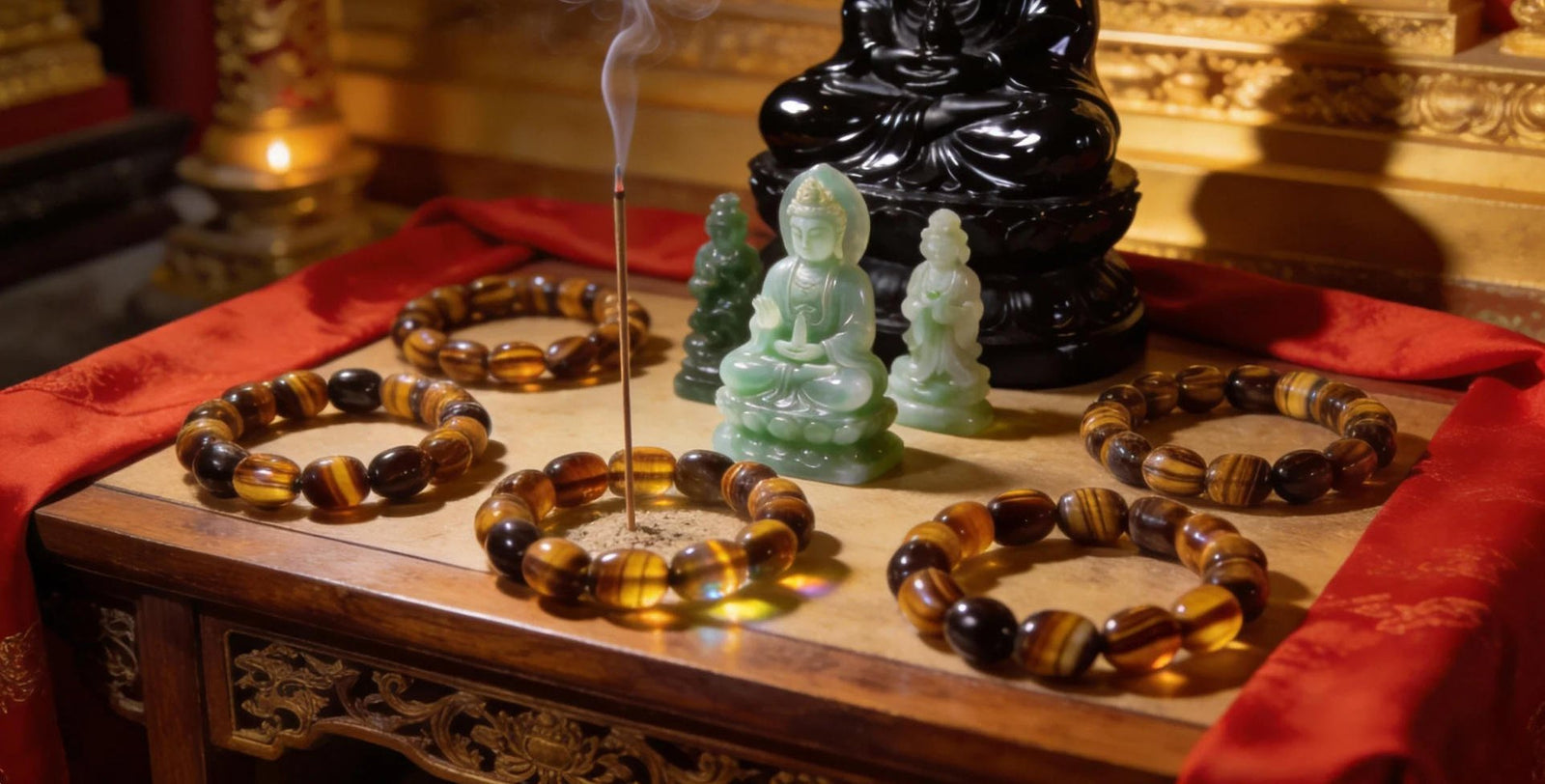
Explore our Golden Tiger's Eye prosperity bracelet.
Common Questions About Guardian Buddha Amulets
Who is my specific Guardian Buddha?
Your guardian is determined by your birth year according to the Chinese zodiac. This ancient system creates a direct karmic link. Here is the complete list for your reference:
- Rat: Avalokiteshvara (The Bodhisattva of Compassion)
- Ox, Tiger: Akasagarbha (The Bodhisattva of Infinite Space and Wisdom)
- Rabbit: Manjushri (The Bodhisattva of Transcendent Wisdom)
- Dragon, Snake: Samantabhadra (The Bodhisattva of Action and Virtue)
- Horse: Mahasthamaprapta (The Bodhisattva of the Power of Wisdom)
- Sheep, Monkey: Vairochana (The Celestial Buddha of Ultimate Reality)
- Rooster: Acala (The Fierce Protector of Buddhist Teachings)
- Dog, Pig: Amitabha (The Buddha of Infinite Light and Life)
Can I wear a Guardian Buddha that isn't for my zodiac sign?
Absolutely. While the zodiac system provides a powerful and traditional starting point for your practice, the ultimate guide is your own heart and intuition.
If you feel a particularly strong, unexplainable connection to Manjushri, even though you were born in the year of the Rat, you should honor that connection. Buddhist practice is not about rigid rules but about what genuinely aids your path to awakening.
The goal is to cultivate these enlightened qualities, and any authentic representation that inspires you is beneficial.
What is the real difference between an amulet and a regular necklace?
The difference lies entirely in intention and symbolism. A regular necklace is primarily an aesthetic accessory. A Guardian Buddha amulet is a spiritual tool.
Its value comes from its sacred iconography, the intention with which it was crafted, and most importantly, the intention with which you wear and use it. It is consecrated, treated with reverence, and actively integrated into your spiritual practice as a daily reminder of your path and potential.
While your Guardian Buddha is a potent starting point, many find resonance with other potent symbols in our collections which are also crafted with this deeper purpose in mind.
How do I cleanse or “recharge” my amulet?
An amulet can accumulate energetic residue over time. You can cleanse it physically and spiritually. Physically, a soft, dry cloth is usually sufficient. Spiritually, you can let it rest in the light of a full moon overnight, smudge it with sage or sandalwood smoke, or place it on a crystal slab like selenite.
However, the most powerful way to "recharge" your amulet is to recharge your own practice. Sit in meditation while holding it, chant its mantra with renewed focus, and reaffirm your intention. The amulet's power is a reflection of your own commitment.
Is it disrespectful to wear Buddhist symbols if I'm not a Buddhist?
This is a question of respect, not rules. If you wear a Guardian Buddha amulet as a mere fashion trend, without understanding or honoring its profound meaning, it could be considered disrespectful.
However, if you are drawn to the teachings of compassion, wisdom, and mindfulness that it represents, and you wear it with a genuine intention to cultivate those qualities in yourself, it is a beautiful and positive act.
The Dharma is for everyone, and using its tools with sincerity and respect is always welcome.
What should I do if my amulet breaks?
Do not see it as a bad omen. In the Tibetan tradition, a broken amulet is often seen as a positive sign. It can signify that the amulet has absorbed a significant amount of negativity or obstacles on your behalf, sacrificing itself for your protection.
It can also mark the completion of a specific karmic cycle in your life. When it breaks, the correct response is gratitude. Thank the amulet for its service to your path. Then, instead of throwing it in the trash, treat it with final respect.
The best practice is to wrap it in a clean cloth and bury it in the earth, returning it to nature.
Your Next Step on the Path
You now understand that a Guardian Buddha amulet is far more than a piece of jewelry. It is a key, a companion, and a mirror for your own innate potential. It is a commitment to walking your life's path with greater awareness, resilience, and compassion.
The protection it offers is not from the outside world, but from the habits of your own mind, guiding you toward the clarity and peace that is your birthright.
Your journey of authentic protection begins with this sacred connection. It starts by identifying the enlightened guardian who has been karmically linked to you since birth. This is your personal gateway to the vast wisdom of the Buddhist path.
We invite you to take the next step. Explore our curated collection to meet the Bodhisattva aligned with your spirit and discover the Guardian Buddha pendant aligned with your path. Find the sacred piece that will serve as your daily reminder of the unwavering strength and wisdom you already possess.
For an additional protection tradition, read the Five Thunder Talisman complete guide.
Keep reading