buddhist-jewelry
Buddhist Jewelry Care & Maintenance Complete Guide: Jad
You hold it in your palm for the first time. Perhaps it’s a string of mala beads, a simple pendant, or an intricately carved bracelet. The first thing you notice is the coolness, a deep and pleasant chill that seems to emanate from its core.
Then you feel its weight—it is substantial, smooth, and feels ancient. As you run your thumb over its polished surface, you sense a quiet resonance, a silent story waiting to be understood. This piece of jade jewelry isn't just an accessory; you feel an immediate, almost instinctual connection to it.
You wonder about its journey, from deep within the earth to your hands. What secrets does it hold? What energy does it carry? And more practically, how do you honor this profound connection by caring for it, ensuring its luster and spirit remain vibrant for a lifetime?
This guide is your answer, a deep get into the world of jade, created for you to understand, connect with, and cherish your sacred object.

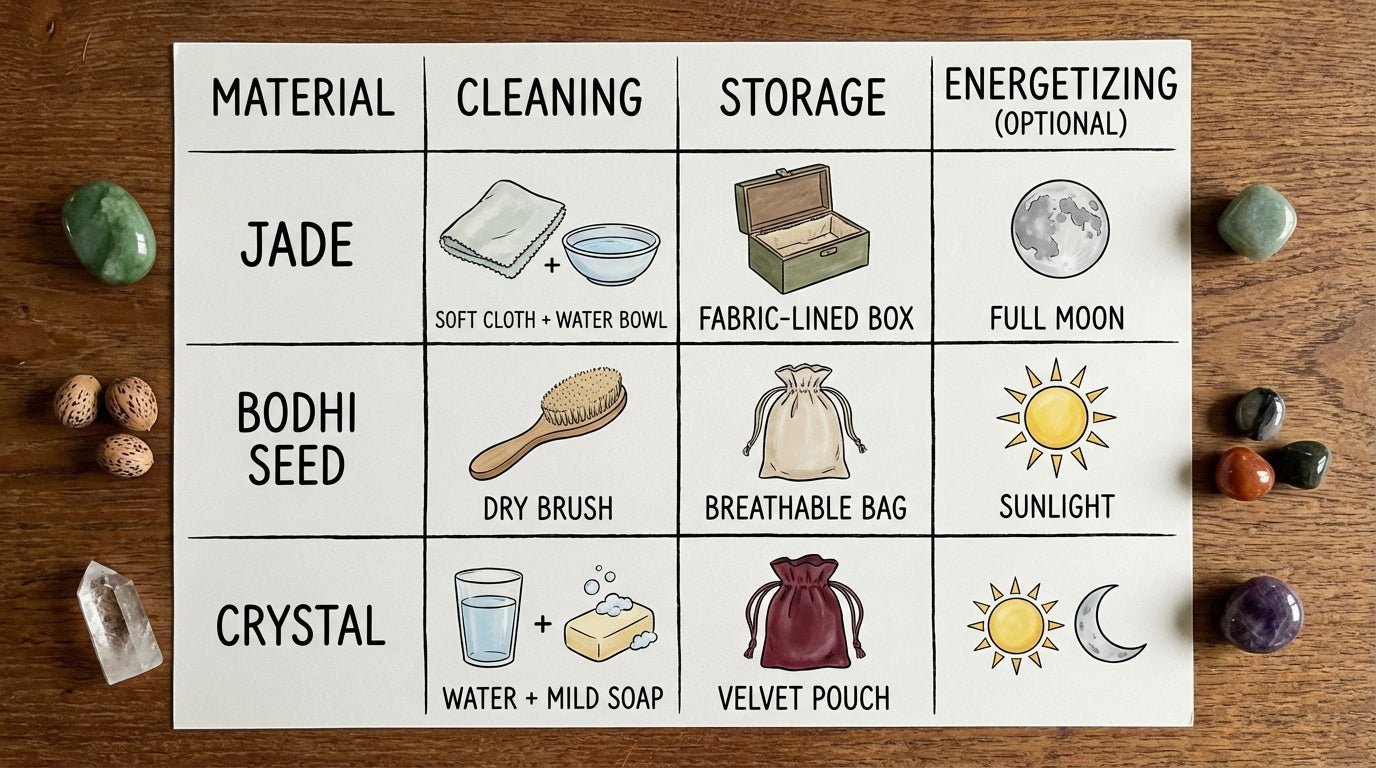
Caring for Buddhist jewelry is mostly about gentleness — keep jade, bodhi seed, and crystal pieces away from harsh chemicals, heat, and long soaks; wipe them softly; and store them somewhere clean and dry.
What Jade Really Is: The Stone of Heaven
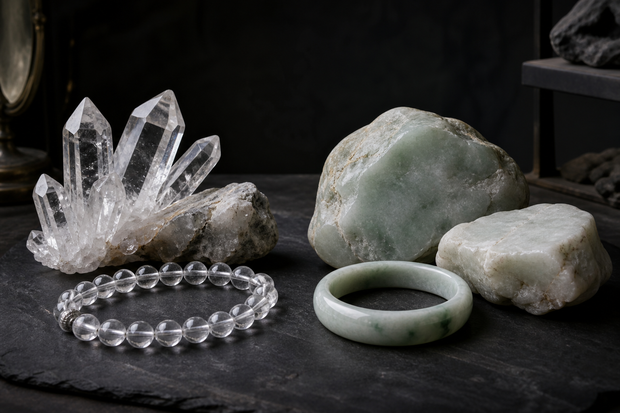
To truly understand your jade, you must first understand that "jade" is not a single entity. It is a name given to two distinct, though related, silicate minerals: Nephrite and Jadeite. Each has its own history, character, and spiritual weight.
Understanding this distinction is the first step in appreciating the profound legacy of your piece.
Nephrite is the stone of ancient China, the original yu (玉). For over 7,000 years, this was the material carved into ritual objects, protective talismans, and symbols of imperial power. Its primary source was the Kunlun Mountains and the riverbeds of Khotan, in modern-day Xinjiang.
Imagine caravans on the Silk Road, carrying not only silk and spices, but these precious stones, imbued with the power of the mountains. Nephrite is incredibly tough—more so than steel—due to its dense, fibrous structure.
This resilience made it a symbol of permanence and incorruptibility. Its colors are typically more subdued: creamy whites, soft celadons, and deep spinach greens. When you hold a piece of nephrite, you are connecting to millennia of history, to emperors and sages who saw in it a bridge between the earthly and the divine.
Jadeite, on the other hand, is a relatively recent discovery in this long history. It was introduced to China from Burma (now Myanmar) in the 18th century during the Qing Dynasty. Its crystalline structure is different, giving it a higher hardness and a more brilliant, vitreous luster.
Jadeite is what most people today picture when they think of fine jade: vibrant, intense "imperial green," delicate lavender, and even rare reds and blacks. Its arrival created a sensation, and it quickly became the most prized variety.
Jadeite's energy is often described as more vibrant and dynamic compared to the quiet, grounding presence of nephrite. It doesn’t replace nephrite’s significance; rather, it adds another dimension to the story of jade.
In the Himalayan regions, both forms of jade were revered. Tibetan culture, with its deep connection to the natural world, saw jade as a sacred substance. It was used in ritual implements and worn as powerful protection against negative forces.
For Buddhists, the stone’s inherent qualities of purity and resilience became metaphors for the enlightened mind—a mind that is both strong and serene, clear and compassionate. When you wear a piece of jade, you are not simply wearing a stone.
You are wearing a piece of the earth that has been a silent witness to history and a constant symbol of the highest human aspirations.
The Deeper Meaning: A Symbol of the Enlightened Heart
Beyond its geological origins and historical prestige, jade carries a profound spiritual resonance within Buddhist philosophy. It is far more than a stone of good luck or fortune; it is a physical intention-setting of core spiritual principles.
Its meaning is woven from its very substance, reflecting the qualities you seek to cultivate on your own path.
In the language of the spirit, jade is intrinsically linked to the heart. Its most common green hues resonate directly with the Anahata, or heart chakra, the center of compassion, love, and emotional balance.
Wearing jade against your skin is believed to gently open and purify this energy center, helping to dissolve emotional blockages and foster a state of unconditional love—for others and, just as importantly, for yourself.
This is why jade is so often associated with Guan Yin (known as Avalokiteshvara in Tibetan Buddhism), the Bodhisattva of Compassion. She who "perceives the sounds of the world" is often depicted holding a jade vase or wearing jade jewelry, symbolizing her ability to offer pure, healing compassion to all beings.
Your jade piece can serve as a constant, tangible reminder of this compassionate potential within you.
The stone is also a powerful symbol of wisdom and purity. Its cool, smooth surface represents a calm and untroubled mind, while its inner translucence speaks to clarity of thought and spiritual insight. In many traditions, jade is seen as a "wisdom stone," believed to help you access your intuitive knowledge and see past the illusions of the ego.
It encourages a state of mental equanimity, allowing you to navigate life's challenges with grace rather than reactivity. This purity is not about being flawless, but about returning to your true, unblemished nature—the Buddha-nature that resides within all of us.
Your jade doesn’t give you these qualities; it helps you remember that you already possess them.
Furthermore, jade is considered a stone of protection. This isn't a superstitious belief but a practical spiritual one. It is thought to create a shield of positivity around the wearer, deflecting negativity and harmonizing the surrounding environment.
In traditional Chinese medicine, jade is known to balance the body's vital life force, or *qi*. A balanced qi leads to physical, mental, and spiritual well-being. The stone is believed to absorb negativity from your aura and transmute it, which is why it is said that a piece of jade worn for a long time can change color as it becomes attuned to you.
It becomes a silent guardian, a companion on your journey that shares your energy and supports your highest good. When you explore our curated collection of authentic pieces, you are seeking more than jewelry; you are searching for a spiritual ally.
Real Benefits for Modern Life: Your Anchor in the Storm
In a world of constant digital noise and emotional flux, the traditional teachings of jade offers tangible, practical support. Its benefits are not abstract concepts; they are real-world tools that you can integrate into your daily life to foster a sense of peace, clarity, and resilience.
Think of your jade pendant or bracelet as a physical anchor for your mindfulness practice. During a stressful day filled with back-to-back meetings and urgent emails, your mind can easily become scattered and overwhelmed.
The simple, conscious act of touching your jade can break that cycle. Feel its coolness against your skin. Notice its smooth, solid presence. Use that sensory input as a cue to take a single, deep breath.
In that moment, you are not in the chaotic future or the regretful past; you are right here, grounded in the present. Your jade becomes a portable sanctuary, a touchstone that instantly reconnects you to your center, allowing you to respond to challenges with calm instead of anxiety.
Jade also serves as a powerful aid for emotional balance. Its connection to the heart chakra helps to soothe turmoil and encourage emotional honesty. When you are grappling with difficult feelings like anger, grief, or frustration, holding your jade can be a profoundly comforting practice.
It encourages you to acknowledge these feelings without judgment, allowing them to flow through you rather than getting stuck. It doesn't magically erase your problems, but it provides a stable, compassionate energy that supports you as you navigate them.
Over time, this practice can help you cultivate a more resilient and harmonious inner landscape, making you less susceptible to the emotional highs and lows of daily life.
Furthermore, wearing jade can enhance your capacity for clear and compassionate communication. As it works to balance your heart energy, it fosters a greater sense of empathy. You may find yourself listening more deeply in conversations, speaking your truth with more kindness, and working through difficult relationships with greater ease.
The wisdom aspect of jade helps cut through mental fog, promoting clarity in your thoughts and intentions. Before an important decision or a difficult conversation, take a moment to hold your jade. Set the intention for clarity and compassion.
This simple ritual can shift your entire approach, leading to more positive and authentic outcomes. By choosing to wear a piece from our entire selection of sacred items, you are making a conscious choice to bring these qualities of clarity and compassion into every interaction.
 — explore our crystal collection for authentic pieces.
How To Spot the Real Thing Jade: A Guide for the Conscious Buyer
Choosing a piece of jade is an intimate and personal process. It is a commitment to a lifelong companion, so ensuring its authenticity is paramount, not only for its monetary value, but for its spiritual integrity.
The market is flooded with imitations and treated stones, but with the right knowledge, you can learn to identify genuine, natural jade.
Your own senses are your first and most reliable tools. First, use your sense of touch. Real jade, whether nephrite or jadeite, is a dense stone that feels cool and smooth against your skin.
It should feel heavier than it looks. When you first pick it up, it will have a distinct coolness that takes a while to warm to your body temperature. Plastic or glass imitations will feel lighter and will warm up almost instantly.
Next, listen. If you have two pieces of real jade (or can test one against another known piece), gently tapping them together should produce a clear, high-pitched, resonant chime, like a tiny bell. A dull, low-pitched thud suggests a less dense material or a treated piece.
Visually inspect the stone closely. Natural jade is rarely, if ever, perfect. Look for tiny internal variations—fibrous or crystalline structures, cloudy patches, or mineral inclusions (often seen as tiny dark specks). These "flaws" are signs of authenticity, the stone's natural birthmarks.
A piece that is perfectly uniform in color and completely free of any internal features is often a sign of imitation or dyeing. Look for a deep, oily luster that seems to glow from within, rather than a superficial, glassy shine that sits on the surface.
This inner glow is a hallmark of high-quality, natural jade.
It is also crucial to understand the treatment grades of jadeite.
- Type A Jade: This is 100% natural, untreated jadeite. It has not been subjected to any chemical treatments, dyes, or polymers. It has only been cut and polished. For any spiritual practice, this is the only type you should seek. Its energy is pure and unadulterated.
- Type B Jade: This jadeite has been soaked in acid to remove impurities and then injected with a polymer resin to enhance its transparency and durability. This treatment compromises the stone's structure and energetic integrity.
- Type C Jade: This jade has been dyed to improve its color. The color is not natural and can fade over time with exposure to light and chemicals.
How to Use and Care For Your Jade: A Lifelong Practice
Your relationship with your jade jewelry is a living one that deepens over time. It begins with intention and is nurtured through mindful use and proper care. This is how you transform a beautiful object into a sacred part of your spiritual path.
When you first receive your jade, take time to form a connection. Find a quiet space where you won't be disturbed. Hold the piece in your hands. Close your eyes and simply feel its presence—its weight, its temperature, its texture.
Breathe deeply and attune your energy to its calm, steady resonance. You may wish to perform a simple cleansing by leaving it in the light of a full moon overnight or by placing it near a singing bowl as you play it.
Then, set an intention for your piece. What do you wish to cultivate with its help? Peace? Compassion? Clarity? Whisper your intention to the stone, infusing it with your purpose.
In your daily life, wear your jade not only as decoration, but as a mindful practice. Throughout the day, let it be a touchstone that brings you back to the present moment. When you feel stressed, touch it.
When you feel grateful, touch it. Let it absorb your energy and reflect back its serene stability. If you have a jade mala, you can use it for mantra recitation. Hold the mala in your left hand (the receiving hand), draped over your middle finger.
Use your thumb to pull each bead towards you as you recite your chosen mantra, such as *Om Mani Padme Hum*. This practice focuses the mind, builds positivity, and deepens your connection with both the mantra and the jade itself.
Proper physical care is an act of respect for your sacred object. Jade is tough, but it can be scratched by harder gemstones like diamonds or sapphires. When you're not wearing it, store your jade in a separate soft pouch or a fabric-lined jewelry box.
The most important rule of care is to protect it from harsh chemicals. Avoid exposing your jade to perfumes, hairsprays, household cleaners, and chlorine from swimming pools. To clean your jade, simply use a soft, damp cloth and lukewarm water.
You can use a very mild, diluted soap if necessary, but be sure to rinse it thoroughly and dry it completely with a soft cloth. Never use ultrasonic cleaners or steam cleaners, as the intense resonance and heat can cause microscopic fractures.
By treating your jade with this gentle reverence, you ensure it will remain a vibrant companion for your entire life's journey. You can shop our authentic jade collection knowing that each piece is crafted to last when cared for with this mindfulness.
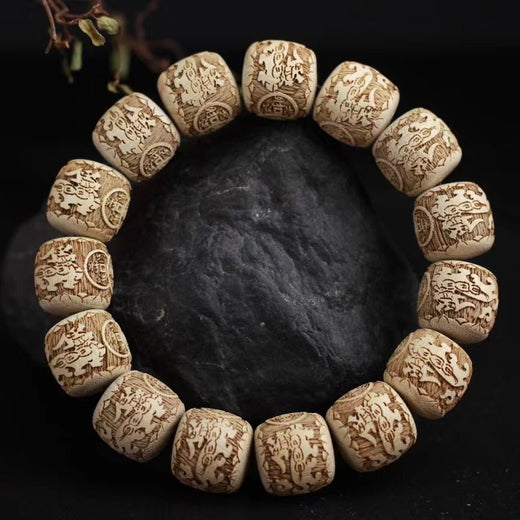
Explore our white jade Bodhi prayer beads.
Common Questions About Jade
Can my jade jewelry change color over time?
Yes, and this is often considered a beautiful and positive sign. Natural, untreated (Type A) jade is slightly porous. As you wear it against your skin, it can slowly absorb your body's natural oils.
This process can deepen its color, enhance its translucency, and increase its luster over many years. In many Asian cultures, this change is highly valued, as it signifies that the jade has attuned to your personal energy, or *qi*, and has become a part of you.
It's a visual representation of the bond you have formed with your stone. A piece that becomes more vibrant and "alive" with wear is a sign of its authenticity and your symbiotic relationship with it.
Is it safe to wear my jade in the shower or while sleeping?
It is best to remove your jade jewelry before showering or sleeping. Soaps, shampoos, and conditioners contain chemicals that can build up on the surface of the jade, creating a dull film that obscures its natural luster.
While jade is a durable stone, repeated exposure to thermal shock (rapid changes from hot to cold water) could potentially stress the stone over a very long period. As for sleeping, while it's not inherently harmful to the stone, wearing bracelets or necklaces can pose a risk of snagging or breaking the cord or chain, especially if you move around a lot in your sleep.
Removing it is a simple precaution to ensure its longevity.
What is the real difference between nephrite and jadeite?
While both are called jade, they are distinct minerals. Nephrite is a calcium magnesium silicate, while jadeite is a sodium aluminum silicate. On the Mohs hardness scale, jadeite is slightly harder (6.5-7) than nephrite (6-6.5), making it more resistant to scratching.
However, nephrite's fibrous structure makes it incredibly tough and resistant to breaking. The most noticeable difference is often in their appearance. Jadeite can occur in a wider and more vibrant range of colors, including the most prized emerald-green "imperial jade," and it tends to have a more glassy, brilliant luster.
Nephrite's colors are typically more muted—creamy whites, celadons, and deep spinach greens—and it has a more subtle, oily or waxy luster. Both are equally significant, with nephrite holding a much longer history in Chinese culture.
How should I "cleanse" my jade's energy?
Energetic cleansing is about refreshing your jade's spiritual vibrancy, not physical cleaning. You should use gentle, natural methods. One of the most common and safest ways is to place your jade in the light of the full moon overnight.
The moonlight is believed to purify the stone without being harsh. You can also use sound; place your jade near a Tibetan singing bowl and let the resonant resonance wash over it. Another method is to rest it on a bed of brown rice for 24 hours, as the rice is thought to absorb any accumulated negativity.
Always follow your intuition. The most important element of any cleansing is your intention to purify and restore the stone.
Which hand is the "correct" hand to wear a jade bracelet on?
In traditional Chinese energy philosophy, there are different beliefs about this. The most common perspective is that the left hand is the "receiving" hand, the side through which you absorb energy into your body.
Wearing jade on your left wrist is believed to draw its healing, calming, and protective energies inward. The right hand is considered the "giving" or "projecting" hand, the side through which you give energy out to the world.
Therefore, wearing it on the right might be for projecting its qualities of compassion and wisdom outward. There is no single "correct" answer. We recommend you start by wearing it on your left wrist, but ultimately, trust your own intuition.
Pay attention to how you feel and wear it on the hand that feels most natural and beneficial to you.
My jade piece broke. What does this mean?
In many traditions, a piece of jade breaking is not seen as a bad omen, but as the ultimate act of protection. It is believed that the jade sacrificed itself to protect you from a significant misfortune, accident, or influx of negativity.
It absorbed the harm that was meant for you, and in doing so, its purpose in your life was fulfilled. You should thank the piece for its service and protection. It is not recommended to repair or continue wearing a broken piece.
The traditional practice is to return it to the earth. You can bury it in your garden or in a potted plant, giving its physical form back to nature while carrying its spirit and its lesson with you.
Your Next Step on the Path
You now hold more than a stone; you hold a key to its history, its spirit, and its power to enrich your life. Understanding your jade is the first step, but the true journey begins when you integrate it into your daily practice.
Let it be your quiet companion, your reminder of the calm and compassionate heart that resides within you. This is not the end of your learning, but a new beginning. Let your curiosity guide you as you continue to explore the profound world of these sacred objects.
The right piece will feel like coming home, a reflection of your own inner light. We invite you to explore all to find the companion that is waiting to join you on your path.
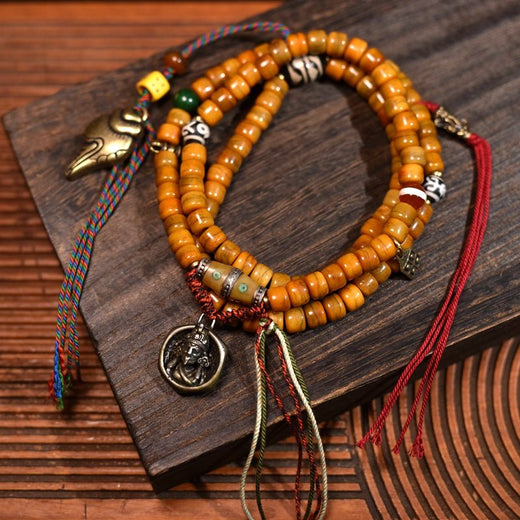
For mala practitioners, you can browse our Tibetan 108-bead mala collection to find a piece worth caring for over a lifetime.
Keep reading