
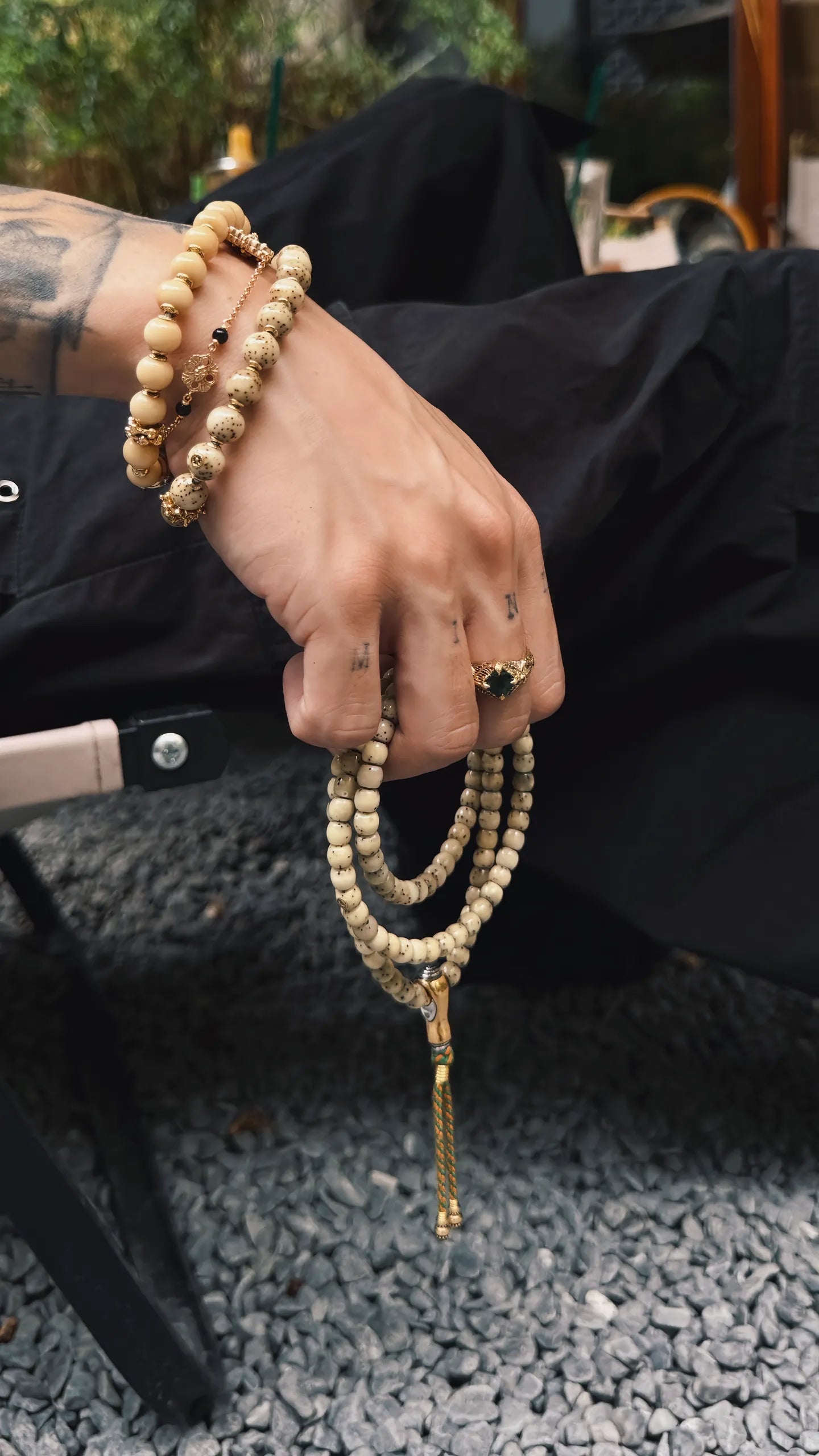
Your First Mala: A Sacred Guide
You feel the call to deepen your practice, to find a tangible anchor for your intentions. You've seen malas—those elegant strands of 108 beads—adorning the wrists of yogis or resting in the hands of meditators.
But where do you begin? With so many materials, sizes, and styles, choosing your first mala can feel as complex as the meditation itself. Let this be your guide. We will walk you through the simple, heartfelt process of selecting a mala that doesn't just look beautiful, but feels like an extension of your spiritual self.

Choose Your First Mala is your First Mala: A Practical Guide to Choosing the Perfect Prayer Beads Your First Mala: A Practical Guide to Choosing the Perfect Prayer Beads You feel the call to deepen your practice, to find a tangible anchor for your intentions.
The Soul of the Mala: more than Beads
Before you choose, it's vital to understand what you're holding. A mala is not mere decoration; it is a sacred tool, a spiritual abacus that has been used for millennia to focus the mind and connect with the divine.
Its origins trace back to ancient India around the 8th century B.C.E., where they were known as japa beads, used for the meditative practice of reciting mantras or names of a deity. As Buddhism blossomed and traveled across Asia, the mala was adopted and integrated, becoming an indispensable part of Tibetan, Chinese, and Japanese spiritual life.
The anatomy of a mala is itself a lesson in mindfulness. The most prominent feature is the circle of 108 beads. This number is sacred, not arbitrary. It resonates across spiritual traditions and cosmic philosophies.
In Tibetan Buddhism, it's said there are 108 kleshas, or earthly afflictions, to overcome on the path to enlightenment. In yogic tradition, there are 108 marma points, or sacred confluences of life force, in the body.
The diameter of the Sun is about 108 times the diameter of the Earth. The number connects you to a universal rhythm, a cosmic heartbeat. A full circle of 108 repetitions provides a rhythmic, moving meditation.
With each breath, you gently move one bead, keeping your mind focused and your heart centered.
Beyond the 108, you will find the guru bead. This is the larger, often more decorative bead that sits apart from the main loop. It represents the student-guru relationship, the wisdom of your teachers, and the ultimate awareness you seek.
It is the start and end point of your meditation. You do not cross the guru bead; instead, you pause, offer gratitude, and if you wish to continue, you turn the mala around and go back the way you came.
Finally, the tassel or knot that extends from the guru bead symbolizes the connection to the divine and the oneness of all things. It is the lotus flower of a thousand petals, representing enlightenment.
This isn't a bracelet; it's a tool for transformation, a physical map of your spiritual journey.
An Invitation to Your Senses: Choosing Your Mala's Material
A mala is a profoundly sensory experience. It rests against your skin, its weight is a constant presence in your palm, and its texture grounds you in the present moment. The material you choose is your first and most intimate connection to your mala.
Forget the overwhelm of endless options and instead, focus on what resonates with you. Close your eyes and imagine the feel of each material. Which one calls to you? Which one feels like home?
Seeds: A Connection to Growth and Enlightenment
Seeds are the very essence of potential. They hold the blueprint for life and represent the journey from a humble origin to full, magnificent expression. Malas made from seeds are often lightweight and carry a deep, organic energy.
- Bodhi Seed: This is the classic, quintessential material for a Buddhist mala. These seeds come from the Ficus religiosa tree, the very species of tree under which Prince Siddhartha sat and attained enlightenment, becoming the Buddha. They are not seeds from the actual, original Bodhi tree, but from its descendants. Using a Bodhi seed mala is a direct nod to the potential for enlightenment within you. These seeds are lightweight, porous, and with every touch, they absorb the oils from your skin, developing a unique, dark patina over years of use. Your Bodhi seed mala becomes a living record of your devotion, a personal archive of your journey. It is ideal for long meditation sessions and for those who appreciate a classic, minimalist aesthetic.
- Rudraksha Seed: Though more closely associated with Hinduism and the god Shiva, Rudraksha seeds are widely used by Buddhist practitioners as well. The name translates to "Tears of Shiva," and the seeds are believed to offer protection and calm the nervous system. Their uniquely textured, multi-faceted surface provides a wonderful tactile sensation during japa, helping to keep the mind from wandering. They are powerful, energetic beads that are perfect for anyone seeking focus and a shield against negativity.
Wood: Grounding, Aromatic, and Serene
Wooden malas connect you to the earth's stable, nurturing, and life-giving energy. They are often warm to the touch and can be incredibly aromatic, adding another sensory layer to your practice.
- Sandalwood: For a meditation that begins before you even start. Sandalwood malas are beloved for their distinct, sweet, and woody fragrance, which has been used for centuries in spiritual ceremonies to purify spaces and calm the mind. The scent itself is a tool for mindfulness, gently pulling your awareness back to the present moment each time you notice it. Sandalwood is believed to soothe nervous tension, promote tranquility, and attract positive resonance. It is a serene companion for anyone looking to cultivate a peaceful and centered mind.
- Rosewood: A beautiful, dark wood that is associated with the heart chakra. Rosewood carries a gentle, compassionate energy. It is known for its healing properties, both for the physical body and the emotional self. If your practice is centered on cultivating self-love, compassion for others, or healing from past wounds, a Rosewood mala can be a powerful ally. It has a smooth, comforting feel and a subtle, pleasant scent.
Bone: A Tibetan Reminder of Impermanence
In Tibetan Buddhism, materials like bone are not seen as morbid but as profound teaching tools. They serve as a constant reminder of impermanence (anicca), one of the core tenets of the Dharma.
Meditating on impermanence helps to release attachment and live more fully in the present.
- Yak Bone: For a deep, earthy connection to the heart of Tibetan tradition. Hand-carved yak bone malas have a substantial, comforting weight and a slightly textured, organic feel. The yak is an essential animal on the Tibetan plateau, embodying strength, stability, and endurance. A yak bone mala is revered as a powerful protector, carrying the stable, enduring energy of the high Himalayas. It reminds you of the preciousness of this life and encourages you to practice with diligence and purpose. Each bead is unique, a a sign of its handcrafted origin.
Gemstones: Crystalline Energy for Specific Intentions
Gemstone malas combine the traditional structure of prayer beads with the energetic properties of crystals. Each stone vibrates at a unique frequency, offering support for specific spiritual or emotional goals. Choosing a gemstone mala allows you to align your tool directly with your intention.
- Lapis Lazuli: A stone of royalty, wisdom, and truth, deeply revered in ancient Egypt, Persia, and Tibet. Its deep celestial blue, often flecked with golden pyrite, is like a starry night sky. Lapis Lazuli is said to stimulate the third eye and throat chakras, enhancing intuition, spiritual insight, and clear communication. It is a powerful stone for seekers of truth and those wishing to connect with their inner wisdom.
- Turquoise: A sacred stone of protection and healing, especially significant in Tibetan and Native American cultures. It is believed to be a bridge between heaven and earth, promoting spiritual attunement and purification. Turquoise is a protective talisman, shielding the wearer from negative energy. It also encourages wholeness, truth, and clear communication from the heart.
- Amethyst: This beautiful purple quartz is a stone of spiritual awareness and tranquility. It is known for its ability to calm the mind, soothe anxiety, and prepare the consciousness for meditation. Amethyst is connected to the crown chakra, facilitating a connection to higher states of awareness and divine wisdom. It's an excellent choice if your goal is to reduce stress and deepen your meditative state.
As you explore these possibilities, let your intuition guide you. The mala that is right for you will feel right. You can explore a wide variety of these authentic materials in our collection of Tibetan Mala Beads.
Aligning with Intention: What Is Your Spirit Seeking?
Choosing a mala is not an intellectual exercise; it is an intuitive process. The most powerful mala for you is the one that resonates with the deepest calling of your heart at this moment in your life.
Instead of getting lost in the details of every material, try approaching the choice from a different angle. Ask yourself: What energy do I want to cultivate? What is my primary intention for my practice right now?
If you are seeking grounding and stability...
Life can often feel chaotic and unmoored. If you find your thoughts scattering or feel a sense of anxiety, you may be seeking to reconnect with the earth's steady, supportive energy.
A grounding mala can be a physical anchor, reminding you to breathe and come back to your center.
- Consider: Yak Bone for its deep connection to the enduring Tibetan landscape; Tiger's Eye for its stabilizing energy that fosters courage and focus; or Rosewood for a gentle, heart-centered grounding. These materials have a weight and substance that feel reassuring in your hand.
If your goal is clarity, focus, and enlightenment...
Perhaps your path is one of dedicated study and practice. You seek to cut through the fog of confusion and see things as they truly are.
Your intention is to sharpen your mind, deepen your concentration, and walk the path toward wisdom.
- Consider: Bodhi Seed, the ultimate symbol of enlightenment, to connect you directly with the Buddha's journey; Sandalwood, whose aroma clears the mind and enhances concentration; or Clear Quartz, a master amplifier that clarifies thought and magnifies your intention.
If you wish to cultivate compassion and healing...
Your spiritual work may be focused on opening your heart, both to yourself and to others. You might be healing from past hurts or actively trying to cultivate metta (loving-kindness) and karuna (compassion).
Your mala can be a tool for this gentle, powerful work.
- Consider: Rose Quartz, the quintessential stone of unconditional love; Turquoise, for its whole-being healing and heart-centered communication; or Amazonite for soothing emotional trauma and alleviating worry.
If you are deepening your connection to tradition...
You may feel a strong pull toward the ancient lineage and wisdom of the Tibetan Buddhist path. Your desire is to use a tool that is authentic and steeped in the history of the Dharma, one that connects you to the generations of practitioners who came before you.
- Consider: Yak Bone or Bodhi Seed, as these are two of the most traditional and significant materials used in Tibetan malas. Lapis Lazuli is also a powerful choice, as it has been a treasured stone in Tibet for centuries, often ground into powder to paint sacred thangkas.
Let your current life circumstances and spiritual aspirations be your compass. The right mala will feel like a supportive friend on your path. Feel free to browse our entire collection to see which one speaks to your unique intention.

The Practicalities of Practice: Size, Style, and Wear
Beyond material and intention, a few practical considerations will ensure your mala is a perfect fit for your hands and your lifestyle. These details affect how the mala feels during meditation and how you might incorporate it into your daily life.
Bead Size: Finding Your Tactile Sweet Spot
Mala beads typically come in three common sizes: 6mm, 8mm, and 10mm. The difference may seem small, but it has a significant impact on the feel and use of the mala.
- 6mm beads: These create a lighter, more delicate mala. They are less obtrusive and can be comfortably worn as a necklace. During meditation, the smaller beads require a more precise touch, which can be a meditative practice in itself. They are excellent if you have smaller hands or prefer a more subtle feel.
- 8mm beads: This is the most popular and versatile size. It offers a perfect balance: the beads are substantial enough to feel distinct in your hand as you count them, but the mala is not overly heavy or bulky. It can be easily worn or carried. If you are unsure where to start, 8mm is an excellent choice.
- 10mm beads: These larger beads create a weighty, powerful-feeling mala. The size and space between them make it very easy to track your mantra repetitions without looking. This size is ideal for those who prefer a more substantial, tactile anchor during their practice or for individuals with larger hands.
Knotted vs. Unknotted: The Space Between Breaths
You will notice that some malas have a small, hand-tied knot between each bead, while others are strung continuously. This is more than a stylistic choice.
- Knotted Malas: The knot serves a practical purpose. It creates a consistent space between the beads, making it easier to move from one to the next with your thumb during japa. This rhythmic spacing can help you maintain a steady pace. The knots also add tremendous durability to the mala; if it were ever to break, you would only lose one bead, not all 108. This is the traditional Tibetan style.
- Unknotted Malas: These malas have a more fluid, draping quality. The beads sit directly next to one another. While they can be slightly more challenging for mantra counting, some people prefer their simpler aesthetic and the way they feel.
Full Mala vs. Wrist Mala
While the traditional mala has 108 beads, you will also find wrist malas, often called "power bracelets." These are not only fashion accessories; they are functional, portable tools for practice.
A wrist mala is a smaller version, typically with 21 or 27 beads (divisors of 108), allowing you to complete several rounds to reach 108. They are perfect for on-the-go mindfulness, allowing you to easily recite a few mantras while waiting in line, sitting in traffic, or during a stressful moment at work.
Many practitioners own both a full mala for their formal sitting practice and a wrist mala for daily wear. You can explore our view our bracelet collection.
Awakening Your Mala: Cleansing and Consecrating Your New Tool
When your mala arrives, it is more than an object you've purchased. It is a spiritual companion that has been on a journey to reach you, passing through many hands and environments. The first step in making it truly yours is to cleanse it of any lingering energies and then awaken it with your own personal intention.
Cleansing Your Mala
Think of this as wiping the slate clean, preparing the vessel for your unique spiritual energy. There are several gentle and effective ways to do this. Choose the one that feels most natural to you.
It's important to avoid soaking wood or seed beads in water, as this can damage them over time.
- Smudging: This is a traditional method using the smoke of sacred plants. Light a bundle of sage, palo santo, or cedar and allow the smoke to smolder. Pass your mala through the smoke several times, turning it over so every bead is bathed in the purifying smoke.
- Sound Bathing: Sound is a powerful energetic cleanser. You can place your mala inside or next to a Tibetan singing bowl and gently strike the bowl, allowing the resonant resonance to wash over the beads. The sound of a tingsha or bell can also be used.
- Moonlight: The gentle, feminine energy of the moon is a wonderful cleanser. Place your mala on a windowsill or outside where it can bathe in the light of a full or new moon overnight.
Setting Your Intention (Consecration)
Once your mala is cleansed, it is ready to be infused with your purpose. This simple ritual formally dedicates your mala to your practice and transforms it from a strand of beads into a sacred tool.
- Find a quiet, peaceful space where you will not be disturbed.
- Sit comfortably and take a few deep, centering breaths.
- Hold your new mala in both hands at your heart center.
- Close your eyes and bring your intention to mind. What do you seek? Is it peace? Clarity? Compassion? Strength?
- You can state your intention aloud or silently. You might say something like, "I dedicate this mala to the cultivation of compassion for all beings," or "May this mala be a tool that guides me toward clarity and wisdom."
- Spend a few moments meditating with this intention, allowing its energy to permeate the beads. You can even go through one full round of 108 breaths or a simple mantra like "Om" to seal your intention.
Your mala is now awake and ready to accompany you on your path.
Weaving the Mala into Your Life: How to Use Your Prayer Beads
The primary use of a mala is for japa, the practice of mantra repetition. This ancient technique helps to focus the wandering mind, making it an incredibly accessible and powerful form of meditation, even for beginners.
Here is a simple guide to begin your practice:
- Find a Comfortable Position: Sit in a way that allows your spine to be straight but not rigid. You can be on a cushion on the floor or in a chair.
- Hold Your Mala: Traditionally, the mala is held in the right hand, draped over your middle finger. The left hand can rest gently in your lap. The index finger is sometimes thought to represent the ego, so it is not used to touch the beads; instead, you use your thumb.
- Choose Your Mantra: A mantra is a sacred sound, word, or phrase that you repeat. It can be in Sanskrit, like the universal mantra Om Mani Padme Hum (the mantra of compassion), or it can be a simple affirmation in your own language, such as "I am peaceful" or "Breathe in, breathe out."
- Begin at the Guru Bead: Start with the first bead next to the guru bead. Hold it between your thumb and middle finger.
- Recite and Move: Recite your chosen mantra once, either aloud or silently. After one full recitation, use your thumb to pull the next bead toward you, and recite the mantra again.
- Continue the Cycle: Continue this process, moving from one bead to the next, until you have completed all 108 repetitions and have arrived back at the guru bead. The rhythmic movement and sound will help anchor your attention.
- Pause and Reflect: When you reach the guru bead, do not cross over it. This is a moment to pause. Offer gratitude to your teachers, to the practice, and to yourself. If you plan to do another round, simply flip the mala around and continue in the opposite direction.
Beyond formal meditation, your mala can be a constant companion. Wear it as a necklace or wrap it around your wrist as a physical reminder of your intention throughout the day. When you feel stressed, you can simply hold it in your hand, its familiar weight and texture a comforting anchor to bring you back to the present moment.
Caring for Your Sacred Companion
Your mala will become a cherished part of your spiritual life, and with a little care, it can last for many years. Treat it with the respect you would any sacred object.
- Storage: When you are not using or wearing your mala, store it in a safe and special place. A small silk or cotton pouch is ideal. You can also place it on your personal altar or another clean, respected surface. Avoid leaving it on the floor.
- Cleaning: Over time, your mala will absorb oils from your skin. You can gently clean the beads by wiping them with a soft, slightly damp cloth. Avoid harsh chemicals or soaps, especially on wood and seeds.
- What to Do If It Breaks: It is not uncommon for a mala to break after long and dedicated use. In Buddhist tradition, this is not seen as a bad omen. On the contrary, it can symbolize a breakthrough in your practice, the release of a karmic cycle, or the fulfillment of the intention you set for the mala. It is a moment for reflection, not sadness. You can gather the beads and have the mala re-strung, perhaps with a new guru bead or tassel, to symbolize a new intention and a new chapter in your journey.
By choosing your first mala with intention, awakening it with purpose, and using it with devotion, you are not only acquiring a beautiful piece of spiritual jewelry. You are welcoming a powerful ally, a patient teacher, and a constant companion for your path toward greater peace, wisdom, and compassion.
Your Questions Answered
- Can anyone use a mala, or is it only for Buddhists?
- Anyone can use a mala. While it has deep roots in Buddhist and Hindu traditions, it is fundamentally a tool for mindfulness and meditation. People from all spiritual paths and walks of life use malas to help focus the mind, reduce stress, and set intentions. The key is to approach the practice with respect and sincerity.
- What do I do if my mala breaks?
- A breaking mala is traditionally viewed as a positive sign, symbolizing a spiritual breakthrough or the completion of a cycle. It means the mala has absorbed and helped you work through the energy it was meant to. You can see it as a celebration. You can gather the beads to have it restrung, often with a new intention, or you can return the beads to the earth as an offering.
- How do I choose a mantra to use with my mala?
- Your mantra can be traditional or personal. A good starting point is a universal Sanskrit mantra like "Om," representing the sound of the universe, or "Om Mani Padme Hum," the mantra of compassion. Alternatively, you can create a personal affirmation in your own language that resonates with your intention, such as "I am calm and centered" or "May I be filled with loving-kindness." Choose something that feels good to you and is easy to remember.
- Can I wear my mala as jewelry?
- Absolutely. Wearing your mala is a wonderful way to keep your intentions close to you throughout the day. It can serve as a physical reminder to be mindful, compassionate, and present. When wearing it, simply treat it with care and respect, avoiding activities that might cause it to get snagged or damaged, like strenuous exercise or swimming.
- Does my mala have to have 108 beads?
- A traditional full-length mala used for japa meditation has 108 beads. This number is sacred and provides a complete cycle for mantra practice. However, wrist malas with 21 or 27 beads are also very common and practical. These allow you to complete multiple rounds to reach 108 while being more portable for daily use. The most important thing is that the tool serves your practice.


