
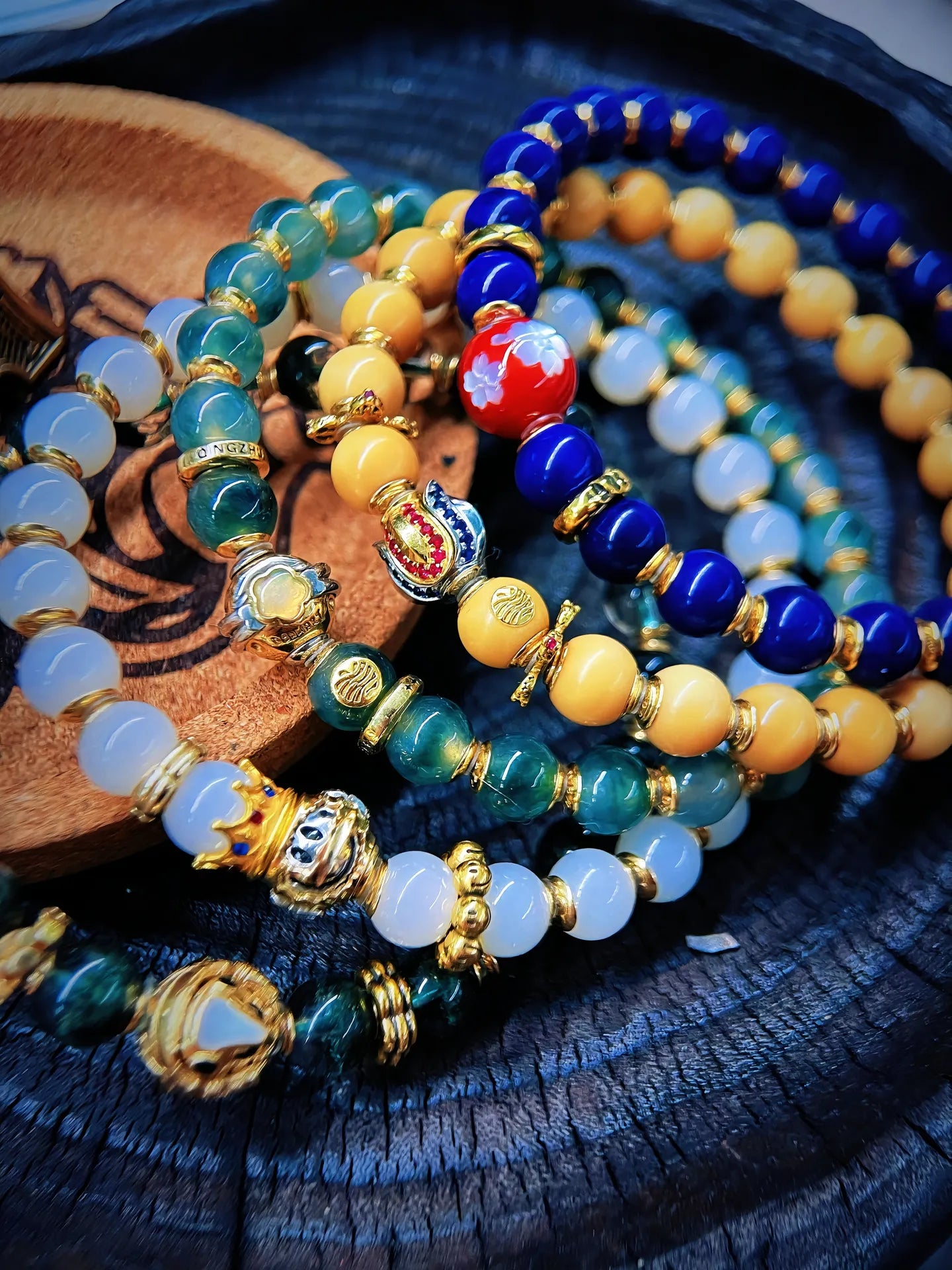
Choosing a Mala: The Ultimate Guide
You’ve seen them draped over a yogi’s hands or glimpsed them in a quiet meditation space. A mala—a string of 108 beads—whispers of ancient traditions, mindful pauses, and a personal sanctuary you can carry in your palm.
For you, that whisper has become a call. It’s a pull towards something deeper, a desire for a tangible connection to your inner world. But now you stand before a forest of choices: rudraksha, bodhi seed, amethyst, sandalwood.
The question isn't just "which one is beautiful?" but "which one is mine?" This isn't about finding a piece of jewelry; it's about meeting a spiritual companion. Your first mala should feel like a homecoming, not a homework assignment.
Let's walk this sacred path together, bead by bead.

How To Choose Your is the Beginner's Heart: Your Essential Guide to Choosing Your First Mala The Beginner's Heart: Your Essential Guide to Choosing Your First Mala You’ve seen them draped over a yogi’s hands or glimpsed them in a quiet meditation space.
A Whisper Through Time: The Ancient Roots of the Mala
Before you choose your mala, it helps to understand the profound history held within its simple, circular form. This string of beads is not a recent invention; it is an ancient technology for the soul, with roots stretching back over 3,000 years to ancient India.
The word "mala" (माला) is Sanskrit for "garland," the same way a garland of flowers is an offering of devotion. A mala is an offering of your attention, your breath, and your intention.
Originally used in Hindu and Jain traditions for the practice of japa, the meditative repetition of a mantra or divine name, the mala was a practical tool. It allowed a practitioner to keep count of their recitations without consciously focusing on the number, freeing the mind to immerse itself fully in the sound and resonance of the mantra.
When Buddhism emerged from this rich spiritual landscape, it naturally adopted this powerful tool, and the japa mala became an integral part of Buddhist practice across Asia, from the mountains of Tibet to the temples of Japan.
But why 108 beads? This number is deeply sacred and significant across numerous Eastern philosophies and spiritual traditions. The reasons are as varied as they are beautiful, creating a rich weave of meaning:
- The Nature of the Mind: In Buddhist thought, it's said there are 108 earthly desires or defilements (kleshas) that create suffering. These include things like greed, anger, and ignorance, which cloud our true, enlightened nature. Each repetition of your mantra on a bead is a conscious act of transforming one of these defilements, a step-by-step journey from suffering to liberation.
- Cosmic Connection: The universe itself seems to echo the importance of 108. The average distance of the Sun and the Moon to Earth is roughly 108 times their respective diameters. Ancient astronomers and yogis saw this cosmic harmony as a reflection of the interconnectedness of all things—the macrocosm of the universe reflected in the microcosm of your being.
- The Body's Energy: In yogic and Ayurvedic traditions, it is believed there are 108 major energy lines, or nadis, that converge to form the heart chakra (Anahata). Using a mala is seen as a way to connect with and purify this central point of compassion and love within your own body.
- The Breath of Life: Some yogic texts state that if you can calm your breath to the point where you are only taking 108 breaths in a day, you will achieve enlightenment. While a profound feat, it points to the deep connection between the mala, the breath, and the pursuit of higher consciousness.
When you hold a 108-bead mala, you are not only holding a string of beads. You are holding a map of the cosmos, a guide to your own inner landscape, and a tool that has been blessed by the intentions of millions of practitioners over thousands of years.
You are becoming part of a timeless lineage of seeking.
Your Inner Compass: Clarifying Your Intention
Before you look at a single bead, the most crucial step is to turn your gaze inward. The most powerful mala is not the one made from the rarest stone, but the one that resonates with the deepest need of your heart right now.
Your intention is the compass that will guide you to your perfect spiritual tool. Let's create a quiet space for this exploration.
Close your eyes. Take a few deep, slow breaths, allowing your shoulders to soften. Place a hand on your heart and feel its gentle rhythm. Now, ask yourself: What need brought me here? What am I truly seeking?
Don't search for a perfect or "spiritual" sounding answer. Be honest. Be gentle. Your true intention might be found in one of these quiet callings:
- For the Anxious Heart Seeking Calm: Is your mind a whirlwind of to-do lists, worries, and what-ifs? Do you long for a sense of peace, a moment of stillness in the storm? Your intention might be "calm," "peace," or "grounding." You are seeking a tool to soothe a restless, anxious mind and anchor you in the present moment.
- For the Focused Mind Seeking Clarity: Are you a student, an artist, a professional, or anyone trying to bring a project to life? Do you struggle with distraction, procrastination, or mental fog? Your intention could be "focus," "clarity," or "creativity." You need a tool to help you cut through the noise and anchor your wandering thoughts.
- For the Healing Spirit Seeking Wholeness: Are you working through a difficult life transition, mending a broken heart, or learning to practice self-compassion? Your journey might be about emotional healing, forgiveness, or self-love. Your intention could be "healing," "love," or "compassion." You are looking for a tangible reminder of your own resilience and capacity for love.
- For the Courageous Explorer Seeking Strength: Do you feel you are entering a new chapter that requires bravery and confidence? Are you working to overcome fear or to stand more firmly in your own power? Your intention might be "strength," "courage," or "protection." You need a touchstone to remind you of the unshakeable strength you already possess.
- For the Spiritual Seeker Deepening Practice: Perhaps your goal is more directly connected to your spiritual path. You might be looking to deepen your meditation practice, connect with your intuition, or explore higher states of consciousness. Your intention could be "awakening," "wisdom," or "connection."
Your intention is the seed. The materials of the mala are the fertile soil that will help it grow. Hold this intention in your heart as we now explore the map of materials.
The Soul of the Stone, The Spirit of the Seed: a closer Look at Materials
A mala’s material is not inert. It has a texture, a weight, a history, and an energy that has been shaped by the Earth over millennia. Each type of wood, seed, or stone carries a unique resonance that can support and amplify your specific intention.
As you read through these descriptions, notice what you feel. Which story calls to you? Which energy feels like the support you need right now? Run your fingers over these words and see what resonates.
Seeds & Woods: The Earth's Wisdom
Bodhi Seed (The Awakener): These are not technically seeds from the Bodhi tree (Ficus Religiosa) itself, but from a related species. The name honors the sacred tree under which Siddhartha Gautama, the historical Buddha, attained enlightenment.
Bodhi seeds are humble, lightweight, and often have small, natural imperfections. Feeling their subtle, organic texture under your thumb is a constant, gentle reminder of your own innate potential for awakening and wisdom. They darken and become smoother with time, absorbing the oils from your skin and the energy of your practice, becoming a living record of your journey.
Choose a Bodhi Seed mala if your path is one of spiritual curiosity, a desire to connect to the roots of the practice, and the pursuit of your own enlightenment.
Rudraksha (The Protector): Legend tells that when the Hindu deity Lord Shiva awoke from a long meditation and saw the suffering of the world, he shed a single tear. From this tear, the Rudraksha tree grew.
"Rudra" is another name for Shiva, and "aksha" means eye. These potent seeds, characterized by their distinct, grooved surfaces (mukhis), are revered for their powerful grounding and protective energy. They are said to shield the wearer from negativity and create a cocoon of personal energy.
Holding a Rudraksha mala feels ancient and powerful, connecting you to a primal, earthly strength. Choose this if your intention is protection, courage, and a deep, unshakable sense of stability.
Sandalwood (The Meditator): For centuries, the fragrant aroma of sandalwood has filled temples and meditation halls. Its scent is naturally calming, known to quiet the mind and promote a state of tranquility, making it an ideal aid for meditation.
The wood itself is smooth and soothing to the touch. A Sandalwood mala is a multi-sensory experience; its gentle weight and serene fragrance serve as a constant invitation to return to your breath and to the present moment.
Choose this if your primary intention is to cultivate a peaceful mind, deepen your meditation, or find moments of calm throughout a busy day.
Gemstones: The Earth's Heartbeat
Amethyst (The Intuitive): This beautiful purple quartz is a stone of spiritual awareness and tranquility. Known as a natural stress reliever, Amethyst is believed to calm the mind, soothe irritability, and balance mood swings.
It’s a stone that encourages you to turn inward, enhancing intuition and connecting you to a higher state of consciousness. It’s perfect for those seeking to quiet mental chatter and access their own inner wisdom.
Choose Amethyst if your intention is calm, stress relief, or the deepening of your spiritual intuition.
Rose Quartz (The Compassionate): The soft, gentle pink of Rose Quartz is the universal stone of unconditional love. Its energy is nurturing, comforting, and deeply healing for the heart. It encourages compassion, forgiveness, and acceptance—not only for others, but most importantly, for yourself.
It’s a wonderful companion for anyone on a journey of emotional healing, recovering from grief, or learning to practice radical self-love. Choose Rose Quartz if your intention is healing, compassion, or opening your heart to give and receive love more freely.
Lapis Lazuli (The Truth-Seeker): With its deep celestial blue and flecks of golden pyrite, Lapis Lazuli has been prized by royalty and spiritual seekers for millennia. It is a stone of truth, wisdom, and clear communication.
It stimulates the throat chakra, encouraging you to speak your truth with clarity and confidence. It also activates the third eye, enhancing intellectual ability and the quest for knowledge. Choose Lapis Lazuli if your intention is to live more authentically, communicate more clearly, or connect with your innate wisdom.
Tiger's Eye (The Warrior): This stone, with its mesmerizing bands of gold and brown, carries the energy of the tiger—focused, courageous, and patient. Tiger's Eye is a powerful grounding stone that also enhances focus and willpower.
It helps you see situations with clarity, free from emotional confusion, and gives you the courage to take decisive action. It is an excellent tool for overcoming fear and achieving your goals. Explore our full range of mala beads to see these powerful materials brought to life.
Choose Tiger's Eye if your intention is focus, courage, and personal empowerment.
Black Onyx (The Guardian): Sleek, solid, and deeply protective, Black Onyx is a stone of grounding and strength. It is known for its ability to absorb and transform negative energy, acting as a protective shield for your energetic field.
It provides support during times of stress, confusion, or grief, helping to build emotional and physical stamina. Holding Black Onyx feels like planting your feet firmly on the earth. Choose this powerful stone if your intention is protection, grounding, and building inner strength.

Beyond the Beads: Understanding Mala Anatomy
A traditional mala is more than a string of 108 beads. Each component has a specific purpose and a symbolic meaning that enriches your practice. Understanding this anatomy deepens your connection to the tool.
The 108 Beads: This is the main body of the mala, the path you travel with your fingers and your mantra. Each bead represents a single recitation, a single breath, a single moment of mindfulness.
The circular nature of the mala symbolizes the cyclical nature of life, death, and rebirth.
The Guru Bead: The 109th bead, which is often larger or distinct from the others, is called the Guru or Meru bead. "Guru" means teacher, and this bead represents the teacher or the wisdom that guides you.
In a physical sense, it signals the start and end point of your 108 recitations. When you reach the Guru bead during your meditation, you pause. It is a moment for gratitude and reflection.
You do not cross over the Guru bead out of respect; instead, you turn the mala around and begin your next round in the opposite direction.
The Tassel: The tassel that hangs from the Guru bead is rich with symbolism. The many individual threads represent all of us, separate yet connected. They come together as one, bound at the top, symbolizing our connection to the divine and to each other—oneness and unity.
It can also be seen as representing the roots of the lotus flower, which grows from the mud (suffering) into a beautiful blossom (enlightenment).
The Knots: In an authentic, traditionally crafted mala, you will find a small, tight knot between each bead. These knots serve a practical purpose: they create perfect spacing for your fingers to move from bead to bead, and they prevent the beads from scattering if the string ever breaks.
Spiritually, each knot is tied with intention, sealing the energy of the mantra into the mala itself and representing the divine link that connects all beings.
Weaving a Mala into Your Life: Practical Ways to Connect
Your mala is a companion, ready to be integrated into your daily life in ways both profound and simple. Its primary purpose is for japa meditation, but its presence can be a source of mindfulness throughout your day.
Using Your Mala for Japa Meditation
This practice is simple, beautiful, and deeply effective at calming the mind.
- Find a Quiet Space: Sit comfortably with your spine straight, either on a cushion on the floor or in a chair. Take a few deep breaths to center yourself.
- Hold Your Mala: Hold the mala in your right hand (a tradition representing the giving or active hand) and let it drape over your middle finger. The index finger is sometimes associated with the ego, so it is traditionally not used to touch the beads.
- Begin at the Guru Bead: Use your thumb to pull the first bead (the one next to the Guru bead) toward you.
- Recite Your Mantra: As you touch this first bead, recite your chosen mantra, either aloud or silently in your mind. A simple and powerful mantra for a beginner is the universal sound "Om," or the Sanskrit "So Hum" (meaning "I am that"). You can also use a personal affirmation that aligns with your intention, such as "I am calm" or "I am filled with love."
- Continue the Cycle: With each recitation, use your thumb to pull the next bead toward you, moving along the mala until you have completed all 108 beads.
- Pause at the Guru: When you feel your thumb touch the Guru bead, you have completed one full round. Do not cross over it. Take this as a moment to pause, offer gratitude, and sit in the stillness you have cultivated. If you wish to do another round, simply flip the mala around and go back in the direction you came from.
Beyond Formal Meditation
Your mala's power isn't confined to your meditation cushion.
- Wear It with Intention: Wear your mala as a necklace or wrap it around your wrist. Every time you catch a glimpse of it or feel its weight against your skin, let it be a gentle nudge to return to your intention. It becomes a sacred, wearable reminder of the peace or strength you are cultivating. Both full malas and shorter mala bracelets can serve this beautiful purpose.
- Create a Sacred Space: When you’re not wearing it, place your mala on a personal altar, your nightstand, or your desk. Its presence can help sanctify the space and serve as a visual anchor for mindfulness.
- A Tactile Anchor: During a stressful meeting, a difficult conversation, or a moment of anxiety, you can discreetly hold your mala in your hand or pocket. Simply feeling the smooth beads under your fingers and focusing on your breath can be an incredibly grounding and calming practice.
if you choose a full 108-bead mala for deep meditation or a simple bracelet for a constant reminder, the intention remains the same. You can find both in our complete collection of authentic, mindfully crafted pieces.
Caring for Your Sacred Companion
Your mala will absorb your energy and intentions, becoming a very personal and sacred object. Treating it with respect and care will preserve its physical and energetic integrity for years to come.
Energetic Cleansing
Just as you might tidy your home, it's beneficial to periodically cleanse your mala of any stagnant or negative energy it may have absorbed. This is especially important when you first receive it.
- Sunlight and Moonlight: Place your mala in the light of the full moon overnight to cleanse and recharge it with gentle, feminine energy. You can also place it in the early morning sun for a short period, but be cautious, as prolonged direct sunlight can fade certain gemstones like Amethyst.
- Sound Healing: The resonance of sound is a powerful cleanser. You can place your mala in or near a Tibetan singing bowl and ring the bowl, letting the resonant frequencies wash over it. The clear, high-pitched sound of tingshas also works beautifully.
- Smoke Cleansing: Light a stick of sage, palo santo, or sacred incense. Hold your mala and allow it to pass through the cleansing smoke several times, visualizing the smoke carrying away any unwanted energy.
A crucial note: avoid cleansing your mala with water. Water can damage the string (especially if it is silk) and can be harmful to porous woods and seeds like Bodhi and Rudraksha.
Storing and Handling
When you are not using or wearing your mala, store it in a special place, like a small silk pouch or a dedicated box. This protects it physically and honors its sacred nature. Avoid simply tossing it into a purse or drawer with other items.
Try not to let your mala touch the ground, as this is considered disrespectful in many traditions.
What if My Mala Breaks?
It can feel distressing when a cherished mala breaks, but in Buddhist tradition, this is not seen as a bad omen. In fact, it is often viewed as a positive sign. A broken mala can symbolize the breaking of a cycle of suffering, a karmic completion.
It signifies that you have fulfilled the intention you set with that particular mala, and it is time for a new one. It is a moment for reflection on the progress you have made on your journey, a a sign of the work you have done.
Choosing your first mala is the beginning of a beautiful relationship. It is a journey back to yourself, guided by intuition and intention. Listen to the quiet whisper in your heart. Trust the material that calls to you.
Your mala is waiting—not as an accessory, but as a friend, a teacher, and a steadfast companion for the path ahead.
Frequently Asked Questions
1. What if I'm not a Buddhist or a yogi? Can I still use a mala?
Absolutely. While malas have deep roots in Buddhist and Hindu traditions, they are, at their core, tools for mindfulness and intention-setting. Anyone seeking a closer connection to themselves, a way to calm their mind, or a tangible reminder of a personal goal can benefit from using a mala.
It is a universal tool for anyone on a path of self-discovery, regardless of their specific spiritual beliefs.
2. How do I choose a mantra to go with my mala?
Your mantra should resonate with your intention. For beginners, simple is often best. You can use a single, powerful word like "Peace," "Love," or "Strength." You can use a simple affirmation like "I am calm and centered." Or you can use a traditional Sanskrit mantra like "Om" (the sound of the universe) or "So Hum" (meaning "I am That").
The right mantra will feel good to you; don't overthink it. Trust what feels authentic.
3. What's the difference between a 108-bead mala and a wrist mala/bracelet?
A full 108-bead mala is the traditional tool for japa meditation, designed for completing a full round of 108 mantra recitations. Wrist malas, which often have 21 or 27 beads, are more portable versions.
They can be used for shorter meditation sessions (completing 4 rounds on a 27-bead wrist mala equals 108) or worn primarily as a constant, physical reminder of your intention throughout the day. Practitioners have both: a full mala for their dedicated practice and a wrist mala for daily wear.
4. My mind wanders constantly during meditation. Is the mala not working?
This is the most common experience in meditation, and it means the mala is doing its job perfectly! The mind's nature is to wander. The purpose of the mala is not to force your mind into silence, but to give you a gentle, physical anchor to return to when you notice it has wandered.
Each time you realize you've been lost in thought and you gently bring your attention back to the feel of the bead and the sound of your mantra, you are strengthening your muscle of mindfulness.
This is the practice.
5. What do I do if my mala breaks?
First, take a moment to honor the mala and the journey you have shared. A broken mala is traditionally seen as a breakthrough, symbolizing that you have completed a cycle or that the mala has absorbed all the negative energy it can hold.
You can gather the beads and


