buddhist-jewelry
Dzi Bead Bracelet: Authentic Collector's Guide (2026)
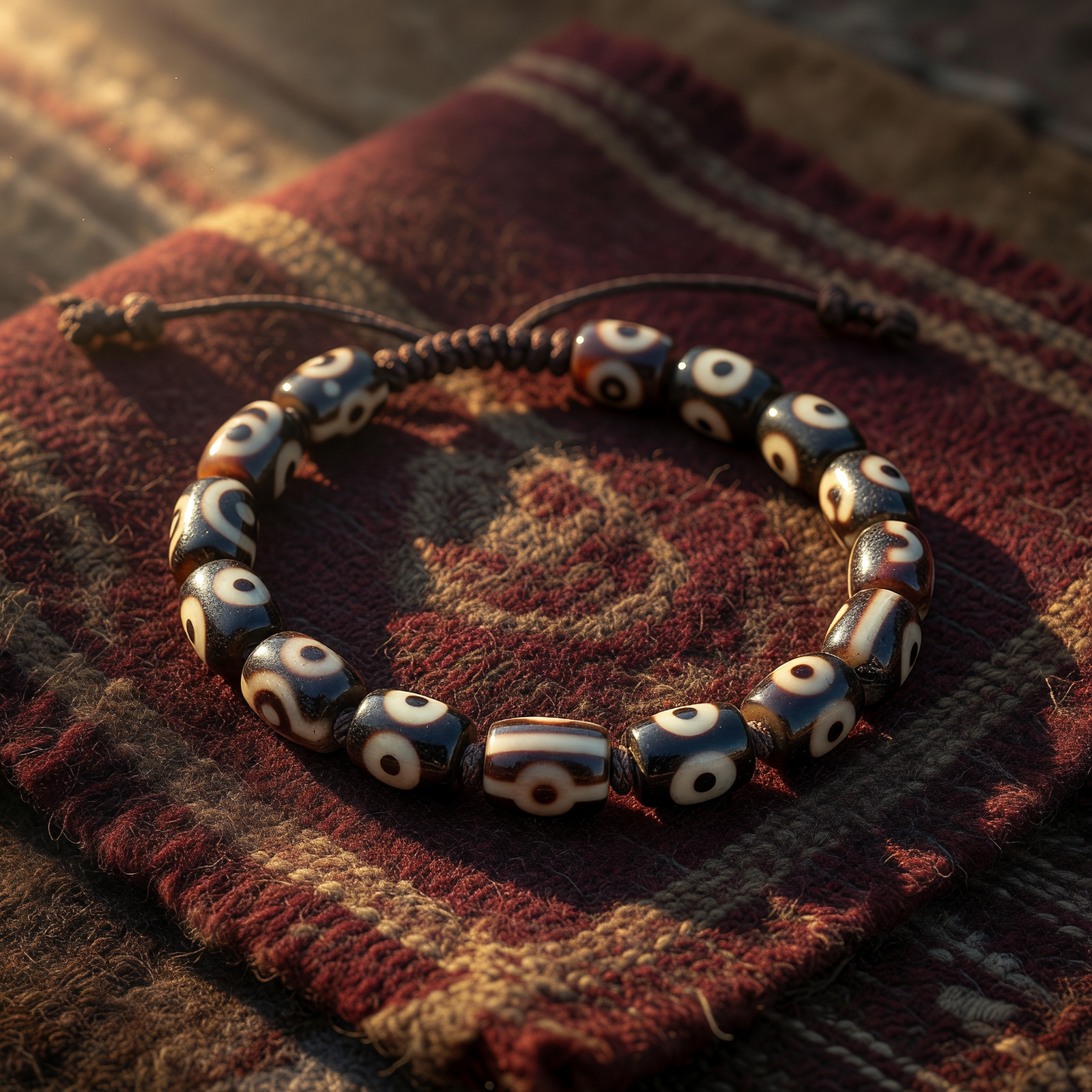
You might be holding a Dzi bead bracelet right now, or perhaps you're looking at one online. You feel its weight, trace the etched lines with your thumb, and a question surfaces, quiet but persistent: "Is this real?" It's not only about the agate or the pattern.
You're asking about its story, its journey from a Himalayan peak or a dusty Kathmandu workshop to your hands. You're questioning its provenance. In a world saturated with replicas, this question is the beginning of a genuine connection to a powerful tradition.
It’s the difference between owning a pretty stone and carrying a piece of living history. This guide is for you, the person who asks that question. We’ll explore the world of authentic Tibetan bracelets, moving beyond surface-level aesthetics to the heart of what makes a Dzi bead a true companion.
The Foundation: What a Dzi Bead Really Is
Let's clear the air. A common misconception we encounter is that a Dzi bead is a kind of mystical talisman that fell from the sky, fully formed, as a gift from the gods. While the folklore is beautiful and meaningful—tales of petrified celestial insects or jewels dropped by deities—those on a path of self-inquiry need to understand the earthly reality that gives rise to this reverence.
A Dzi is not a magic bean. Its power lies in its material, its history, and the human intention embedded within it through centuries of tradition.
At its core, an authentic Dzi (pronounced 'zee') is a type of agate bead that has been treated and etched with specific patterns. The word itself means "brightness, splendor, clarity" in Tibetan. These are not only any stones.
The agate is specifically chosen for its quality and potential. The real artistry and mystery lie in the ancient etching process, a closely guarded secret passed down through Tibetan families since at least the 9th century.
Artisans would use plant-based compounds and heat to permanently alter the surface of the agate, creating the iconic white lines against the dark body. This isn't a paint or a glaze; it's a chemical transformation of the stone itself.
This is why a real Dzi's pattern feels like it's part of the stone, not sitting on top of it.
When you examine a genuine antique Dzi, you're reading a story. You might see tiny, reddish dots just under the surface, known as cinnabar spots or "bloodspots." These are not flaws; they are iron inclusions within the agate that are believed to appear as the bead absorbs energy over time, a sign of a potent and active stone.
You might also notice a fine, crackled pattern on the surface, which collectors call "dragon skin." This is the result of weathering and age, the bead's slow exhale over hundreds of years. These are the details that separate an investment piece from a modern replica.
A replica is sterile and perfect. An authentic Dzi has lived. It carries the patina of time and the silent witness of the Himalayas.

As you deepen your practice with these beads, you'll begin to recognize what authenticity actually feels like in your hands.
Why This Matters in 2026
You might wonder why a stone from ancient Tibet holds any relevance today. In a time of artificial intelligence and fleeting digital trends, what can a Dzi bead bracelet offer? Its value has shifted from purely a tribal amulet to something deeper: a tangible anchor in an intangible world.
For the collector, the professional, or the artist, it's a touchstone for qualities that are becoming increasingly scarce.
A scholar or an executive sits before a critical presentation. The data is sound, the slides are polished, but they need an inner fortitude, a quiet confidence that technology can't provide. Glancing at the Dzi on their wrist isn't a plea for supernatural aid.
It's a physical reminder of endurance. This stone has survived centuries. It has been passed through countless hands, weathered Himalayan winters, and rested in monasteries filled with the low hum of chanting. Its presence is a silent a sign of resilience.
It helps you connect with your own inner strength, the part of you that is just as enduring.
Or perhaps you're an artist or a writer, facing a blank canvas or an empty page. You seek a connection not only to your own creativity, but to a lineage of human creation. Holding a Dzi connects you to the artisan who crafted it generations ago, to their patience and skill.
It connects you to a culture that has valued beauty and meaning since the 11th century. It serves as a conduit, reminding you that you are part of a long, unbroken chain of making things that matter.
It helps quiet the noise of self-doubt and opens a channel to a closer, more timeless source of inspiration.
For those who have traveled or plan to visit the Himalayas, the Dzi is a piece of that sacred landscape you can carry with you. It's the color of the earth near Mount Kailash, the texture of a prayer-worn stone from the Jokhang Temple in Lhasa.
It's a point of focus, a way to bring the clarity and vastness of the Tibetan plateau into your daily life. In 2026, where so much is disposable and virtual, the Dzi bead bracelet is a statement of permanence, authenticity, and a connection to something real.
Real Benefits: How a Dzi Bracelet Actually Works
When we talk about the "benefits" of a Dzi bead, it's crucial to step away from the language of quick fixes and mystical solutions. Its function is more subtle, more nuanced, and rooted in the Tibetan worldview of mind and reality.
It works with you, not for you. It's less of a battery and more of a lens, focusing your own inherent qualities.
A Guardian, Not a Force Field
The most common attribute associated with Dzi beads is protection. But what does that truly mean? It's not a mystical shield that deflects physical harm. The protection is primarily for the mind. In Buddhist thought, the greatest dangers are the internal ones: anger, jealousy, ignorance, and attachment—the mental poisons or *kleshas*.
A Dzi acts as a constant, gentle reminder to remain mindful. When you feel a surge of frustration in traffic or anxiety before a meeting, the weight of the bracelet on your wrist—typically between 8 to 12 millimeters in diameter—can be a trigger to pause, breathe, and observe your own mental state.
The protection it offers is the space to choose a wiser response rather than a reactive one. It guards your inner peace by reminding you to be its guardian. This aligns with the purpose of many sacred objects in our guide to ancient protection symbols, which often serve to protect the spirit from its own afflictions.
The Energetic Provenance of the Stone
In Tibetan culture, an object's history is part of its power. A Dzi that has been owned by a high lama, used in ceremonies at Jokhang Temple, or passed down through a family for generations is considered to have accumulated immense positive potential.
This isn't just superstition; it's a belief in energetic lineage. Think of it like a cherished family heirloom. A simple wooden chair is just a chair, but the one your grandfather built with his own hands carries his love, his hard work, and your memories.
It has a different quality. Similarly, a Dzi is believed to absorb and carry the intentions and blessings of its past. When you wear it, you are not only wearing a stone; you are connecting with a lineage of positive aspiration.
This is why provenance is everything. Knowing the history of your piece adds a layer of meaning that a mass-produced replica can never possess.
A Mirror for Your Intention
Ultimately, a Dzi bead is an amplifier. It doesn't create qualities out of thin air; it reflects and magnifies the intentions you bring to it. If you wear a 2-Eyed Dzi with the intention of cultivating harmony in your relationships, it will serve as a daily reminder of that goal.
If you choose a 9-Eyed Dzi for its association with compassion and merit, its presence will prompt you to act more kindly. The bead itself does not possess mystical powers, but it is a potent tool for focusing your own.
As explained in our complete guide on Buddha bracelets, the object is a partner in your practice. You activate it with your sincerity. It becomes a physical anchor for your highest aspirations, helping you to remember who you want to be, moment by moment.
How to Choose an Authentic Dzi Bead Bracelet
working through the market for Dzi beads can be daunting. For every genuine piece, there are a hundred imitations. Those committed to collecting must train their eye to spot authenticity—it's the most crucial skill you can develop.
It requires patience and a focus on details that mass production cannot replicate.
First, consider the **Material**. An authentic Dzi is always made from agate. Glass, resin, or bone fakes are common. Agate has a specific cool, weighty feel in your hand—roughly 2.6 grams per cubic centimeter.
It has a waxy, slightly oily luster, whereas glass is overly shiny and slippery. Look closely at the bead's perforations (the drill hole). Older, traditionally drilled holes may show signs of wear and are often not perfectly straight.
Modern fakes frequently have perfectly smooth, laser-drilled holes.
Next, examine the **Craftsmanship and Age**. The etched patterns on a genuine Dzi should look like they have soaked into the stone. They shouldn't appear painted on or perfectly crisp like a modern print.
Look for slight imperfections and a softness to the edges of the lines. The most prized characteristic is the patina of age. Look for the "dragon skin" weathering marks—a fine, crazed pattern on the surface—and the waxy luster that comes from being handled and worn for generations.
A new bead will look flat and lifeless by comparison. Cinnabar spots, the small red dots, are another good sign, though not all authentic Dzi have them.
Finally, and most importantly, is **Provenance**. Where did the bead come from? This is where trust in your source is paramount. At Buddhabelief, we've spent years building relationships with families and traders in the Himalayan region.
Our workshop lead in Boudhanath, Master Tenzin, has contacts that go back generations, allowing us to source beads from private collections that rarely enter the open market. A reputable seller should be able to tell you something about the bead's history.
Be wary of fantastic stories that can't be substantiated. A simple, honest history—"this came from a monastery in Bhutan in the 1980s" or "worn by a trader's grandmother"—is far more valuable.
When selecting from our Himalayan artisan bracelets, you'll see Dzi beads presented in various ways. A single, powerful Dzi might be the centerpiece of a simple cord bracelet, allowing its character to stand out.
Others might be woven into arrangements with turquoise, coral, or even set in beautifully worked Tibetan silver. Each style has its own feel, but the heart of the piece is always the authenticity of the Dzi itself.

How to Actually Use and Care for Your Dzi Bracelet
Acquiring an authentic Dzi is the first step. The next is to build a relationship with it. In Tibetan tradition, these are not only pieces of jewelry to be worn casually. They are companions that require respect and mindful handling to maintain their potency.
When you first receive your bracelet, take a moment. Find a quiet space. Before putting it on, you might perform a simple cleansing ritual. The traditional method is to use smoke from purifying incense like juniper or sandalwood.
Hold the bracelet in the smoke for a few moments, turning it over, with the intention of clearing any previous energies it may have picked up on its journey to you. This is not about washing away its history, but about preparing it for your own.
As you do this, set your intention. What do you hope this Dzi will remind you of? Clarity? Compassion? Courage? State it silently or aloud. This act consecrates the bead to your personal path.
When it comes to wearing it, you may wonder which wrist is appropriate. Traditionally, the left wrist is considered the "receiving" side, associated with taking in energy, blessings, and protection. Wearing your Dzi on the left is the most common practice among practitioners in the Lhasa region and beyond.
The right wrist is the "giving" side, associated with projecting energy and action into the world. Some practitioners might wear a Dzi on the right if its purpose is related to compassionate action or sharing wisdom.
Care for your Dzi extends beyond the physical. Avoid exposing it to harsh chemicals or wearing it during heavy manual labor. But more importantly, treat it with respect. Tradition suggests removing it before sleeping or during intimate moments.
It is also considered best not to let others handle your Dzi casually, as it is a very personal item attuned to your energy. If you are not wearing it, keep it in a clean, safe place, perhaps wrapped in a silk cloth or stored in a wooden box lined with cotton.
These small acts of mindfulness are not rules to be followed out of fear, but practices that deepen your connection to the piece and the sacred tradition it represents.
Common Questions About Dzi Bead Bracelets
How can I be absolutely sure my Dzi bead is real?
Absolute certainty with antiques is rare without scientific testing, but you can become highly confident by focusing on key indicators. First is the material: it must be agate, which feels cool and weighty. Second, inspect the surface for signs of age like a waxy luster and "dragon skin" weathering—a fine network of cracks visible under magnification.
The etched lines should appear absorbed into the stone, not painted on top. The drill hole can also be a clue; older holes are often imperfect and show wear patterns consistent with centuries of handling.
Ultimately, the most reliable factor is provenance. Purchase from a trusted source that has deep connections in the Himalayas and can speak to the history of their pieces. At Buddhabelief, we rely on the expertise of artisans like Master Tenzin in Kathmandu, whose family has been in this trade since the 1960s, ensuring the authenticity of our collection.
What's the difference between a 3-Eyed and a 9-Eyed Dzi?
The number of "eyes" on a Dzi bead corresponds to different symbolic meanings and aspirations. A 3-Eyed Dzi is one of the most common and represents the three stars of luck: happiness, honor, and longevity.
It's also associated with the body, speech, and mind, as well as the wealth god Dzambala, making it popular for those seeking prosperity. The 9-Eyed Dzi is often considered the most sought-after. The number nine holds deep significance in Tibetan Buddhism, representing completion and the culmination of all virtues.
It is believed to bring all forms of luck and merit, offering protection against all kinds of misfortune and obstacles. While the 9-Eyed carries particular weight, the best Dzi for you is the one whose meaning resonates most with your personal journey and intentions.
The choice is less about hierarchy and more about personal connection.
Can a Dzi bead bring bad luck if it's not right for me?
This is a common concern rooted in superstition. In the authentic Tibetan Buddhist view, a genuine Dzi bead cannot bring bad luck. It is a neutral tool, a vessel for positive potential. It does not have its own malicious agency.
However, like any powerful spiritual object, it should be treated with respect. The idea of a Dzi being "wrong" for someone usually stems from a mismatch of expectation. If you expect the bead to solve all your problems without any inner work, you will be disappointed.
The Dzi is a mirror; it reflects and amplifies the intention you put into it. If your intentions are clear and positive, it will support that. If your mind is chaotic, it simply serves as a reminder to return to a state of balance.
It is a companion for your journey, not an entity that dictates your fate.
Do I have to be a Buddhist to wear one?
No, you do not need to be a practicing Buddhist to wear and appreciate a Dzi bead bracelet. Collectors and wearers from many backgrounds are drawn to them for their historical significance, cultural beauty, and the universal values they represent—like protection, clarity, and compassion.
The most important thing is to approach the Dzi with respect for its origins. Understand that for millions of people in the Himalayan region, this is a sacred object, not merely a fashion accessory.
Wearing it with an appreciation for its cultural context and a mindful intention is what matters. It's an invitation to connect with a rich tradition, regardless of your personal spiritual path. Think of it as carrying a piece of world heritage that inspires you to cultivate your own best qualities.
How are Buddhabelief's Dzi beads blessed?
We believe in specific, authentic blessings rather than vague spiritual claims. Our Dzi beads undergo a traditional blessing process that is deeply respected in the Tibetan community. Once sourced and crafted into bracelets by our artisans in Kathmandu, select pieces are taken to our partner monasteries, such as branches of the historic Sera Monastery founded in 1419.
There, resident monks include the beads in their daily puja (ritual ceremonies), often for a period of weeks or longer. During these ceremonies, they chant specific mantras, such as those of Chenrezig (the Buddha of Compassion) or Tara, infusing the beads with positivity and intention.
This process isn't about "activating" them with supernatural power; it's about steeping them in an environment of deep peace and devotion, making them suitable companions for a spiritual or mindful path. It's a continuation of the bead's lineage of positive purpose.
What does it mean if my Dzi bead breaks?
In Tibetan culture, if a Dzi bead breaks or chips while you are wearing it, it is not seen as a bad omen. On the contrary, it is believed that the bead has served its purpose by absorbing a significant negative obstacle or misfortune that was headed your way.
It is considered to have sacrificed itself for your well-being. The proper way to handle a broken Dzi is with gratitude. You should not simply discard it. The tradition is to wrap the pieces in a clean cloth (a khata, or ceremonial scarf, is ideal) and return them to the earth—by burying them in a clean place in nature, like at the base of a tree, or placing them in a river or lake.
This act honors the service the Dzi has provided. It is a powerful moment of release and a a sign of the protective qualities of the bead.
Your Journey with the Dzi
Choosing a Dzi bead bracelet is more than an acquisition; it's the beginning of a relationship. It's a commitment to carrying a piece of history, a fragment of the sacred Himalayas, with you on your own path.
As we move through 2026 and beyond, those walking a genuine practice need tangible anchors to their deepest values more than ever. This small, etched stone on your wrist—typically 15mm in diameter, its surface etched with concentric circles or stripes—can be that anchor.
It won't change the world around you, but it can change how you meet that world. It can be the silent witness to your challenges and your triumphs, a constant reminder of the resilience, clarity, and compassion you are cultivating within yourself.
I've seen practitioners in the Jokhang Temple courtyard touch their Dzi beads the same way—worn smooth from decades of fingers, each one carrying the weight of a life lived with intention.
This is an investment in a legacy—not only the legacy of the stone, but your own. The Dzi you choose today becomes the one you'll reach for in moments of doubt, the one whose patina deepens with your years.
We invite you to explore our handwoven Tibetan bracelet collection and find the companion that speaks to your journey.
Keep reading