
buddhist-jewelry
Guardian Buddha 1993: Your Sacred Guide for 2026
If you were born in 1993, your Chinese zodiac sign is usually the Rooster. In a Japanese twelve-zodiac guardian-honzon tradition, the Rooster is associated with Fudō Myōō—known in Sanskrit as Acala or Acalanātha. That is the careful, source-based answer. Two qualifications matter: the zodiac year begins at Lunar New Year rather than January 1 for the convention used in this guide, and the guardian-honzon system is a regional devotional tradition rather than a teaching shared uniformly by every Buddhist school.
Is everyone born in 1993 a Rooster?
No. A common source of incorrect “guardian Buddha” recommendations is treating January 1 as the beginning of the Chinese zodiac year. The zodiac is tied to a traditional lunisolar calendar. The Hong Kong Observatory’s official 1993 Gregorian–lunar conversion table labels 1993 the Gui-you year of the Rooster and shows the first day of the first lunar month on January 23.
For this guide, that produces a simple boundary:
- January 1–22, 1993: still within the preceding lunar year, so do not automatically use the Rooster assignment.
- January 23–December 31, 1993: Rooster under the Lunar New Year convention used here.
Some specialist astrological systems use a different annual boundary, such as the solar term associated with the beginning of spring. That is a separate convention and should be labeled as such. This page uses Lunar New Year because it is the convention applied by our Chinese Zodiac & Guardian Buddha Calculator. If your birthday is close to the boundary, enter your complete birth date rather than selecting a figure from the Gregorian year alone.
The National Diet Library’s history of the Japanese calendar also explains why a lunisolar calendar cannot be treated like the modern Gregorian calendar: lunar months follow the moon, while intercalary months are used to keep the calendar aligned with the seasons. The practical lesson is modest but important—date conversion comes before any zodiac-to-guardian mapping.
Who is Acala, Acalanātha, or Fudō Myōō?
Acala is the Sanskrit name commonly translated as “Immovable.” Acalanātha is a related Sanskrit form, and Fudō Myōō is the Japanese name. In Japanese esoteric Buddhist settings, Fudō is classified among the Wisdom Kings (Myōō). Calling him a “Buddha” is therefore convenient retail shorthand, but it is not the most precise description.
Naritasan Shinshoji, a major Shingon Buddhist temple centered on devotion to Fudō Myōō, describes Fudō as a manifestation of Dainichi Nyorai and explains his fierce appearance as an expression of resolve and compassion. Daikakuji, another Shingon temple, likewise presents Fudō as the central figure among the Five Wisdom Kings. These temple explanations give the figure a specific doctrinal and ritual context; they should not be reduced to a generic “luck charm.”
The names can be confusing in English product catalogs. You may encounter Acala, Acalanatha, Acalanātha, Fudo Myoo, Fudō Myōō, or simply the Immovable Wisdom King. These spellings can point to the same figure, but a name alone is not enough to authenticate an image. Iconography and provenance matter.
Why is Fudō Myōō associated with the Rooster?
Daikakuji’s official guide to Buddhist-image copying states directly that people are assigned guardian honzon according to their zodiac sign and that Fudō Myōō is the guardian for people born in the year of the Rooster. A reference record hosted by Japan’s National Diet Library lists the same Rooster–Fudō mapping and directs readers to a Japanese calendar reference work discussing zodiac guardian figures.
This evidence supports the wording “1993 Rooster Guardian Buddha: Acala/Fudō Myōō” when the tradition is named. It does not support a claim that every Buddhist community, country, or lineage assigns a personal protector by birth year. Buddhism includes many schools and cultures, and the twelve-zodiac guardian-honzon framework is one devotional system among them.
That distinction is not a technicality. Naming the regional tradition respects both the temples that transmit it and readers whose Buddhist practice does not use zodiac guardians. It also prevents a symbolic association from being presented as a universal religious fact.
How to recognize Fudō Myōō iconography
Official explanations from Naritasan and Daikakuji identify a group of visual attributes that help distinguish Fudō Myōō. Individual works vary, and not every small pendant can show every detail, but the following features are useful checkpoints:
- A fierce expression: the wrathful face does not signify uncontrolled anger. Temple explanations interpret it as determined compassion directed against delusion and harmful conduct.
- A sword in the right hand: Naritasan describes the sword as the wisdom that cuts through confusion or worldly attachments. Daikakuji similarly connects it with cutting through afflictions.
- A rope or lasso in the left hand: often called a kensaku, it symbolizes restraint and guidance. It should not be mistaken for a decorative chain.
- Flames behind the body: the halo of fire is associated with burning away obstacles or afflictions. The flame pattern alone is not proof of identity, because other wrathful figures may also appear with fire.
- A rock seat: Naritasan and Daikakuji connect the rock or stone base with firmness and an unwavering resolve.
Use the whole group of attributes, not a single feature. A sword-bearing or flame-backed figure is not automatically Acala. Also remember that the Japanese Fudō form is not the only Buddhist representation of Acala. Himalayan works may use a different posture, color, surrounding figures, and ritual-art vocabulary. A product title should therefore name both the figure and the iconographic tradition instead of presenting every Acala image as a standard Japanese temple-style Fudō.
What does “immovable” mean here?
“Immovable” is best read as a religious and ethical image of steadiness, not a prediction that life will become easy. Fudō’s fixed posture, rock seat, sword, rope, and flames form a visual vocabulary: remain grounded, recognize confusion, restrain harmful impulses, and return to a disciplined path.
A reader does not need to turn those symbols into supernatural promises. The image can function as a prompt for reflection: What deserves steady attention? Which habit needs to be interrupted? What would a clear and compassionate response look like? Those questions stay close to the iconography without claiming that an object controls external events.
Devotees may understand prayer, mantra, goma fire ritual, and temple worship through the teachings of their own community. Others may approach Fudō primarily through art history or cultural study. Both approaches should be described honestly. A commercial article should not invent a guaranteed result, speak on behalf of every Buddhist lineage, or imply that buying an object substitutes for practice.
What does the 1993 association mean in 2026?
Someone born in 1993 turns 33 during 2026, or remains 32 until their birthday. That ordinary life-stage fact may make themes such as commitment, work, caregiving, or long-term decisions feel relevant, but the calendar does not establish a universal spiritual forecast.
There is no source-based reason to promise that a 1993 Rooster will gain money, avoid illness, repair a relationship, or receive special protection in 2026 by wearing Acala imagery. Those outcomes depend on circumstances and choices, and health or financial decisions require appropriate professional advice.
A more responsible 2026 practice is to use the “immovable” theme as a voluntary reflection framework:
- Name one commitment. Choose a concrete responsibility rather than a vague prediction.
- Identify one source of confusion. Separate evidence from fear, sales language, or wishful thinking.
- Choose one restrained action. The rope can be read as a reminder to pause before an impulsive response.
- Review the result. Ask whether the action was clear, ethical, and compassionate; adjust without treating a setback as a supernatural sign.
This approach does not claim to reproduce temple ritual. It simply keeps the symbolism connected to observable conduct instead of fortune-telling.
How to approach an Acala image respectfully
There is no single etiquette rule that covers every Buddhist culture, temple, household, or type of object. If you participate in a particular community, follow the guidance of its teachers. For a general audience, a few principles are sensible:
- Learn the figure’s name and tradition before treating the image as fashion.
- Keep devotional images clean and handle them deliberately.
- Avoid claiming that an item is blessed, consecrated, antique, or temple-made unless there is verifiable provenance.
- Do not present symbolic jewelry as medical treatment, financial advice, or guaranteed spiritual protection.
- If an item is damaged or no longer wanted, ask a relevant temple or community about customary handling rather than inventing a universal disposal rule.
Wearing a pendant and maintaining a devotional practice are not automatically the same thing. A pendant can be a personal reminder, a work of religious art, or a sign of affiliation; its meaning depends on context and the wearer’s intention. Respect begins with accurate identification and modest claims.
How to evaluate a Fudō Myōō pendant or thangka
Start with identification, not marketing promises. Compare the figure’s sword, rope, flames, posture, and rock seat with the temple references below. Then review the listing for material, dimensions, process, maker, and origin. “Handmade,” “consecrated,” and “traditional” are factual claims only when the seller can explain what they mean and provide evidence.
For miniature thangka pendants, small scale can simplify details. That does not necessarily make the work inauthentic, but it increases the importance of a clear front-facing photograph and an accurate description. Look for consistency between the name in the title and the figure in the image. Do not assume that a red, blue, black, or gold color scheme proves identity.
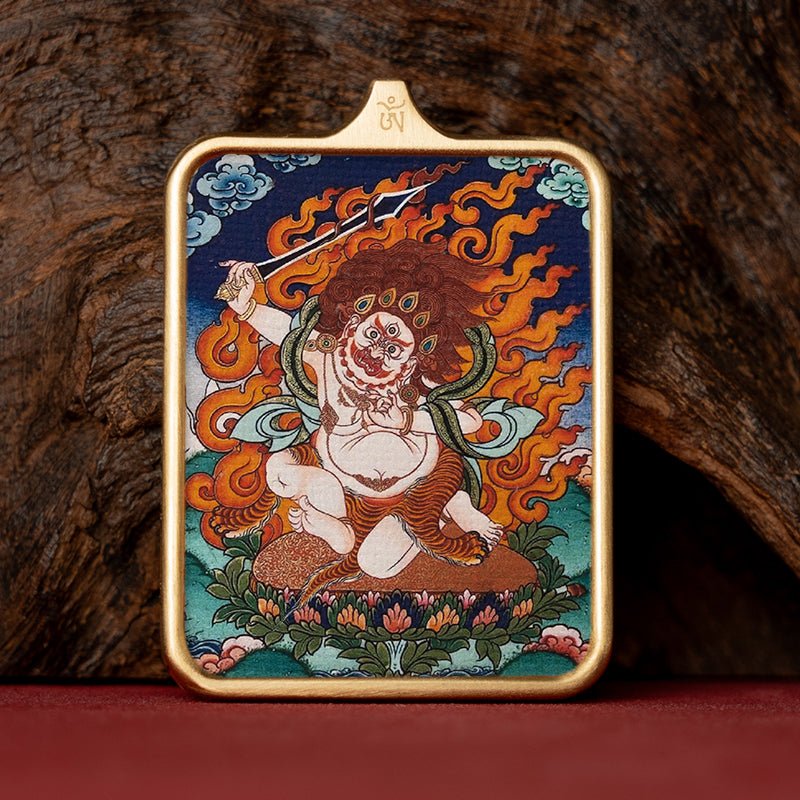
You can browse the Thangka pendant collection to compare formats, but treat collection placement as navigation rather than independent authentication. For a specific example, see the White Acala/Achala pendant in Himalayan iconography. Acala is called Fudō Myōō in Japan, but this pendant’s white, kneeling form belongs to Himalayan iconography; it is not presented here as a standard Japanese temple-style image. The link identifies an iconographic variant, not a promise of protection or results.
Where this guide fits in the wider birth-year system
The Rooster–Fudō association is one entry in a broader zodiac guardian-honzon map. Other zodiac signs are associated with other figures, and some signs share a guardian. The terminology also varies: “guardian Buddha,” “birth-year Buddha,” “zodiac protector,” and “guardian honzon” may be used for overlapping ideas.
For the full map, terminology notes, and links to individual years, see the complete Birth-Year Guardian Buddha guide. Use that overview only after confirming the zodiac sign from a complete birth date. A convenient label should never replace the calendar step or the cultural context.
Frequently asked questions
What is the Guardian Buddha for someone born in 1993?
Under the Japanese twelve-zodiac guardian-honzon tradition, a person whose birth date falls in the 1993 Rooster year is associated with Fudō Myōō, also known as Acala or Acalanātha. This is a tradition-specific association, not a universal teaching of all Buddhist schools.
Is every person born in 1993 a Rooster?
No. Using the Lunar New Year convention in this guide, January 23 was the first day of the first lunar month in 1993. Birthdays from January 1 through January 22 remain in the preceding lunar year and should be checked separately.
Is Acala a Buddha?
Acala is more precisely classified as a Wisdom King, called Fudō Myōō in Japanese. “Guardian Buddha” is a widely used English label for the wider birth-year system, but it is not the most exact title for Fudō.
What symbols identify Fudō Myōō?
Common identifying features include a fierce expression, a sword in the right hand, a rope or lasso in the left, flames behind the body, and a firm rock seat. Because other wrathful figures can share individual features, identify the full composition rather than relying on one symbol.
Does wearing an Acala pendant guarantee protection or good fortune?
No. Jewelry cannot guarantee health, wealth, safety, luck, or a particular spiritual result. It may be worn as devotional imagery, cultural art, or a personal reminder, but practical decisions still require evidence, care, and appropriate professional advice.
Why can an Acala pendant look different from Japanese Fudō Myōō images?
Acala appears in more than one regional iconographic tradition. Japanese temple images of Fudō Myōō and Himalayan forms can differ in color, posture, surrounding figures, and details. The linked white, kneeling pendant is identified as Himalayan Acala/Achala, not as a standard Japanese temple-style Fudō image.
Sources and further reading
- Daikakuji Temple: Buddhist image-copying guide — official temple explanation of Fudō Myōō’s iconography and the Rooster guardian-honzon association.
- Naritasan Shinshoji: About Fudō Myōō — official temple account of the sword, rope, flames, rock seat, and doctrinal meaning.
- National Diet Library Reference Collaborative Database: twelve-zodiac guardian honzon — library reference record listing Rooster–Fudō and its cited calendar source.
- National Diet Library: The Japanese Calendar — background on the lunisolar calendar and intercalary months.
- Hong Kong Observatory: 1993 Gregorian–Lunar Calendar Conversion Table — official table identifying 1993 as the Gui-you Rooster year and January 23 as the first day of its first lunar month.
Editorial note: This guide describes a religious and cultural tradition for educational purposes. It does not provide medical, financial, legal, or mental-health advice and does not promise supernatural outcomes.
Keep reading