News
Healing Crystals Complete Guide 2026: Tibetan Buddhist
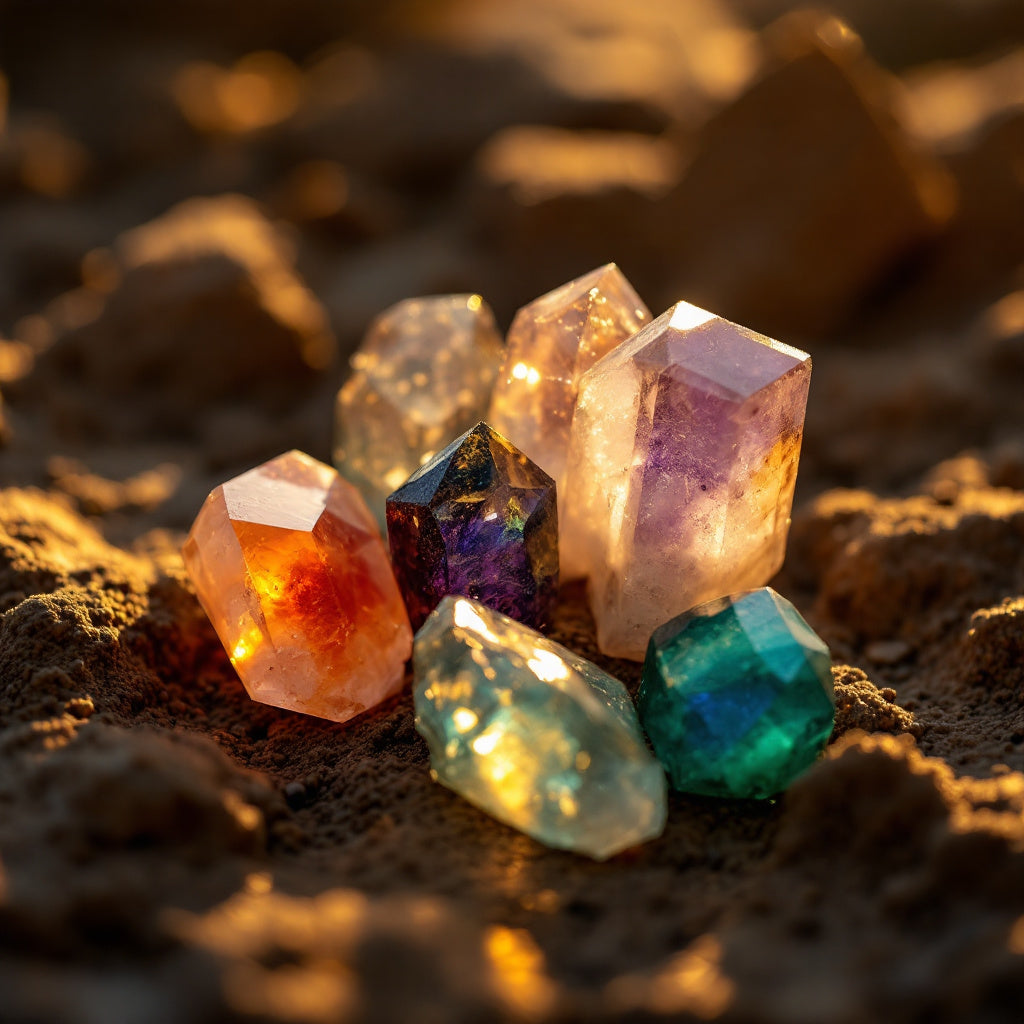
You're holding a small green stone at a market stall — maybe a jade pendant, maybe something labeled "healing crystal" with a handwritten tag — and you genuinely don't know if you're about to buy something meaningful or just a pretty rock with a marketing story attached.
That hesitation is honest. It's also the exact right place to start. Because the question of what healing crystals meaning actually refers to has two very different answers depending on who you ask: a TikTok wellness influencer, or a Tibetan monk who has been working with stones as sacred objects for forty years.
Explore our healing crystal collection and you'll see that difference immediately.
Healing Crystals is because the question of what healing crystals meaning actually refers to has two very different answers depending on who you ask: a TikTok wellness influencer, or a Tibetan monk who has been working with stones as sacred objects for forty years.
What Healing Crystals Actually Are (And What They're Not)
Let's get the misconception out of the way first, because it's a significant one: healing crystals are not magic batteries that passively emit frequencies into your aura while you scroll Instagram. That framing — wildly popular on Pinterest and in certain wellness spaces — has almost nothing to do with how stones and minerals have been used in Tibetan Buddhist practice since the 11th century.
The Tibetan word for precious or semi-precious stones used in spiritual contexts is rinchen (རིན་ཆེན་), which translates more accurately as "precious" or "jewel" — and it carries weight. The Three Jewels of Buddhism (the Buddha, the Dharma, the Sangha) use this same word.
Stones in Tibetan practice are not passive. They are selected, consecrated, assigned meaning within a cosmological framework, and used actively — in ritual, in offering, in the construction of sacred objects.
The Tibetan medical text Gyushi (Four Tantras), compiled around 1200 CE during the reign of King Trisong Detsen's successors, includes detailed sections on mineral and gem substances — their properties, their effects on the three humors (wind, bile, phlegm), and their use in both medicinal compounds and ritual objects.
Lapis lazuli, turquoise, and coral appear throughout with specific indications for balancing constitutional imbalances. This is a sophisticated, internally consistent system. It doesn't map cleanly onto modern crystal healing vocabulary, but it does confirm something important: the idea that specific stones carry specific properties is not New Age invention.
It's a very old idea with deep roots in Himalayan culture.
What the modern crystal healing movement got right — even if accidentally — is the basic intuition that different stones feel different, that certain minerals have been associated with certain qualities across multiple cultures, and that the act of holding, wearing, or meditating with a physical object can support a mental or spiritual practice.
What it got wrong is the passive, transactional framing: buy this stone, receive this healing. That's not how it works in any traditional context.
In Tibetan Buddhist practice, a crystal or stone becomes meaningful through three things: selection (choosing the right stone for the right purpose), consecration (a lama or monk performing the appropriate blessing ritual, often tied to a specific deity), and practice (the person using the stone actually engaging with it — reciting mantra, making offerings, meditating).
Remove any of those three, and you have a pretty stone. Keep all three, and you have something that functions as a genuine support for practice.
This is the framework we use when we talk about our crystal stones — not resonance charts, but lineage, consecration, and actual use.

Why This Matters in 2026 — The Specific Moment You're In
Here's what's actually happening right now, in 2026, that makes this conversation more relevant than it was five years ago.
The wellness industry's crystal boom peaked around 2019-2021 and then fractured. On one side, you have an increasingly skeptical backlash — articles calling crystal healing pseudoscience, social media threads mocking "healing stone" marketing. On the other side, you have a quieter, more serious cohort of practitioners who got interested through the trend but are now asking harder questions.
They've had the rose quartz on their nightstand for two years. They've read the Instagram captions. And they're starting to wonder: is there something more substantial here, or was I sold a story?
If you're in that second group — genuinely curious, a little skeptical of the hype, but not ready to dismiss the whole thing — you're in exactly the right place. Because the answer is: yes, there is something more substantial.
It just doesn't live in the New Age section of the bookstore.
Scenario 1: You're burning out at work and someone suggested crystals. Your colleague keeps a piece of black tourmaline on her desk and swears it helps with stress. You don't know whether to believe her.
Here's the honest answer: the tourmaline isn't going to fix your workload or your manager. But in Tibetan practice, black stones — obsidian, tourmaline, onyx — are associated with wrathful protector deities whose function is to cut through obstacles and negativity.
The practice of keeping such a stone nearby, reciting a short protection mantra when you touch it, and using it as a moment to pause and breathe — that has genuine value. Not because the stone is emitting frequencies, but because you've created a physical cue for a mental practice rooted in centuries of Buddhist methodology.
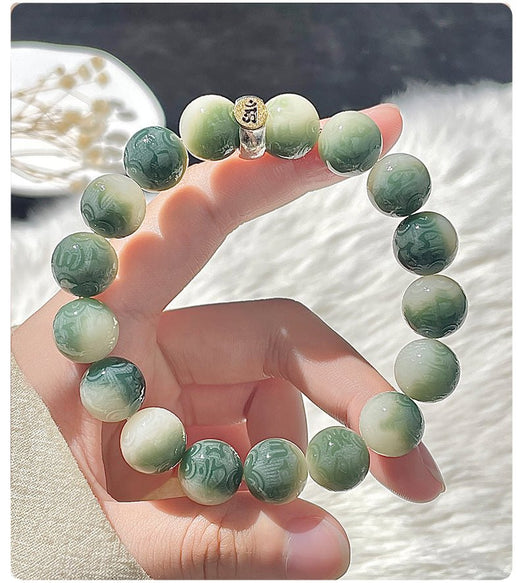
Scenario 2: You're going through a relationship transition and feel unmoored. Green jade has been associated with Guanyin (Avalokiteshvara in Tibetan form, Chenrezig) for centuries across both Chinese and Tibetan Buddhist traditions. Guanyin is the bodhisattva of compassion.
Wearing a jade Guanyin pendant isn't a talisman that makes love appear — it's a reminder, worn against your skin, of the quality you're trying to cultivate: compassion, including toward yourself. That's a real function.
It works the same way a photograph of someone you love works — not magic, but meaningful in a way that shapes how you move through your day.
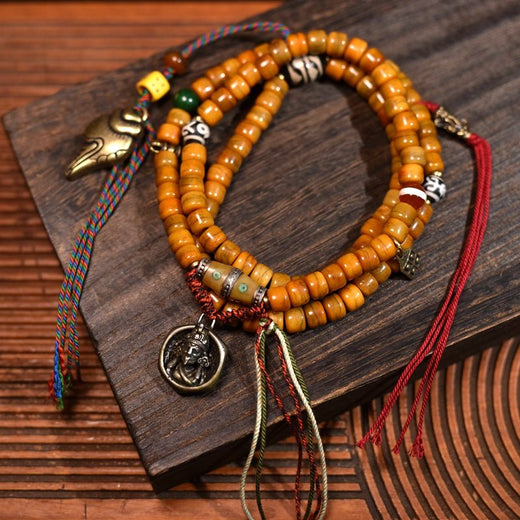
Scenario 3: You've started meditating with an app and want to go deeper. Mala beads — the 108-bead prayer necklaces used in Tibetan Buddhist mantra recitation — are traditionally made from specific stones for specific practices.
Clear quartz malas are used for clarity practices and for amplifying the effect of mantra recitation. This isn't metaphor; it's a practical instruction from the tradition. If you're doing a mantra practice, the material of your mala is considered relevant to the work you're doing.
Our clear quartz mala is made following exactly these traditional specifications.
Scenario 4: You want to understand the geometry and symbolism behind the stones you're drawn to. The Flower of Life pattern — which appears on some crystal jewelry and sacred objects — has roots that connect to Buddhist cosmological diagrams (mandalas).
Understanding that context transforms a pretty geometric pattern into something you can actually contemplate. This is the direction serious practitioners move: from aesthetic appreciation toward actual understanding of what they're wearing and why.
The 2026 moment, specifically, is one where the information gap is closing. More people have access to good translations of Tibetan texts, to teachers who explain things clearly, to jewelry made by artisans who actually know the tradition — not only the market.
The question is if you want to stay in the shallow end of the pool or learn to swim.
Real Meanings — Four Crystals in the Tibetan Buddhist Tradition
Each one has a specific deity connection, a specific use context, and a specific quality it's meant to support.
Clear Quartz — The Clarity Stone of Mantra Practice
In Tibetan Buddhism, clear quartz (shel in Tibetan) holds a specific place in ritual practice that goes well beyond the generic "master healer" label it gets in Western crystal healing. Crystal quartz spheres — called shel gong — appear on monastery altars as objects of offering and as tools for divination by certain lamas.
More practically relevant to your daily life: quartz is the traditional material for malas used in clarity-focused practices and in the recitation of mantras associated with wisdom deities, particularly Manjushri, the bodhisattva of wisdom, whose mantra is Om A Ra Pa Ca Na Dhih.
The logic in the tradition is that quartz, being transparent and colorless, mirrors the quality of mind that practitioners are trying to cultivate: clear, unobstructed, without the distortion of conceptual overlay. When you hold a quartz mala and recite mantra, the stone is functioning as a physical anchor for that intention.
Our detailed breakdown of how this works in practice is in our complete clear quartz guide — worth reading if this stone calls to you.
What to look for: natural clarity without chemical treatment, no dye, minimal visible inclusions if you want a traditional altar piece. Milky quartz (less transparent) is fine for malas and has its own associations with the moon and cooling energy in Tibetan medicine, particularly in formulations used during summer months in the Himalayan regions.
Green Jade — Guanyin's Stone and the Practice of Compassion
Jade's association with Guanyin (the Chinese intention-setting of Avalokiteshvara, the bodhisattva of compassion — known as Chenrezig in Tibetan) is one of the most documented gem-deity relationships in all of Buddhist art history. Museum collections from the Tang Dynasty (618–907 CE) onward show Guanyin figures carved in nephrite and jadeite.
In Tibetan Buddhist iconography, Chenrezig is often depicted with a green or white body, holding a lotus, and the green of jade maps directly onto this imagery.
The practical use: jade Guanyin pendants are worn as protection amulets, but protection in this context doesn't mean warding off evil spirits in a superstitious sense. It means keeping the quality of compassion present in your daily life — a reminder worn at the throat (near speech) or heart.
Monks at Kopan Monastery in Kathmandu will often tell visitors that the most powerful protection is a compassionate mind, and the pendant is a support for cultivating that mind, not a substitute for it.
Quality note: true nephrite jade (the historically significant variety) is increasingly rare and expensive. Much of what's sold as "jade" is either jadeite (also genuine, slightly different mineral composition) or serpentine (a green stone that is not jade at all).
We address how to tell the difference in the How to Choose section below, where we walk through specific gravity tests and color saturation markers.
Black Obsidian — Wrathful Protectors and Cutting Through Obstacles
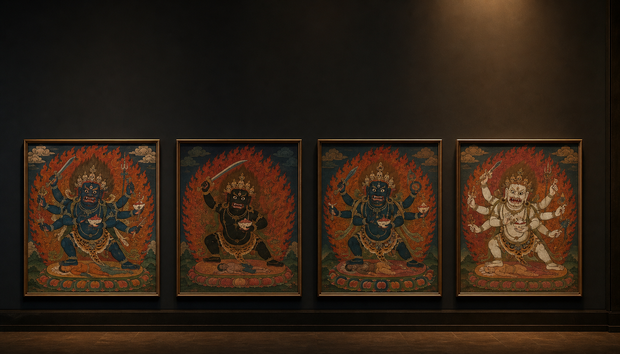
Black obsidian is volcanic glass — formed when lava cools so rapidly that no crystalline structure has time to form. In Tibetan Buddhist iconography, this quality maps onto the wrathful protector deities: Mahakala, Palden Lhamo, Yamantaka.
These are not evil figures. They are manifestations of enlightened energy in wrathful form, whose function is to cut through the obstacles that prevent practitioners from progressing on the path — specifically ego-clinging, delusion, and the forces that perpetuate suffering.
Obsidian protection bracelets in the Tibetan tradition are not passive good-luck charms. They are worn with the intention of invoking this cutting quality — a willingness to let go of what's not serving you, to face difficult truths, to move through obstacles rather than around them.
The stone's sharp edges (obsidian was used for surgical blades in ancient Mesoamerican cultures and remains sharp enough to cut modern surgical steel) are part of its symbolic resonance. Our obsidian protection bracelet is blessed during a Mahakala puja performed by the monks at our partner monastery — a specific ritual context, not a generic "blessing."
If you're drawn to obsidian, ask yourself honestly: are you ready to cut through something? Because that's what you're inviting when you work with this stone in its traditional context.
Labradorite — Chenrezig's Iridescence and the Bardo Teachings
Labradorite is the most visually striking of the four stones we're discussing — that flash of blue-green-gold light that appears when you tilt it, called labradorescence, is caused by light scattering between microscopic layers of feldspar.
In Tibetan Buddhist contexts, labradorite has been associated with Chenrezig (Avalokiteshvara) specifically in his eleven-faced, thousand-armed form — the most complex and visually overwhelming iconographic version of the bodhisattva of compassion, in which he simultaneously perceives and responds to the suffering of all beings in all directions.
The iridescence of labradorite — the way it shows you different colors depending on your angle and the light — is used as a contemplative metaphor for the bardo teachings: the idea that reality shifts depending on the state of mind perceiving it, and that what appears solid and fixed is actually dynamic and dependent on causes and conditions.
This is not a stretch. Tibetan teachers have used physical objects as contemplative supports for exactly this kind of teaching for centuries. The stone doesn't teach you — but it can remind you of a teaching you've already received.

How To Spot the Real Thing Crystals — What Actually Matters
The crystal market in 2026 has a serious authenticity problem, and it's worth being direct about it. A significant percentage of "crystals" sold online — particularly on large marketplace platforms — are either dyed, heat-treated, synthetic, or mislabeled entirely.
This matters not only for aesthetic reasons but for practical ones: if you're using a stone as a support for practice, you want to know what you actually have.
Here's what to look for, stone by stone:
Clear Quartz: Natural quartz has inclusions — small bubbles, veils, fractures, or mineral traces. Perfect, flawless clarity in a large piece is a red flag for glass or synthetic quartz. The slight imperfections in natural quartz are features, not defects.
Weight is also a reliable indicator: quartz is denser than glass and will feel noticeably heavier for its size.
Green Jade: The three-tier test used by experienced buyers in Kathmandu markets: (1) temperature — real jade feels cold and stays cold longer than serpentine or glass; (2) hardness — jade (both nephrite and jadeite) is extremely hard and will not scratch easily; (3) translucency under strong light — genuine jade shows a fibrous or granular internal structure, not uniform color.
If a piece is uniformly, perfectly green with no variation, it's likely dyed or synthetic.
Black Obsidian: Obsidian is volcanic glass, so it has a naturally glassy luster and conchoidal fracture pattern (curved, shell-like breaks). Fake obsidian is often just black glass, which is essentially the same thing chemically — the difference is geological origin and the intentional practice context behind its use.
For practice purposes, source matters: obsidian from the Tibetan plateau or from verified volcanic regions carries more resonance in the tradition than factory glass.
Labradorite: The labradorescence (the color flash) is the tell. Genuine labradorite shows directional iridescence that shifts as you move the stone. Dyed or fake versions may show surface color but lack the internal light-play.
Hold it under a single light source and tilt slowly — the flash should appear and disappear as you move through specific angles.
Beyond individual stone identification, there are three broader questions to ask any seller of Tibetan blessed crystals:
- Where was this sourced? Kathmandu Valley, Lhasa, and the Tibetan plateau are the primary sourcing regions for crystals used in authentic Tibetan Buddhist practice. "Sourced from China" is not automatically disqualifying, but it warrants follow-up questions.
- Was this blessed, and by whom, in what context? "Blessed by monks" is insufficient. The specific ritual, the monastery, and the deity invoked should be identifiable. If a seller can't tell you, the blessing claim is marketing language, not a verifiable fact.
- What is the artisan context? Our pieces are made by artisans in our Boudhanath workshop, where Tenzin Dorje — a third-generation metalsmith whose family has been making ritual objects since his grandfather worked for the Fourteenth Dalai Lama's household — oversees the setting and finishing of every crystal piece. That's a specific, verifiable claim. Hold other sellers to the same standard.
For a closer get into how sacred geometry intersects with crystal jewelry design, the Flower of Life guide covers the mandala-crystal connection in detail.

How to Actually Use Healing Crystals — Daily Practices That Work
This is the section most crystal guides skip, or handle so vaguely that it's useless. "Hold your crystal and set an intention" is not a practice. Here are four concrete, tradition-grounded ways to work with crystals that you can start today, regardless of your experience level.
Practice 1: Morning Touchstone (5 minutes)
Before you look at your phone in the morning, pick up your crystal — whichever stone you're working with — and hold it in both hands for two minutes.
Not to receive healing from it. To remind yourself of the quality it represents. If it's jade, bring compassion to mind — specifically, think of one person you'll interact with today and consciously wish them well.
If it's obsidian, think of one thing you're holding onto that you could let go of today. If it's quartz, simply try to notice the quality of your mind right now: clear or cloudy?
Then put the stone down and proceed. That's it. Two minutes. The stone is a cue, not a cure.
Practice 2: Mala Mantra Recitation (10-20 minutes)
If you have a crystal mala — 108 beads, traditionally hand-knotted between each bead — you can use it for mantra recitation. The simplest mantra to start with is Om Mani Padme Hum, the mantra of Chenrezig (Avalokiteshvara), associated with compassion.
Hold the mala in your right hand, starting at the guru bead (the larger bead at the top). Move one bead per recitation, using your thumb and ring finger. When you complete a full round of 108, you've done one mala.
Three malas (324 recitations) is a traditional minimum for a daily practice. The crystal material of the mala matters: quartz for clarity practices, jade or green stone for compassion practices. This is not decoration — it's a functional specification from the tradition.
Practice 3: Altar Offering
In Tibetan Buddhist homes, a small altar with offerings is common. Crystals — particularly quartz points or spheres — are placed on the altar as offerings of clarity and light.
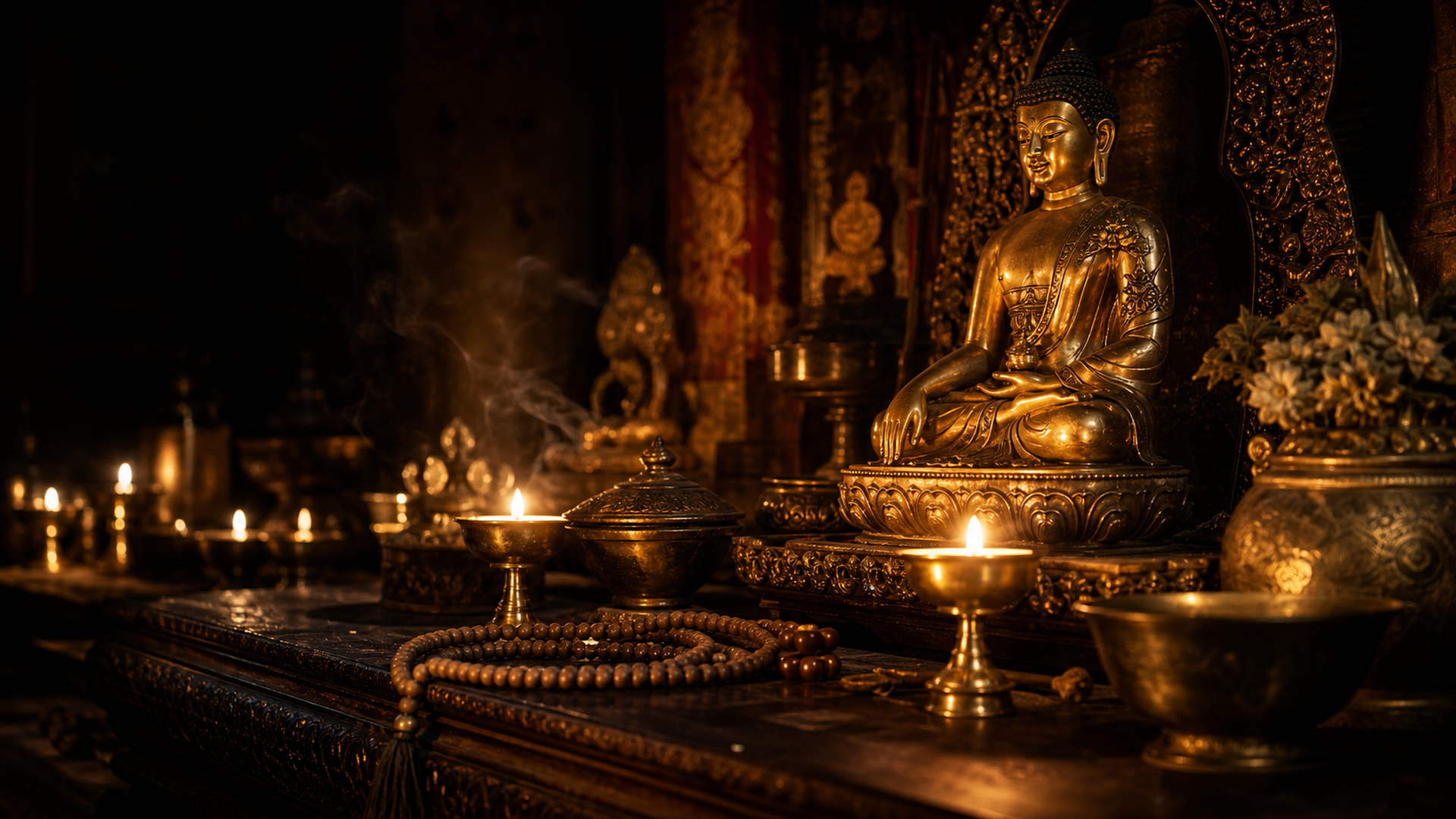
You don't need a formal altar setup. A clean shelf with a candle, a small image of a deity or teacher, and a crystal is sufficient. The act of maintaining the altar — keeping it clean, refreshing the offerings — is itself a practice of attention and care.
Practice 4: Wearing with Intention
Jewelry in Tibetan Buddhist practice is not passive decoration. When you put on a crystal bracelet or pendant in the morning, take three seconds to consciously recall what it represents.
When you notice it during the day — when it catches the light, when you feel its weight — let it bring you back to that quality for a moment. This is what the tradition calls a "support for mindfulness" — a physical object that helps you remember what you're trying to practice.
Our authentic crystal jewelry is designed with this function in mind: pieces you'll actually notice and feel, not pieces that disappear into background decoration.
Common Questions
Do healing crystals actually work, or is it all placebo?
This is the honest question, and it deserves an honest answer. From a strict scientific standpoint, there is no peer-reviewed evidence that crystals emit measurable healing frequencies or that their proximity to the body produces physiological changes beyond what you'd get from any other object you hold with intention.
The "resonance" language used in most crystal healing marketing is not supported by physics as those sellers use it.
That said, placebo is not nothing. The placebo effect is one of the most robustly documented phenomena in medicine — the mind's capacity to produce real physiological changes based on expectation and belief is well established.
More relevantly for our purposes: the Tibetan Buddhist tradition doesn't actually claim that stones work through physical emission. The claim is that they function as supports for mental practice — as cues, reminders, and consecrated objects that help a practitioner maintain intention.
That mechanism is entirely plausible and doesn't require any physics-bending claims. The stone works because you work with the stone. That's a meaningful distinction from passive crystal healing, and it's the framework we'd encourage you to use.
What is the difference between Tibetan crystal use and New Age crystal healing?
The core difference is agency and practice. In New Age crystal healing, the stone does something to you — it emits energy, raises your resonance, attracts abundance. You are relatively passive; the stone is the active agent.
In Tibetan Buddhist practice, the stone is a support — it helps you do something. You are the active agent. The stone's role is to anchor intention, remind you of a quality you're cultivating, or serve as a consecrated object in a ritual context.
The second framework is more demanding (it requires you to actually practice) but also more empowering. It also has a thousand-year track record in a living tradition, which the New Age framework, developed largely in the 1970s-80s in California, does not.
Neither framework is inherently fraudulent, but they are genuinely different in their assumptions and their demands on the practitioner.
How do I know if a crystal has been authentically blessed?
Ask specific questions: What ritual was performed? Which deity was invoked? Which monastery or lama conducted the blessing? How long did the ritual last? In Tibetan Buddhist practice, consecration rituals (rab gnas) are formal, documented events.
A Mahakala puja, for example, involves specific torma offerings, specific mantra recitation counts, and specific visualization practices. A lama performing this ritual can describe it in detail. If a seller says "our crystals are blessed by Tibetan monks" but cannot tell you the name of the monastery, the name of the lama, or the name of the ritual, the blessing claim is marketing language.
Legitimate consecration is specific and traceable. We document the blessing context for every piece we sell — monastery name, ritual type, approximate date — because we believe you deserve to know exactly what you're receiving.
Which crystal should I start with as a beginner?
If you're new to Buddhist practice and drawn to crystals, we'd suggest starting with either clear quartz or green jade, for different reasons. Clear quartz is the most versatile — it's used across multiple deity practices, it's appropriate for general clarity and meditation support, and it's the material for the most accessible mala practice (Om Mani Padme Hum with a quartz mala).
Green jade is the better choice if you're going through a difficult emotional period — a breakup, grief, burnout — because the compassion practice it supports is immediately applicable to your situation. Obsidian and labradorite are powerful stones but carry stronger energetic associations (wrathful protectors, bardo teachings) that are better approached once you have some practice foundation.
Start simple. Start with one stone, one practice, one intention.
Can I wear multiple crystals at once?
In Tibetan Buddhist practice, combining stones is done deliberately, not randomly. Certain combinations have traditional precedent — quartz and turquoise together appear in many traditional Tibetan jewelry pieces, with turquoise associated with sky and protection and quartz with clarity.
Obsidian and quartz together is a more nuanced combination — wrathful energy and clarity — that some practitioners use intentionally during periods of major transition. What the tradition cautions against is wearing many stones simultaneously with vague intentions, treating each one as a separate passive emitter.
If you're wearing three different stones, you should be able to articulate what each one represents in your practice and why you're combining them. Otherwise, simplify. One stone worn with clear intention outperforms five stones worn with vague hope.
How do I cleanse or recharge my crystals?
The Tibetan Buddhist answer to this question is different from the New Age answer. In the New Age tradition, you cleanse crystals by placing them in moonlight, burying them in salt, or using sound bowls — based on the idea that they absorb negativity that needs to be discharged.
In Tibetan Buddhist practice, the concept is different: a consecrated object is maintained through continued practice and occasional re-blessing, not through physical cleansing rituals. Practically, this means: keep your stones clean (physically clean them with a soft cloth), treat them with respect (don't leave them in chaotic or disrespectful environments), and if you feel the connection to your practice has faded, recite mantra over the stone or have it re-.
The "recharging" is really about refreshing your own intention and practice relationship with the stone, not about the stone's physical state.
Are crystals appropriate for non-Buddhists to use?
Yes, with honesty about what you're doing. You don't need to be a Buddhist to find value in working with crystals — the practices of using physical objects as supports for intention, attention, and mindfulness are universal.
What we'd encourage is cultural honesty: if you're using a jade Guanyin pendant, know who Guanyin is. If you're wearing an obsidian bracelet blessed in a Mahakala puja, understand what Mahakala represents. You don't need to adopt Tibetan Buddhism as your religion to respect the tradition your object comes from.
In fact, that respect is itself a form of practice — it's the opposite of the extractive relationship where you take the aesthetic and discard the meaning. Take the meaning too. It's more interesting, and it's more honest.
Buddhabelief works exclusively with monastery-certified craftsmen in Lhasa and Kathmandu to bring you pieces that carry genuine spiritual significance — not mass-produced replicas.
What is the significance of the number 108 in crystal malas?
The number 108 appears across multiple Indian and Tibetan Buddhist traditions, and there are several explanations for its significance — some astronomical (the ratio of the sun's distance from Earth to the sun's diameter is approximately 108), some mathematical (it's the product of 4 × 27, with 27 lunar mansions in Vedic astronomy), and some related to the 108 defilements listed in certain Buddhist texts.
In practice, the most relevant explanation is the simplest: 108 recitations of a mantra constitutes one complete round, and three rounds (324) is a traditional minimum for a daily practice. The number creates a container — a defined unit of practice that you can complete, count, and build upon.
When you hold a 108-bead mala, you're holding a tool calibrated to a specific practice unit. The crystal material of the beads is part of that calibration.
Your Journey With Crystals Starts Here, Not Somewhere Else
Here's what we've noticed after years of working with practitioners who come to Tibetan Buddhist crystals from a wellness background: the ones who get the most from it are the ones who stop waiting to feel ready and just start.
You don't need to understand the full cosmology of Tibetan Buddhism to hold a piece of quartz and recite Om Mani Padme Hum for five minutes in the morning. You don't need to be certain that jade "works" before you put on a jade pendant and
Material, origin and ceremony details vary by product. Use the individual listing and request supporting records before relying on a particular workshop, artisan or temple claim.
Keep reading