
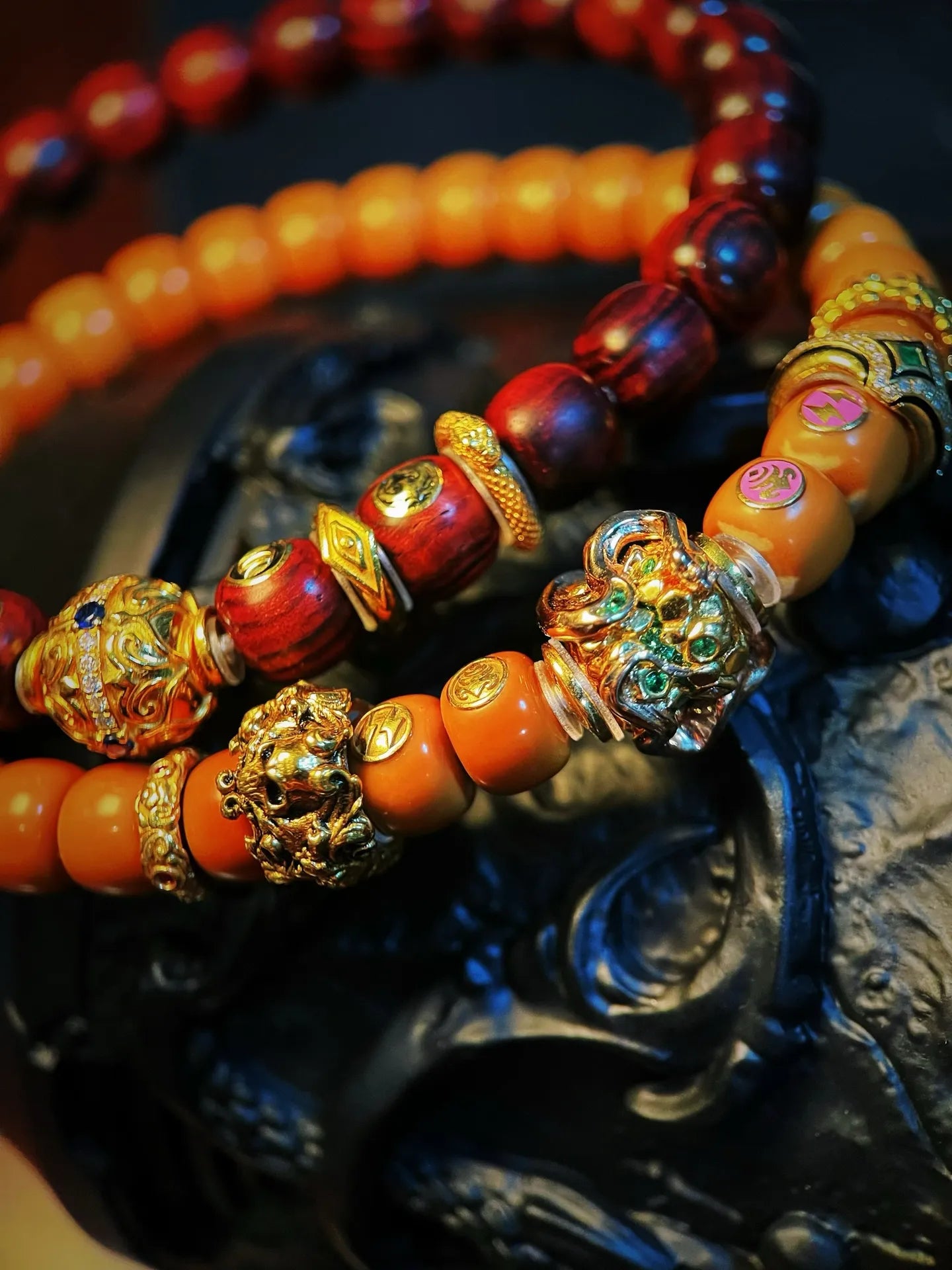
The Ultimate Guide to Mala Beads: History, Benefits, Tr
The gentle weight rests in your palm. Your thumb finds the first bead, cool and smooth against your skin. The digital noise of the day—the endless notifications, the racing thoughts about your to-do list, the subtle hum of anxiety—begins to fade into the background.
It doesn’t vanish, but its power over you lessens with each deliberate touch. This isn’t just a string of beads; it's an anchor. It’s a physical link to a tradition thousands of years old, a tool designed to bring you back to your breath, to your intention, to this exact moment.
You may have seen them worn as beautiful jewelry, but their true purpose is far deeper. They are a quiet rebellion against the frantic pace of modern life, a personal sanctuary you can hold in your hand.
This guide is your invitation to understand not only what a mala is, but what it can become for you: a companion on your path to inner stillness.

What a Mala Really Is: A Journey Through Time and Spirit
To truly understand a mala, you must look beyond its current form and trace its origins back to the fertile spiritual landscape of ancient India, nearly 3,000 years ago. The very concept is rooted in the Sanskrit word japa, which means "to mutter" or "to whisper." Early Hindu sages and yogis sought a method to focus their minds during prolonged periods of mantra recitation.
They needed a tool for spiritual accounting, a way to track thousands of repetitions without breaking their meditative state. Thus, the japa mala was born, not as jewelry, but as a profoundly practical spiritual instrument.
The earliest malas were crafted from the materials at hand, imbued with sacred energy. Rudraksha seeds, with their textured surfaces and association with the deity Shiva, were among the first and most revered materials.
They were believed to offer divine protection and calm the heart. The practice was deeply intertwined with Vedic traditions long before the birth of Siddhartha Gautama. When Buddhism began to flourish in India around the 5th century BCE, it absorbed and adapted this powerful tool.
For Buddhist practitioners, the mala became the perfect vehicle for counting recitations of mantras like "Om Mani Padme Hum," focusing the mind on the qualities of compassion and enlightenment.
The spread of the mala follows the footsteps of Buddhism itself. As the dharma traveled north along the Silk Road, through the treacherous passes of the Himalayas into Tibet, the mala came with it.
Tibetan masters like Padmasambhava (Guru Rinpoche), who brought Buddhism to Tibet in the 8th century CE, integrated the mala into the rich weave of Vajrayana practices. Here, materials took on even deeper significance. Malas were crafted from the bones of revered lamas to serve as a stark reminder of impermanence (anicca).
Bodhi seeds, from the same species of tree under which the Buddha attained enlightenment in Bodh Gaya, became highly prized for their direct connection to the path of awakening. As you explore the diverse array of Tibetan mala beads available today, you are connecting with this rich and unbroken lineage, a sacred technology passed down through generations of devoted practitioners.
The Deeper Meaning: Deconstructing the Sacred Anatomy of a Mala
A mala is far more than a simple counting device; it is a microcosm of the cosmos and a map of the spiritual journey. Every component is rich with symbolism, designed to guide your awareness inward.
The most significant feature, the number of beads, is almost universally 108. This number is profoundly sacred in many Eastern traditions for a multitude of reasons.
In Vedic cosmology, 108 is seen as the number of wholeness and existence. Ancient astronomers calculated that the diameter of the Sun is approximately 108 times the diameter of the Earth, and the average distance from the Sun to the Earth is 108 times the Sun's diameter.
In yogic philosophy, there are said to be 108 primary nadis, or energy channels, that converge at the heart chakra. For a Buddhist practitioner, the number represents the 108 kleshas, or human defilements, that must be overcome to achieve nirvana.
Each recitation on a bead is a step in purifying these afflictions, transforming ignorance into wisdom. When you complete a full cycle of 108 repetitions, you are symbolically traversing the entire landscape of your inner world and affirming your commitment to awakening.
The 109th bead, which is larger and often distinct, is known as the Guru bead, Sumeru, or stupa. This bead is the anchor of the mala. It is never counted but serves as the starting and ending point for your Japa practice.
The Guru bead represents the student-teacher relationship, your connection to your own inner teacher, or the state of absolute reality—the awareness that lies beyond the cycle of recitation. When you reach the Guru bead, it is a moment to pause, reflect, and express gratitude.
The tassel that extends from the Guru bead is equally symbolic. Its individual threads represent the diverse paths and practices, all flowing from and returning to a single source. It symbolizes our interconnectedness and the unified consciousness that binds us all together.
Even the way you use the mala reflects this deep symbolism. As you pull each bead towards you, you are drawing the divine energy of the mantra into your own being. The circular nature of the mala itself is a constant reminder of the cyclical nature of life, death, and rebirth (samsara).
By engaging with this sacred tool, you are not only counting; you are participating in a timeless ritual that aligns your personal energy with universal principles.
Real Benefits for Your Modern Life: Beyond the Mystical
While a mala's origins are ancient and mystical, its benefits are profoundly practical and perfectly suited to the challenges you face today. Using a mala is a direct antidote to the scattered attention and chronic stress that define modern existence.
It works on your mind and body in specific, measurable ways.
First and foremost, a mala provides a powerful point of tactile grounding. When your mind is racing with anxieties or replaying past events, the simple, physical sensation of a bead between your thumb and middle finger acts as an anchor to the present moment.
This isn't just a mental trick; it engages your nervous system. The repetitive, rhythmic motion of moving from one bead to the next has a deeply calming effect. It can help regulate your breathing and slow your heart rate, shifting you out of the "fight or flight" sympathetic nervous system and into the "rest and digest" parasympathetic state.
In a world of constant digital distraction, this tangible, screen-free practice is a form of sensory rebellion that reclaims your focus.
Furthermore, using a mala deepens the impact of your chosen mantra. When you pair a verbal recitation with a physical action, you create a stronger neurological connection. This process, known as multi-sensory integration, helps embed the mantra's intention more firmly in your subconscious.
Over time, the feeling of calm and focus you cultivate during your practice becomes associated with the mala itself. Eventually, just picking up your mala can trigger a conditioned relaxation response, making it an immediate source of comfort during a stressful day.
It transforms meditation from an abstract concept into a concrete, repeatable action. if you are seeking peace, clarity, or compassion, a mala becomes your dedicated tool for cultivating that state of being, one bead at a time.
Finally, the practice of Japa meditation with a mala is a foundational training for your attention span. It is a form of single-pointed concentration, or *dharana*. Each time your mind wanders—and it will—the act of returning your focus to the next bead is like a single repetition in a mental workout.
You are gently but firmly training your brain to be less reactive and more intentional. This enhanced ability to focus will extend beyond your meditation cushion, improving your concentration at work, your presence in conversations, and your overall sense of control over your own mind.
It’s a practical skill that our entire collection of mindfulness tools is designed to support.

How to Choose an Authentic Mala That Resonates With You
Choosing a mala is an intimate and intuitive process. It is a spiritual tool that will become a close companion, so it’s important to select one that feels right to you. An authentic mala is defined by its construction, materials, and the intention with which it is made.
The first element to consider is the material. Traditional malas are often made from organic materials that carry their own specific energy. Bodhi seeds are revered for their direct link to the Buddha's enlightenment.
Sandalwood, with its soothing aroma, is known for its calming and clarifying properties. Rudraksha seeds are associated with protection and grounding. Increasingly, malas are also crafted from gemstones, each with a unique vibrational quality.
For example, you might choose Lapis Lazuli to enhance wisdom and truth, Rose Quartz to cultivate compassion and heart-opening, or Black Onyx for grounding and protection. Your choice of material should align with the intention you wish to cultivate in your practice.
Ask yourself what quality you are seeking to invite into your life right now.
Next, look at the construction. A traditionally crafted mala is hand-knotted between each of the 108 beads. These knots serve a practical purpose: they prevent the beads from clicking against each other during meditation, provide perfect spacing for your fingers, and ensure that if the mala breaks, you won't lose all the beads.
Spiritually, these knots represent the divine bond that connects all beings or the challenges in life that, when navigated, become part of our path to wisdom. A mala should also have a distinct Guru bead, which marks the cycle's beginning and end.
When you are finding the mala that resonates with your path, notice the small details of craftsmanship, as they reflect the care and mindfulness put into its creation.
Ultimately, the most important factor is your own intuition. While understanding the properties of different materials is helpful, allow yourself to be drawn to a particular mala. Which one catches your eye? Which one feels right in your hand?
Your energetic system often knows what it needs. Trust that the mala you are most attracted to is the one that holds the right medicine for you at this point in your journey. It is a personal choice, a connection between you and this sacred object that will absorb your energy, prayers, and intentions over time.
How to Use Your Mala for Japa Meditation
Using a mala is a simple, beautiful, and deeply personal practice. While there are traditional guidelines, remember that the primary goal is to connect with your inner self. Your intention is more important than perfect technique.
First, find a comfortable and quiet place where you can sit undisturbed for a few minutes. You can sit cross-legged on a cushion or upright in a chair with your feet flat on the floor.
Take a few deep breaths to center yourself and settle into your body. Hold your mala in your right hand (though using your left is perfectly acceptable if it feels more natural), draping it over your middle finger.
The index finger, which is associated with the ego in some traditions, should not touch the beads; it can be extended gently away from the others.
Next, choose a mantra. This can be a traditional Sanskrit mantra like "Om Mani Padme Hum" (for compassion) or "Om Shanti Shanti Shanti" (for peace), or it can be a simple affirmation in your own language, such as "I am calm" or "I am present." Starting at the bead directly next to the Guru bead, use your thumb to gently pull the first bead towards you as you silently or audibly recite your mantra one time.
Then, move to the next bead, pulling it towards you and repeating the mantra. Continue this process, one bead, one recitation, moving with a steady and relaxed rhythm.
Your mind will inevitably wander. When you notice your thoughts have drifted, gently and without judgment, guide your attention back to the sensation of the bead in your fingers and the sound of your mantra.
The practice is not about having a perfectly empty mind, but about the gentle act of returning, again and again. When you have completed all 108 beads and reached the Guru bead, take a moment to pause.
You can offer a moment of gratitude or simply sit in the stillness you have cultivated. If you wish to do another round, do not cross over the Guru bead. Instead, turn the mala around and go back in the direction you came from.
This honors the sacredness of the Guru bead as a point of reflection.
Common Questions About Mala Beads
Can I wear my mala as a necklace or bracelet?
Absolutely. Practitioners wear their mala throughout the day as a physical reminder of their intentions. When worn against your skin, it can serve as a source of calm and grounding energy. The key is to wear it with respect.
It is a sacred tool, not only a fashion accessory. When you put it on, take a moment to connect with its purpose. When you take it off, place it in a special, clean place, like a small bag or on an altar, rather than tossing it aside.
Wearing your mala helps it absorb your personal energy, deepening your connection to it over time.
What should I do if my mala breaks?
A breaking mala is not a bad omen; in fact, it is often seen as a positive sign. Traditionally, it can signify the end of a cycle, the fulfillment of the intention you were working with, or a breakthrough in your practice.
It means the mala has served its purpose for you. When this happens, you have a few options. You can gather the beads and respectfully restring them, perhaps setting a new intention for the renewed mala.
Alternatively, you can offer the beads back to the earth by burying them in a garden or placing them in a body of water. It is a moment to reflect with gratitude on the journey you have taken with that mala.
How do I cleanse and charge my mala?
Because your mala absorbs energy, it’s beneficial to cleanse it periodically. There are several gentle methods. You can leave it in the light of a full moon overnight to cleanse and recharge it. You can also gently smudge it by passing it through the smoke of sage, palo santo, or incense.
Another effective method is to place it on a selenite crystal plate, which is known for its cleansing properties. Sound healing, such as using a Tibetan singing bowl, can also clear stagnant energy. Choose the method that feels most resonant to you and perform it with the intention of purifying your sacred tool.
Which hand should I use for Japa meditation?
In many traditions, including Tibetan Buddhist and Hindu practices, the right hand is used for Japa meditation. The right hand is often associated with giving, purity, and sacred actions, while the left hand is associated with receiving and mundane tasks.
The mala is typically draped over the middle finger, and the thumb is used to advance the beads. However, this is a guideline, not a rigid rule. The most important thing is your comfort and focus.
If using your left hand feels more natural or is necessary for any reason, you should feel free to do so. Your intention and presence are what truly empower the practice.
Do I need to be a Buddhist to use or wear a mala?
No, you do not need to be a Buddhist or adhere to any specific religion to benefit from a mala. A mala is a universal tool for mindfulness, meditation, and intention-setting. People from all spiritual paths and walks of life use them to help focus the mind and connect with a closer sense of peace.
The key is to approach the mala with respect for its cultural and spiritual origins. By using it with sincere intention, you are honoring its history and its power as a tool for personal transformation, regardless of your personal belief system.
What is the significance of the knots between the beads?
The knots tied between each bead on a traditional mala serve both practical and spiritual purposes. Practically, the knots create space, making it easier to move from one bead to the next with your thumb during meditation.
They also provide security, so if the string were to break, the beads would not scatter. Spiritually, the knots have several layers of meaning. They can symbolize the challenges or "knots" we face in life.
They also represent the interconnectedness of all things and the divine link that ties everything in the universe together. Each knot secures a bead in place, just as our practice secures our awareness in the present moment.
Your Next Step on the Path
You now understand that a mala is far more than a beautiful object. It is a bridge to your inner world, a tool for transformation, and a companion for your spiritual journey. It is a physical intention-setting of your commitment to mindfulness, peace, and awakening.
Holding a mala connects you to a lineage of seekers who, across generations, have walked this same path of turning inward. The practice is not about achieving perfection, but about gently and consistently returning to your center, one breath and one bead at a time.
Your journey is unique, and the right tool can make all the difference.
We invite you to explore our carefully curated collection of authentic mala beads. Allow your intuition to guide you to the one that calls your name, the one that is ready to accompany you on your next chapter.
Find the mala that will not only adorn your body but also anchor your soul.


