
buddhist-jewelry
Laughing Buddha Meaning: Budai, Symbols & Placement
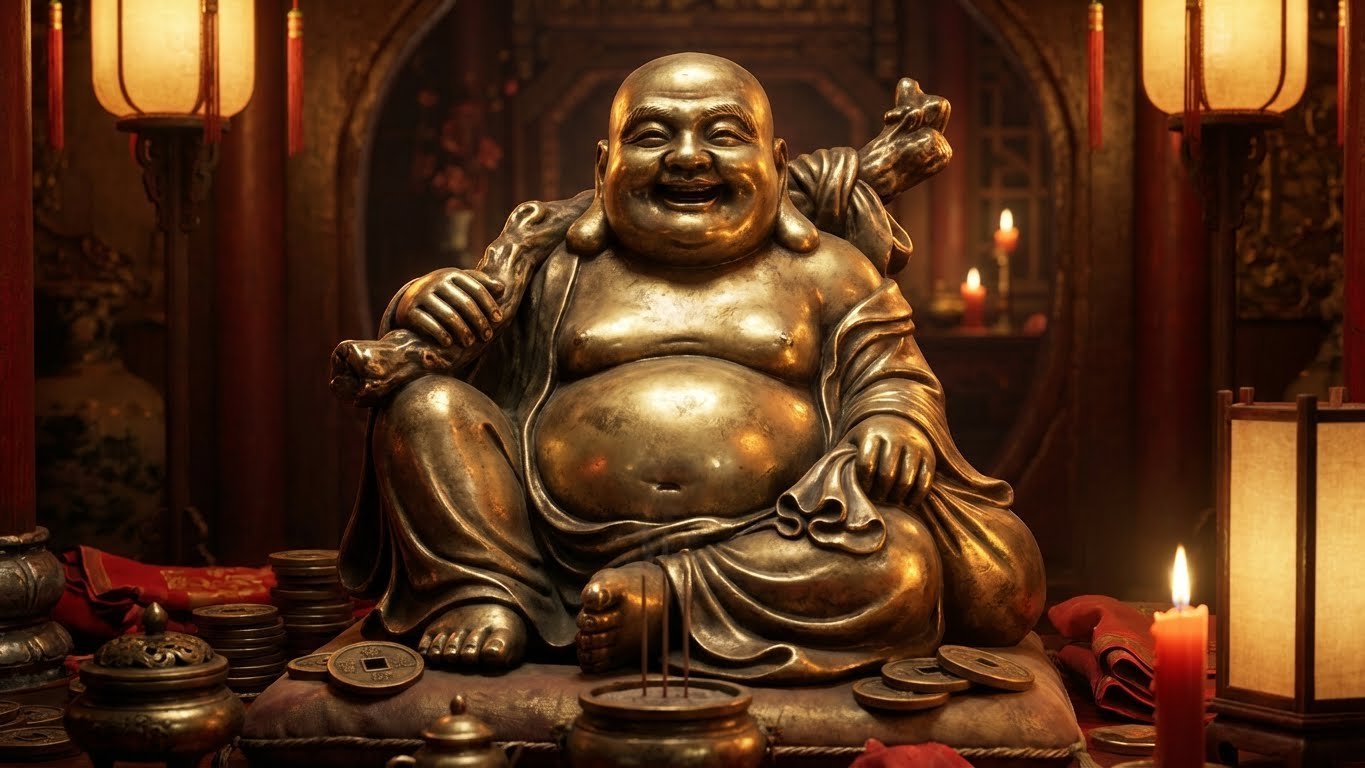
Updated July 2026. The figure commonly called the Laughing Buddha is Budai in China and Hotei in Japan. He is shown as a smiling, round-bellied monk carrying a cloth sack. In East Asian tradition he became associated with Maitreya, the future Buddha, but he is not Siddhartha Gautama, the historical Buddha.
What does the Laughing Buddha mean? Budai commonly represents contentment, generosity and an openhearted response to ordinary life. His sack, beads, fan, children or coins add meanings shaped by regional art and later popular custom. These symbols can support reflection, but a statue or pendant cannot guarantee wealth, protection or healing.

Who Is the Laughing Buddha?
Museum records describe Budai as a semi-legendary itinerant monk associated with tenth-century China. His name means "cloth sack," referring to the bag that is one of his most recognizable attributes. The Metropolitan Museum of Art identifies his laughing face, round stomach and sack, while the British Museum records the common combination of sack and rosary beads.
Budai's image spread through Chinese and Japanese art. In Japan he is called Hotei and became one of the Seven Gods of Good Fortune. The name "Laughing Buddha" is therefore a popular label for a particular East Asian figure, not a general name for every image of the Buddha.
Is the Laughing Buddha Gautama Buddha or Maitreya?
| Figure | Identity | Typical appearance |
|---|---|---|
| Gautama Buddha | Siddhartha Gautama, the historical teacher of Buddhism | Usually shown in monastic robes with established gestures and marks of Buddhahood |
| Budai / Hotei | A semi-legendary Chinese monk and popular East Asian figure | Smiling, exposed round belly, loose robe, cloth sack and often beads or a fan |
| Maitreya | The future Buddha in Buddhist tradition | Appears in several forms; East Asian tradition later associated Budai with Maitreya |
The distinction matters. The Smithsonian's National Museum of Asian Art notes that the familiar round-bellied "Laughing Buddha" is not traditionally understood to depict the historical Buddha. Museums also document the later belief that Budai represents or embodies Maitreya. It is more accurate to say Budai became associated with Maitreya than to collapse all three identities into one.
Laughing Buddha Symbols and Their Meanings
| Feature | Common interpretation | Context |
|---|---|---|
| Cloth sack | Generosity, sufficiency and freedom from burden | The sack gives Budai his name; stories about exactly what it contains vary |
| Large belly | Contentment, abundance and an expansive spirit | A defining artistic feature, not a Buddhist rule that body size proves holiness |
| Laughing face | Joy, approachability and ease | One reason the figure became popular in homes and businesses |
| Rosary beads | Buddhist practice and the monastic identity of Budai | Documented in historical objects; the bead count and design vary |
| Fan | Good fortune or the granting of wishes in later popular imagery | Especially common in Japanese Hotei depictions |
| Children | Playfulness, family happiness or fertility | A later artistic association, not a universal doctrinal meaning |
| Coins or ingots | Prosperity and business luck | Common in modern feng shui and commercial versions |
What Do Different Laughing Buddha Poses Mean?
A standing Budai can suggest movement, welcome or vitality; a seated Budai suggests ease and stability. A raised sack emphasizes his namesake attribute, while beads emphasize Buddhist practice. Figures surrounded by children or coins draw on later associations with family happiness or prosperity.
Use the visible attributes to identify a figure, but do not assume that every hand position has one ancient, universal meaning. Material also does not determine spiritual power: jade, bronze, wood, resin and carved seeds each have different craft and care qualities, but none guarantees luck.

Where Should a Laughing Buddha Be Placed?
There is no single placement rule shared by all Buddhist communities. For a devotional image, the practical standard is respect: choose a clean, stable position where the figure will not be stepped over, used as clutter or handled carelessly.
- Home entrance or living area: a common modern choice because the smiling figure feels welcoming.
- Workspace or shop: often used as a reminder of generosity and calm, rather than as a promise of profit.
- Meditation or altar area: keep it clean and visually distinct from ordinary storage.
- Avoid unstable or dirty locations: do not place a meaningful object where it can easily fall, be damaged or become an obstruction.
Feng shui sources may recommend particular compass directions or rooms. Those are tradition-specific suggestions, not universal Buddhist commandments. If a temple, teacher or family tradition gives more specific guidance, follow that context.
Should You Rub the Laughing Buddha's Belly?
Rubbing the belly for good luck is a widespread popular custom, especially around decorative figures. It is not a required Buddhist ritual, and it should never override care or permission.
- Do not touch an image in a temple, museum, shop or another person's home unless touching is clearly invited.
- Repeated rubbing can polish, stain or wear stone, metal, wood and painted surfaces.
- For your own durable decorative figure, gentle handling is a personal custom rather than a guarantee of luck.
Can You Wear a Laughing Buddha Pendant?
Yes, people wear Budai images as cultural, spiritual or decorative jewelry. Wear the image in a way that matches your own tradition and keeps the piece secure. A pendant can serve as a reminder of contentment or generosity, but it should not be sold as proven protection, medical treatment or guaranteed wealth.
If you are comparing a statue or carving, examine the material, dimensions, maker information and photographs. This hand-carved Maitreya Buddha sculpture shows how Budai-inspired imagery can appear in a small natural-material carving. For related iconography, use the Buddhist symbols guide.
How to Choose an Authentic or Well-Made Figure
- Identify the object honestly: look for Budai, Hotei or Maitreya wording instead of vague claims about an "ancient Buddha."
- Check materials: ask whether stone is natural, treated or imitation and whether metal is solid, plated or cast resin.
- Look for maker and origin details: handmade, antique, monastery-made and blessed are separate claims that each require evidence.
- Inspect iconography: the sack, robe, beads and belly should be clearly rendered; extra symbols may reflect a modern design.
- Separate age from appearance: patina, wear and an old-looking finish do not prove antiquity.
- Read dimensions and care notes: scale, stability and material care determine whether the piece suits a shelf, altar or pendant setting.
Frequently Asked Questions
What is the rule of the Laughing Buddha?
There is no single universal rule. Treat the image respectfully, place it securely and understand its meaning without expecting guaranteed luck, wealth or protection.
Is the Laughing Buddha the real Buddha?
He is not Siddhartha Gautama, the historical Buddha. The figure is Budai, a semi-legendary Chinese monk who later became associated with Maitreya, the future Buddha.
What does the Laughing Buddha's belly mean?
The large belly commonly symbolizes contentment and abundance in popular art. It is an iconographic feature of Budai, not a universal Buddhist teaching about body shape.
Do you rub the Buddha's head or belly for luck?
The popular custom concerns Budai's belly, but rubbing is not a required Buddhist ritual. Never touch a temple, museum or privately owned object without permission.
Which Laughing Buddha pose is best for wealth?
Modern feng shui imagery often uses coins, ingots or a raised sack for prosperity. No pose can guarantee wealth, and fixed pose meanings vary between sellers and traditions.
Can I keep a Laughing Buddha in my bedroom?
There is no universal prohibition. If the figure has devotional meaning for you, choose a clean, respectful and stable place consistent with your tradition.
Sources
Keep reading