
News
Om Mani Padme Hum: Complete Meaning and Practice Guide 2026

You've been sitting with this mantra for years. You've recited it on your mala, heard it in teachings, seen it carved into mani stones along Himalayan trails. And yet — if someone asked you right now to explain what each syllable actually purifies, or why the sequence matters, or what Avalokiteśvara has to do with your Tuesday morning sit — you might pause.
That pause is worth paying attention to. It's not ignorance; it's the honest recognition that you've been carrying something whose full weight you haven't yet felt. This guide is an attempt to hand that weight back to you — all of it, syllable by syllable — so that the next time you pick up your Buddhist meditation accessories and begin counting, something has shifted.

What Om Mani Padme Hum Really Is
Start with the most common English-language reduction of this mantra: the translation "The jewel in the lotus." You'll find it on wellness websites, tattoo parlors, and the backs of yoga mats. It's not wrong, exactly — it's just so compressed that it loses almost everything that matters.
The full Tibetan transliteration is ཨོཾ་མ་ཎི་པདྨེ་ཧཱུྃ། (Wylie: oṃ ma ṇi pad me hūṃ). It is the root mantra of Avalokiteśvara — called Chenrezig (སྤྱན་རས་གཟིགས།) in Tibetan — the bodhisattva of compassion. In Tibetan Buddhism, Avalokiteśvara is not a distant deity.
He is understood to be the embodiment of the compassion of all Buddhas, and the Tibetan people have a particular relationship with him: the Dalai Lamas are considered his human emanations. When you recite this mantra, you're not making a wish.
You're engaging in a transformation practice.
The mantra appears in the Kāraṇḍavyūha Sūtra, a Sanskrit Mahāyāna text composed between the 4th and 5th centuries CE, which was translated into Tibetan and became central to Vajrayāna practice. The sūtra makes an extraordinary claim: that this six-syllable mantra contains the entire teaching of the Dharma.
The 14th Dalai Lama has said that the mantra is "very good to recite" and that it contains all the teachings of the Buddha — not as metaphor, but as a structural reality that practitioners can access through sustained recitation.
What makes this mantra structurally unique is its correspondence system. Each of the six syllables maps to:
- One of the six realms of existence (the realms beings cycle through in saṃsāra)
- One of the six perfections (pāramitās) cultivated on the bodhisattva path
- One of the six root afflictions (kleśas) being purified
- One of the six buddha families
- One of the six colors associated with Avalokiteśvara's form in visualization practice
This is not poetic decoration. In Vajrayāna, these correspondences are the mechanism. The mantra works — to the degree that it works — because each syllable is a compression of an entire transformation path.
You are not repeating a word. You are, syllable by syllable, addressing every world of your habitual existence and offering it a specific antidote.
One more thing to clear up before we go deeper: this is not a "Hindu mantra adopted by Buddhism." While oṃ appears in earlier Hindu contexts, the six-syllable sequence is specifically Buddhist, specifically Mahāyāna, and its full meaning cannot be separated from the Avalokiteśvara teachings.
Wearing it or reciting it as generic "Sanskrit spirituality" misses what makes it potent.
Why This Mantra Still Matters in 2026 — And Why It Matters Differently for You
There's a version of this question that sounds almost embarrassing to ask after years of practice: "Does reciting a mantra actually do anything?" If you've been sitting for a decade, you've probably moved past the early convert's certainty and arrived somewhere more honest — a place where you hold the practice lightly, do it anyway, and remain genuinely uncertain about the mechanism.
That's actually a good place to be. But let's look at what's happening in your life right now, in 2026, that makes this particular practice worth examining more carefully.
If you fit the profile of a committed practitioner in your late 30s to mid-50s, several things are likely true simultaneously. Your formal sitting practice is solid — maybe 30 to 45 minutes daily, rarely skipped.
But you've noticed what Tibetan teachers sometimes call nyam (ཉམས།) — a kind of plateau or temporary regression that can feel like the practice has stopped yielding. Your cushion time feels mechanical. The gap between your meditation self and your Tuesday-afternoon-in-a-difficult-meeting self feels wider than it did three years ago.
At the same time, your life's actual challenges have gotten more textured. A parent's cognitive decline. A teenager who won't talk to you. A career success that somehow produced more anxiety than the struggle did.
These are not problems that respond to more rigorous noting practice. They require something that moves — something that can be carried into the parking lot, the hospital waiting room, the 11pm scroll through your phone.
This is exactly where mantra practice — specifically this mantra — was designed to function. It is, in the Tibetan understanding, a moving meditation. The 11th-century Tibetan master Atisha, who helped re-establish Buddhism in Tibet after the persecution under King Langdarma in the 9th century, emphasized mantra recitation as a practice that could purify the mind even when formal sitting conditions were unavailable.
You don't need a cushion. You don't need silence. You need a mala of 108 beads and the intention to recite.
There's also a relational dimension that becomes more relevant as your practice matures. The bodhisattva vow — the commitment to attain awakening for the benefit of all beings — is easy to hold abstractly on a cushion.
It becomes genuinely difficult when "all beings" includes the colleague who undermined you in a meeting, or the family member whose political views make your chest tighten. Reciting Chenrezig's mantra is, in a very direct sense, a practice of extending that vow into the specific texture of your relationships.
Each recitation is a small act of orienting toward compassion rather than reactivity.
The global context in 2026 adds its own weight. Collective anxiety about AI displacement, climate trajectories, and political polarization is real and documented — not as abstract statistics but as the actual background radiation of daily life for those working through these currents.
Tibetan Buddhism has always operated in conditions of impermanence and threat. The mantra was recited during the Cultural Revolution, when Tibetan practitioners were imprisoned for holding a mala — some for decades in camps like Drapchi Prison.
That history is not separate from your practice. It is part of what you're holding when you hold the beads.
For a closer foundation on building a practice that can hold all of this, our Buddhist meditation and spiritual practice guide covers the broader architecture that mantra fits into.
The Six Syllables: What Each One Actually Purifies
This is the section most guides skip. They give you the general meaning and move on. We're going to stay here, because this is where the practice becomes precise.
The primary source for the syllable-by-syllable breakdown in Tibetan Buddhism is the commentary tradition associated with the Kāraṇḍavyūha Sūtra and, more accessibly, the explanations given by the 14th Dalai Lama in his public teachings, including those compiled in The Meaning of Life (translated by Jeffrey Hopkins, 1992).
What follows draws on that tradition.
OM (ཨོཾ) — Purifying Pride / The world of Gods
Oṃ is composed of three Sanskrit letters: A, U, and M. In the Vajrayāna context, these represent the practitioner's impure body, speech, and mind — and simultaneously the pure body, speech, and mind of a Buddha.
The syllable is associated with the world of the gods (devas) — the highest of the six realms, characterized by pleasure, longevity, and the particular suffering of knowing it will end. The affliction being addressed is pride — the subtle certainty of one's own superiority that is, paradoxically, most dangerous in comfortable and successful lives.
The pāramitā being cultivated is generosity. The associated color in visualization is white.
For a practitioner in a high-achieving professional life, this syllable deserves more than a passing recitation. The god realm is not a distant mythology. It is the phenomenology of a good year — when things are working, when you feel competent and recognized — and the subtle way that comfort can insulate you from the urgency of practice.
MA (མ) — Purifying Jealousy / The world of Demi-Gods
Ma addresses the world of the asuras (demi-gods or jealous gods) — beings of great power who are consumed by envy of those above them. The affliction is jealousy. The pāramitā is ethics. The color is green.
Jealousy in the asura realm is specifically the jealousy of people who have almost everything — which makes it a particularly relevant teaching for high-functioning practitioners. It's not the jealousy of deprivation. It's the jealousy of comparison, of measuring your practice against someone else's realization, your career against a peer's trajectory.
Those on a path of self-inquiry recognize this contraction immediately. This syllable is an antidote to that specific pattern.
NI (ཎི) — Purifying Desire / The Human Realm
Ṇi corresponds to the human realm — our own realm, characterized by the unique combination of suffering and opportunity that makes human rebirth considered precious in Tibetan Buddhism. The affliction is desire (or passion). The pāramitā is patience. The color is yellow.
This is the syllable that speaks most directly to the texture of your daily life: the wanting that underlies most of your decisions, the low-grade dissatisfaction that no amount of achievement fully quiets. The human realm's particular gift is that it contains enough suffering to motivate practice and enough freedom to actually do it. Ṇi is the syllable that honors that gift by addressing its shadow.
PAD (པད) — Purifying Ignorance / The Animal Realm
Pad addresses the animal realm, characterized by instinct, immediate threat, and the absence of reflective capacity. The affliction is ignorance (avidyā — the fundamental misapprehension of the nature of reality). The pāramitā is concentration. The color is blue.
Ignorance here is not lack of information. It's the structural confusion about the nature of self and phenomena that underlies all suffering. When your meditation practice feels mechanical, when you're going through the motions without the quality of investigation that once made sitting feel alive — that's the animal realm quality entering your practice. Pad is the syllable that addresses it.
ME (མེ) — Purifying Greed / The Hungry Ghost Realm
Me corresponds to the hungry ghost realm (pretas) — beings depicted with enormous stomachs and needle-thin throats, unable to consume enough to satisfy their hunger. The affliction is greed (or miserliness). The pāramitā is renunciation. The color is red.
The hungry ghost realm is the phenomenology of compulsive consumption — not only material consumption, but the consumption of experiences, validation, and even spiritual experiences. If you've ever noticed yourself collecting retreat experiences or accumulating teachings without integrating them, me is the syllable that speaks to that pattern.
HUM (ཧཱུྃ) — Purifying Hatred / The Hell Realm
Hūṃ addresses the hell realm — the world of maximum suffering, characterized by heat, cold, and unrelenting pain. The affliction is hatred (or aggression). The pāramitā is wisdom. The color is black.
Hūṃ is also understood as the seed syllable of the mind of all Buddhas — the indestructible quality of awakened awareness. It is simultaneously the syllable that addresses the most extreme suffering and the one that points most directly to liberation.
In many Vajrayāna practices, hūṃ is the syllable that "seals" the mantra, bringing the entire sequence into the ground of wisdom.

Choosing an Authentic Mala for This Practice
The question of which mala to use for Chenrezig practice is not purely aesthetic. In Tibetan Buddhism, different materials carry different associations, and for a mantra practice you're committing to over months and years, the physical object matters more than most Western practitioners initially expect.
The traditional materials recommended for Avalokiteśvara / Chenrezig practice in Tibetan texts include:
- Crystal (quartz) — associated with purity and the clarity of Avalokiteśvara's nature. Recommended in several Vajrayāna texts for compassion practices.
- White sandalwood — the cool, clean scent supports a quality of open-heartedness. Sandalwood malas have been used in Chenrezig practice since at least the 15th century in both Tibetan and Chinese Buddhist traditions.
- Bodhi seed — named for the tree under which the Buddha attained enlightenment, these are considered particularly auspicious for any mantra accumulation practice.
- Lotus seed — directly connected to the imagery of the mantra itself. The lotus (padma) is Avalokiteśvara's symbol.
- White coral or pearl — less common, but referenced in some Tibetan texts for compassion deity practices.
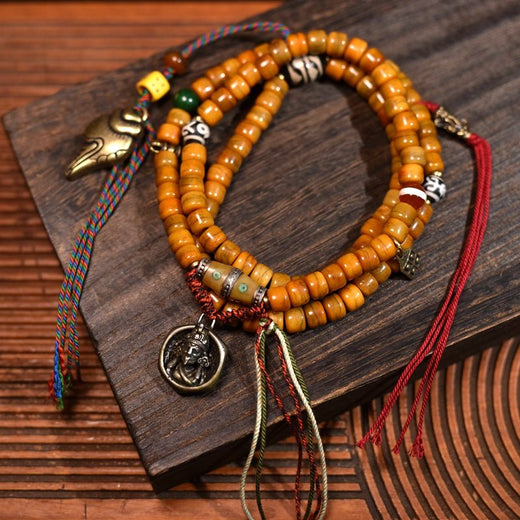
What makes a mala authentic for serious practice is not only the material — it's the sourcing, the construction, and ideally the blessing. A mala with 108 beads (the standard count for a full mantra accumulation round) should have a guru bead (the large bead at the top, sometimes called the sumeru) and, in the Tibetan tradition, two marker beads at the 27-bead positions to help you track counts without looking.
When you're evaluating a mala for this practice, ask these questions:
- Are the beads genuinely 108? Mass-produced malas sometimes come in at 106 or 110. For accumulation practice, this matters.
- What is the knot construction? Traditional Tibetan malas are knotted between each bead — this prevents the beads from sliding too quickly during recitation and allows for precise counting.
- Has it been blessed? A mala blessed during a Chenrezig puja or empowerment carries a different quality than one that hasn't. This isn't superstition — it's the recognition that objects can hold the intention of practice.
- Who made it? This is the question that separates authentic pieces from decorative reproductions.
Related: 108-bead sandalwood mala
For a broader look at how to match materials to specific practices and intentions, our guide to daily practice essentials walks through the full range of traditional materials and their traditional correspondences.
How to Actually Practice: Mala Counting, Accumulation, and Integration
There is a difference between reciting Om Mani Padme Hum and practicing it. The difference is intention, structure, and what you do with the practice off the cushion.
The Basic Mechanics of Mala Counting
Hold the mala in your right hand. The guru bead (sumeru) rests between your thumb and index finger. You recite one mantra per bead, moving the bead toward you with your thumb — away from the guru bead, not toward it.
When you reach the guru bead again, you have completed 108 recitations (one mala). You do not cross over the guru bead. Instead, you reverse direction and begin again. Crossing the guru bead is considered disrespectful to the lineage the bead represents.
In Tibetan practice, a standard session might be three malas (324 recitations) to seven malas (756 recitations). For formal accumulation practice — where you're working toward a specific count, often 100,000 recitations as a foundation practice — you would track your total count in a notebook or practice journal.
Those undertaking serious accumulation typically aim for 10 malas (1,080 recitations) per day, though this varies by tradition and personal capacity.
The recitation speed matters less than you might think. What matters is that the mind is engaged with the meaning. Some teachers recommend reciting slowly enough to feel each syllable. Others — particularly in the context of accumulation practice — recommend a pace that is brisk but not mechanical.
The Tibetan approach tends toward the latter: a steady, rolling pace that keeps the mind occupied without allowing it to wander into commentary.
Visualization: The Full Practice
In Vajrayāna, mantra recitation is ideally paired with visualization. For Chenrezig practice, the traditional visualization involves seeing Avalokiteśvara seated above your crown, white in color, with four arms — the first two joined at the heart holding a wish-fulfilling jewel, the other two holding a crystal mala and a lotus.
As you recite, white light radiates from his heart, enters through the crown of your head, and purifies the afflictions corresponding to each syllable.
If you've received a Chenrezig empowerment (wang), you have authorization to practice the full visualization. If you haven't, the recitation alone is still considered highly beneficial — the mantra is widely understood to be accessible to anyone, regardless of empowerment status, unlike some higher tantric practices.
Integration: The Practice Between the Beads
The most underused aspect of mantra practice is what happens between formal sessions. The traditional instruction is to carry the recitation as a background practice throughout the day — while walking, waiting, commuting, doing dishes.
This is not multitasking in the modern sense. It's the cultivation of what Tibetan teachers call rigpa in everyday activity: a quality of presence that doesn't require silence or stillness to maintain.
For a practitioner working through a demanding professional life, this is where the practice pays its most immediate dividends. The moment before a difficult conversation — three silent recitations. The hospital waiting room during a parent's appointment.
The five minutes in the car before you walk into your house at the end of a hard day. These are not interruptions to your practice. They are your practice.
For a structured framework that integrates mantra into a complete daily practice, the daily meditation routine guide offers a practical template that many practitioners have found useful for building this kind of continuity.

Common Questions from Serious Practitioners
Does the pronunciation have to be perfect for the mantra to be effective?
This question surfaces regularly among those committed to the practice, and it deserves a direct answer. In Sanskrit, the distinction between ṇi (retroflex) and ni (dental) is phonemically significant. In Tibetan transliteration, the pronunciation has already shifted from the Sanskrit original — Tibetans pronounce it closer to "Om Mani Peme Hung" than the Sanskrit "Om Mani Padme Hum." The Dalai Lama himself uses the Tibetan pronunciation in his public teachings.
The short answer: pronunciation matters enough to learn correctly, but the tradition itself has already accommodated variation. What matters more is the quality of attention you bring to the recitation. A perfectly pronounced mantra recited with a distracted, merit-accumulation-obsessed mind is less effective than an imperfectly pronounced one recited with genuine bodhicitta intention.
Learn the correct pronunciation — there are excellent recordings of Tibetan teachers available — and then stop worrying about it.
What does "Om Mani Padme Hum" literally translate to?
The most linguistically careful translation is something like: "Oṃ — the jewel in the lotus — hūṃ." Maṇi means "jewel" or "gem" (as in the wish-fulfilling jewel, cintāmaṇi). Padme is the locative case of padma, meaning "in the lotus." So the central four syllables mean "the jewel in the lotus" — but this is also understood as an address to Avalokiteśvara, whose full name in Sanskrit includes the epithet Maṇipadma ("jewel-lotus one").
Some scholars, including Donald Lopez in his work on the mantra, have argued that the phrase is best understood as a vocative address: "O jewel-lotus one." The oṃ and hūṃ frame this address as a complete Vajrayāna invocation.
The translation "jewel in the lotus" is poetic and not wrong, but it loses the directness of the address to the bodhisattva.
How many recitations do I need to complete before the practice "works"?
This question reveals something worth examining in your own practice. The Tibetan tradition does use specific accumulation numbers — 100,000 recitations is a common foundation practice milestone, and some teachers give specific counts for specific purposes.
But the framing of "works" is worth interrogating. The practice works in the way that exercise works: not through crossing a threshold but through consistent engagement that gradually changes the underlying condition. The 100,000 count is not a magic number — it's a commitment device, a way of ensuring that you've practiced long enough and consistently enough that the mantra has genuinely entered your stream of consciousness.
If you're asking how many recitations before you notice a difference in your quality of mind during difficult moments, most practitioners report something tangible after two to three months of daily practice at 10+ malas per day.
A mala typically contains 108 beads, so ten malas equals roughly 1,080 recitations daily — a rhythm that, sustained over weeks, shifts how practitioners respond to reactive patterns.
Can I recite this mantra without a Tibetan Buddhist teacher or empowerment?
Yes — and this is one of the things that makes Om Mani Padme Hum unusual among Vajrayāna practices. Most higher tantric practices require empowerment (wang), oral transmission (lung), and teaching (tri) before they can be practiced.
Chenrezig's six-syllable mantra is widely considered accessible without formal empowerment, and Tibetan teachers including the Dalai Lama have encouraged its recitation by anyone, Buddhist or not. That said, if you have the opportunity to receive a Chenrezig empowerment — and they are offered regularly by visiting Tibetan teachers at dharma centers across North America — the empowerment deepens the practice significantly.
It establishes a direct connection to the lineage and gives you authorization for the full visualization practice. But the mantra itself? You already have permission.
What's the difference between reciting this mantra and just repeating words?
This is the question that separates Vajrayāna mantra practice from secular repetition practices. In the Tibetan understanding, a mantra is not a word — it's a sound-form of a buddha's mind. The syllables carry what Tibetan teachers call byin rlabs (བྱིན་རླབས།) — blessing or empowerment — because they have been recited by an unbroken lineage of practitioners going back to the mantra's origin.
When you recite Om Mani Padme Hum, you are not generating meaning through your own cognitive effort. You are tuning into a frequency that has been held by millions of practitioners across centuries. The secular version of this is something like the way a word repeated in a foreign language eventually begins to feel like the thing it names — except the Tibetan teaching is that the mantra is the thing it names, not a representation of it.
if you hold this as literal metaphysics or as a useful framework for deepening attention, the practical instruction is the same: recite with the understanding that you are connecting to something larger than your individual effort.
Buddhabelief works exclusively with monastery-certified craftsmen in Lhasa and Kathmandu to bring you pieces that carry genuine spiritual significance — not mass-produced replicas.
Should I use a mala or can I count on my fingers?
Both are valid. Tibetan practitioners traditionally use a mala, and there are practical reasons for this beyond tradition: the physical sensation of moving each bead gives the hands something to do, which reduces the likelihood of the body becoming restless during recitation.
The mala also allows you to practice with eyes open or in motion — walking, sitting in a waiting room — without the mental overhead of tracking a count. Finger counting (using the joints of each finger, a traditional Indian and Tibetan method) works well for shorter sessions when you don't have your mala with you.
The main thing to avoid is counting in your head while simultaneously trying to maintain the quality of recitation — the cognitive load of mental arithmetic competes with the meditative quality of the practice.
The mala solves this problem elegantly, which is why it has persisted as the primary counting tool across traditions for over two thousand years. Our range of meditation tools collection includes malas specifically designed for active daily use — lighter, more durable, appropriate for practice both on and off the cushion.
How do I know if the mala I'm buying has actually been blessed?
This is the right question to ask, and the honest answer is: you often can't verify it independently, which means you're relying on the integrity of the source. A blessing in the Tibetan tradition typically involves a lama or monk reciting specific mantras and prayers over the object, often during a puja or after an empowerment.
The
Material, origin and ceremony details vary by product. Use the individual listing and request supporting records before relying on a particular workshop, artisan or temple claim.


Keep reading