
News
Red String Bracelet Meaning in Tibetan Buddhism (2026 Guide)
You’re scrolling again. It’s late, the blue light of your phone is painting shadows on the ceiling, and your thumb is tired. You see influencers in Bali, posts about hustle culture, a dozen conflicting “how to be happy” infographics.
Instead of feeling connected, you feel a quiet hum of anxiety. You’ve been looking for something simple, something real to hold onto amidst the digital noise. You might have seen a simple red string on someone's wrist and wondered about it.
It’s more than a trend; it's a centuries-old practice, a quiet anchor. For those seeking a tangible connection to their intentions, some authentic Tibetan bracelets offer a starting point not found in an app or a feed.
What It Really Is (And Isn't)
You've probably seen red strings everywhere. On celebrities, on your yoga teacher, maybe even on a friend who just got back from a trip. It's easy to lump them all together as a single spiritual trend.
But the red cord you see in Tibetan Buddhist tradition is quite distinct, with its own profound history and purpose. It’s not only a fashion accessory, and it's not the same as the popular Kabbalah string.
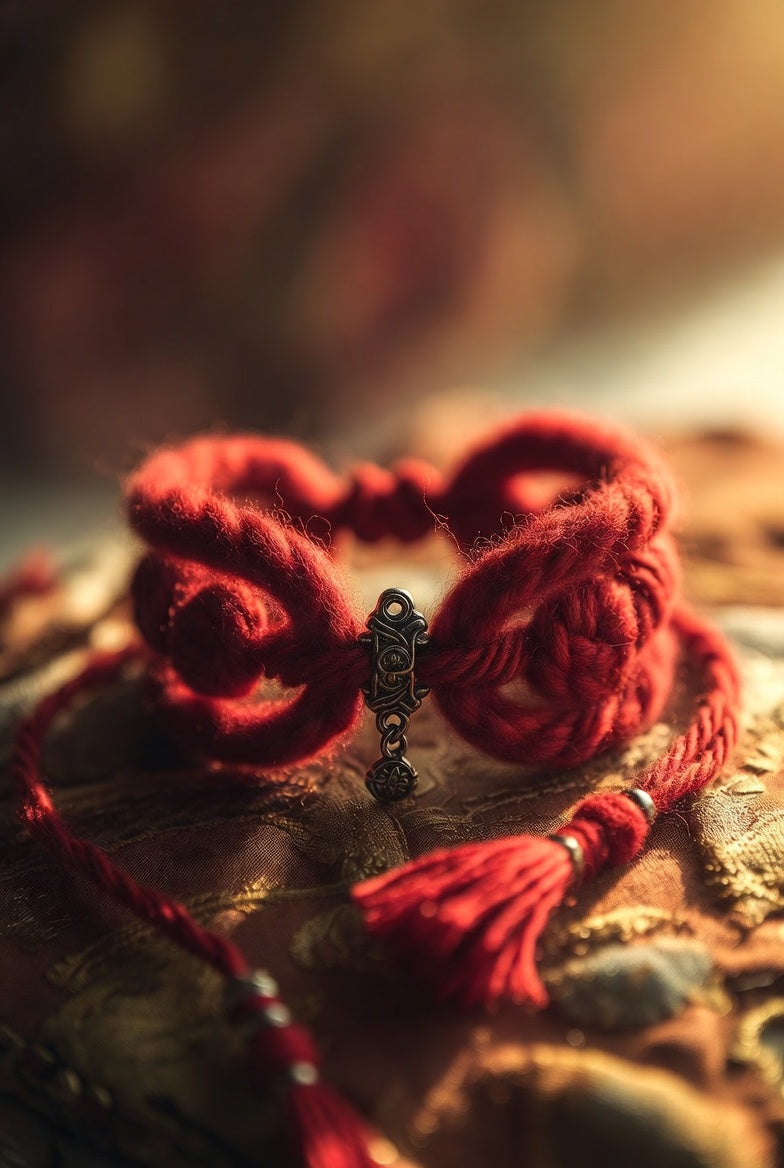
In Tibetan, this blessed cord is often called a sungdi or srung-mdud. The name itself means “protection knot.” It’s not something you simply buy and put on. Traditionally, you receive it from a Lama (a teacher) or a monk after a ceremony, a blessing, or a teaching.
The act of receiving it is as important as the object itself. It represents a connection—to the teacher, to the teachings (the Dharma), and to the community of practitioners (the Sangha).
The biggest misconception we see is confusing it with the Kabbalah red string. While both use a red cord and are associated with protection, their origins and application are very different. The Kabbalah practice often involves a specific ritual of winding a string around Rachel's Tomb, then wearing it on the left wrist (the “receiving” side of the body) with seven knots to ward off the “evil eye.”
The Tibetan approach is less about a specific formula and more about the transference of blessings. The color red (dmar po) in the Himalayas is a powerful, protective color. You see it on the walls of monasteries and in the robes of monks.
It symbolizes the life force, compassion, and the fiery energy that overcomes obstacles. The blessing is imparted into the string through the recitation of mantras—sacred sounds that carry specific energies—by a practitioner. The Lama will often blow on the string after the mantras, symbolically infusing it with the breath and energy of the practice.
It's then tied onto your wrist, often with a simple sliding knot or a specific protection knot like the Vajra or Endless Knot. Its purpose isn't to deflect external evil forces in a superstitious way, but to serve as a constant, physical reminder of the protective qualities you are cultivating within yourself: compassion, awareness, and inner strength.
Why This Matters in 2026

You might wonder, “Why would a simple string matter in my life, with my job, my student loans, my complicated relationships?” It’s a fair question. The world of 2026 isn't the ancient Tibetan plateau.
But the internal challenges we face are, in many ways, timeless—they’ve just taken on new, digital forms.
Think about your average Tuesday. You wake up and the first thing you reach for is your phone. Before your feet touch the floor, you're hit with work emails, a news cycle designed to provoke outrage, and the curated perfection of social media.
This is the modern version of what Buddhists call “samsara”—a cycle of grasping, aversion, and confusion. We are constantly pulled out of our own lives and into a vortex of external demands and comparisons.
This leads to a specific kind of modern suffering: a low-grade, persistent anxiety and a feeling of being disconnected from what truly matters. You feel busy but unproductive, connected but lonely.
This is where a practice, symbolized by the red string, finds its relevance. It’s not about adding another complicated “wellness hack” to your to-do list. It’s about subtraction. It's a rebellion of simplicity against overwhelming complexity.
Scenario 1: The Pre-Meeting Anchor. You’re about to log into a video call you’re dreading. Your heart rate is up, and you’re already running through negative scenarios in your head. You glance down and see the red cord on your wrist.
You pause. You take one conscious breath. You feel the texture of the string under your thumb. This tiny action breaks the cycle of anxious thoughts. It doesn't meaningfully solve the meeting, but it brings you back into your own body, into the present moment.
You enter the call centered, not scattered. It's a shield of intention, reminding you to stay grounded in your own integrity, no matter the external pressure.
Scenario 2: The Doomscroll Interrupter. It’s 11 PM. You planned to read a book, but you’ve been scrolling for 45 minutes. You feel that familiar mix of numb and agitated. As you shift your hand, the bracelet brushes against your skin.
It’s a gentle nudge. A reminder of your intention to be more mindful with your time and attention. Maybe tonight you don’t stop scrolling. That’s okay. But the reminder was there. And tomorrow, or the next day, that gentle nudge might be enough for you to put the phone down and choose differently.
It’s not about perfection; it’s about planting a seed of awareness.
In 2026, the greatest battle is for our attention. Corporations and algorithms are designed to hijack it for profit. A blessed red string, in this context, becomes a radical act. It’s a non-digital, non-commercial, personal reminder that your attention is yours to give.
It’s a connection to something ancient and stable in a world that feels increasingly fragmented and chaotic. It doesn’t offer an easy fix, but it offers a tangible starting point—a thread back to yourself.
Real Benefits, or How It Actually Works
When we talk about the “benefits” of a blessed red string, it's easy to slip into language that sounds mystical or superstitious. But from a practitioner's perspective, the way it “works” is deeply practical and psychological.
It’s not a magic charm that grants wishes. Rather, it’s a tool for training your own mind. The power isn’t in the string itself; the string is what points you back to the power within you.
We've spent years speaking with the artisans and monks who create and bless these items, and their explanations always come back to these three core functions.
A Tangible Anchor for Mindfulness
Your mind is like a restless monkey, jumping from thought to thought, from past regrets to future anxieties. Mindfulness is the practice of gently bringing that monkey back to the present moment. But “the present moment” is an abstract concept.
A physical anchor makes it concrete. That’s the primary function of the red string. Every time you feel it on your skin—when you’re typing, washing your hands, reaching for your keys—it’s a small, non-intrusive bell of awareness.
It’s a silent invitation to check in: “Where is my mind right now? Am I breathing? Am I holding tension in my shoulders?” You can develop a simple habit: whenever you notice the bracelet, you take one conscious breath.
This single practice, repeated dozens of times a day, can fundamentally change your relationship with your own mind. It breaks you out of autopilot and re-engages you with your life as you are actually living it.
It's a far more integrated approach than setting a 10-minute timer on a meditation app, because it weaves the practice into the fabric of your day.
A Symbol of Interconnection and Support
One of the most pervasive forms of suffering in the modern West is a profound sense of loneliness and isolation. We are told to be self-sufficient, to “pull ourselves up by our bootstraps.” A traditional Tibetan red string directly challenges this narrative.
When you wear a cord. You are connected to the person who blessed it, to their lineage of teachers stretching back centuries, and to the entire community of people who hold these values. It’s a reminder that you are not on this journey alone.
When you feel overwhelmed or lost, looking at the string can remind you of the compassion (karuṇā) and wisdom (prajñā) of this tradition. It’s like having a silent council of elders on your wrist, not telling you what to do, but reminding you that support exists and that countless others have walked this path before you.
This sense of belonging can be a powerful antidote to the anxiety that comes from feeling like it’s all on you.
A Shield of Intention, Not Magic
The term “protection” is easily misunderstood. The Tibetan Buddhist view of protection is not about creating an invisible force field to ward off bad luck or external threats. The real dangers are internal: anger, jealousy, greed, ignorance, and crippling self-doubt.
These are the “demons” that truly harm us. The red string acts as a shield of *intention*. By wearing it, you are making a commitment to yourself to be more mindful of these internal states.
When you feel a surge of anger in traffic, the bracelet is a reminder: “Is this how I want to use my energy?” When you feel the sting of jealousy scrolling through social media, it’s a prompt: “Can I wish this person well and return to my own path?” The protection is proactive, not passive.
It works because *you* make it work. The blessing on the string is an empowerment, a spiritual boost to support your own efforts to protect your mind from its own worst habits. It’s a partnership between you and the tradition, aimed at cultivating a resilient and compassionate heart.
This is a far more empowering approach than simply hoping an object will solve your problems for you and is a core part of the complete guide to sacred Tibetan jewelry.
How to Choose an Authentic Red String Bracelet

As the red string has grown in popularity, the market has become flooded with mass-produced imitations. These might look similar, but they lack the very essence of what makes a Tibetan protection cord meaningful: the intention and the blessing.
Choosing an authentic piece is not about brand names or high prices; it’s about understanding and respecting its origin. Here are the criteria we’ve learned to look for after years of building relationships in Nepal and Tibet.
1. The Source of the Blessing: This is the most important and most invisible element. An authentic Tibetan red string is not only a piece of jewelry; it's a sacred object. It should be blessed by a qualified practitioner—a Lama, Rinpoche, or a community of monks or nuns.
The blessing process, involving the recitation of specific mantras and prayers, is what infuses the simple cord with its purpose. When you're looking for a bracelet, ask about its origin. Where was it blessed?
By whom? A reputable source will be transparent about this. For example, we work with monks from Sera and Drepung monasteries, who bless our cords during their daily pujas (ritual ceremonies). A bracelet without a blessing is just a red string.
2. The Material and Craftsmanship: Simplicity is key. Authentic cords are typically made from a sturdy, simple thread, like high-quality cotton or nylon. The focus isn't on expensive materials. The value is in the blessing, not the gold or silver it might be attached to.
Pay attention to the knot. Often, you'll find a specific, functional knot like a sliding knot, which allows you to adjust the size. Other times, it may incorporate a symbolic knot, like the Endless Knot (shrivatsa), which represents the interconnectedness of all things and the unending wisdom of the Buddha.
The handwoven red string bracelet we offer, for example, is tied by artisans in our Kathmandu workshop who have practiced this craft for generations, using a durable cord and a secure, adjustable knot designed for daily wear.
3. The Intention of the Seller: Look at how the bracelet is presented. Is it sold with sensational claims of “ancient magic” or promises of wealth and instant luck? Or is it presented with respect for its cultural and spiritual context?
We believe that how we talk about these objects is part of our responsibility. The language should be educational and respectful, not hyped-up marketing. A seller who takes the time to explain the meaning, the process of blessing, and how to use the bracelet as a mindfulness tool is more likely to be offering a genuine article.
Their goal should be to share a piece of their culture, not only to make a sale. Our broader handwoven Tibetan bracelet collection is curated with this principle at its core.
Ultimately, choosing an authentic piece is an investment in a practice. You're not only buying a bracelet; you're connecting with a lineage and a set of intentions. A cheap, mass-produced string from a factory has no story.
An authentic, blessed cord carries the quiet energy of its creators and the profound legacy of the Dharma.
How To Use It Day To Day in Your Daily Life
So, you’ve chosen a red string bracelet that feels right. It’s on your wrist. Now what? The real practice begins. Integrating this simple object into your life is where its true value unfolds. It’s not about following rigid rules, but about cultivating a personal and meaningful relationship with this tool for awareness.
Here are some practical steps we share with newcomers.
Putting it On and Setting an Intention: When you first put on the bracelet, take a moment. Don’t just throw it on while rushing out the door. Sit quietly for a minute. Hold the bracelet in your hands.
Think about why you were drawn to it. What is the quality you wish to cultivate more of in your life? Is it patience? Compassion? Focus? Maybe it’s simply the intention to be more present.
As you slide the bracelet onto your wrist and tighten the knot, hold that intention in your mind. You can even say it aloud or silently to yourself: “May this remind me to be patient,” or “May this help me stay grounded.” This simple act transforms the bracelet from a passive object into an active partner in your journey.
Daily Micro-Practices: The bracelet’s main function is as a mindfulness trigger. Create a simple “if-then” habit. For example: “If I notice my bracelet, then I will take one deep breath.” You can do this anywhere, anytime.
While waiting in line for coffee, sitting in traffic, or during a boring meeting. Another practice is to touch the bracelet deliberately during moments of stress. Feeling overwhelmed? Gently touch or rub the knot with your thumb.
Let the physical sensation anchor you in the present moment, pulling your attention away from the storm of anxious thoughts. This is a core principle discussed in any good guide to wearing Buddha bracelets—using the physical to ground the mental.
What to Do When It Breaks: This is a common source of anxiety for people, but in the Tibetan tradition, it’s viewed very differently. A blessed protection cord is believed to absorb negativity or obstacles that you might have otherwise faced.
When it breaks or falls off, it is often seen as a sign that it has done its job. Its protective capacity has been “used up.” There is no need for alarm. The second, and perhaps more profound, teaching here is that of impermanence (anitya).
Everything is in a state of change, and the breaking of the string is a direct, tangible lesson in this fundamental truth. When it breaks, the appropriate response is gratitude. Thank it for its service and its teaching.
You can then respectfully dispose of it (burying it in the earth near a plant is a lovely gesture) and, if you wish, begin anew with another.
This daily interaction is what builds the bracelet’s significance. It becomes a personal symbol, encoded with your own experiences, struggles, and small victories of awareness. It's a quiet conversation you have with yourself throughout the day.
Common Questions About the Tibetan Red String Bracelet
What's the real difference between Tibetan and Kabbalah red strings?
While they look similar, the distinction is significant. The main difference lies in their spiritual origin, purpose, and method. The Kabbalah red string, from Jewish mysticism, is specifically worn on the left wrist to receive protection from the “evil eye” (ayin hara).
It's often tied with seven knots while reciting a specific prayer. Its focus is primarily on warding off external negative influences. The Tibetan Buddhist red string, or sungdi, is different. Its power comes from being.
It can be worn on either wrist and its purpose is more internal. It serves as a mindfulness tool and a reminder to cultivate inner protection—qualities like compassion, awareness, and strength—to overcome your own mental afflictions.
It symbolizes a connection to a teacher and the Buddhist teachings, rather than being a stand-alone ritual object. One is about deflecting the external, the other about cultivating the internal.
Which wrist should I wear my Tibetan red string on?
Unlike the strict “left wrist only” rule in the Kabbalah tradition, Tibetan Buddhism is generally more flexible on this. There isn't a universally mandated rule. However, there are different schools of thought. Some Lamas will tie it on the left wrist, as this side is associated with receiving blessings and energy.
Others may place it on the right wrist, which is associated with action and giving. Often, the Lama will simply tie it on whichever wrist you offer. We have found that the most practical advice is to wear it on your non-dominant wrist.
This is for a simple, pragmatic reason: it will interfere less with your daily activities and will last longer. The most important aspect is not the wrist you choose, but the intention you carry.
The bracelet is a reminder for *you*, so wear it where it feels most comfortable and will best serve its purpose as a daily anchor for your mindfulness practice. When you wear a cord blessed by a Lama from Sera Monastery or by the artisans in our Kathmandu workshop, you are carrying a symbol of connection.
Its power comes from being blessed by a Lama or monks through the recitation of mantras.
What do I do if my red string bracelet breaks or falls off?
Your first reaction might be panic, but please don't be. In Himalayan traditions, this is seen as a positive event. There are two main interpretations. The first is that the bracelet has fulfilled its purpose.
It is believed to absorb a certain amount of negativity or obstacles meant for you, and when it breaks, it signifies that its protective capacity is exhausted—it has done its job. The second, deeper meaning is a direct teaching on impermanence, a core concept in Buddhism.
Everything, from our bodies to our relationships to this simple string, is subject to change and decay. The breaking of the string is a gentle, physical reminder of this truth. The proper response is one of gratitude.
Thank it for its service and its teaching. You can then respectfully dispose of the old string, perhaps by burying it in a garden or a potted plant, and choose a new one if you wish to continue the practice.
Do I need to be a Buddhist to wear one?
Absolutely not. While the red string has deep roots in Tibetan Buddhism, its core functions—as a tool for mindfulness, a symbol of intention, and a reminder of compassion—are universal human values. You do not need to subscribe to any dogma or label yourself a “Buddhist” to benefit from its presence.
Think of it as a piece of helpful technology from a very old and wise culture. If your intention is one of respect and a genuine desire to cultivate more peace and awareness in your life, you are honoring the spirit in which the bracelet is given.
It is a tool, not a test of faith. For anyone feeling adrift or seeking a tangible anchor in a chaotic world, the red string can serve its purpose, regardless of your spiritual background.
It's an invitation, not a conversion.
How is the bracelet actually blessed? What does that mean?
The blessing is the heart of the bracelet's significance. It's not a vague or meaningful act. It's a specific process of consecration performed by a trained practitioner. Typically, a bundle of new cords is brought into a monastery or a Lama's shrine room.
During a ritual or prayer session (puja), the Lama or monks will chant specific mantras. These mantras are sacred sounds associated with particular enlightened beings or qualities, like the mantra of Chenrezig (Avalokiteshvara) for compassion, or Tara for protection from fear.
As they chant, they visualize light and blessings flowing from the Buddhas and into the strings. At the end of the recitation, the lead Lama will often blow on the cords, symbolically infusing them with the power and energy of the mantras and their own spiritual breath.
“Blessing” in this context means to imbue an object with positive, spiritual presence and to dedicate it to a virtuous purpose—in this case, to help the wearer remember their own potential for goodness and awareness.
Can I get my bracelet wet or take it off?
Yes, you can. These bracelets are made to be lived in. The artisans and monks who create and bless them understand that they will be part of your daily life, which includes showering, washing dishes, and swimming.
Most traditional Tibetan protection bracelets are made from durable cord that withstands water. It may fade or wear faster with constant exposure to water, but this is part of its natural lifecycle. As for taking it off, traditionally, it's meant to be worn continuously until it falls off on its own.
This is because its function as a constant reminder is most effective when it's always present. However, this is a guideline, not a strict commandment. If you have a job or a situation where you need to remove it for safety or practical reasons, you can absolutely do so.
Simply put it back on with the same intention you started with. The practice is meant to support your life, not complicate it.
What are the knots on a Tibetan bracelet?
The knots on a Tibetan bracelet are rarely just decorative; they are imbued with meaning. The most common type is a simple, functional sliding knot. This practical design allows the bracelet to be adjustable for any wrist size and ensures a secure fit.
However, you will often find bracelets featuring specific symbolic knots. The most revered of these is the Endless Knot, or Shrivatsa. It is one of the Eight Auspicious Symbols in Tibetan Buddhism. With its intricate, overlapping design that has no beginning and no end, it represents the Buddha's endless wisdom and compassion, the interconnectedness of all phenomena, and the eternal continuity of the mind.
Wearing a bracelet with an Endless Knot is a powerful reminder of these profound concepts. Other ancient protection symbols, like the Vajra knot, may also be used, which represents indestructibility and clarity of mind.
Your Journey, Your Anchor
Your journey is uniquely yours. The questions you’re asking—about your purpose, your path, your place in the world—are the right questions. There are no easy answers to be found in a single article or a single object.
We know that. The path of self-awareness is not a quick fix; it's a lifelong walk, one step at a time.
As you move toward 2026 and beyond, the world will only get louder. The demands on your attention will only increase. Finding small, tangible ways to anchor yourself in your own values and intentions will not be a luxury, but a necessity for your well-being.
A simple, blessed red string won't walk the path for you. It won't erase your anxiety or solve your problems.
What it can do is be a faithful companion. A quiet, constant reminder on your wrist that says, “Come back. Breathe. You are here.” It can be the thread that connects your highest aspirations to your daily actions.
It's a link to something ancient, stable, and compassionate in a world that often feels anything but. It is a small, red dot of sanity in the noise. When you're ready to find a piece that resonates with your path, we invite you to explore our Himalayan artisan bracelets, each one carrying a story and a blessing for your journey ahead.
Keep reading