
buddhist-jewelry
Tiger Eye Bracelet Meaning: A Guide for Practitioners 2026
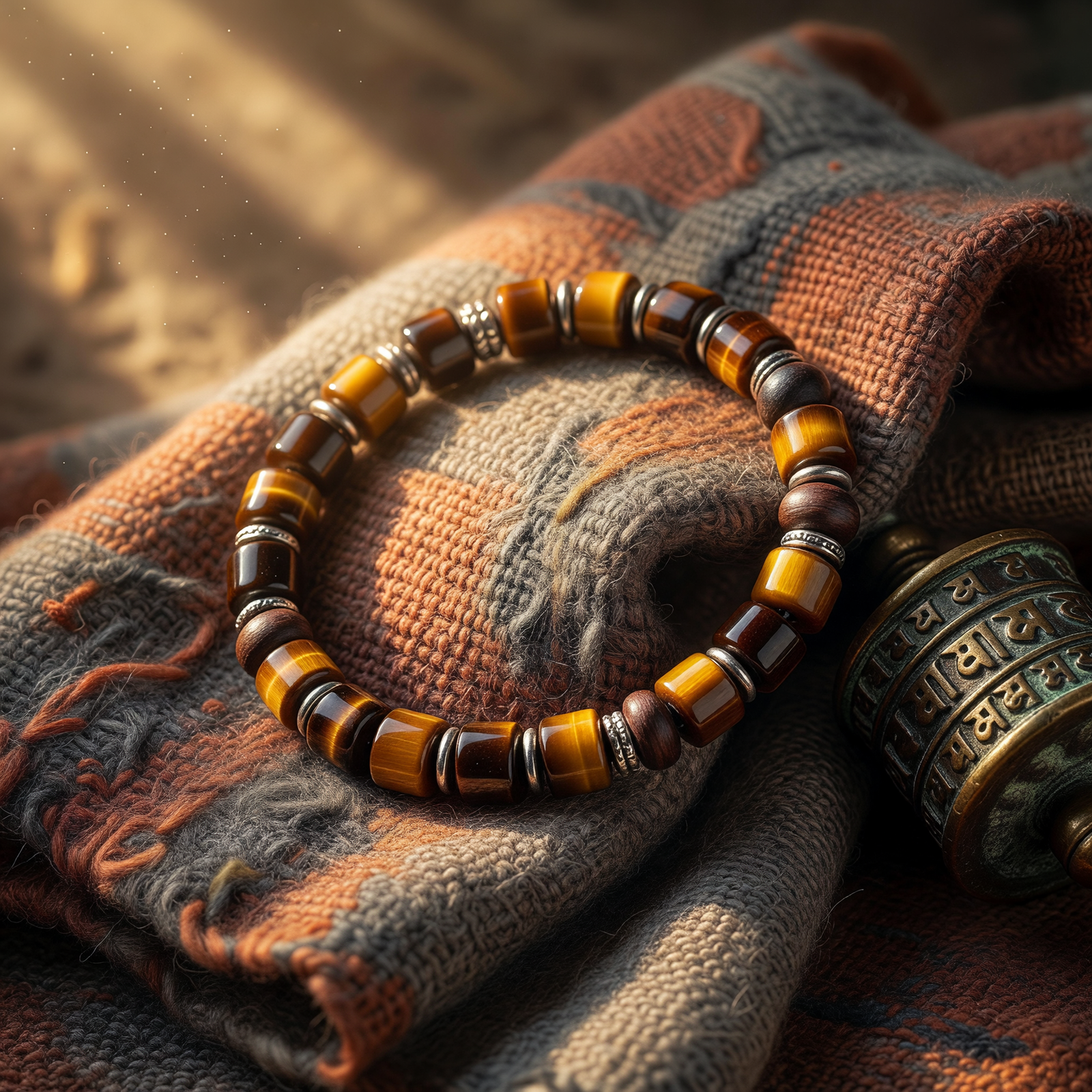
You sit down on your cushion, same time as always. You count the breath. In… out. But the mind is a tempest. A difficult meeting from yesterday replays on a loop, a subtle worry about your aging parents surfaces, the silent tension with your partner hangs in the air. The practice feels… flat. The spaciousness you once found so readily now seems distant. This is the plateau. It's a familiar landscape for any serious practitioner, a place where the initial momentum of practice meets the stubborn gravity of daily life. You're not looking for a magic fix, but a skillful means—a tool to support the work you're already doing. A Tiger Eye bracelet, when understood correctly, can be such a tool. And to understand it, we recommend exploring our complete guide to authentic Tibetan bracelets for a closer context.
The Foundation: What Tiger's Eye Really Is
Walk into any crystal shop from Santa Monica to Brooklyn, and you'll hear a familiar story about Tiger's Eye. It's the "stone of power," a tool for "drawing in wealth," a talisman for go-getters and entrepreneurs. While there's a kernel of truth in its association with strength, this popular narrative misses the mark for those on a path of self-inquiry. It frames the stone as a tool for grasping, for acquiring external validation and material success. From a Dharma perspective, this approach only strengthens the very attachments we're working to understand and release. The authentic meaning of Tiger's Eye is not about accumulating external power, but about cultivating *internal* stability and clear seeing. Think of the tiger itself, not as a symbol of aggressive ambition, but of unwavering presence rooted in the present moment. A tiger in the jungle doesn't fidget. It doesn't second-guess. It moves with an economy of motion, its gaze steady, calm, and fully aware. This is the presence the stone points toward: the mind's innate capacity for focused, undistracted awareness. In the Mahayana tradition, we speak of the Bodhisattva's courage—not the brute force of a warrior, but the fearless compassion to face suffering (both our own and others') without turning away. This requires a mind that is grounded and clear. The chatoyancy of Tiger's Eye—that beautiful, shimmering band of light that moves across the stone's surface—is a perfect metaphor for this quality. The stone itself is dark, earthy, and solid, representing the grounded foundation of your practice. The moving light represents the focused beam of your awareness, able to scan your inner and outer landscape without getting lost in the shadows. It's not about attracting a bigger paycheck; it's about developing the clarity to see your professional life as a field for practice, and the courage to act with integrity even when it's difficult. We see it not as a mystical object, but as a piece of the earth that reminds you of your own inherent stability. When the mind is scattered by the winds of karma—praise and blame, gain and loss—this stone serves as a tactile reminder of the ground beneath your feet. It's a call to return to the present moment, to the quiet strength that is always available when you stop grasping and simply *are*.
Why This Matters for Your Practice in 2026
You've been practicing for years. You've sat through retreats, you've read the books, you have a vocabulary for your inner world. Yet, the challenges of 2026 are unique and persistent. The pressure to perform in a demanding career, the complexities of long-term relationships, and the demanding task of caring for aging parents—these are the real-life arenas where the Dharma is tested.
A Tiger Eye bracelet isn't a panacea, but it serves as a potent ally in working through these specific challenges with skill and presence.
When our team was in Dharamsala last year, we
Consider your professional life. You're likely in a position of responsibility. This comes with high-stakes meetings, difficult decisions, and the constant need to balance ambition with integrity. The common narrative of Tiger's Eye would suggest wearing it to "win" the negotiation or "dominate" the room.
The practitioner's view is different. You wear it as a reminder to stay grounded when challenged. When a colleague's comment triggers your defensiveness, a glance at the stone on your wrist—its bands of gold and brown catching the fluorescent office light—can be the micro-pause you need.
It's a prompt to take a breath, to feel your feet on the floor, and to respond from a place of clarity rather than reactivity. It supports the courage to speak a difficult truth or to hold your ground with equanimity, not aggression.
Then there is the landscape of your relationships. The work of partnership, of family, of caring for those who once cared for you, requires immense patience and resilience. You might find yourself in a conversation with your partner where old patterns surface, or facing the immense emotional weight of a parent's declining health.
In these moments, the mind can easily become clouded by fear, grief, or frustration. The Tiger's Eye serves as an anchor. Its steady, earthy quality—the weight of it, roughly 8 to 10 grams on your wrist—is a reminder to stay present with the discomfort, to listen without immediately formulating a defense, and to find the inner stability to offer genuine compassion instead of anxious advice.
The "protection" it offers is not from external harm, but from your own unskillful reactions—the sharp words, the emotional shutdown, the retreat into ego.
Finally, there's the practice plateau itself. After a decade of meditation, the path is no longer novel. The initial insights have settled, and now comes the long, patient work of integration. It can feel stagnant.
A physical object, intentionally chosen and imbued with meaning, can reinvigorate your practice. Using a Tiger Eye mala or bracelet during meditation can provide a new focal point. The weight, the temperature, the smooth texture of the beads can become a sensory anchor, a way back to the body when the mind is lost in endless discursive thought.
It helps transform the abstract intention of "being grounded" into a tangible, felt experience, reminding you that awakening is not a far-off goal but a present-moment reality, available right here, in the simple feeling of a stone against your skin.
The Real Benefits: How a Tiger Eye Bracelet Works for a Practitioner
For someone deep in their practice, the benefits of a tool like a Tiger Eye bracelet extend far beyond generic claims of "good luck" or "wealth attraction." The way it "works" is not through magic, but by supporting and reminding you of the qualities you are already cultivating through your practice.
It acts as a bridge between your formal sitting meditation and your active life. Here are three core ways it functions as a skillful means.
Cultivating Skillful Courage (Vīrya)
In the Buddhist tradition, courage is not about the absence of fear. It's about the willingness to stay present *with* fear, discomfort, and uncertainty. This is the paramita of *Vīrya*—not aggressive force, but joyful, persistent effort in the face of challenges.
A Tiger Eye bracelet is a constant, physical reminder of this quality. Its deep, stable colors and the unwavering "gaze" of its chatoyancy evoke the quiet confidence of a Bodhisattva. When you're about to enter a difficult conversation or make a decision that feels daunting, the simple act of touching the beads can be a moment of recollection.
It's a silent prompt: "Can I meet this moment with stability? Can I act from a place of clarity, not reactivity?" It helps you access the courage to be vulnerable, to speak your truth with kindness, and to hold your seat when the winds of change blow strong.
This is the true power of the stone—not to eliminate challenges, but to help you meet them with your whole being.
Grounding the Mind, Clarifying Intention
The Buddha often used metaphors of the earth to describe a stable mind. It is unshaken, solid, and reliable. In a world of constant digital distraction and mental chatter, this quality of groundedness is more valuable than ever.
The Tiger's Eye, with its earthy tones of gold and brown, is a powerful anchor to the body and the present moment. When you feel your mind spinning out into anxious future scenarios or ruminating on past regrets, the physical sensation of the bracelet on your wrist can pull your awareness back.
It's a tool for embodiment. This grounding effect is the prerequisite for clear intention. A scattered mind cannot form a clear intention; it can only react. By helping to settle the mental agitation, the stone creates the inner space needed for genuine insight to arise.
You see the situation more clearly, you understand your own motivations more deeply, and your actions become more purposeful and aligned with your core values.
Protection as Mindful Awareness
Many traditions speak of Tiger's Eye as a stone of protection. For a practitioner, this concept needs refinement. The ultimate protection is not a shield against external forces, but the wisdom of mindful awareness.
The real dangers are the "kleshas" or mental afflictions: greed, hatred, and delusion. A Tiger Eye bracelet serves as a "dharma protector" in this context. It's a reminder to be watchful of your own mind.
Its steady, eye-like appearance is a symbol of introspection. When you feel the spark of anger, the pull of craving, or the fog of confusion, the bracelet can act as a silent alarm. "Pay attention.
What is happening in your mind right now?" This is the essence of protection on the path. It's about catching unskillful states before they take root and dictate your actions. It is a form of protection that empowers you, rather than making you dependent on an external object.
This mirrors how many ancient protection symbols with ancient spiritual meanings function—as reminders for the mind. A simple, well-crafted handwoven red string bracelet, for example, serves this same purpose of mindful recollection.
How to Choose an Authentic Tiger Eye Bracelet
When you're choosing a tool for your practice, authenticity matters. An object created with intention, by artisans who understand its purpose, carries a different quality than a mass-produced item from an anonymous factory. The care woven into its creation becomes part of its story and its function.
Choosing an authentic Tiger Eye bracelet is an investment in your practice, and there are several key factors to consider.
First, look at the stone itself. Genuine, high-quality Tiger's Eye will have a vibrant and distinct chatoyancy. This is the silky, lustrous shimmer that moves as you turn the stone in the light. It should look like a cat's eye, a clear and moving band of light.
Lower-quality stones will have a duller, more muddled effect. Be wary of pieces that look too perfect or uniform; natural stones have variations and subtle imperfections that are part of their beauty. Glass imitations often have air bubbles and lack the fibrous, layered structure that creates the unique shimmer of real Tiger's Eye.
When you hold a genuine stone from South Africa's Northern Cape region, you'll feel the weight and density that distinguishes it from synthetic alternatives.
Second, consider the craftsmanship. This is where you can truly feel the difference. How are the beads strung? Are they on a cheap, flimsy elastic cord that will snap in a few months, or are they hand-knotted on a durable, high-quality cord?
The artisans in our Kathmandu atelier, for example, use traditional knotting techniques that not only ensure longevity but are also a meditative practice in themselves. Look at the other components. Are the accent beads made of cheap plated metal, or are they meaningful materials like sandalwood, bodhi seed, or even sterling silver?
The overall construction should feel solid and intentional. This attention to detail is a hallmark of our entire handwoven Tibetan bracelet collection.

Third, understand the context and source. Where does the bracelet come from? Who made it? We've spent years building relationships with artisans like Master Tenzin in Boudhanath, ensuring that each piece is not only ethically made but also created in an environment of respect and mindfulness.
An authentic piece often combines Tiger's Eye with other significant elements from the Tibetan tradition. For instance, you might find it paired with a powerful Dzi bead bracelet, where the grounding presence of the Tiger's Eye complements the celestial presence of the Dzi.
Or it might be accented with finely detailed Tibetan silver charms featuring auspicious symbols. These combinations are not random; they are thoughtfully designed to create a harmonious and potent tool for your journey. Choosing from a source that understands and respects this lineage ensures you are getting more than a piece of jewelry; you are acquiring a companion for your practice, rich with meaning and integrity.
Exploring our range of Himalayan artisan bracelets connects you with this deep commitment to authenticity.
How to Actually Use Your Bracelet in Daily Practice
A Tiger Eye bracelet is not meant to be a passive ornament. It's an active tool, a piece of practice equipment, much like your cushion or your mala. Integrating it into your daily life is how you unlock its true potential as a support for your path. The key is to move beyond simply wearing it and begin to work with it intentionally. **During Your Formal Sit:** Before you begin your meditation session, take a moment to hold the bracelet in your hands. Feel its weight, its coolness against your palm, and the smoothness of the beads—each one roughly the size of a chickpea. You can use it to set your intention for the session. You might silently say, "May this session help me cultivate a stable and clear mind." During the meditation itself, if you find your mind wandering and becoming agitated, you can gently bring your awareness to the physical sensation of the bracelet on your wrist. This simple sensory anchor can be remarkably effective at cutting through discursive thought and bringing you back to the present moment, back to the body. It's a skillful, compassionate way to guide the mind home without judgment. **As a Pause Button Throughout Your Day:** The modern workday is a torrent of demands, emails, and meetings. It's easy to get swept away. Use your bracelet as a trigger for micro-practices. For example, every time you notice it on your wrist while typing, let it be a reminder to check your posture and take one conscious breath. Before you walk into a stressful meeting or make a difficult phone call, pause for ten seconds. Hold the bracelet, feel the beads between your fingers, and connect with the intention of groundedness and clarity. This small ritual can completely shift the presence you bring into a situation, moving it from a reactive encounter to a mindful engagement. Our guide on Buddha bracelets and their meanings explores this idea of using jewelry as a constant, gentle reminder. **In Difficult Conversations:** Relationships are often our most challenging and rewarding field of practice. When you anticipate a difficult conversation with a partner, family member, or colleague, you can consciously use your bracelet as a tool. Before you speak, you might subtly touch one of the beads. Let this be a reminder to listen fully before you respond. Let it be a reminder of your intention to speak with kindness and honesty, to stay connected to your own feelings without blaming the other person. The bracelet becomes a silent ally, helping you stay anchored in your center when emotional currents are strong. It supports your commitment to turning habitual reactions into skillful, compassionate responses. This is the essence of bringing the dharma off the cushion and into every corner of your life, which is the ultimate goal of wearing any of our traditional Tibetan protection bracelets.Common Questions from Practitioners
Even for seasoned practitioners, incorporating a new tool into your practice can bring up questions. Here are some of the ones we hear most often, answered from a perspective that respects the depth of your journey.
Which wrist should I wear my Tiger Eye bracelet on?
In many contemplative traditions, you'll hear that the left hand is for "receiving" and the right is for "giving." While this can be a helpful starting point, those on a path of self-inquiry are encouraged to approach it with a practitioner's curiosity.
Try wearing it on your left wrist when you feel you need to cultivate more inner stability, groundedness, and self-compassion—receiving its supportive qualities. Try it on your right wrist when you feel called to act in the world with courage, clarity, and integrity—projecting those qualities.
Ultimately, the most important factor is your own experience. Wear it on the wrist that feels most natural and supportive for you. The body has its own wisdom; pay attention to what it tells you.
There is no rigid dogma here, only skillful means.
Is Tiger's Eye a traditional stone in Tibetan Buddhism?
While stones like turquoise, coral, and Dzi beads have been woven into Tibetan culture since at least the 7th century during the Yarlung Dynasty, Tiger's Eye is more of a modern integration. It isn't found in ancient Tibetan texts or historical jewelry in the same way.
However, the principles it embodies—groundedness, clarity, and the unwavering gaze of awareness—are absolutely central to the Dharma. Tibetan Buddhism has always been adaptable, skillfully incorporating tools and symbols that resonate with the core teachings.
We see Tiger's Eye as a powerful contemporary ally for the practitioner, a stone whose inherent qualities align perfectly with the goals of the path, even if its historical usage in Tibet is not as ancient as other materials.
Can I wear it with my other malas or bracelets?
Yes, absolutely. The practice is about integration, not segregation. Wearing your Tiger Eye bracelet alongside a Bodhi seed mala, a sandalwood bracelet, or a simple red cord is a beautiful way to combine different aspects of your practice.
Each piece can serve as a reminder for a different quality you are cultivating. Perhaps the Bodhi seed reminds you of your ultimate potential for awakening, while the Tiger's Eye reminds you of the grounded, steady work required to get there.
The key is intention. When you put them on, know why you are wearing each piece. Let them be a sangha on your wrist, a community of reminders supporting your journey.
How do I "cleanse" or care for my bracelet?
The internet is full of elaborate rituals involving moonlight, salt, and sage. From our perspective, the most important way to care for your bracelet is with mindfulness and respect. Physically, you can wipe the beads with a soft, damp cloth to remove oils and dust—we recommend doing this monthly or whenever you notice buildup.
But more importantly, the "cleansing" is about your own intention. When you take the bracelet off at night, do so with a sense of gratitude. When you put it on in the morning, reaffirm your intention for the day.
You can periodically hold it and bring your practice to it—reciting a mantra like Om Mani Padme Hum or simply breathing with it for a few moments. This infusion of your own mindful presence is what keeps the bracelet's purpose alive and vivid.
Is a Tiger Eye bracelet connected to a specific deity or protector?
In Vajrayana practice, certain qualities are associated with specific deities. The unwavering, clear-seeing, and courageous presence embodied by Tiger's Eye resonates strongly with the qualities of protector deities like Mahakala or the wisdom sword of Manjushri, which cuts through ignorance.
While there isn't a direct, one-to-one scriptural link, you can certainly use the bracelet as a support for these specific practices. It can serve as a physical representation of the deity's enlightened qualities, helping you to connect with and internalize that presence during your visualization and recitation.
It's a way of making the practice more tangible and embodied.
How is a Buddhabelief bracelet different from one I can buy anywhere?
The difference lies in lineage, intention, and authenticity. A mass-produced bracelet is an anonymous commodity. Our pieces are part of a relationship. We work directly with artisans in the Himalayas who are often practitioners themselves, many based in the Kathmandu Valley.
The materials are carefully sourced, and the creation process is mindful. Furthermore, many of our pieces are blessed by monks at Sera Monastery in Lhasa. This isn't a quietly striking enchantment; it's an infusion of positive intention and aspiration from a lineage of dedicated practitioners.
When you wear one of our bracelets, you are connecting to this entire chain of intention, from the artisan's hands to the monastery's prayers, all in support of your own journey on the path.
Your Journey Forward in 2026
The path of a practitioner is not a straight line. It has its plateaus, its valleys, and its breathtaking peaks. As you navigate the complexities of your life in 2026—balancing a meaningful career, nurturing deep relationships, and facing life's significant transitions—the need for reliable tools becomes ever more apparent.
A Tiger Eye bracelet, understood in this deeper context, is far more than an accessory. It is a companion. It is a quiet, constant reminder of the qualities you are already working so diligently to cultivate: the unshakable stability of the earth, the clear-eyed courage of the tiger, and the warm, protective light of your own awareness.
This is not about finding an external solution. It's about choosing a physical anchor that reflects and supports the deep internal work you are already committed to. The Tiger Eye stone, with its distinctive golden-brown bands formed over millions of years, sits close to your skin as a tactile presence.
Every time you glance at your wrist, let it be a call to return home—to your breath, to your body, to this very moment. Let it be a reminder that the strength and clarity you seek are not in the stone itself, but within you.
The stone is simply a key, a beautiful and tangible means to help you open up the door. We invite you to explore our Tibetan bracelet selection and find the piece that resonates with your journey.
Keep reading