buddhist-jewelry
Healing Beyond Medicine: Tibetan Sacred Jewelry & Spiri
You feel it, don’t you? A persistent, low-humming disquiet beneath the surface of your busy days. You’ve followed the modern prescriptions for wellness—the apps, the diets, the frantic pursuit of ‘balance’—yet a core part of you remains untouched, unheard.
It’s the part that senses a closer reality, a connection that can’t be quantified by heart-rate monitors or calorie counters. You might find yourself staring out a window, feeling a profound sense of disconnection not only from nature, but from your own inner landscape.
This isn’t a failure of medicine or a flaw in your routine; it’s a spiritual yearning, a call from your innermost self for a different kind of nourishment. It’s a call for a tool, a talisman, an anchor that can ground you not only in the physical world, but in the vast, silent world within.
This is the space where Tibetan sacred jewelry begins its work.

What It Really Is: An Unbroken Lineage of Intention
To understand Tibetan sacred jewelry, you must first release the modern notion of it as mere adornment. These are not simply accessories; they are spiritual tools, portable monasteries, and carriers of an ancient, unbroken lineage.
Their story begins not in a design studio, but in the high, thin air of the Himalayas, where spirituality is woven into the very fabric of existence. The origins are deeply rooted in the pre-Buddhist Bön religion, an animistic tradition that revered the power of the natural world.
In Bön, materials like turquoise, coral, and amber were not only beautiful; they were seen as living entities, pieces of the sky, the earth's lifeblood, and solidified sunlight, each holding potent protective energies.
When Padmasambhava, the "Second Buddha," brought Vajrayana Buddhism from India to Tibet in the 8th century, these ancient beliefs were not erased but skillfully integrated. The Bön reverence for nature fused with sophisticated Buddhist philosophy.
The creation of sacred jewelry became a form of meditation, a devotional practice. Artisans, often monks or dedicated lay practitioners from regions like Amdo or Kham, would recite mantras with every knot tied, every bead strung, every symbol hammered into silver.
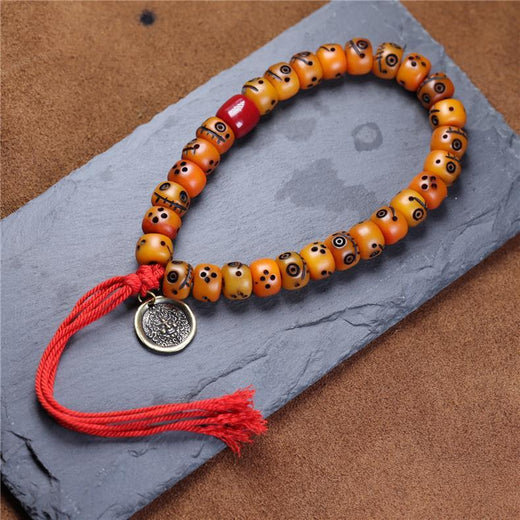
The workshops of Lhasa and the great monastic centers like Drepung and Sera became hubs where this sacred craft was perfected. A Dzi bead, for instance, wasn't just a patterned agate; it was a 'heavenly stone' believed to be a gift from the gods, a vessel of immense protective power.
Each piece in our curated collection of sacred artifacts carries the echo of this profound history.
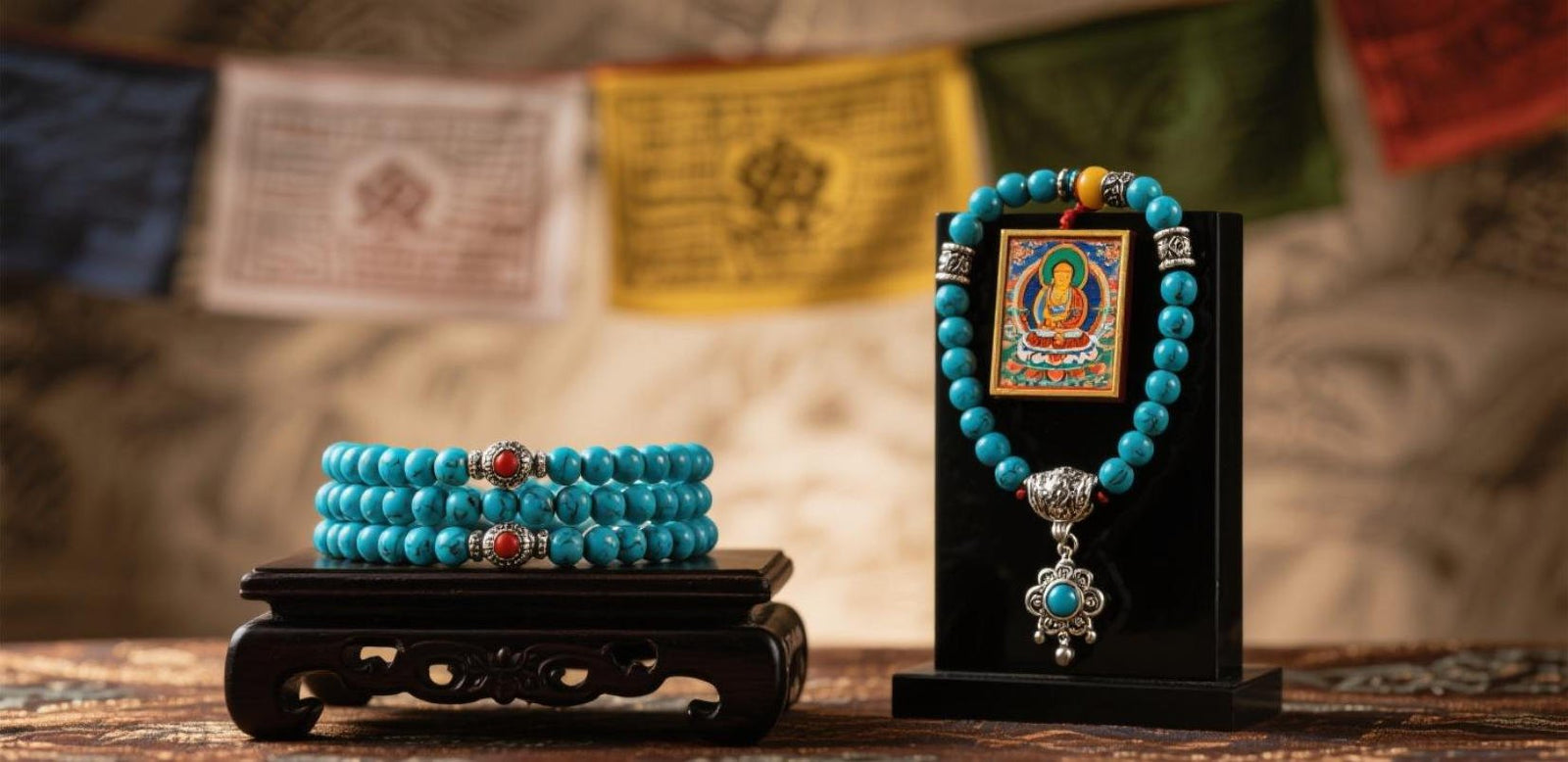
The materials themselves tell a story of geography and spirit. The vibrant blue turquoise was mined from the Himalayas, seen as a sky stone that connects the wearer to the heavens and offers protection from the evil eye.
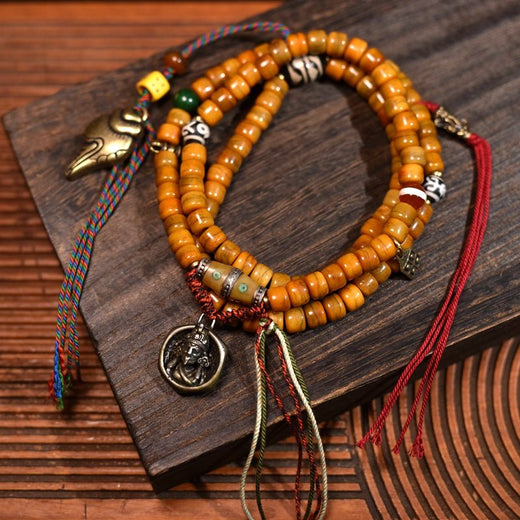
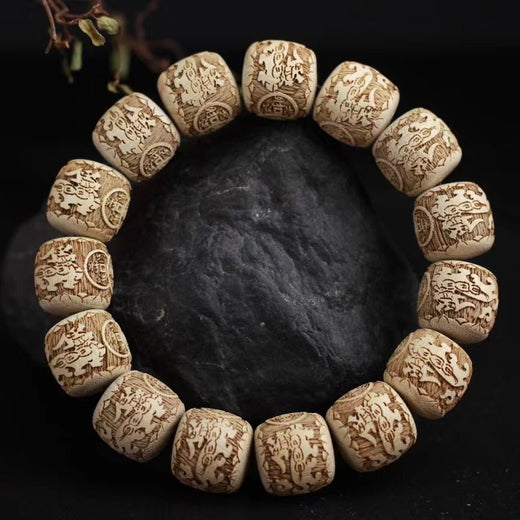
The deep red coral, traded from the distant seas, symbolized the life-force and was believed to ward off illness. Yak bone, a reminder of impermanence, was carved into beads to help the practitioner contemplate the nature of life and death.
This is not mass production. This is the painstaking work of hands calloused by devotion, crafting objects designed to serve a single purpose: to aid you on your path to inner awakening. When you hold an authentic piece, you are holding a tangible piece of this history, a direct connection to the heart of the Tibetan spiritual tradition.
The Deeper Meaning: A Language of Symbols
Every element of Tibetan sacred jewelry is a word in a rich symbolic language, designed to communicate profound spiritual truths directly to your subconscious mind. Wearing these pieces is not a passive act; it is an active engagement with the core tenets of the Dharma.
You are wrapping yourself in a visual representation of the path to enlightenment, a constant reminder of your own innate potential for wisdom and compassion.
Consider the ubiquitous Endless Knot, or Srivatsa. On the surface, it is a beautiful, interwoven pattern with no beginning and no end. But its deeper meaning points to the fundamental Buddhist teaching of dependent origination (pratītyasamutpāda)—the concept that all phenomena are interconnected and arise in dependence upon other factors.
When you wear the Endless Knot, you are carrying a reminder that your actions, thoughts, and words ripple out into the universe, and that you are inextricably linked to all living beings. It is a symbol of the ultimate unity of wisdom (prajna) and compassion (karuna).
Look closer at a Ghau box, the portable shrine worn as a pendant. It is not only a locket. Traditionally, it holds a sacred relic, a written mantra, or blessed herbs from a high lama.
The box itself becomes a personal sanctuary, a mobile field of protective energy. The exterior is often adorned with the Eight Auspicious Symbols (Ashtamangala), such as the Parasol that shields you from suffering, the Golden Fish representing freedom from the ocean of worldly existence, and the Dharma Wheel, which signifies the turning of the Buddha's teachings.
Each symbol works on a subtle level to align your energy with these enlightened qualities. Finding your personal talisman among these potent symbols is a journey of self-discovery.
The materials, too, are imbued with meaning. The 108 beads of a Bodhi seed mala represent the 108 delusions you seek to overcome through your practice. The very act of turning each bead as you recite a mantra is a physical intention-setting of this spiritual journey.
A Dorje (or Vajra) symbol, representing a thunderbolt or diamond, speaks of the indestructible nature of ultimate reality. It is the adamantine clarity of the enlightened mind. To wear the Dorje is to invoke that strength and clarity within yourself.
You are not only wearing jewelry; you are wearing a map of the mind, a guide back to your own true nature.
Real Benefits for Modern Life: Your Anchor in the Storm
While rooted in traditional teachings, the benefits of wearing and using Tibetan sacred jewelry are profoundly relevant to the challenges you face today. This is not about superstition; it is about using tangible objects to cultivate specific, positive states of mind.
It’s a practice of applied psychology, grounded in centuries of contemplative science.
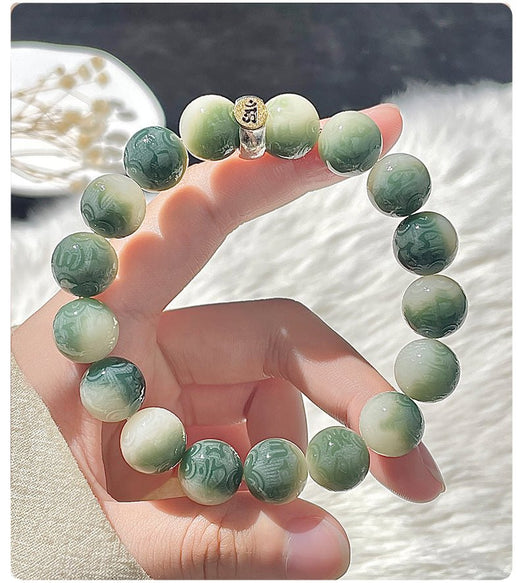
One of the most immediate benefits is its power as a tool for mindfulness. In a world of constant digital distraction, your attention is your most precious resource. A simple beaded bracelet or a mala becomes a physical anchor to the present moment.
When you feel the familiar weight on your wrist or the smooth texture of the beads between your fingers, it serves as a non-judgmental prompt: "Come back. Be here now." This simple, repeated act of returning to the present can dramatically reduce the anxiety that arises from a mind lost in future worries or past regrets.
It is a gentle interruption of the cycle of rumination, giving your nervous system a chance to reset.
Beyond mindfulness, these pieces are powerful instruments for setting and holding intention. When you first receive a piece of sacred jewelry, you can perform a simple ceremony to imbue it with a specific purpose.
Perhaps you need more compassion in your daily interactions, or more courage to face a difficult situation. By holding the piece and consciously dedicating it to that intention, you create a powerful psychological link.
Every time you see or touch the jewelry, your mind is subconsciously reminded of that goal. It becomes a silent partner in your personal growth, keeping your highest aspirations at the forefront of your awareness, even on the most chaotic days.
Many find that the full range of authentic Tibetan jewelry offers specific symbols that resonate perfectly with their personal intentions.
Finally, these objects help you create a sense of the sacred in your everyday life. Your morning commute, your desk at work, the line at the grocery store—these are not typically places of peace.
But a sacred amulet worn under your shirt or a mala in your pocket transforms your personal space. It creates a subtle but palpable energetic boundary, a reminder that even amidst the mundane, you carry a connection to something deeper.
It is a way of declaring that your inner peace is not contingent on your external circumstances. You are carrying your temple with you. This fosters a profound sense of self-reliance and inner stability that no external situation can easily shake. — explore our Tibetan jewelry collection for authentic pieces.

How To Spot the Real Thing: A Guide for the Discerning Seeker
In a market flooded with imitations, choosing authentic Tibetan sacred jewelry is an act of discernment that honors both the tradition and your own spiritual path. Authenticity is not only about appearance; it's about the material, the craftsmanship, and the intention embedded within the piece.
Your ability to recognize these qualities will ensure you invest in a true spiritual tool, not a mere trinket.
First, train your eye and your hand to recognize genuine materials. Real turquoise has a unique matrix (the dark veining) and a cool, waxy feel; cheap imitations are often dyed howlite, which is lighter, more porous, and feels plasticky.
True red coral will have subtle variations in color and texture, unlike the uniform, painted look of fakes. Bodhi seeds from a mala that has been used in practice develop a deep, lustrous patina from the oils of the hand—a quality impossible to replicate artificially.
Learn the difference between hand-hammered Tibetan silver, which often has a softer luster and slight imperfections that speak of its human origin, and the sterile perfection of machine-stamped metals.
Second, examine the craftsmanship. Authentic pieces are made by hand, and they show it. Knots between mala beads will be tight and even, but not perfectly identical. Carvings in bone or wood will have a depth and life to them that a machine router cannot achieve.
Look for signs of wear on older pieces, not as a flaw, but as a a sign of their history of use in spiritual practice. A genuine Ghau box will open and close securely, crafted with a precision born of patience.
This dedication to quality is a hallmark you'll find throughout our entire shop.
Finally, and most importantly, consider the source. Where does the jewelry come from? Is the seller transparent about their relationship with the artisans? Authentic purveyors, like Buddhabelief, often work directly with Tibetan communities, families, or monasteries.
This ensures that the artisans are fairly compensated and that the craft itself is preserved. This ethical sourcing also means the jewelry is created in an environment of spiritual integrity. When you choose a piece from such a source, you are not only buying an object; you are becoming a patron of a living tradition and supporting the people who are its heart and soul.
Your choice becomes an act of merit, a connection that extends all the way back to the Himalayas.
How to Use It: Activating Your Sacred Tool
Acquiring a piece of sacred jewelry is the first step; the next is to consciously activate it, transforming it from a beautiful object into a vibrant part of your spiritual practice. This is a process of consecration and connection, making the piece uniquely yours.
When your jewelry first arrives, find a quiet moment when you will not be disturbed. The traditional method of cleansing is through smoke. You can light a stick of natural incense (sandalwood is excellent) or a bundle of sage and pass the item through the smoke several times.
As you do this, visualize the smoke purifying the piece of any energies it may have picked up on its journey to you. Your intention is key here: see it becoming a clean, clear vessel for your own spiritual presence.
Next, it is time to bless and awaken the piece. Hold it in your hands at your heart center. Close your eyes and take several deep breaths. Connect with your deepest aspiration—what you hope this tool will help you cultivate.
It might be compassion, clarity, patience, or protection. Speak this intention aloud or silently in your mind, infusing the object with your purpose. You can recite a mantra that feels meaningful to you. A simple and powerful one is "Om Mani Padme Hum," the mantra of compassion.
Repeat it 7, 21, or 108 times while holding the jewelry. This act charges the piece with sacred resonance and aligns it with your energy field.
For daily use, wear your jewelry with mindfulness. When you put it on in the morning, take a moment to reconnect with the intention you set for it. Throughout the day, let it be a touchstone.
If you are using a mala for mantra practice (japa), hold it in your left hand (representing wisdom) and use your thumb to count each bead as you recite your mantra, pulling the beads toward you.
Never cross the large "guru" bead; instead, when you complete a round of 108, turn the mala around and go back in the other direction. Treat your sacred jewelry with respect. It is best to remove it before sleeping, showering, or engaging in strenuous activity.
By engaging with it in this conscious way, you build a profound relationship with your sacred tool, making it an ever-present ally on your path.
Common Questions
Do I have to be a Buddhist to wear Tibetan jewelry?
Absolutely not. The principles embodied in Tibetan sacred jewelry—compassion, wisdom, interconnectedness, and inner peace—are universal human values. You do not need to adhere to any specific dogma to benefit from its power as a mindfulness tool and a symbol of your highest aspirations.
The key is to approach it with respect and a genuine intention for personal growth. Think of it as a tool for exploring your own inner landscape, regardless of your spiritual background. It is an invitation, not a requirement.
How should I cleanse or "recharge" my jewelry?
Your sacred jewelry is an energetic tool, and like any tool, it benefits from regular maintenance. Besides the initial cleansing, it's good practice to cleanse it periodically, especially if you've been through a stressful period.
The simplest methods are energetic. You can smudge it with sage or incense, as described in the initial activation. Another beautiful method is to leave it in the light of the full moon overnight to absorb lunar energy.
You can also place it on a slab of selenite or a bed of quartz crystals, which are known for their purifying properties. The most important element is your intention to clear away any accumulated negative or stagnant energy.
What does it mean if my bracelet or necklace breaks?
In the Tibetan tradition, the breaking of a sacred item like a mala or bracelet is not seen as a negative event. It is often interpreted as a sign that the piece has served its purpose for you.
It may have absorbed a significant amount of negativity on your behalf, or it may signify the end of a particular cycle or karmic lesson in your life. Instead of being sad, it is a moment for reflection.
Thank the piece for its service to you. You can choose to have it restrung (especially if the beads are precious), or you can respectfully return the components to the earth by burying them in a special place.
Can I wear my sacred jewelry while sleeping or in the shower?
It is generally recommended that you remove your sacred jewelry before sleeping or bathing. From a practical standpoint, this protects the materials. Water can damage delicate threads, wood, and certain stones, while sleeping with a necklace can cause it to snag and break.
More importantly, from a spiritual perspective, taking it off is an act of respect. You are acknowledging its status as a sacred tool for your waking, conscious practice. You can place it on your altar or a clean, special place on your nightstand while you sleep.
What is the significance of the 108 beads on a mala?
The number 108 is deeply significant in many Eastern traditions. In Buddhism, it is said there are 108 types of defilements or afflictions (kleshas) that prevent us from attaining enlightenment. A full cycle of reciting a mantra 108 times on a mala is a symbolic act of overcoming these 108 obstacles.
The number also has astronomical significance, with the distance between the Earth and the Sun being approximately 108 times the Sun's diameter. The "guru" bead, the 109th bead, represents the teacher or the state of enlightenment itself, which is not counted but serves as a marker for the start and end of a cycle.
Is it okay for other people to touch my sacred jewelry?
This is a matter of personal preference, but it's wise to be mindful. Because you have cleansed your jewelry and imbued it with your specific intentions and energy, it becomes a very personal item.
Allowing it to be handled casually by many different people can introduce other energies that may dilute your own connection to the piece. If someone asks to see it, you can certainly hold it out for them to look at without touching.
If someone does handle it and you feel its energy has been affected, simply perform one of the cleansing rituals to restore its clarity and reconnect it to your personal intention.
Your Next Step on the Path
You have felt the call for something deeper, a form of healing that nourishes the soul. You now understand that Tibetan sacred jewelry is far more than adornment; it is a key, a map, and a companion for your inner journey.
It is a tangible link to a lineage of wisdom that has guided seekers for centuries. The next step is not one of logic, but of intuition. It is about finding the piece that speaks directly to your spirit, the symbol that resonates with the change you wish to cultivate in your life.
This is a personal and sacred choice. We invite you to mindfully explore our collection of authentic, artisan-crafted pieces and discover the sacred tool that is waiting to support you on your path to wholeness and peace.
Keep reading