
buddhist-jewelry
Yak Bone Bracelet Meaning: A Guide for Practitioners (2026)
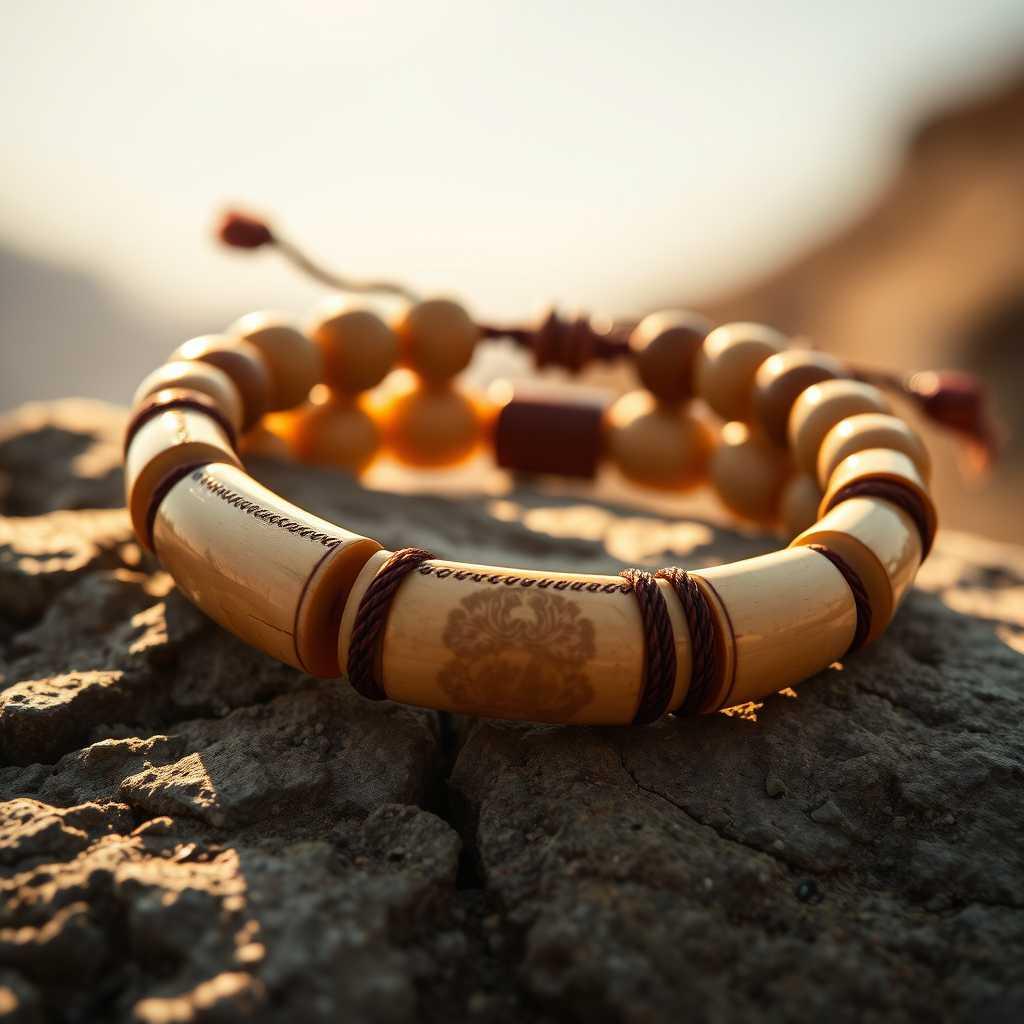
You’re in a tense meeting, the kind where spreadsheets and projections feel more real than the people in the room. Your mind is hooked, chasing anxieties about targets and timelines. Then, as you shift your hand, your thumb brushes against the cool, dense beads on your wrist.
It’s not a distraction; it’s an anchor. The smooth, organic surface reminds you of something more fundamental than the quarterly report. It’s a silent, tactile whisper of impermanence, a connection back to your practice and the earth itself.
This is the quiet power of a yak bone bracelet, a tool that goes far beyond simple adornment. It’s a piece of the Himalayas, a tangible teaching, and one of the most profound types of authentic Tibetan bracelets you can wear.
The Foundation: More Than Bone, A Direct Teaching
Walk through the Barkhor circuit in Lhasa, and you'll see practitioners wearing yak bone bracelets alongside their prayer beads—not as tribal artifacts or primitive charms, but as essential tools. The Western impulse to categorize them as 'morbid' misses the point entirely.
In Tibetan culture, nothing is wasted, and death is not a taboo subject to be hidden away. It is an integral, visible part of life. The yak is not only an animal; it's the lifeblood of the Tibetan plateau—providing transport, milk, wool, and fuel.
When a yak dies of natural causes after a long life, using its bones for practice tools is the final act of respect and gratitude. It ensures the animal's life continues to provide value, this time on a spiritual level.
This transforms the material from a mere remnant into a direct teaching on impermanence, or anicca. Every time you see or touch the bracelet, you are engaging in a form of maraṇasati, the mindfulness of death.
This isn't a morbid obsession. In the Buddhist context, contemplating the certainty of death and the unpredictable nature of its timing is one of the most potent catalysts for living a meaningful life. It cuts through trivialities, dissolves petty grievances, and focuses the mind on what truly matters: your intention, your compassion, your practice.
The bone on your wrist is a constant, silent teacher, reminding you, "This, too, shall pass. Your time is precious. Practice now." It's a far cry from a simple fashion accessory; it's a piece of wisdom literature you can wear.

Why This Matters for Your Practice in 2026
Your practice has evolved beyond introductory concepts. You've sat through retreats, you understand the core tenets, but perhaps you've hit that familiar plateau. The intellectual understanding of impermanence is there, but the felt sense of it can get lost in the day-to-day demands of a career, family, and the relentless hum of digital life.
This is where a physical anchor becomes not only helpful, but essential.
Breaking Through the Practice Plateau: When meditation feels stale or your mind seems to be running the same old loops, the intellectual part of your practice has likely taken over. You can recite the teachings, but they aren't landing.
A yak bone bracelet serves as a pattern interrupt. Its physical reality—the weight of bone worn smooth by Tibetan artisans in Lhasa, the temperature against your wrist, the texture—bypasses the thinking mind. It's a direct, non-conceptual reminder of the body, of decay, of the life cycle.
Touching it can be a micro-meditation, a way to ground yourself in the present moment and the raw truth of existence when you're feeling stuck in abstract thought.
Bridging the Boardroom and the Zafu: You might be working through a high-stakes career where decisiveness and confidence are currency. How do you reconcile that with the Buddhist teachings on non-attachment and ego? A yak bone bracelet is a discreet ally.
In a tense negotiation or before a critical presentation, a quiet touch can remind you of a bigger picture. It can temper ambition with wisdom, reminding you that this career, this deal, this success, is also impermanent.
This doesn't weaken your resolve; it strengthens it with perspective, allowing you to act with clarity and integrity rather than fear or greed. It helps you embody your practice where it counts the most—off the cushion.
working through Life's Deepest Challenges: As we and our loved ones age, the reality of impermanence becomes less of a philosophical concept and more of a lived, often painful, experience. Caring for aging parents, facing your own mortality, or working through the complexities of long-term relationships are the advanced curriculum of practice.
A yak bone bracelet becomes a companion in this journey. It's a memento mori that encourages you not to turn away from the difficult truths of sickness, old age, and death. Instead, it encourages you to turn toward them with compassion and courage.
It reminds you that this precious, fleeting time is all we have, urging you to be present for the hard conversations and the beautiful, ordinary moments alike.
The Real Benefits: How It Deepens Your Path
Beyond its function as a reminder, wearing a yak bone bracelet actively cultivates specific qualities that are central to the path. It works on you subtly, consistently, shaping your awareness through daily contact. This is about more than symbolism; it's about embodiment.
A Tangible Anchor for Mindfulness of Impermanence (Anicca)
You can read about impermanence a thousand times, but feeling it is another matter. The smooth, dense surface of carved bone is a direct link to this truth. It was once part of a living, breathing creature, a powerful being working through the harsh Himalayan landscape.
Now, it is this bead on your wrist. This transformation is the teaching of anicca in physical form. When you find yourself caught in a storm of emotion—frustration over a delayed flight, anxiety about the future, irritation with a colleague—the simple act of touching your bracelet can be a powerful circuit breaker.
It doesn't offer a platitude; it offers a fact. This feeling, this situation, this body, is in a state of constant flux. This realization doesn't lead to nihilism, but to a liberating sense of freedom and a greater ability to engage with life as it is, without clinging or aversion.
Cultivating Compassion (Karuna) and Non-Attachment
The bone is a reminder of a life that was lived and has ended. This naturally fosters a sense of compassion. It connects you to the cycle of birth and death that all beings, including yourself, are a part of.
This isn't an abstract idea of 'all sentient beings'; it's a connection to one specific life. This empathy can then radiate outward. Furthermore, this constant, gentle reminder of endings helps to soften the grip of attachment.
When you are viscerally aware that everything is temporary, you begin to hold your successes, your relationships, and even your identity a little more lightly. You can still love deeply and work diligently, but the frantic, fearful clinging begins to subside.
You learn to appreciate things for what they are, in the moment they are here, without the desperate need for them to be permanent. This is the heart of non-attachment in practice, a quality that those on a path of self-inquiry find is supported by the lessons in our guide to Buddhist bracelets.
A Connection to Lineage and Place
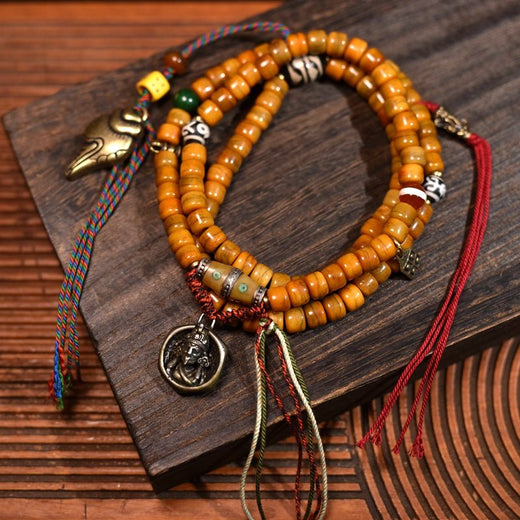
This isn't just any bone; it is yak bone from the Himalayas, carved by artisans in workshops like ours in the shadow of the great Boudhanath stupa in Kathmandu. When you wear one of our pieces, you are not only wearing a spiritual symbol; you are connecting to a specific place and a living tradition.
You can feel the lineage in the craftsmanship. Master Tenzin, who leads our workshop, learned his craft from his father, who learned it from his. The techniques and the reverence for the material are passed down through generations.
This connection adds a layer of meaning and authenticity that cannot be replicated. It's a tangible link to the heart of the Dharma, to the mountains where these teachings flourished since the 8th century, and to the hands of the artisans who continue to keep this sacred craft alive.
Your bracelet becomes a thread connecting your personal practice to a vast weave of devotion and wisdom.
How to Choose an Authentic Yak Bone Bracelet
For a practitioner like you, authenticity is everything. The spiritual and symbolic value of a yak bone bracelet is completely lost if it's a plastic replica or an unethically sourced piece. The energy of the object matters, and that energy begins with its origin.
Discerning real from fake is crucial for ensuring your practice tool is a genuine support, not a hollow imitation.
1. Source and Ethics: This is the most important factor. Where did the bone come from? We work directly with nomadic families and small communities in the high Himalayas who revere their yaks. The bone we use is sourced only from animals that have died of natural causes, often old age.
This ethical foundation is non-negotiable. It ensures the bracelet is an object of respect, not harm. When you're looking, ask about the sourcing. A reputable maker will be transparent about this. Be wary of mass-marketplaces where the origin is unknown; these pieces are often made from other bones or plastics, with no connection to Tibetan culture.
We can trace each bracelet back to the specific herding families in the Changtang plateau who provided the material.
2. Material Feel, Weight, and Appearance: Real yak bone has distinct characteristics.
- Weight & Density: Yak bone is surprisingly dense and has a satisfying weight to it—a 108-bead mala typically weighs between 80 to 120 grams. Plastic or resin fakes feel light and hollow in comparison.
- Temperature: It feels cool to the touch, similar to natural stone. It will slowly warm to your skin temperature over the first few minutes of wear. Plastic feels neutral or slightly warm from the start.
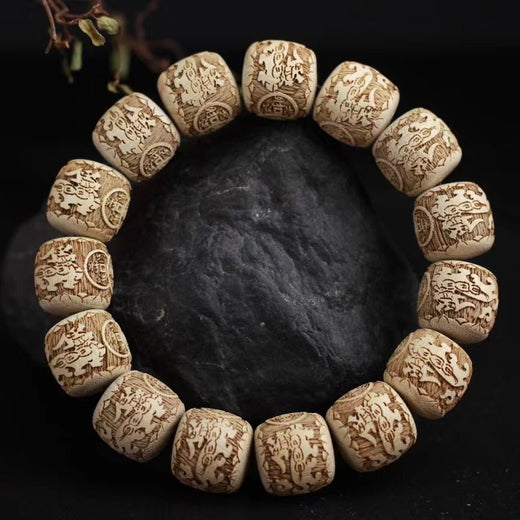
- Imperfections: Look closely. Authentic bone beads will have subtle imperfections—tiny pores, fine grain lines, or slight variations in color from creamy white to a closer beige or even brown. This is a sign of a natural material. A bracelet where every single bead is flawlessly identical in color and shape is almost certainly molded from resin.
These principles of material authenticity are explored across our complete guide to authentic Tibetan jewelry.
3. Craftsmanship: The hand of the artisan should be visible. In our Kathmandu atelier, each bead is carved and polished by hand. This means you might notice minute differences between the carving of the mantras on each bead.
Machine-made pieces will have sharp, perfect edges and unnaturally uniform carvings. Hand-craftsmanship imparts a certain presence or vitality to the piece that a machine cannot replicate. This is true if you are choosing a simple bone bracelet or one of our more intricate Tibetan silver bracelets, where the artisan's touch is paramount. explore the full collection.

How To Use It Day To Day in Your Daily Practice
Acquiring an authentic yak bone bracelet is the first step. The next is integrating it into your life so it becomes more than jewelry—it becomes a part of your practice. This is not about complex rituals, but about simple, consistent awareness.
1. Setting Your Intention: When your bracelet first arrives, take a few moments. Don't just tear open the package. Sit quietly with it in your hands. Feel its weight and texture—the slight warmth that builds as bone adjusts to skin temperature.
Close your eyes and set a clear intention for its purpose. You might dedicate its presence to reminding you of impermanence, to cultivating compassion, or to staying grounded during stressful times. This conscious act of dedication transforms it from a passive object into an active participant in your spiritual journey.
2. The Morning Anchor: Make putting on your bracelet a mindful moment. As you fasten it on your wrist in the morning, let it be the first conscious contact with your intention for the day.
You can pair it with a simple thought: "Today, may I remember the preciousness of this day. May I act with kindness." This takes only a few seconds but frames your entire day with purpose.
3. A Touchstone During Meditation: While a yak bone bracelet is not typically used as a mala for counting mantras, its physical presence can be a powerful aid during sitting meditation. When your mind wanders (as it inevitably will), you can gently bring your awareness to the feeling of the bracelet on your skin.
This simple sensory anchor can be just as effective as focusing on the breath for returning to the present moment. It's a way of grounding your practice in the physical world.
4. The Pattern Interrupt in Daily Life: This is perhaps its most powerful use. You're stuck in traffic, feeling rage build. You're in an argument with a loved one, about to say something you'll regret.
You're feeling overwhelmed by your to-do list. In these moments, consciously reach for your wrist. Touch the beads. Take one deep breath. Let the cool, solid feel of the bone remind you: This moment of anger will pass.
This conflict is temporary. This life is finite and precious. It doesn't solve the external problem, but it shifts your internal state, allowing you to respond with more wisdom and less reactivity. This practice is similar to how one might use specific ancient protection symbols—as a reminder to return to a state of mindful awareness.
Common Questions from Fellow Practitioners
Are yaks harmed to make these bracelets?
Absolutely not. This is a point of deep ethical importance for us and for the entire tradition. Authentic Tibetan yak bone jewelry is made exclusively from the bones of yaks that have died from natural causes, usually old age.
In the harsh environment of the Tibetan plateau, these animals are essential for survival and are treated with immense respect. Using their bones after death is a final gesture of honor, ensuring that no part of the cherished animal goes to waste.
It's a practice rooted in a no-harm (ahimsa) philosophy and a deep understanding of the cycle of life and death. We partner directly with communities in the Lhasa and Shigatse regions who share this reverence, ensuring our pieces carry an energy of respect, not violence.
You can wear it with a clear conscience, knowing it represents a life fully lived.
What's the difference between yak bone and cow bone jewelry?
While they may look similar to an untrained eye, there are key differences in both material and meaning. Yak bone is significantly denser and less porous than cow bone, giving it a heavier, more substantial feel and a smoother finish when polished.
This density is a result of the yak's adaptation to the extreme altitudes and harsh conditions of the Himalayas—bone tested by 15,000 feet elevation and subzero winters. Spiritually, the context is entirely different. The yak is intrinsically linked to Tibetan Buddhism and the Himalayan landscape; its bone carries the symbolism of that specific lineage and environment.
Cow bone lacks this direct connection to the Dharma tradition. Those seeking authentic pieces will notice that mass-produced "Tibetan" bracelets are actually made from cow bone because it's cheaper and more widely available, but they miss the essential spiritual resonance of authentic yak bone.
How should I care for my yak bone bracelet?
Yak bone is a durable, natural material, but it deserves mindful care. The most important thing is to avoid prolonged exposure to water. Don't wear it while showering, swimming, or doing dishes, as water can cause the bone to swell and potentially crack over time.
It's also best to avoid direct contact with harsh chemicals, perfumes, or lotions. The best way to care for it is simply to wear it. The natural oils from your skin will condition the bone over time, giving it a beautiful, subtle luster or patina that deepens over months and years.
If you need to clean it, you can wipe it gently with a soft, dry cloth. Treat it as the sacred object it is, and it will be a companion on your path for many years.
Is it appropriate to wear a yak bone bracelet if I'm not a Buddhist?
Yes, absolutely. While the bracelet has deep roots in Tibetan Buddhism, the core teaching it represents—impermanence—is a universal truth, not one exclusive to any single religion or philosophy. Anyone can benefit from a tangible reminder to live more fully, to appreciate the present moment, and to hold life's challenges with a bit more perspective.
Wearing it with respect for its cultural origin is what matters most. If the principles of mindfulness, compassion, and awareness of life's fleeting nature resonate with you, then a yak bone bracelet can be a powerful and meaningful tool for your personal journey, regardless of the specific labels you apply to your path.
What do the carvings on the beads often mean?
Many yak bone bracelets feature beads carved with sacred mantras or symbols. The most common carving is the six-syllable mantra of Avalokiteshvara (Chenrezig in Tibetan), the bodhisattva of compassion: Om Mani Padme Hum.
Each syllable is said to purify a specific negative emotion and connect the wearer to the boundless compassion of all enlightened beings. So, when you wear a bracelet with this mantra, it becomes not only a reminder of impermanence but also an active tool for cultivating compassion for yourself and others.
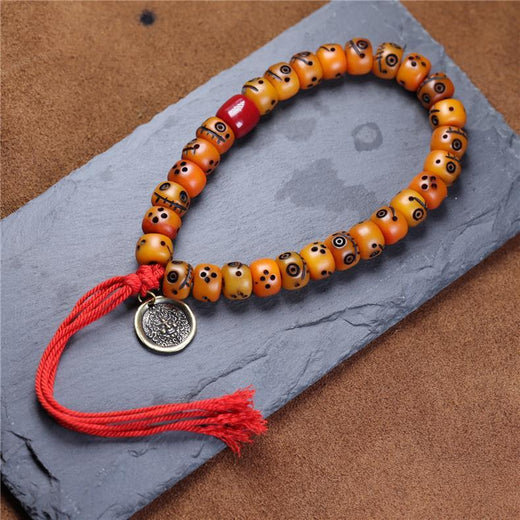
Some bracelets might also feature other symbols like the endless knot or the vajra, each with its own deep layer of meaning within the Vajrayana tradition, much like the powerful iconography found on an authentic Dzi bead bracelet.
Why does the color of the bone vary so much?
The variation in color is one of the surest signs of authenticity. Yak bone is a natural material, and no two pieces are exactly alike. The color can range from a creamy, off-white to a deep, rich brown.
Several factors contribute to this: the age of the animal, the specific bone used from the skeleton, and the natural minerals the bone absorbed over its lifetime. The beads may also darken over time as they absorb the oils from your skin, developing a unique patina that reflects your personal journey with the piece.
This natural, evolving character is something to be cherished. It's a visible representation of the bracelet's organic nature and its connection to a living tradition, unlike the sterile uniformity of mass-produced plastic replicas.
Your Journey, Your Anchor
Choosing to wear a yak bone bracelet isn't about acquiring another spiritual object to display. It's about selecting a quiet, steadfast companion for your practice. As you continue to navigate your path through 2026 and beyond, you will face moments of doubt, professional pressure, family challenges, and the inevitable plateaus in your practice.
These are not signs of failure; they are the curriculum itself.
In those moments, the weight and feel of this simple bracelet—typically between 60 to 90 grams depending on the bead size—can be your anchor. It will not provide easy answers or quick fixes. Instead, it will offer something far more valuable: a direct, physical reminder of the core truth of impermanence.
It will pull you out of the turbulent stories in your head and ground you in the reality of the present moment. It is a piece of the ancient Himalayas, a a sign of a life lived with strength, and a tool to help you live your own life with greater wisdom, compassion, and courage.
If you feel called to find such a companion, one that is ethically sourced and crafted with intention by the hands of true artisans in the Kathmandu Valley, we invite you to explore our Himalayan artisan bracelets. Find the piece that speaks to your journey.
Keep reading