buddhist-jewelry
Buddha Bracelet Meaning, Benefits & Which Wrist to Wear
You’re scrolling through your phone late at night, the blue light stinging your eyes. Another day has blurred by in a series of emails, notifications, and that low-humming anxiety that seems to be the background music of life.
Then you see it—a photo of someone, maybe a friend or an influencer, looking calm. On their wrist is a simple, beautiful bracelet. It’s not flashy, but it has a presence. And a question quietly forms in your mind: What does that actually mean? Is it just another accessory, or is there something more to it?
You’re not necessarily looking to join a religion, but you are looking for an anchor. Something real. That quiet curiosity is the first step, and it's why you're here. You're wondering if one of those authentic Tibetan bracelets could be a small, tangible piece of peace for your own life.
The Foundation: What a Buddhist Bracelet Really Is
Let's clear up a common misconception right away. A Buddhist bracelet is not a magic charm. It's not an amulet you wear that will automatically solve your problems or grant you wishes. If you see it that way, you might be disappointed.
The real power of the bracelet isn't what it does *for* you, but what it reminds *you* to do for yourself.
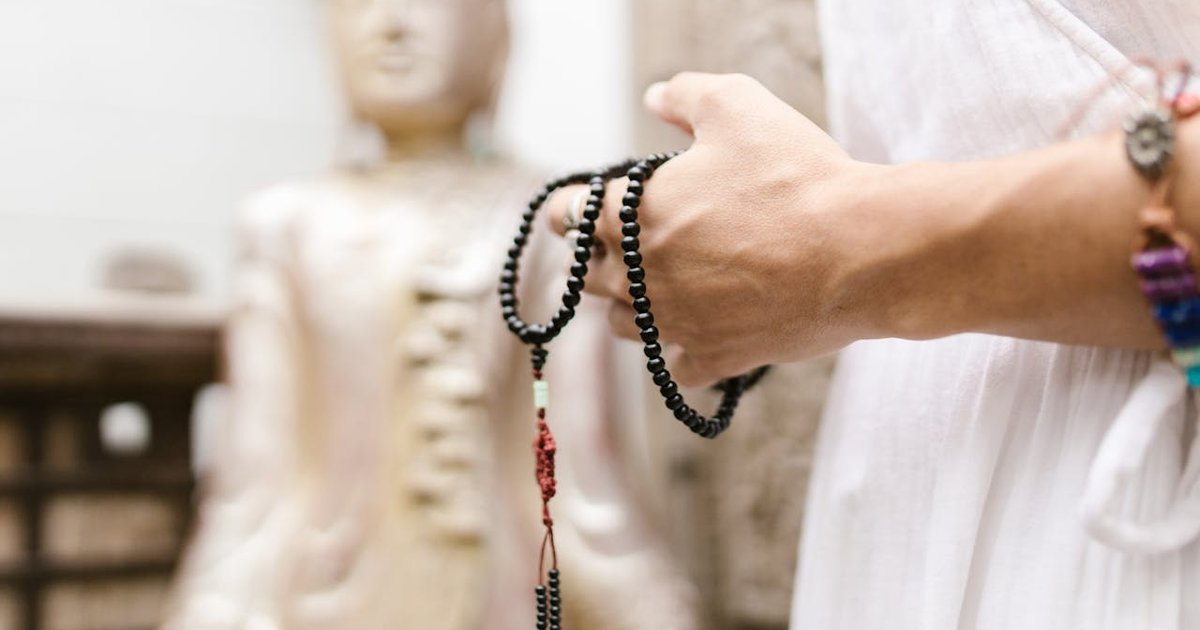
Think of it as a tool for mindfulness, a physical nudge back to the present moment. In Tibetan, a wrist mala is called a phreng ba (pronounced 'treng-wa'). Its purpose is to be a constant, gentle companion that reminds you of your own inner capacity for calm, compassion, and wisdom.
When you feel that old wave of work anxiety rising, the simple weight of the beads on your skin can be the trigger that reminds you to take one conscious breath. That's it. That's the practice.
It's not about levitating or achieving some mystical state; it's about finding a single, grounded moment in the middle of a chaotic day.
The materials themselves are part of this grounding. Since the 8th century, artisans in the Himalayas have used natural elements like sandalwood, known for its calming scent, or Bodhi seeds, from the same type of tree the Buddha sat under for enlightenment.
These materials connect you to the earth. When our artisans in Kathmandu string these beads—each mala typically containing 108 beads—they aren't just assembling a product. They are infusing each knot with an intention of peace, a practice passed down through generations.
It's this human touch, this quiet dedication, that separates a true practice tool from a mass-produced accessory. It's a piece of a lineage, a story you wear on your wrist. For those wanting to explore the deeper meaning behind these sacred pieces, understanding their origin is key.
Alt text: A close-up shot of a handwoven Tibetan Buddhist bracelet resting on a piece of aged wood, with soft, natural light highlighting the texture of the knots.
Why This Matters More Than Ever in 2026

Your world is full of abstract pressures. You have key performance indicators at work, follower counts on social media, and a constant stream of news about global events you can't control. It's easy to feel like you're living in your head, disconnected from your own body and the present moment.
By 2026, the digital noise has only intensified, and the search for tangible, meaningful anchors has become a quiet act of rebellion.
This is where a simple, physical object like a Buddhist bracelet finds its genuine relevance. It's an analog tool in a digital age. It doesn't need to be charged, it doesn't send notifications, and it doesn't demand your attention.
It simply rests on your wrist, a quiet counterpoint to the relentless hum of modern life.
These scenarios play out in real practice:
- During a stressful meeting: You're on a video call, and the pressure is mounting. Instead of anxiously tapping your fingers or picking at your nails, your thumb finds the smooth surface of a wooden bead on your bracelet—perhaps a piece of sandalwood from Nepal, warm and slightly fragrant. You roll it back and forth, a small, discreet movement that no one else can see. This simple tactile sensation grounds you, pulling your focus from the whirlwind of anxious thoughts back to the physical reality of the room. You take a breath. You feel a little more centered.
- The social media comparison trap: You're scrolling through Instagram before bed, and the familiar feeling of inadequacy starts to creep in. Everyone else seems to be traveling, getting promoted, or living a more photogenic life. Your eyes fall to the bracelet on your wrist. It's a reminder of *your* path, *your* intention. Maybe your intention for the week was simply to be more gentle with yourself. The bracelet doesn't judge; it just reminds you of the promise you made to yourself. You put the phone down.
- A moment of indecision: You're facing a choice, big or small. Should you take that new job? Should you have that difficult conversation? You feel overwhelmed by the 'what ifs'. You hold your bracelet, close your eyes, and take three slow breaths, feeling the beads against your palm. The goal isn't for the bracelet to give you the answer, but to quiet the noise long enough for you to hear your own intuition.
In 2026, wearing a Buddhist bracelet isn't about escapism. It's about engagement. It's a commitment to engage with your own life, your own mind, and your own well-being, one present moment at a time.
Real Benefits: How a Simple Bracelet Actually Works
It's fair to be skeptical. How can a string of beads actually create a benefit in your life? It works on three subtle but powerful levels: the physical, the intentional, and the energetic. It's not magic; it's a practice of awareness that you cultivate, with the bracelet as your guide.
A Physical Anchor for Your Wandering Mind
Your mind loves to wander. It worries about the future and replays the past. Mindfulness is the practice of gently bringing it back to the here and now. A Buddhist bracelet is a perfect tool for this because it engages your sense of touch.
The tactile sensation of the wood, stone, or seed against your skin is an undeniable, present-moment experience. When you feel your thoughts spiraling, you can consciously bring your attention to the feeling of the bracelet on your wrist: its weight, its temperature, the texture of the beads.
This act of sensory focus breaks the chain of anxious thought. It's a mini-meditation you can do with your eyes open, standing in line at the grocery store or sitting in traffic. It's a physical interruption to the mental chaos, reminding you that you have a body, you are here, and you can breathe.
A Symbol of Your Personal Intention
When you first choose a bracelet, you can set an intention for it. This isn't a wish; it's a commitment to a quality you want to cultivate. Your intention might be 'patience' during a frustrating project at work.
It might be 'compassion' in your relationship. It could be 'courage' as you navigate a life change. Once you've set this intention, the bracelet becomes its living symbol. Every time you glance at it, you're not only seeing a piece of jewelry; you're seeing a reminder of your chosen path.
It's a silent accountability partner. On a day when you're about to send a reactive email, a glimpse of your 'patience' bracelet might give you the crucial pause you need to reconsider. It transforms a passive accessory into an active tool for personal growth, making the abstract goal of 'being a better person' into a concrete, daily practice.
Browsing through our Tibetan bracelet selection is often the first step in discovering which intention is calling to you.
A Connection to a Lineage of Blessings
This is a component that sets authentic, mindfully-crafted pieces apart. When we say our bracelets are blessed, we mean something specific and measurable. Some of our malas and bracelets are taken to Sera Monastery in Lhasa, where they are part of a 49-day ceremony.
The monks performing their daily chants, prayers, and rituals place the items within this sacred space. The pieces absorb the resonant energy of these powerful, positive intentions. It's believed that this process infuses the materials with a protective and peaceful quality.
When you wear the bracelet, you are connecting to that lineage of intention. You're carrying a small piece of the peace that was cultivated in that monastery, a link to the centuries of practice held within those walls.
As you move through your own day, you're supported by the positive aspirations of those who came before.
How to Choose an Authentic Bracelet That's Right for You

Choosing your first Buddhist bracelet should be an intuitive process, not a stressful one. It's about finding a piece that feels like a friend. However, knowing what to look for can help you select a truly authentic and meaningful companion for your journey, rather than a soulless factory-made object.
First, consider the **materials**. They are the heart of the bracelet. Sandalwood is prized for its soothing aroma, which is said to calm the mind. Bodhi seeds are deeply significant, as they come from the ficus religiosa tree, under which the Buddha attained enlightenment; wearing them is a reminder of everyone's potential for awakening.
Stones like turquoise or lapis lazuli have been used since the 7th century in Tibetan culture for their protective qualities. The key is that the material should feel good and meaningful *to you*. The meaning isn't just in the material itself, but in the connection you forge with it.
Second, look at the **craftsmanship**. A genuinely crafted bracelet has a certain feeling to it. The knots between beads are tied with care and intention. You can feel the human touch. When Master Tenzin, who leads our workshop in Boudhanath, crafts a piece, he is engaging in a form of active meditation.
This intention is woven into the very fabric of the bracelet. This is why we often refer to pieces like our handwoven red string bracelets with such reverence. Each knot is tied while reciting a mantra, infusing the cord with protective energy.
This is a world away from a machine-stamped product. When considering an investment piece, like one with a genuine Dzi bead, the history and craftsmanship are what give it its true value.
Alt text: Master Tenzin, an artisan in our Kathmandu workshop, carefully tying a knot on a red string bracelet, his focused expression showing deep intention and skill.
Third, understand the **symbolism**. Many bracelets incorporate specific symbols. The Endless Knot, for example, represents the interconnectedness of all things and the endless cycle of life. The Vajra symbol stands for indestructibility and clarity of mind.
You don't need to be an expert in iconography. Instead, read the story behind a symbol and see if it resonates with what you're currently working through in your life. Choosing a bracelet with one of these powerful protection symbols can provide a focused point of strength.
Ultimately, trust your intuition. Browse our handwoven Tibetan bracelet collection and notice which one your eye keeps returning to. That's often the one that has a message for you.
How To Use It Day To Day: Simple Daily Practices
Owning a beautiful bracelet is one thing; integrating it into your life as a practice tool is another. The goal is to build a relationship with it. Here are a few simple, non-intimidating ways to begin.
The Morning Intention Ritual (1 Minute): Before you even look at your phone in the morning, take a moment with your bracelet. Hold it in your hands. Close your eyes. Take one deep breath in and one long breath out.
As you put the bracelet on your wrist, state your intention for the day. It can be a single word: "Patience," "Focus," "Kindness." This simple act frames your day, anchoring the bracelet as a dedicated tool for your awareness rather than mere ornament.
Many practitioners in the Kathmandu Valley begin this way, using the first moments of consciousness to set direction.
The Mindful Touchstone Technique: Throughout the day, use the bracelet as a trigger to return to the present. You can set a quiet, recurring alarm on your phone or computer for once an hour.
When it goes off, your task is simple: stop what you're doing, touch your bracelet, and take one conscious breath. Feel the beads beneath your fingertips—whether they're sandalwood, bone, or semi-precious stone. Notice the air entering and leaving your lungs.
That's it. This ten-second practice can break the spell of autopilot and defuse stress before it builds up. It's a way of peppering your day with tiny moments of clarity.
Caring for Your Bracelet with Respect: How you care for the bracelet is part of the practice. It's a sacred object, a companion. We recommend taking it off before you shower or swim, as water and soaps can damage natural materials like wood and thread over time.
When you take it off at night, don't just toss it on your nightstand. Place it consciously in a small dish or on a clean cloth—the way you'd set down a mala after evening practice.
This small act of respect reinforces its special purpose in your life. It's a physical intention-setting of the care and reverence you are cultivating for yourself.
Common Questions About Buddhist Bracelets
As you begin this journey, questions will naturally arise. Here are our answers to some of the most common ones we hear, based on our years of experience and conversations with practitioners across the Himalayan regions.
Which wrist should I wear my Buddhist bracelet on?
This is a question we hear often, and the answer is rooted in intention. Traditionally, the left wrist is considered the 'receiving' side of the body, connected to your inner self. Wearing your bracelet on the left wrist is thought to help you absorb the positive energies and intentions of the piece—like compassion, mindfulness, or protection.
It's about internalizing the qualities you wish to cultivate. The right wrist is seen as the 'projecting' or 'giving' side. Wearing a bracelet here signifies sharing its qualities with the world. For instance, if your intention is to be more compassionate towards others, wearing it on the right can serve as a reminder to act with kindness.
There's no strict rule, however. We encourage you to experiment. Try wearing it on your left wrist for a week and notice how you feel. Then switch to the right. The most important thing is the connection *you* feel and the intention *you* set.
Can I wear more than one Buddhist bracelet?
Absolutely. In Himalayan cultures, it's very common to see people wearing several bracelets stacked together, each with its own story and purpose. Walk through the streets of Lhasa or Kathmandu and you'll witness wrists adorned with three, four, sometimes five pieces layered together.
Stacking bracelets can be a beautiful way to combine intentions. You might wear a sandalwood bracelet for calm, alongside a red string for protection, and another with a mantra for compassion. It's less about a set of rules and more about creating a personal combination of reminders that resonate with your journey.
We suggest starting with one piece that truly speaks to you. Live with it for a while, connect with its meaning, and then, if you feel drawn to another, add it to your collection.
The key is to be intentional, not only decorative. Each bracelet should serve as a distinct anchor for your awareness, rather than becoming a source of distraction. Think of it as assembling a small, dedicated team of reminders on your wrist.
What does it mean if my bracelet breaks?
When a cherished bracelet breaks, the initial feeling is often disappointment. But from a Buddhist perspective, this can be a very meaningful event. A broken bracelet isn't a sign of bad luck; rather, it's often seen as a symbol that the bracelet has served its purpose for you.
It may signify the end of a particular cycle or that a specific lesson has been learned. It's absorbed the energy it needed to and has completed its work. Instead of simply throwing it away, we suggest a small ritual.
Find a place in nature—under a tree, near a stream, or in your garden—and return the beads to the earth. As you do, take a moment to thank the bracelet for the reminders and protection it offered.
This act transforms a moment of loss into one of gratitude and acknowledges the impermanence of all things, which is a core Buddhist teaching. It creates space for a new intention and a new beginning.
Do I have to be a Buddhist to wear one?
Not at all. This is a common and important question. You do not need to identify as a Buddhist to wear and benefit from a Buddhist bracelet. These pieces are, at their core, tools for human qualities that are universal: mindfulness, compassion, patience, and inner peace.
They are reminders of the potential that exists within every person, regardless of their spiritual path or religious affiliation. Think of it like practicing yoga or meditation; you don't have to be a Hindu or Buddhist to benefit from the practices.
What matters is your intention and your respect for the culture it comes from. If the bracelet serves as a meaningful reminder for you to be more present, kind, or calm in your daily life, then it is serving its purpose beautifully.
We welcome anyone with a sincere heart and a desire for a more conscious life to explore these pieces.
How do I cleanse or 'recharge' my bracelet?
Cleansing your bracelet is a wonderful practice to refresh its energy and your connection to it. It's not about a mystical process, but about mindfully clearing away accumulated energetic dust. There are several gentle, traditional methods.
One of the simplest is placing your bracelet in the light of the full moon overnight. The soft light is considered purifying without being harsh on the materials. You can also use sound; the resonance from a singing bowl, when played near the bracelet for three to five minutes, are believed to clear and reset its energy.
Smudging with sage or palo santo is another common practice, allowing the smoke to waft over the piece. For a very simple method, you can just let it rest on a natural surface, like a piece of wood or on the earth in your garden for a few hours.
The most important part of any cleansing ritual is your own intention. As you perform the action, hold the intention to release any old, stagnant energy and renew your commitment to the bracelet's purpose.
What is the difference between a Buddhist bracelet and a full mala?
The primary difference lies in their form and traditional use. A full mala, or *japa mala*, almost always has 108 beads, plus a 'guru' bead. Its main purpose is for counting mantras during meditation.
You hold the mala and recite a mantra for each of the 108 beads, which helps keep the mind focused. A Buddhist bracelet is essentially a smaller, wearable version. It doesn't have 108 beads (the number can vary, often 18, 21, or 27, which are divisions of 108).
Its primary function isn't for a full mantra-counting session but as a constant, portable reminder of your practice and intention throughout the day. You can certainly use it to count a small number of breaths or mantras if you need a moment of calm.
Think of the full mala as the dedicated tool you use in your formal sitting practice at home, and the bracelet as the companion you take with you out into the world. Those walking a dedicated path of practice find traditional Tibetan protection bracelets to be the perfect daily reminder.
Your Journey, Your Reminder
That quiet curiosity you felt while scrolling on your phone was a signal. It was a call from a closer part of yourself asking for a little more presence, a little more intention, a little more peace.
A Buddhist bracelet isn't the answer to that call, but it can be a beautiful and constant companion as you learn to find the answers within yourself.
As you move through 2026 and beyond, this small, tangible object on your wrist can be your anchor. It's a reminder that no matter how chaotic the external world gets, you always have the power to come back to your own breath, to your own heart, to this present moment.
It's not about becoming someone else; it's about remembering who you already are.
Your journey is unique, and the path unfolds one step, one breath at a time. We invite you to explore our collection and see if there is a piece that feels like it was made to walk that path with you.
We hope you find a companion for your journey.
Which wrist should I wear my Buddhist bracelet on?
This is a question we hear often, and the answer is rooted in intention. Traditionally, the left wrist is considered the 'receiving' side of the body, connected to your inner self. Wearing your bracelet on the left wrist is thought to help you absorb the positive energies and intentions of the piece—like compassion, mindfulness, or protection.
It's about internalizing the qualities you wish to cultivate. The right wrist is seen as the 'projecting' or 'giving' side. Wearing a bracelet here signifies sharing its qualities with the world. For instance, if your intention is to be more compassionate towards others, wearing it on the right can serve as a reminder to act with kindness.
There's no strict rule, however. We encourage you to experiment. Try wearing it on your left wrist for a week and notice how you feel. Then switch to the right. The most important thing is the connection *you* feel and the intention *you* set.
Can I wear more than one Buddhist bracelet?
Absolutely. In Himalayan cultures, it's very common to see people wearing several bracelets, each with its own story and purpose. Stacking bracelets can be a beautiful way to combine intentions. You might wear a sandalwood bracelet for calm, alongside a red string for protection, and another with a mantra for compassion.
It's less about a set of rules and more about creating a personal combination of reminders that resonate with your journey. We suggest starting with one piece that truly speaks to you. Live with it for a while, connect with its meaning, and then, if you feel drawn to another, add it to your collection.
The key is to be intentional, not only decorative. Each bracelet should serve as a distinct anchor for your awareness, rather than becoming a source of distraction. Think of it as assembling a small, dedicated team of reminders on your wrist.
What does it mean if my bracelet breaks?
When a cherished bracelet breaks, the initial feeling is often disappointment. But from a Buddhist perspective, this can be a very meaningful event. A broken bracelet isn't a sign of bad luck; rather, it's often seen as a symbol that the bracelet has served its purpose for you.
It may signify the end of a particular cycle or that a specific lesson has been learned. It's absorbed the energy it needed to and has completed its work. Instead of simply throwing it away, we suggest a small ritual.
Find a place in nature—under a tree, near a stream—and return the beads to the earth. As you do, take a moment to thank the bracelet for the reminders and protection it offered. This act transforms a moment of loss into one of gratitude and acknowledges the impermanence of all things, which is a core Buddhist teaching.
It creates space for a new intention and a new beginning.
Do I have to be a Buddhist to wear one?
Not at all. This is a common and important question. You do not need to identify as a Buddhist to wear and benefit from a Buddhist bracelet. These pieces are, at their core, tools for human qualities that are universal: mindfulness, compassion, patience, and inner peace.
They are reminders of the potential that exists within every person, regardless of their spiritual path or religious affiliation. Think of it like practicing yoga or meditation; you don't have to be a Hindu or Buddhist to benefit from the practices.
What matters is your intention and your respect for the culture it comes from. If the bracelet serves as a meaningful reminder for you to be more present, kind, or calm in your daily life, then it is serving its purpose beautifully.
We welcome anyone with a sincere heart and a desire for a more conscious life to explore these pieces.
How do I cleanse or 'recharge' my bracelet?
Cleansing your bracelet is a wonderful practice to refresh its energy and your connection to it. It's not about a mystical process, but about mindfully clearing away accumulated energetic dust. There are several gentle, traditional methods.
One of the simplest is placing your bracelet in the light of the full moon overnight. The soft light is considered purifying without being harsh on the materials. You can also use sound; the resonance from a singing bowl, when played near the bracelet, are believed to clear and reset its energy.
Smudging with sage or palo santo is another common practice, allowing the smoke to waft over the piece. For a very simple method, you can just let it rest on a natural surface, like a piece of wood or on the earth in your garden for a few hours.
The most important part of any cleansing ritual is your own intention. As you perform the action, hold the intention to release any old, stagnant energy and renew your commitment to the bracelet's purpose.
What is the difference between a Buddhist bracelet and a full mala?
The primary difference lies in their form and traditional use. A full mala, or *japa mala*, almost always has 108 beads, plus a 'guru' bead. Its main purpose is for counting mantras during meditation.
You hold the mala and recite a mantra for each of the 108 beads, which helps keep the mind focused. A Buddhist bracelet is essentially a smaller, wearable version. It doesn't have 108 beads (the number can vary, often 18, 21, or 27, which are divisions of 108).
Its primary function isn't for a full mantra-counting session but as a constant, portable reminder of your practice and intention throughout the day. You can certainly use it to count a small number of breaths or mantras if you need a moment of calm.
Think of the full mala as the dedicated tool you use in your formal sitting practice at home, and the bracelet as the companion you take with you out into the world.
Keep reading