
News
Black Tourmaline Meaning 2026: Protection, Grounding &

You sit down to meditate. You've been practicing for eight years. The cushion is familiar, the breath is familiar — and yet something keeps pulling you back into the day's residue. The difficult conversation with your manager.
The news cycle you checked one too many times. The ambient hum of a world that doesn't stop transmitting. You're not a beginner. You know the technique. But tonight the mind is sticky in a specific way, like it's coated in something external rather than something arising from within.
A number of practitioners we've spoken with describe exactly this — not distraction, but contamination. That distinction matters. And it's precisely the territory where black tourmaline, understood properly through both its mineralogy and its place in Tibetan Buddhist practice, becomes worth your serious attention.
Our healing crystal collection exists because of conversations like this one.
What Black Tourmaline Actually Is (And What It Isn't)
Let's start with the mineral itself, because most of what circulates online about black tourmaline meaning skips the part that makes it genuinely interesting.
Black tourmaline is the common name for schorl, a sodium iron aluminum borosilicate hydroxide — one of the most abundant members of the tourmaline group. It forms in granite pegmatites and metamorphic rocks under conditions of intense heat and pressure.
The black coloration comes from its high iron content. Schorl accounts for roughly 95% of all tourmaline found in nature, which means it's not rare in the geological sense, though gem-quality specimens with clean striations and good density absolutely are.
Here is the detail that separates black tourmaline from virtually every other stone used in contemplative practice: schorl is piezoelectric and pyroelectric. Piezoelectricity means the crystal generates a small electrical charge when subjected to mechanical pressure — squeeze it, and it produces voltage.
Pyroelectricity means it generates charge in response to temperature change. These aren't metaphysical claims. They're documented physical properties, the same properties that make tourmaline useful in pressure sensors and electronic oscillators. When you hold a piece of black tourmaline, you are holding a stone that is, in a measurable sense, energetically responsive to physical force.
This matters because it gives the traditional Tibetan understanding of the stone a grounding in observable physics that most crystals simply don't have. Tibetan practitioners from at least the 11th century onward were empirical observers of nature.
The use of schorl in protective amulets and monastery boundary markers across the Himalayan region — from Ladakh through Nepal into Tibet proper — reflects centuries of working with a material that behaved differently from inert stone.
Now, the misconception worth breaking directly: black tourmaline is frequently conflated with black obsidian, and the two are sold interchangeably by suppliers who either don't know or don't care about the difference. They are not the same material, and they don't work the same way in practice.
Obsidian is volcanic glass — amorphous, meaning it has no crystalline structure. It forms when lava cools too rapidly for crystals to grow. It is sharp, reflective, and in Tibetan and Mesoamerican traditions alike, associated with mirror-work, scrying, and confronting shadow.
It's a potent material, but its energetic quality is reflective — it shows you what's there. If you want to understand the distinct role of obsidian in protection practice, that's a separate conversation worth having.
But don't let a vendor tell you they're interchangeable.
Black tourmaline's quality is absorptive and grounding, not reflective. It doesn't show you the negativity — it draws it down and neutralizes it. In the language of Tibetan practice, this maps onto the earth element (sa), the quality of stability, heaviness, and the capacity to hold without being destabilized.
The striations running along schorl's surface — those fine parallel lines you can feel with your thumb — are not decorative. They're the physical expression of its columnar crystal structure, and in Tibetan iconography, vertical lines on protective objects are associated with the pillar quality: that which connects heaven and earth and does not move.

Why This Matters in 2026
If you've been practicing for a decade or more, you've probably noticed that the quality of what you're protecting against has shifted. The threats to a stable practice in 2026 are less dramatic than the ones the classical texts were written for.
You're not working through a war zone or a plague. What you're working through is something subtler and, in some ways, harder to defend against precisely because it doesn't announce itself.
The scenario most practitioners recognize: You have a strong morning sit. You feel genuinely settled — what Tibetan teachers sometimes call shinay, the quality of calm abiding. You go to work. By 2 PM, something has happened to that quality.
You didn't make a bad decision. You didn't have a blowout argument. But you've been in back-to-back video calls, you've absorbed three other people's anxiety about a product launch, you've read the news during lunch, and now the settledness is gone.
Not because your practice failed. Because you've been in an environment of continuous low-grade energetic noise for six hours.
This is the specific condition that black tourmaline's protective quality addresses — and why its use has migrated from monastery boundary stones to the wrist of someone sitting in a glass-walled office in San Francisco or Seattle.
Tibetan Buddhism has always been pragmatic about protection. The tradition distinguishes between inner obstacles (which require practice to address) and outer obstacles (which can be addressed through protective means — amulets, mantras, physical boundaries).
The use of protective stones isn't a concession to superstition; it's an acknowledgment that the practitioner exists in a physical world and that the physical world has qualities that either support or undermine practice.
A monk in Sera monastery doesn't meditate in the middle of a marketplace. He creates conditions. Black tourmaline, worn or placed intentionally, is a condition.
The 2026 context adds a layer that the tradition didn't anticipate but would recognize: electromagnetic frequency exposure. The piezoelectric properties of schorl mean it interacts with electromagnetic fields in ways that other stones don't.
Researchers in materials science have documented schorl's capacity to generate weak electrical fields that may influence its immediate electromagnetic environment — though the research here remains preliminary and we won't overstate it. What we can say is that the monks we've spoken with at Kopan Monastery in Kathmandu, who have been blessing protective stones for decades, are aware of this property and consider it relevant to the stone's use in contemporary practice.
They call it the stone's "activity" — its capacity to do something rather than simply be something.
There's also the matter of the practice plateau. If you've been sitting for ten years, you know the feeling: the technique is solid, the commitment is real, but something isn't moving. Sometimes this is just the nature of the path — the middle stretch is genuinely harder than the beginning.
But sometimes it reflects an accumulated energetic burden that the practice alone isn't clearing efficiently. This isn't a failure of the practice. It's a signal that the conditions around the practice need attention. Working with black tourmaline — particularly in the form of a mala or bracelet worn during formal sitting — is one traditional response to this specific condition.
Our complete guide to healing crystals in Tibetan Buddhist practice goes deeper into how different stones address different obstacles. But black tourmaline's particular relevance in 2026 is its address of the contamination problem — the accumulated residue of a world that transmits continuously and doesn't offer much silence.
Real Benefits and How They Actually Work
Protection: What the Tradition Actually Claims
The Tibetan term most directly relevant here is srung — protection, or more precisely, the quality of being guarded. Protective amulets (srung khor) have been central to Tibetan Buddhist practice since the 8th century, when Padmasambhava used protective objects and mantras to subdue local spirits during the establishment of Samye Monastery.
The use of black stones specifically — schorl, jet, and certain black agates — in protective contexts appears consistently across the material culture of Tibetan Buddhism from that period forward.
What the tradition claims about protection is more nuanced than "bad energy bounces off." The protective function of black tourmaline is understood as a combination of three qualities: its earth-element heaviness that grounds and stabilizes the wearer's energy field; its capacity to absorb rather than reflect negative influences (preventing them from reaching the practitioner's subtle body); and the intention set through blessing, which activates the stone's natural properties in a directed way.
This isn't mysticism for its own sake. Intention and attention shape how we interact with objects. A stone that has been held, prayed over, and intentionally dedicated to a protective function will be used differently than one pulled from a bin.
That difference in use produces a difference in effect.
Grounding: The Earth Element in Practice
In Tibetan Buddhist cosmology, the five elements — earth, water, fire, wind, and space — are not merely physical categories. They're qualities of experience. Earth (sa) is the quality of solidity, support, and the capacity to bear weight without collapsing.
When practitioners speak of feeling "ungrounded," they're describing an excess of wind element (lung) — the quality of movement, thought, and dispersion — without sufficient earth to anchor it.
Lung imbalance is, incidentally, one of the most commonly cited obstacles among those engaged in intensive study and practice. The combination of an intellectually demanding path (Tibetan Buddhism asks a lot of the conceptual mind) with the wind-heavy environment of modern knowledge work creates a specific kind of imbalance: the mind becomes very fast and very thin.
Meditation can paradoxically increase this if the practice is heavily analytical without sufficient body-based grounding.
Black tourmaline's earth-element quality provides a physical anchor. Wearing it at the wrist keeps a piece of dense, heavy, magnetically active stone in constant contact with the body. The weight itself — schorl typically measures 7 to 7.5 on the Mohs hardness scale and is notably heavier than glass or plastic imitations — is part of the medicine.
When you feel the bracelet against your wrist during a difficult meeting or a moment of anxiety, that physical sensation is a cue to drop back into the body. It's a somatic reminder, which is exactly how traditional protective objects were intended to function.
For practitioners working with amplifying stones like clear quartz, pairing them with black tourmaline is a traditional combination: the quartz amplifies intention and clarity, the tourmaline grounds and protects against the amplification becoming destabilizing.
Negative Thought Shielding: The Subtle Body Dimension
This is the area where we want to be careful with language, because it's easy to slide from legitimate traditional understanding into the kind of meaningful thinking that doesn't serve serious practitioners.
The Tibetan understanding of the subtle body (lü tsen) includes channels (tsa), winds (lung), and drops (thigle) — a sophisticated psychophysical map that describes how mental states call in in the body and how the body's condition influences mental states.
Negative thought patterns aren't purely mental events in this framework; they have correlates in the subtle body, particularly in the quality and movement of lung through the central channel.
Black tourmaline's role in this context is as a kind of filter at the boundary of the subtle body — particularly relevant at the wrists and the base of the spine, which are considered entry points for external influences.
The stone's absorptive quality means it takes on the charge of negative influences before they penetrate more deeply. This is why traditional Tibetan protective bracelets are often worn on the left wrist specifically — the left side is considered the receiving side in Tibetan body-mapping, the direction from which external influences enter.
Practically, what this means for your practice: if you notice that you're more susceptible to reactive mental states after certain environments or interactions, wearing black tourmaline on the left wrist during those exposures — and cleansing it regularly — is a traditional and sensible response.
It's not a replacement for the inner work. It's a support for it.

How To Spot the Real Thing Black Tourmaline
The market for black tourmaline jewelry has expanded dramatically in the past five years, and with that expansion has come a significant amount of material that isn't what it's sold as. Here's what to look for.
Weight and texture: Real schorl is heavy for its size. If a bracelet feels light or plasticky, it's almost certainly dyed glass or resin. Run your thumb along the surface of the beads — genuine black tourmaline has a slightly rough, striated texture.
The parallel lines running along the crystal's length are a signature of its columnar structure. I've held counterfeits in Kathmandu markets where the beads were suspiciously smooth and uniform; authentic pieces always show some variation.
Smooth, perfectly uniform beads are a warning sign.
Color and opacity: Authentic black tourmaline is truly opaque — no light passes through even at the thinnest edges. Hold a bead up to a strong light source. If you see any reddish translucency, it may be a different mineral.
The black should be deep and consistent, not surface-coated. Some schorl has minor inclusions or slight variation in surface texture; this is normal and actually a sign of authenticity.
Related: authentic crystal jewelry
We can trace the material back through invoices and supplier relationships. If a supplier can't tell you where their stone comes from, that's a meaningful gap.
The blessing question: For practitioners who want a stone that has been through formal consecration, the blessing process matters as much as the material. Our workshop in Boudhanath works with monks from Kopan Monastery who perform the Nechung blessing ceremony — a 49-day process that includes daily mantra recitation, smoke offerings, and the formal dedication of the objects to their protective function.
This isn't something that can be done in a day or replicated by burning some sage over a shipment. Ask specifically what the blessing process involves. If the answer is vague, it probably didn't happen.
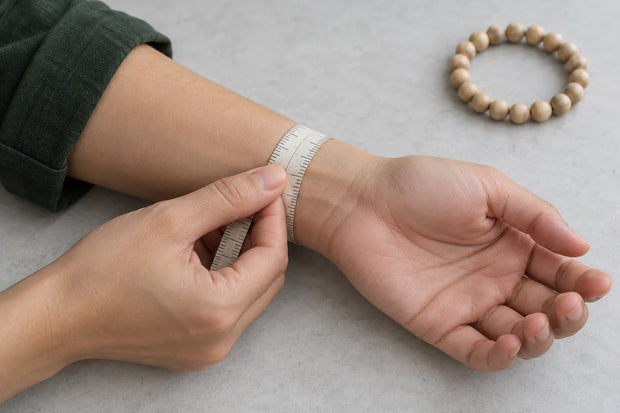
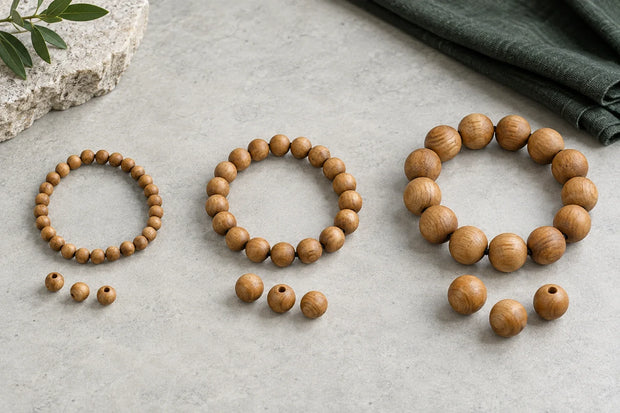
Bead size and form: For daily wear, 8mm beads are the standard — substantial enough to feel present on the wrist without being cumbersome. For use as a mala (108 beads for mantra counting), 6mm is traditional.
Some practitioners prefer a single larger specimen — a tumbled stone of 3-5cm — kept in a pocket or on the desk. All of these are legitimate forms. The bracelet is most practical for continuous wear; the mala integrates the stone into formal practice; the specimen works well as a space anchor on your altar or desk.
Pairing considerations: Black tourmaline works well with clear quartz (amplifies its grounding quality), with red jasper (deepens the earth-element connection), and with copper settings (copper's conductivity complements schorl's piezoelectric properties). It does not pair well with high-frequency stones like moldavite or phenacite for most practitioners — the contrast between tourmaline's heavy, absorptive quality and those stones' intense, activating quality can be disorienting rather than balancing.
Browse our Tibetan blessed crystals with pairing notes included for each piece.
How to Actually Use Black Tourmaline in Daily Practice
Owning the stone is the beginning. Here's how practitioners with serious, established practices actually work with it.
Morning activation: Before you sit, hold the bracelet or stone in both hands for one to three minutes. This isn't a performance — it's a moment of intention-setting. In Tibetan practice, this is called damtsig — renewing the commitment.
You're reminding yourself and the object what it's for. Those on a path of protection recite the mantra of Vajrapani (OM VAJRAPANI HUM) during this time; Vajrapani is the Bodhisattva associated with protection and power, and his mantra has been used since the 8th century to activate protective objects in the Tibetan Buddhist tradition.
Wearing during formal practice: If you're doing shamatha or vipassana, wearing the bracelet on the left wrist during sitting is straightforward. If you're doing Vajrayana practices that involve specific mudras, check with your teacher — some practices specify what should and shouldn't be worn.
For most practitioners doing concentration or insight practices, the stone's grounding quality is a genuine support, particularly during longer sits when the mind tends to become airy and the nervous system needs anchoring to the body.
The transition ritual: This is the practice we find most useful for those working through demanding professional environments. When you return home from work — before you change clothes, before you check your phone — remove the bracelet and place it in a small bowl of dry sea salt or on a piece of selenite for 10-15 minutes.
This is the cleansing step. Schorl absorbs; it needs to be cleared. After cleansing, you can put it back on or leave it to rest. The act of removal and cleansing also functions as a psychological transition — you're marking the boundary between the world you've been in and the space you're returning to.
Space anchoring: A larger specimen of black tourmaline placed at the four corners of your meditation space — or simply one piece near the entrance of your home — is a traditional Tibetan protective arrangement.
The monks at Sera monastery in South India, where many Tibetan teachers trained after exile, maintain stone arrangements at the monastery's perimeter. The domestic version of this is modest but not trivial. The stone's presence at a threshold is an intention made physical, a marker that this ground has been claimed for practice.
Integration with the sacred geometry of your altar: If you work with an altar, black tourmaline belongs at the base — the earth level — rather than at the top with high-frequency stones. This placement reflects its elemental quality and keeps the altar's energetic architecture coherent.
Cleansing methods: Dry sea salt (not saltwater — saltwater can damage the stone's surface over time). Selenite plate overnight. Moonlight during the waning moon (the waning moon is traditionally associated with release and clearing).
Smoke from juniper or cedar — both used in Tibetan sang offerings for centuries. Avoid prolonged direct sunlight; schorl can fade slightly and the heat doesn't serve the stone's properties.

Common Questions
Is black tourmaline actually used in Tibetan Buddhism, or is this a Western projection?
This is the right question to ask, and it deserves a direct answer. Schorl — black tourmaline — does appear in the material culture of Tibetan Buddhist practice, though its use is more prominent in the Bon tradition and in folk protective practice than in high Vajrayana liturgy.
The use of black stones in protective amulets and boundary markers is well-documented across the Himalayan region, and schorl's piezoelectric properties were empirically observed even if not named in scientific terms. What is accurate: Tibetan practitioners have used black tourmaline in protective contexts since at least the 11th century.
What would be an overstatement: claiming it has a specific doctrinal role equivalent to, say, the use of coral in ritual objects. The honest framing is that it belongs to the broad category of protective material culture that runs alongside formal Buddhist practice throughout the Himalayan world — respected, used, and understood as a support for practice rather than a substitute for it.
What's the difference between black tourmaline and black obsidian for protection?
They address different aspects of protection and work through different mechanisms. Black tourmaline (schorl) is a crystalline mineral with piezoelectric properties — it absorbs and grounds negativity, drawing it down and neutralizing it through its earth-element quality.
It's protective in an absorptive sense. Black obsidian is volcanic glass with no crystalline structure — its protective quality is reflective and revelatory. It shows you what's present, including shadow material you may be avoiding.
Obsidian is more challenging to work with because it can surface difficult psychological content. For those on a path of shadow work or going through major life transitions, obsidian can be potent but destabilizing.
Black tourmaline is generally considered safer for continuous daily wear precisely because it absorbs rather than amplifies. You can explore our obsidian protection bracelet to understand how we approach obsidian's distinct role. For most practitioners asking about daily protection, black tourmaline is the right starting point.
Does black tourmaline need to be blessed to work?
The stone has natural properties regardless of blessing — its piezoelectric and absorptive qualities are intrinsic to its mineralogy. A piece of schorl that has never been near a monastery will still be heavier than glass and will still have the earth-element quality that makes it useful for grounding.
What blessing adds is intention, lineage, and activation. A stone that has been through a formal consecration ceremony has been held, prayed over, and dedicated to a specific purpose by practitioners with training in working with protective objects.
That process matters, particularly for practitioners doing formal Vajrayana practice where the energetic coherence of your objects is part of your practice environment. For someone using black tourmaline primarily for grounding and stress reduction, an unblessed stone used with clear personal intention is legitimate and useful.
For someone doing formal deity practice or working with a teacher in a Vajrayana lineage, a properly blessed stone is worth the investment.
How often should I cleanse my black tourmaline?
This depends on your environment and how you're using it. If you're wearing it daily in a demanding professional environment — open-plan offices, client-facing work, high-conflict situations — cleanse it every two to three days.
If you're using it primarily during meditation at home, weekly cleansing is usually sufficient. The practical indicator: if the stone starts to feel heavy or dull in a way that seems different from its normal weight, that's a signal it's saturated and needs clearing.
Practitioners in Kathmandu describe this as the stone feeling "sticky" or "flat." After cleansing, it should feel lighter and more present. Dry sea salt for 4-8 hours is the most reliable method. Selenite plates work well for overnight maintenance.
Avoid saltwater, which can pit the surface over time.
Can I wear black tourmaline while doing Vajrayana practices?
Generally yes, with one caveat: consult your teacher if you're doing practices that involve specific mudra sequences or body-level visualizations where the presence of stones at the wrist might be a distraction or a protocol issue.
For most Vajrayana practitioners doing sadhana practice, wearing a black tourmaline bracelet on the left wrist is compatible and can be a useful support — particularly during longer sessions where maintaining ground while working with high-energy deity practices is relevant.
Teachers in the Kagyu and Nyingma traditions actively recommend protective stones for students doing advanced practices precisely because those practices can temporarily increase sensitivity to environmental influences. The stone provides a stable base. If your teacher has given you specific instructions about what to wear during practice, follow those instructions over any general guidance.
What's the significance of the left wrist specifically?
In Tibetan body-mapping, the left side of the body is associated with the receiving channel — the quality of taking in from the environment. The right side is associated with the giving or projecting channel.
Wearing a protective stone on the left wrist is therefore logical within this framework: you're placing the absorptive, protective material at the primary point of energetic reception. This is consistent across multiple Asian body-energy traditions, including Traditional Chinese Medicine's understanding of the left pulse position.
It's also worth noting that in many Tibetan protective amulet traditions, the left wrist is specified for women and the right for men in certain practices — though this distinction is less consistently applied in contemporary teaching.
If you have a specific practice instruction from a teacher, follow it. If not, left wrist is the traditional default for protective objects.
How do I know if my black tourmaline is fake?
The most common substitutes are dyed black glass, black resin, and occasionally black agate sold as tourmaline. Weight is your first test: genuine schorl is noticeably heavy for its size. Surface texture is your second: real tourmaline has striations — fine parallel lines running along the bead — that you can feel with your fingernail.
It will not be perfectly smooth. Third, examine the color under strong light: genuine schorl is completely opaque with no translucency. Fourth, temperature: real stone feels cool to the touch initially and warms slowly; glass warms faster.
Material, origin and ceremony details vary by product. Use the individual listing and request supporting records before relying on a particular workshop, artisan or temple claim.
Can black tourmaline help with the practice plateau?
Honestly: it depends on what's causing the plateau. Black tourmaline is useful when the plateau is connected to accumulated energetic burden — the contamination problem described earlier in this article. If your practice feels stuck because you're carrying too much residue from a demanding environment, and your sits feel clouded rather than simply dry, working with black tourmaline as a grounding and clearing support can create conditions for movement.
It's less directly useful if the plateau is a concentration issue, a conceptual obstacle, or simply the natural settling that happens in the middle of a long path. The traditional advice holds: bring the question to your teacher.
But if you don't have regular teacher access and you're experiencing the specific quality of environmental contamination affecting your practice, adding black tourmaline to your conditions — alongside reviewing your diet, sleep, and the quality of your environment — is a reasonable and traditional response.
Your Journey With Black Tourmaline in 2026
The path doesn't get simpler as you go deeper. If anything, the stakes become clearer — you understand more precisely what you're working with and what gets in the way. The world in 2026 is genuinely noisier than it was when those of us on a path of self-inquiry started practicing.
That's not a complaint; it's just the condition. And conditions call for responses.
The piezoelectric stone that generates charge under pressure — that responds to force by producing energy — is, if you want to read it symbolically, a decent image of what practice asks of you.
The pressure of a demanding life, used correctly, generates something. The stone just does it automatically. You have to choose it.
Related: crystal stones
The practice is yours. We're here to support the conditions.
"faq_schema_data": [ { "question": "Is black tourmaline actually used in Tibetan Buddhism?", "answer": "Schorl — black tourmaline — does appear in the material culture of Tibetan Buddhist practice, particularly in theMaterial, origin and ceremony details vary by product. Use the individual listing and request supporting records before relying on a particular workshop, artisan or temple claim.
Keep reading