
ashtamangala
The Eight Auspicious Symbols of Buddhism (Ashtamangala): Complete Visual Guide
The Eight Auspicious Symbols (Sanskrit: Ashtamangala; Tibetan: Tashi Tagye) form one of the oldest and most widely recognized iconographic groups in Buddhist art. Originally derived from ancient Indian royal coronation emblems, these eight motifs appear across monastery doorways, thangka borders, carved wood, and wearable jewelry throughout Tibet, Nepal, Bhutan, and East Asia.
All Eight Auspicious Symbols Explained
- The Parasol (Chattra): Historically a royal canopy, in Buddhist art the tiered parasol represents shelter from the heat of mental affliction and respect for the Dharma.
- The Golden Fishes (Suvarnamatsya): A pair of symmetrical golden carp swimming freely, traditionally symbolizing spontaneity, adaptability, and moving through life without fear of drowning in confusion.
- The Treasure Vase (Kalasha): A rounded golden vessel with a lotus neck representing the inexhaustible breadth of Buddhist teachings and generosity.
- The Lotus Flower (Padma): Rising cleanly through muddy water to bloom at the surface, the lotus is the universal Buddhist emblem of clarity and ethical purity.
- The Right-Turning White Conch (Shankha): A white spiral shell whose deep resonant sound historically proclaimed royal announcements and came to symbolize the far-reaching voice of the Dharma.
- The Endless Knot (Shrivatsa): A geometric lattice with no beginning or end, illustrating interdependence (pratityasamutpada) and the union of wisdom and compassion.
- The Victory Banner (Dhvaja): A cylindrical silk standard originally carried by ancient Indian rulers, reinterpreted in Buddhism as perseverance over internal obstacles such as ignorance and attachment.
- The Dharma Wheel (Dharmachakra): An eight-spoked wheel representing the Noble Eightfold Path and the Buddha's first teaching at Sarnath.
How the Eight Symbols Appear in Everyday Craft
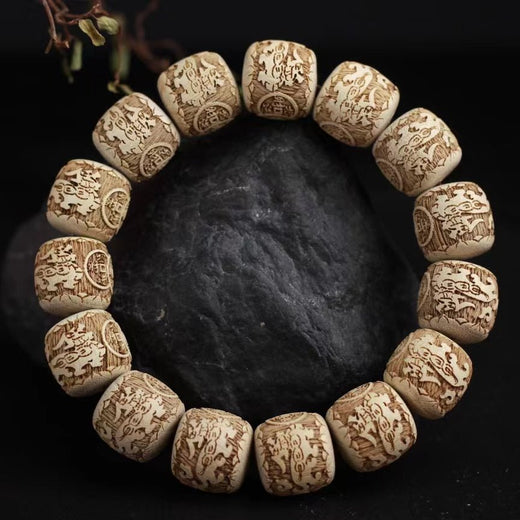
In Himalayan visual culture, the Eight Auspicious Symbols may be depicted individually (such as an engraved Endless Knot pendant or Lotus bead spacer) or combined into a single composite vase emblem. Compare these motifs alongside broader Buddhist iconography in our Buddhist Symbolism Guide, or view wearable designs in Thangka Pendants, Thangka Series, and Mala Beads.
Frequently Asked Questions
Where did the Eight Auspicious Symbols originate?
Art historians trace the Ashtamangala to ancient Indian royal ceremony emblems that were adopted and given philosophical meanings in early Indian and later Tibetan Buddhist art.
What is the difference between the Endless Knot and the Dharma Wheel?
The Endless Knot is a continuous interwoven geometric pattern symbolizing interdependence and the union of wisdom and compassion, while the eight-spoked Dharma Wheel represents the Noble Eightfold Path.
Do all Buddhist traditions use the exact same order for the Eight Symbols?
No. While the eight emblems are consistent across Himalayan and East Asian Buddhism, their listing order and artistic styling vary slightly between Tibetan, Nepalese, and Chinese traditions.
Shop this story
Pieces made by the same hands
Keep reading
More from News
The Five Elements (Wu Xing) in Taoism: Cycles, Colors & Cultural Symbols
A clear cultural guide to the Chinese Five Elements (Wu Xing), covering Wood, Fire, Earth, Metal, and Water, the generating and overcoming cyc...
Read article
How to Wear Mala Beads: A Practical Mala Necklace Guide
NewsTaoist and Buddhist Jewelry: Symbols in Context
Taoist and Buddhist jewelry can appear together in a shop or personal collection, but that does not make their symbols interchangeable. A ...
Read article