buddhist-jewelry
Six-Armed Mahakala: An Authentic Practice Guide

Six-Armed Mahakala: The Complete Iconography & Practice Guide
Within the vast and profound pantheon of Tibetan Buddhism, the appearance of wrathful deities can be startling to the uninitiated. How can a path of peace and compassion produce figures of such terrifying ferocity?
The answer lies in the very nature of compassion itself. True compassion is not passive; it is an active, dynamic force that works tirelessly to alleviate suffering. Sometimes, the most compassionate action is a wrathful one—to shatter ignorance, to tame the untamable ego, and to violently sever the chains of samsara.
This is the world of the Dharmapalas, the Dharma Protectors, and at the forefront stands Mahakala, the Great Black One. Exploring his form, especially through devotional pieces from our collection of wrathful deities jewelry, is to engage with this potent, protective energy directly.
Crafted by hand at partner monasteries in Nepal and Tibet, each piece is made by skilled artisans following traditional Himalayan methods, then consecrated by resident monks.
When our team was inspecting new thangkas in a small workshop
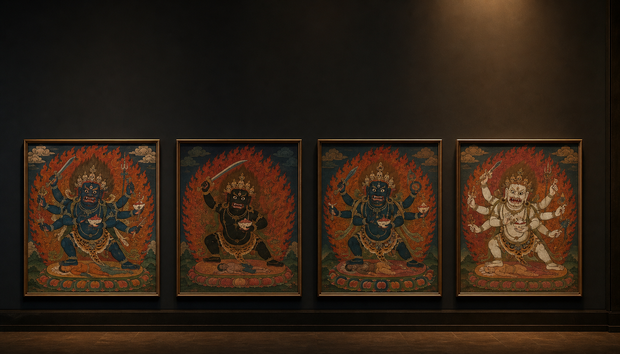
The Six-Armed Mahakala, known in Tibetan as Gönpo Chakdrukpa, is one of the most revered and powerful protectors in the Vajrayana tradition. His form is not a random collection of frightening symbols; it is a precise and deeply symbolic map of the path to enlightenment.
Every arm, every ornament, every flame is a teaching. This guide delves into the complete iconography of Six-Armed Mahakala, moving beyond surface-level interpretations to reveal the authentic meaning embedded within his sacred form, as understood within the lineage traditions.
For a broader context on his various manifestations, you can explore our in-depth Mahakala overview.
Six Armed Mahakala Practice is true compassion is not passive; it is an active, dynamic force that works tirelessly to alleviate suffering.
Who Is Six-Armed Mahakala? The Complete Introduction
Six-Armed Mahakala is a Dharmapala, a class of enlightened beings who have vowed to protect the Buddha's teachings (the Dharma) and its sincere practitioners. He is not a worldly god to be appeased for mundane favors, but a fierce intention-setting of enlightened activity.
His primary role is to eliminate obstacles—both inner and outer—that hinder spiritual progress. These obstacles can be as subtle as a moment of doubt or as powerful as deeply ingrained negative habits and external disruptive forces.
The origin of Six-Armed Mahakala is a profound story of ultimate compassion. He is understood to be a wrathful emanation of Avalokiteshvara (Tibetan: Chenrezig), the Bodhisattva of Compassion. The legend states that Avalokiteshvara, looking down upon the endless suffering of beings in samsara, made a powerful vow to liberate them all.
Despite his tireless efforts, he saw that countless beings were still mired in delusion and negative karma. In a moment of intense compassionate frustration, he generated a wrathful form to accomplish what his peaceful form could not.
From the dark blue syllable HUNG in his heart, Mahakala instantly emerged, fully formed, with a power and ferocity capable of overwhelming any obstacle to enlightenment.
This origin is crucial. It firmly establishes that Mahakala's wrath is not born of anger or malice, but of boundless, uncompromising compassion. He is the fierce love of a parent who will do anything to protect their child from harm.
His terrifying appearance is a skillful means (upaya) designed to subdue the most stubborn and malignant forces of ego-clinging and ignorance.
Six-Armed Mahakala is particularly significant in the Shangpa Kagyu school of Tibetan Buddhism, where he is the principal protector. However, his practice is also central to the Gelug school (as a main protector) and is found within the Sakya and other Kagyu lineages.
He is considered the protector of the "three roots" of practice: the guru, the yidams (meditational deities), and the sangha (community of practitioners). His energy is swift and immediate, a powerful ally for those walking the Vajrayana path.

The Six Arms Decoded — Each Implement and Its Meaning
The six arms of Mahakala are the most defining feature of his form, and they are far from arbitrary. Each arm holds a specific ritual implement, and together they represent the complete array of skillful methods and wisdoms used to protect the Dharma and guide practitioners.
They symbolize the six perfections (paramitas): generosity, ethics, patience, joyous effort, concentration, and wisdom.
The First Pair of Hands (Main Hands)
The two primary hands are held at the heart, signifying that these actions are central to his enlightened activity. They hold the kartika and the kapala, representing the union of skillful means and wisdom.
- Right Hand: Kartika (Ritual Flaying Knife): The kartika, or curved flaying knife, is a potent symbol of cutting through the root of suffering. Its sharp blade severs the three primary poisons: ignorance (moha), attachment (raga), and aversion (dvesha). More fundamentally, it cuts through the clinging to a solid, independent self—the ego—which is the ultimate source of all delusion. It represents the decisive, sharp, and uncompromising nature of wisdom that dissects reality and frees us from conceptual bondage.
- Left Hand: Kapala (Skull Cup) filled with Blood: The kapala is a cup made from the top of a human skull. In his main left hand, it is filled with what is described as the blood and brains of the enemies of the Dharma. This is not literal violence. The "enemies" are the internal afflictive emotions and neurotic thought patterns. The blood symbolizes the raw energy of these negative states. By holding them in the skull cup of wisdom, Mahakala demonstrates his power to transform this raw, negativity into the nectar of blissful wisdom (amrita). It is the ultimate act of alchemical transformation.
The Second Pair of Hands (Middle Hands)
The middle pair of hands holds implements that represent the power of the teachings and control over the phenomenal world.
- Right Hand: Damaru (Skull Drum): The damaru is a two-sided drum made from two skull caps joined at their apex. When played, it produces a sound that represents the primordial resonance of reality itself—the sound of emptiness (shunyata). This sound awakens beings from the slumber of ignorance, calling them to the Dharma. It also symbolizes the impermanence of all things, as its sound arises and ceases in an instant. Furthermore, the sound of the damaru is said to summon the dakas and dakinis, celestial beings who assist practitioners on the path.
- Left Hand: Trishula (Trident): The trident is a powerful weapon with three sharp prongs. Symbolically, it represents Mahakala's complete mastery over the three realms of existence: the desire realm, the form realm, and the formless realm. The three prongs also symbolize the Three Jewels of refuge—the Buddha, the Dharma, and the Sangha—which are the ultimate protection for a practitioner. It signifies the power to pierce through the three poisons and to purify the three main energy channels (nadis) within the subtle body.
The Third Pair of Hands (Lower Hands)
The lowest pair of hands holds implements related to binding and continuous activity for the benefit of beings.
- Right Hand: Mala of Skulls (Rosary): Unlike a traditional 108-bead mala used for counting mantras, this rosary is made of human skulls. This signifies Mahakala's unending, continuous activity for the benefit of all sentient beings. Just as one counts beads one by one, he works to liberate beings one after another, tirelessly, through countless eons. The skulls are a stark reminder of mortality and impermanence, urging the practitioner to practice diligently without wasting a moment.
- Left Hand: Pasha (Lasso or Snare): The pasha is a snare used to bind and capture. In Mahakala's hand, it has a twofold meaning. First, it binds the negative forces, demons, and oath-breakers who seek to harm the Dharma and its followers. It neutralizes their harmful activity. Second, and more subtly, it lovingly lassos sentient beings who are wandering lost in the wilderness of samsara, gently but firmly pulling them back towards the path of liberation and binding them to their spiritual commitments.
Mahakala's Iconography — Colors, Crown, and Form
Beyond his six arms, every detail of Mahakala's appearance is a rich weave of profound symbolism, a visual Dharma teaching.
- Body Color (Deep Blue/Black): Mahakala's body is a deep, dark blue or black, the color of space. This color is not merely menacing; it symbolizes the absolute and unchangeable nature of the Dharmakaya—the ultimate truth body of a Buddha, which is beyond all concepts, colors, and forms. Just as black absorbs all other colors, Mahakala's nature absorbs and dissolves all negativities, obstacles, and delusions into the ultimate reality of emptiness.
- Three Eyes: His three eyes are wide, round, and bulging with intensity. They are not eyes of ordinary anger but of penetrating wisdom. They symbolize his ability to see the past, present, and future simultaneously. They perceive the ultimate reality of all phenomena, beyond the dualistic veil of ordinary perception.
- Bared Fangs and Rolling Tongue: His mouth is open in a fearsome roar, with four sharp fangs bared. The fangs represent the power to crush the four maras, or demonic obstructions to enlightenment: the mara of the aggregates, the mara of afflictive emotions, the mara of the Lord of Death, and the mara of divine pride. His tongue is often depicted as rolling, signifying his ceaseless, active energy that consumes all neurotic states.
- Crown of Five Skulls: Adorning his head is a crown made of five human skulls. These five skulls symbolize the transmutation of the five primary kleshas (afflictive emotions) into the Five Wisdoms of the Buddhas. Anger is transformed into Mirror-Like Wisdom; pride into the Wisdom of Equanimity; attachment into Discriminating Wisdom; jealousy into All-Accomplishing Wisdom; and ignorance into the Wisdom of the Dharmadhatu.
- Flaming Hair: His orange or yellow hair streams upward like a blazing fire. This represents the power of his enlightened mind, burning away all obscurations and negative thoughts. It is the fire of wisdom that consumes ignorance.
- Tiger Skin Loincloth: He wears a loincloth made from the skin of a tiger. In Buddhism, the tiger symbolizes the most powerful of the worldly passions: anger and aggression. By wearing its skin, Mahakala demonstrates that he has completely subjugated and transformed the raw power of anger into a tool for compassionate action.
- Elephant Skin Cloak: Draped over his back is the skin of an elephant. The elephant represents pride, arrogance, and ignorance. Mahakala has "slain" the elephant of ego, signifying his complete victory over pride and his realization of selflessness.
- Garland of Fifty Severed Heads: Around his neck, he wears a long garland of fifty freshly severed, blood-dripping human heads. This graphic imagery represents the fifty primary letters of the Sanskrit alphabet. It symbolizes the purification of speech and the mastery of mantra, the primordial sounds of reality. It shows that he has severed all conceptual and discursive thought patterns, which are the building blocks of samsaric existence.
- Snake Ornaments: He is adorned with snakes as bracelets, anklets, and a sacred thread. Snakes, or nagas, are powerful subterranean beings who can control wealth and weather, but are also associated with hatred and malice. By wearing them as ornaments, Mahakala shows his power to tame and control hatred, transforming its energy.
- Posture and Pedestal: He stands in a dynamic, powerful posture, with one leg bent and the other straight, signifying his readiness to spring into action. He stands upon the prostrate form of the elephant-headed deity Vinayaka (a form of Ganesha), who here represents the most persistent and difficult-to-overcome obstacles to spiritual practice. This is not a sectarian symbol of dominance over Hinduism, but an internal allegory for overcoming the ultimate spiritual blockages. He tramples these obstacles upon a radiant sun disc, which symbolizes the blazing light of wisdom that dispels the darkness of ignorance. The sun disc rests upon a multi-petaled lotus flower, the universal symbol of purity, renunciation, and enlightenment, which grows undefiled from the mud of samsara.

The Three Main Forms of Mahakala in Tibetan Buddhism
While this guide focuses on the Six-Armed form, it is important to understand that he is part of a larger family of Mahakala manifestations. The specific form of a protector is often tied to a particular Buddhist tantra or lineage.
The three most well-known forms are distinguished by their number of arms.
- Six-Armed Mahakala (Shadbhuja Mahakala / Gönpo Chakdrukpa): As detailed here, he is the wrathful emanation of Avalokiteshvara. He is the principal protector of the Shangpa Kagyu school and was later adopted as a chief protector of the Gelug school, founded by Je Tsongkhapa. His practice is focused on overcoming obstacles and providing swift protection for practitioners dedicated to the path of compassion.
- Four-Armed Mahakala (Chaturbhuja Mahakala / Gönpo Chakshipa): This form is an emanation of the meditational deity Chakrasamvara and is the primary protector of the Karma Kagyu lineage. He holds a sword of wisdom, a skull cup, a ritual drum, and a khatvanga staff. His activities are categorized into four types: pacifying, enriching, magnetizing, and subjugating. He is particularly associated with protecting the Mahamudra teachings.
- Two-Armed Mahakala (Panjaranatha Mahakala / Gönpo Gur): This form, often called "Lord of the Tent," is the primary protector of the Sakya school and is inseparable from the Hevajra Tantra. He holds a large sandalwood club or "gandi" and a skull cup. He is considered a wrathful emanation of Manjushri, the Bodhisattva of Wisdom. His role is to protect the sacred space of the mandala and the integrity of the tantric teachings.
Understanding these distinctions helps to appreciate the rich diversity within the tradition of Mahakala in Tibetan Buddhism and to recognize that each form is perfectly suited to the needs of the practitioners and teachings it is meant to protect.
How Mahakala Protects — The Dharma Protector Function
The term "protector" can be misleading if viewed through a mundane lens. Mahakala is not a bodyguard who prevents worldly misfortunes like financial loss or physical harm, although conducive conditions for practice can be a byproduct of his activity. His protection operates on a much deeper, spiritual level.
A Dharmapala's primary function is to protect the practitioner's journey to enlightenment. They do this by clearing away the two types of obstacles: inner and outer.
- Inner Obstacles: These are the most formidable enemies on the path. They are the afflictive emotions (kleshas) like anger, attachment, and pride; they are doubt, laziness, agitation, and the deep-seated clinging to ego. Mahakala's wrathful energy cuts through these internal blockages with the precision of a surgeon's scalpel. His practice helps the meditator to recognize and transform these negative mental states into wisdom.
- Outer Obstacles: These are external circumstances that disrupt one's practice. This could include misleading influences, lack of resources, interpersonal conflicts, or environments that are hostile to spiritual growth. Mahakala's activity helps to create a protected space, pacifying negative external energies and magnetizing the necessary conditions for practice to flourish.
His wrath is a form of skillful means. It is the fierce, uncompromising energy required to confront the sheer stubbornness of our own delusions. Just as other great protectors like the death-destroyer Yamantaka use terrifying forms to conquer the ultimate obstacle of death itself, Mahakala uses his ferocious appearance to conquer the ego that fears death.
The practice of propitiating a protector like Mahakala is not about worshiping an external being. It is about connecting with the enlightened, protective qualities of one's own mind. By meditating on Mahakala, one awakens the fearless, compassionate, and wise energy within oneself that has the power to overcome all obstacles.
Six-Armed Mahakala Jewelry — Wearing the Protector
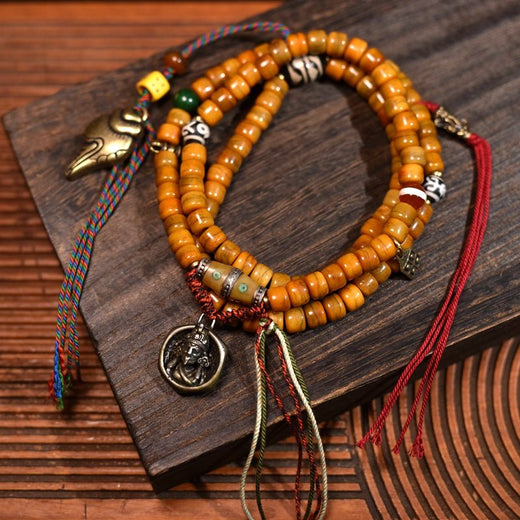
For a dedicated practitioner, sacred art is more than decoration; it is a vital part of the path. Wearing an image of a deity, such as in one of our Mahakala pendants, is a powerful and intimate form of devotional practice.
It serves as a constant, tangible reminder of the qualities one seeks to cultivate.
A Mahakala pendant is not a remarkable talisman that automatically repels harm. Rather, its power lies in its ability to continuously bring the mind back to the practice.
- A Reminder of Transformation: Seeing or feeling the pendant throughout the day is a reminder that anger can be transformed into wisdom, that attachment can be severed, and that even the most terrifying aspects of our own minds can be harnessed for enlightenment.
- A Connection to Protection: It serves as a focal point for connecting with Mahakala's protective energy. In moments of doubt, fear, or distraction, the pendant can be a touchstone that helps to re-establish one's resolve and feel the support of the protector.
- A Symbol of Vow: Wearing the image of a Dharmapala is a personal statement of commitment to the path. It signifies one's dedication to facing inner demons and protecting the integrity of one's own practice.
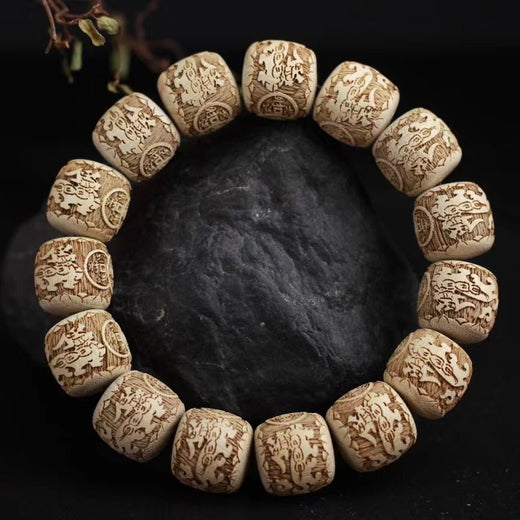
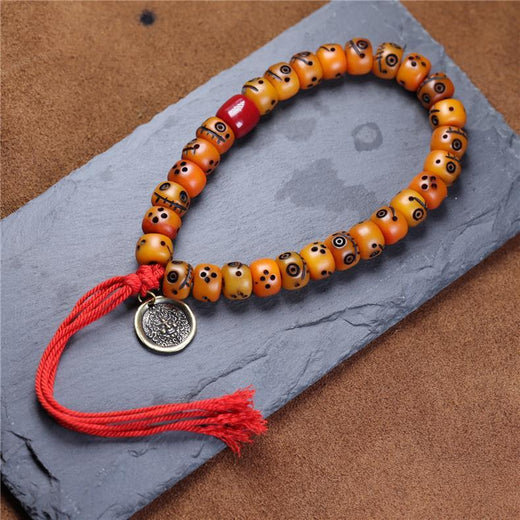
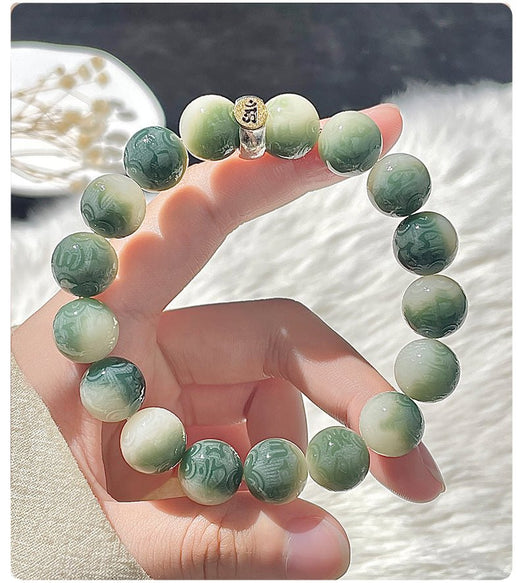
Each piece in our dharma protector collection is crafted with a deep respect for the sacred iconography it represents. The intricate details are not merely aesthetic choices; they are a faithful rendering of a profound spiritual technology.
By wearing such a piece, you carry with you a complete mandala, a map of the transformative power of fierce compassion that lies at the heart of the Vajrayana path.
Explore the Vajrapani Bodhisattva pendant.
Frequently Asked Questions
- 1. Is Mahakala evil or a demon?
- Absolutely not. This is a common misconception based on his wrathful appearance. Mahakala is an enlightened being, a Bodhisattva who has chosen to call in in a fierce form out of supreme compassion to subdue forces that peaceful means cannot. His nature is wisdom and compassion.
- 2. Who is the Six-Armed Mahakala trampling?
- He is shown trampling the elephant-headed figure known as Vinayaka. In this context, Vinayaka is not the Hindu deity Ganesha, but rather a Buddhist symbolic representation of the most stubborn and deeply rooted obstacles to spiritual realization. It symbolizes the complete subjugation of all inner and outer hindrances.
- 3. Can anyone practice Six-Armed Mahakala?
- Traditionally, the specific tantric practice of Six-Armed Mahakala requires a formal empowerment (wang), scriptural transmission (lung), and instruction (tri) from a qualified and authorized lama within an authentic lineage. This ensures the practice is undertaken correctly and safely. However, anyone can appreciate his form, make general prayers, and cultivate a connection to his compassionate energy.
- 4. What is the mantra of Six-Armed Mahakala?
- The core mantra is OM BENZA MAHAKALA HUNG PHET. Worth noting that for formal practice, this mantra should ideally be received as a transmission from a teacher. Reciting it with faith and devotion, however, can be a way to connect with his protective energy.
- 5. What is the difference between Mahakala and the Hindu goddess Mahakali?
- While their names are linguistically related ("Great Black One" and "Great Black Female One"), they are distinct figures from different traditions. Mahakala is a male protector deity in Vajrayana Buddhism, an emanation of a Bodhisattva. Mahakali is a prominent Goddess in the Hindu Shakta tradition, often considered a form of the ultimate reality, Brahman. While there may be historical and cultural overlaps in their origins, their iconographies, mythologies, and roles within their respective religions are different.
- 6. Why is he called "The Great Black One"?
- His black or dark blue color symbolizes his ultimate nature. It represents the Dharmakaya, the truth body of a Buddha, which is uncreated, unchanging, and beyond all conceptual fabrications. Like the vast, empty expanse of space, his nature is primordial and all-encompassing, capable of absorbing all negativity into itself without being stained.
- 7. How does Mahakala relate to Avalokiteshvara?
- Six-Armed Mahakala is a direct, wrathful intention-setting of Avalokiteshvara, the Bodhisattva of Compassion. He was born from Avalokiteshvara's vow to protect beings from suffering. This lineage is key to understanding his true nature: his ferocity is not anger, but the powerful, active expression of an unbearable compassion for all sentient beings trapped in samsara.
The form of Six-Armed Mahakala is a masterwork of sacred symbolism, a complete path encoded in visual language. To gaze upon his image is to be reminded that enlightenment is not a passive state, but an active, fearless engagement with reality.
His wrath is the power that shatters delusion, his implements are the tools that liberate, and his presence is a promise of unwavering protection for all who walk the path with sincerity and courage.
His fierce form is ultimately a intention-setting of love—a love so profound it will stop at nothing to free us from our own self-imposed prisons. Explore our collection of authentic wrathful deity jewelry to carry this profound reminder with you.
Keep reading