God's Rites
Meet Thousand-Armed Avalokiteśvara: Compassion in Every
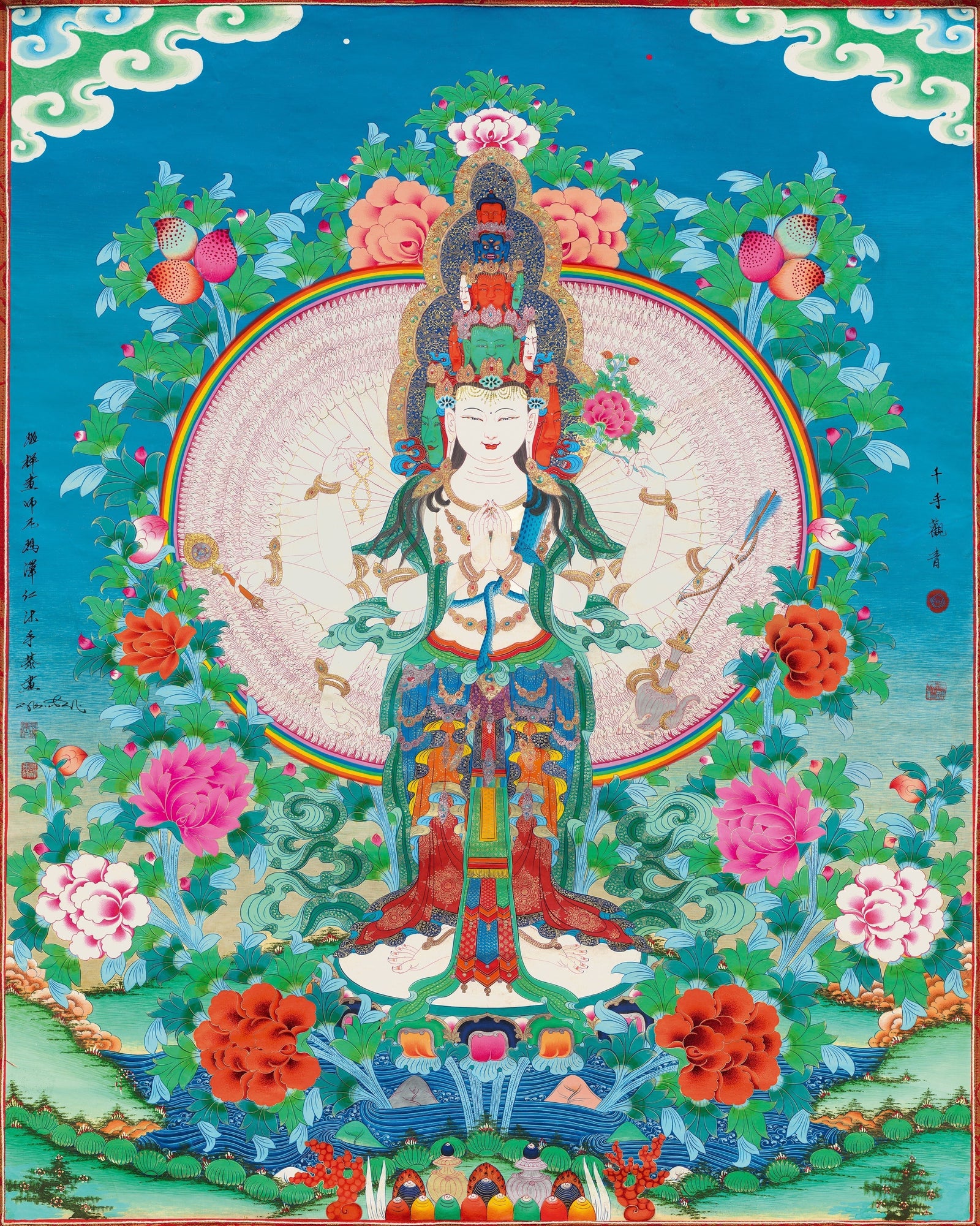
You’re standing at a crossroads, not on a dusty road, but in your own mind. There’s a decision to be made at work, a family member who needs support, a personal goal that feels impossibly distant, and the quiet but persistent hum of global anxieties. You feel stretched thin, pulled in a dozen different directions at once. How can you possibly be present and effective for everyone, including yourself, when your capacity feels so finite? You wish you had more hands, more eyes, more time—more of yourself to offer. This feeling of being overwhelmed by the sheer scale of need, both near and far, is a deeply human experience. It’s the precise point of spiritual exhaustion where the profound symbolism of the Thousand-Armed Avalokiteśvara meets you. This isn't just an ancient, complex deity; it's a mirror for that exact feeling of wanting to help but feeling utterly limited. It is a powerful answer to the question, "How can my one heart hold the suffering of many?"

What It Really Is: The Bodhisattva's Unbroken Vow
To truly understand the Thousand-Armed Avalokiteśvara, known in Tibetan as Chenrezig Chak-tong Chen-tong, you must travel back not just in time, but into the heart of a sacred promise. This form is not a god born of myth, but the dynamic, visual manifestation of a bodhisattva’s vow. The story, deeply rooted in Mahayana texts like the Kāraṇḍavyūha Sūtra, tells of Avalokiteśvara’s immense journey. He worked for eons to liberate all beings from the cycle of suffering, samsara. Looking out from the sacred mountain of Potalaka, he saw that despite his tireless efforts, countless beings were still mired in pain and ignorance. The sheer, unending scale of this suffering crashed over him in a wave of despair. In that moment of profound empathy, his heart broke, and his body shattered into a thousand pieces.
You might recognize that feeling—the heartbreak of seeing suffering you cannot stop. But the story doesn't end in despair. His spiritual father, Amitābha Buddha, saw his plight. From a place of boundless wisdom, Amitābha gathered the pieces and lovingly reassembled his devoted student. He gave him not one head, but eleven, to see suffering in all directions and through all levels of existence. He gave him not two arms, but a thousand, so he could reach out with a thousand different skillful means to help. In the palm of each hand, he placed an eye, symbolizing the union of compassionate action (the hand) and profound wisdom (the eye). This form is the embodiment of compassion that is not passive or sentimental, but active, wise, and limitlessly capable.
This powerful imagery traveled from India along the Silk Road and found its deepest roots in Tibet. For the Tibetan people, Avalokiteśvara is not a distant figure but the very progenitor of their race and the patron bodhisattva of the nation. The lineage of the Dalai Lamas is considered to be his direct human emanation. When you visit the Jokhang Temple in Lhasa, Tibet’s most sacred shrine founded by King Songtsen Gampo in the 7th century, you are walking in a space consecrated to this energy. The Potala Palace itself, the historic residence of the Dalai Lamas, is named after Avalokiteśvara’s pure land, Mount Potalaka. This isn’t just religious history; it’s the living, breathing spiritual DNA of a culture, a testament to a compassion so vast it requires a thousand arms to express its reach. When you connect with this image, you are connecting with this unbroken lineage of enlightened activity.
The Deeper Meaning: A Blueprint for Enlightened Action
At first glance, the iconography of Thousand-Armed Avalokiteśvara can seem overwhelmingly complex. Yet, every detail is a precise teaching, a map for your own spiritual development. This isn't just a figure to be worshipped from afar; it's a blueprint for realizing your own innate capacity for compassion. Let’s look closer at the profound symbolism you are witnessing.
The eleven heads are arranged in a specific hierarchy. The bottom three faces are serene and compassionate, gazing upon beings in the desire realm with loving-kindness. Above them are three wrathful faces, not expressing anger, but the fierce energy required to cut through delusion, obstacles, and negativity. You know this energy—it is the fierce determination you summon to break a bad habit or protect someone you love. Above these are three more serene faces, gazing upon beings in the higher form realms. The tenth head is a slightly more wrathful bodhisattva face, representing the teaching function for those who are difficult to tame. Finally, at the very top, is the calm, red face of Amitābha Buddha, a constant reminder of the ultimate source of this compassionate display—enlightened wisdom itself. This arrangement shows you that compassion is not a single emotion; it is a versatile, intelligent force that adapts its expression to meet the needs of the situation.
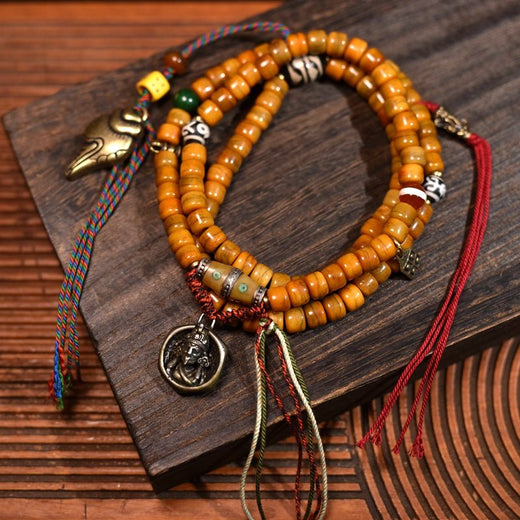
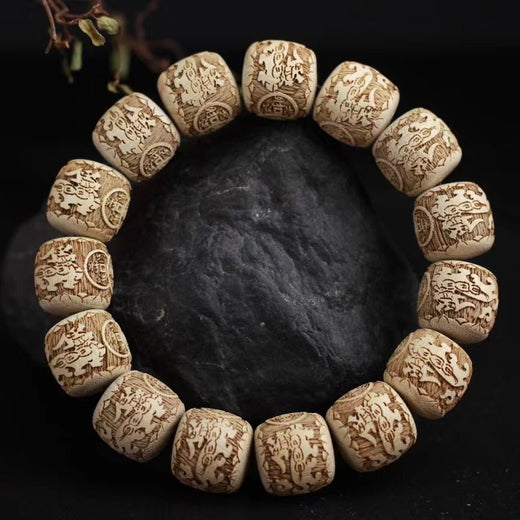
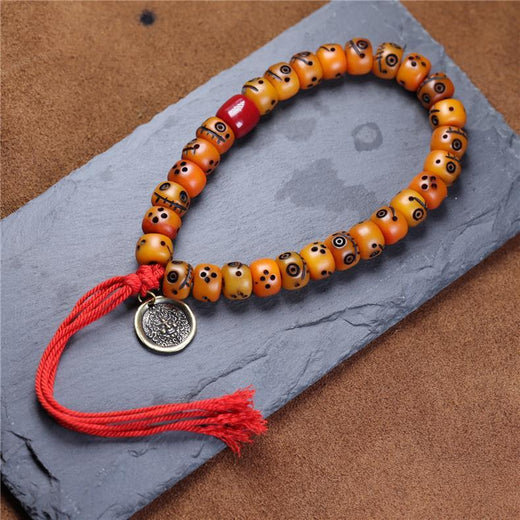
The thousand arms represent the boundless activity of the bodhisattva. The two principal hands are held at the heart in the Anjali mudra, holding the wish-fulfilling jewel (Chintamani). This jewel represents bodhicitta—the altruistic intention to attain enlightenment for the benefit of all beings. It is the core motivation from which all other actions spring. The other primary arms hold key implements: a lotus flower, symbolizing purity and the ability to rise above the mud of samsara; a rosary (mala) for reciting mantras and concentrating the mind; a Dharma wheel, representing the turning of the Buddha's teachings; a bow and arrow, symbolizing the union of wisdom and skillful means that pierces ignorance; and a vase containing the nectar of immortality, for healing and purification. These are the primary tools of enlightened action, and you can find these symbols beautifully rendered in traditional Tibetan Buddhist jewelry, serving as a constant reminder of these inner capacities.
The remaining 992 arms are fanned out in a great circle, each with an eye in the palm. This is perhaps the most crucial symbolism for your own life. The arms represent your ability to act, to reach out, to help. The eyes represent wisdom and insight. Action without wisdom can be clumsy and even harmful. Wisdom without action remains an abstract theory. The union of the eye in the hand signifies that every single act of compassion must be guided by clear-seeing wisdom. It’s the ability to know not just that help is needed, but *what kind* of help is truly beneficial. This form teaches you that true compassion isn't just a feeling; it's a skill—a perfect marriage of a warm heart and a clear, discerning mind.
Real Benefits for Modern Life: Beyond the Altar
You may not be trying to liberate all sentient beings from samsara today, but you are navigating a world that demands immense resilience, empathy, and skill. The teachings embodied by Thousand-Armed Avalokiteśvara are not ancient relics; they are practical tools for transforming your experience of modern life. Engaging with this energy can cultivate tangible qualities that directly address the challenges you face daily.
First, consider the feeling of being overwhelmed. When you’re faced with a demanding project, family conflicts, and personal anxieties all at once, your mind can shut down. You feel powerless. Meditating on or simply holding the image of Avalokiteśvara with a thousand arms acts as a powerful psychological reframe. It shifts your perspective from one of scarcity ("I don't have enough time/energy/patience") to one of abundance and potential. The thousand arms are a symbol of infinite capacity and resourcefulness. It reminds you that for every problem, there are countless potential solutions. This practice cultivates a mindset of creative problem-solving, helping you see options where you previously saw only dead ends. It encourages you to ask, "What is one small, skillful action I can take right now?" instead of freezing in the face of the whole overwhelming picture.
Second, this practice deepens your emotional intelligence and empathy. The eleven heads, with their various expressions, teach you that compassion isn't a one-size-fits-all response. Sometimes, a difficult conversation requires gentle, listening patience (the serene faces). Other times, setting a firm boundary or speaking a hard truth is the most compassionate act (the wrathful faces). By contemplating these different facets, you develop greater flexibility in your relationships. You learn to assess what is truly needed in a situation, rather than defaulting to your habitual emotional response. You begin to see that true kindness sometimes means being firm, and true strength sometimes means being vulnerable. As you internalize these lessons, you begin to see these qualities reflected in your life, and perhaps in the meaningful pieces you choose to wear as daily reminders.
Finally, connecting with Avalokiteśvara helps you cultivate what is known as "unconditional positive regard," both for others and for yourself. The Bodhisattva’s gaze is one of complete acceptance. He sees the suffering, the ignorance, and the destructive habits, but his fundamental response is one of help, not judgment. Applying this in your life means learning to separate a person's actions from their inherent worth. It allows you to respond to difficult colleagues, frustrating relatives, or even your own mistakes with less reactivity and more wisdom. This doesn't mean condoning harmful behavior; it means responding from a place of clarity and a genuine desire for a better outcome, rather than from a place of anger or blame. This is the eye in the palm: seeing clearly what is happening, and still choosing to act with a compassionate heart.

How to Choose an Authentic Representation
When you decide to bring an image of Thousand-Armed Avalokiteśvara into your space, whether as a statue, a thangka painting, or a piece of jewelry, you are inviting a powerful spiritual presence into your life. The authenticity of the piece matters, not for reasons of status, but because a correctly rendered image carries the full integrity of the teachings. An authentic piece is a vessel for transmission, created with intention and adherence to centuries of iconographic tradition.
For statues, look for those crafted using the traditional lost-wax casting method, often from a copper alloy. This technique, perfected over generations by Newari and Tibetan artisans, allows for incredible detail. Pay close attention to the iconography. Are the eleven heads correctly stacked? Do the eight primary arms hold the correct implements? The quality is not just in the material, but in the life and spiritual presence conveyed by the artist. A master artisan doesn't just replicate a shape; they invoke the deity's energy as they work. The face should feel alive with compassion, not like a generic doll. You can sense the difference when you see it—a subtle vitality that a mass-produced item lacks.
For thangka paintings, authenticity lies in both the materials and the strict iconographic grids (thigse) that guide the artist's hand. Traditional thangkas are painted on cotton or silk canvas, prepared with a mixture of chalk and hide glue. The paints are made from ground mineral pigments—lapis lazuli for blue, malachite for green, cinnabar for red—and often embellished with genuine 24k gold. These natural materials give the painting a luminosity and depth that synthetic paints cannot replicate. The proportions must be perfect, as each measurement corresponds to a specific aspect of the enlightened mind. When you explore an authentic collection of Tibetan Buddhist artifacts, you'll notice this profound attention to detail, which ensures the piece functions as a true support for your practice.
Whether you're choosing a large statue for an altar or a small pendant to wear, ask about the source. Was it made by artisans who understand the spiritual significance of what they are creating? Is it from a workshop that honors these traditions? An authentic piece is more than an object of beauty; it is a bridge to a lineage of wisdom. Choosing consciously ensures that you receive not just an artifact, but a genuine tool for your journey.
How to Use It: Integrating Compassion into Your Daily Practice
Bringing an image of Thousand-Armed Avalokiteśvara into your home is the first step. The next is to actively engage with it, allowing its symbolism to permeate your mind and heart. You don't need to be an advanced practitioner to begin. A simple, consistent practice can create profound shifts in your daily experience. Here is a straightforward way to begin.
1. Create a Sacred Space: Find a quiet, clean place in your home where you can place your statue or thangka. It doesn't need to be an entire room; a small shelf or the corner of a desk is perfectly fine. The key is intention. By designating this spot as special, you signal to your mind that this is a place for quiet reflection. You might place the image slightly elevated on a piece of clean cloth. You can make simple offerings, such as a small bowl of water, a flower, or a stick of incense, to represent your generosity and respect.
2. Set Your Motivation: Begin each session by sitting comfortably before the image. Take a few deep breaths to settle your mind. Bring to mind your reason for practicing. You might think, "May this practice help me to be more patient with my family," or "May I develop the wisdom to navigate the challenges at work," or more broadly, "May all beings be free from suffering." This initial motivation, known as bodhicitta, is the fuel for your practice.
3. Simple Visualization: Gaze at the image of Avalokiteśvara. Let your eyes soften and take in the details without straining. See the compassionate faces, the thousand arms reaching out. Now, imagine that brilliant, warm light radiates from the image, filling your entire space. This light is the essence of compassion. Imagine it pouring into you, filling your body and mind, dissolving all your stress, anxiety, and self-criticism. Feel it healing you. Then, imagine this light radiating out from you in all directions, touching your family, your friends, your colleagues, and eventually all beings everywhere, offering them peace and relief from their own struggles.
4. Mantra Recitation: While holding this visualization, you can softly recite the mantra of Avalokiteśvara: Om Mani Padme Hum. This is the most famous mantra in Tibetan Buddhism, and its six syllables are said to contain the entirety of the Buddha's teachings. You don't need to understand its complex meaning intellectually. Simply allow the sound vibration to resonate within you. You can recite it for a few minutes, or for a full mala of 108 repetitions. Let the sound be a continuous expression of the compassionate light you are visualizing.
Even five minutes of this practice each day can begin to rewire your habitual patterns of stress and reactivity, replacing them with a sense of spaciousness, kindness, and inner resourcefulness.
Common Questions About Thousand-Armed Avalokiteśvara
As you delve deeper into the meaning of this profound figure, questions naturally arise. Here are answers to some of the most common inquiries, helping to clarify Avalokiteśvara's role and significance in your journey.
Is Avalokiteśvara a god?
This is a fundamental point of clarification. In Tibetan Buddhism, Avalokiteśvara is not a creator god or a deity to be worshipped for external favors in the way one might think of a god in a theistic religion. He is a bodhisattva—an enlightened being who has postponed their own final nirvana out of a vow to help all other sentient beings achieve enlightenment first. He represents a potential that exists within every single person: the potential for fully awakened compassion. When you connect with Avalokiteśvara, you are not praying to an outside entity for intervention; you are invoking and awakening that same boundless compassion that lies dormant within your own mind. The form is a skillful means, a mirror reflecting your own highest potential back to you.
Why so many arms and heads? Is it meant to be literal?
The form is not meant to be taken as a literal, physical depiction. It is a rich symbolic language designed to communicate concepts that are beyond ordinary words. The thousand arms represent the limitless capacity for compassionate action—the ability to be present and helpful in countless ways simultaneously. The eleven heads symbolize the ability to perceive the needs of beings in all realms of existence and to respond with the appropriate teaching or method. Think of it as a visual metaphor for the multitasking, multi-faceted nature of true, wise compassion. It’s a powerful artistic expression of an infinite spiritual quality, designed to inspire your mind and expand your sense of what is possible.
What is the Great Compassion Mantra (Nīlakaṇṭha Dhāraṇī)?
While Om Mani Padme Hum is the most well-known mantra associated with Avalokiteśvara, the Thousand-Armed form is specifically linked to a longer, more potent mantra known as the Great Compassion Mantra, or Nīlakaṇṭha Dhāraṇī in Sanskrit. The story goes that Avalokiteśvara spoke this powerful dharani (a long-form mantra) before an assembly of Buddhas and bodhisattvas, proclaiming its immense power to heal, protect, and fulfill the wishes of those who recite it with faith. It is significantly longer and more complex than Om Mani Padme Hum and is a central practice in many East Asian Buddhist traditions. For practitioners in the Tibetan tradition, Om Mani Padme Hum remains the primary recitation, but the Great Compassion Mantra is recognized as a profound expression of this specific form's compassionate power.
Is Avalokiteśvara male or female? I've seen different depictions.
This is an excellent observation that points to the fluid nature of enlightened beings. In India and Tibet, Avalokiteśvara is traditionally depicted as male. However, as Buddhism spread to East Asia, the form evolved. In China, Avalokiteśvara became known as Guanyin and is most often depicted as a graceful female figure. This shift likely occurred because compassion is often culturally associated with feminine qualities like nurturing and gentleness. Fundamentally, enlightened beings are beyond gender. The male and female depictions are simply different cultural expressions of the same universal energy of compassion. Neither is more correct than the other; they are skillful means that resonate with different cultures and individuals.
Can a non-Buddhist connect with this energy?
Absolutely. The qualities that Avalokiteśvara represents—compassion, empathy, wisdom, and the desire to help others—are universal human values, not the exclusive property of any religion. You do not need to adopt any dogma or label yourself a Buddhist to benefit from the practice. You can approach the image as a powerful psychological archetype for your own highest potential. The visualization of light and the feeling of kindness are accessible to everyone, regardless of their belief system. The practice is about cultivating beneficial states of mind, and that is a path open to all who wish to walk it.
How does this form relate to other deities like Tara?
In Tibetan Buddhism, the pantheon of enlightened beings is deeply interconnected, like a family. Green Tara, one of the most beloved female bodhisattvas, is said to have been born from a teardrop shed by Avalokiteśvara. As he wept over the suffering of the world, a single tear fell, and from it a lotus bloomed, revealing the beautiful form of Tara. She then vowed to assist him in his work of liberating all beings, specifically promising to work swiftly to remove obstacles and fears. Therefore, Tara is seen as the active, swift expression of Avalokiteśvara's compassion. They are not separate entities but different facets of the same enlightened energy. Working with one often complements and enhances your connection to the other.
Your Next Step on the Path of Compassion
You’ve now journeyed through the history, symbolism, and practical application of Thousand-Armed Avalokiteśvara. You understand that this is not merely a piece of art but a profound technology for transforming the mind. It is a reminder that your capacity for kindness, wisdom, and effective action is far greater than you imagine. The feeling of being overwhelmed is not a sign of your weakness, but the starting point of your journey toward boundless compassion. The thousand arms are not an impossible standard to meet, but an invitation to discover the many ways, both big and small, that you can be a force for good in the world.
This is a path of practice, not perfection. The next step is to simply begin. Let these teachings settle in your heart. Allow the image to inspire you. Whether through quiet contemplation, mantra, or the simple act of choosing a meaningful object for your space, you can start to cultivate this energy in your life today. Explore the pieces that call to you and find a representation that will serve as your daily companion on this beautiful path. We invite you to discover our curated selection of authentic Tibetan pieces, each crafted with intention to support your journey inward.
Keep reading