God's Rites
Black Jambhala Thangka: Break Financial Blocks & Attrac
You’ve done everything you were told to do. You work hard, you save what you can, you make responsible choices. Yet, there’s a persistent friction, a sense that you’re pushing against an invisible current. Bills arrive with uncanny timing, opportunities seem to dissolve just as you reach for them, and a ceiling feels firmly fixed above your financial life. It’s not just about wanting more; it’s the quiet anxiety that your efforts aren’t yielding the stability and freedom you need to live fully, to be generous, or to pursue your deeper spiritual aspirations without constant material worry. This feeling of being stuck, of being fundamentally blocked despite your best intentions, is a profound spiritual challenge. It suggests that the obstacles you face may not be purely external. They may be rooted in subtle energetic or karmic patterns. What if there was a way to address these blocks directly, a method not of financial planning, but of spiritual purification? This is the precise domain of Black Jambhala, a powerful wisdom being whose practice is designed to sever the very roots of poverty and clear the path for true abundance to flow into your life.

What a Black Jambhala Thangka Really Is
To understand the power of a Black Jambhala thangka, you must first look past the Western notion of a "god of wealth." This isn't about praying to an external deity for a lottery win. Black Jambhala, or Jambhala Nagpo in Tibetan, is an emanation of the Buddha Akshobhya, the "Unshakable One," who presides over the Eastern Pure Land of Abhirati. His practice is a sophisticated Vajrayana method for transforming the inner poisons that manifest as outer lack. The tradition holds that the great Indian pandit Atisha Dipankara (982-1054 AD), a key figure in the revival of Buddhism in Tibet, encountered a man dying of starvation. Filled with overwhelming compassion but having nothing to give, Atisha offered a piece of his own flesh. The man refused. In his despair, Atisha saw a vision of Avalokiteshvara, the Buddha of Compassion, who assured him that a powerful emanation would arise to alleviate the suffering of poverty. From this profound moment of compassion, Jambhala manifested.
His practice was transmitted through lineages like the Sakya and Kagyu schools, treasured as a potent method not just for material sustenance but for creating the necessary conditions for Dharma practice. The source texts for his visualization and mantra, such as the Sadhanamala, detail his specific function: he doesn’t just bestow riches, he actively eliminates the karmic debts, negative influences, and internal afflictions like greed and miserliness that create poverty in the first place. His wrathful appearance is key to this function. He is a protector of the Dharma, and he uses his formidable power to conquer the spiritual and material obstacles that prevent you from practicing. He is the active, forceful compassion of the Buddhas, clearing your path so you can walk it without the heavy burden of material distress. When you engage with a Black Jambhala thangka, you are connecting to this specific, unbroken lineage of practice, a stream of spiritual presence preserved for centuries in the sacred arts. This is why the authenticity found in a carefully curated collection of Tibetan Buddhist artifacts is paramount; it ensures you are receiving a genuine key to this ancient tradition.
The Deeper Meaning of His Sacred Form
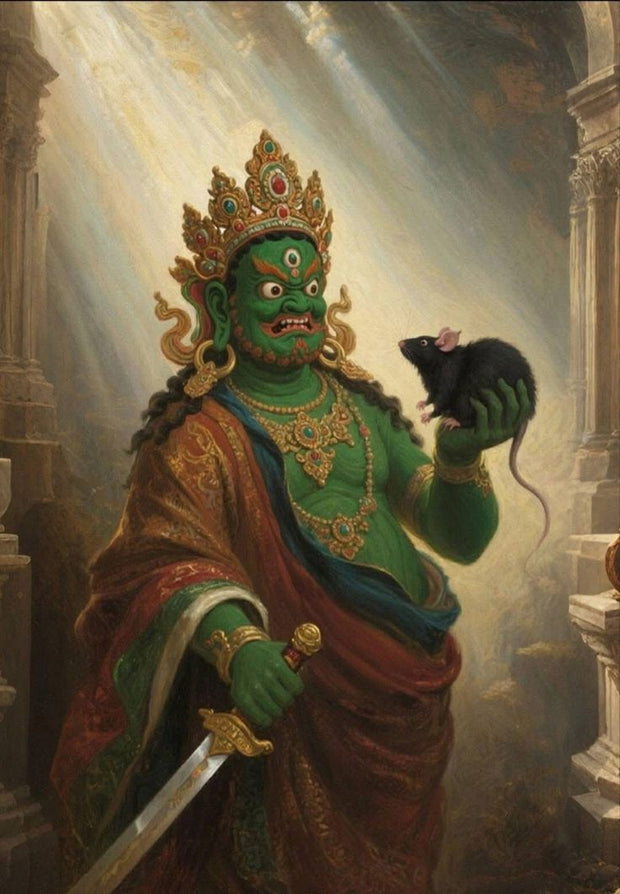
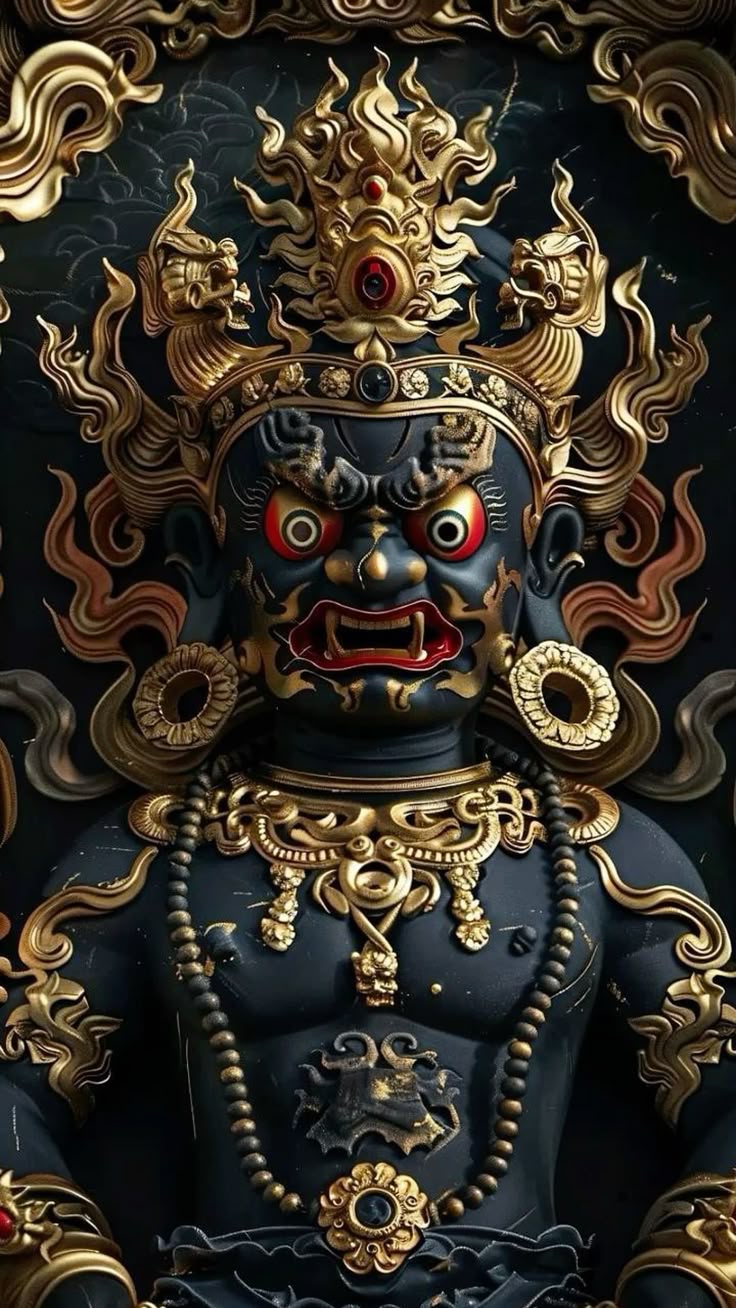
Every detail on a consecrated Black Jambhala thangka is a precise instruction for your mind, a symbolic language that speaks directly to your subconscious to awaken the qualities of abundance. His form is a roadmap to overcoming lack. Your eyes are drawn first to his color: a deep, powerful black or dark blue, like the infinite night sky. This isn't a color of negativity, but of the ultimate, unchanging nature of reality—the Dharmakaya. It represents the profound stability of Akshobhya Buddha's mind, a power that can pacify the intense anger and hatred that often fuel financial desperation and conflict. His nakedness symbolizes this same truth: he is free from the veils of conceptual thought and emotional obscurations, representing the pure, unadorned nature of your own mind.
His wrathful expression—with bared fangs, bulging eyes, and hair standing on end like flames—is not anger. It is compassionate power in action. Think of a fierce surgeon who must cut away disease to save a life. Black Jambhala's wrath cuts through your ego-clinging, your deep-seated scarcity mindset, and the external negative forces that prey on your financial well-being. The flames that surround him are the fires of primordial wisdom, incinerating any obstacle in their path. In his right hand, he holds a skull cup, or kapala, often filled with blood or jewels. This represents the transformation of the ultimate poison—the ego—into the nectar of wisdom. You are offering up your self-cherishing, and in return, you receive spiritual and material treasures. His most famous implement is in his left hand: a mongoose, known as a nakula, spitting forth wish-fulfilling jewels. This is not a magical ATM. In ancient Indian lore, the mongoose is the enemy of the Nagas, serpentine spirits who hoard treasures beneath the earth. By taming the mongoose, Jambhala demonstrates mastery over the forces that control wealth. For you, the practitioner, this symbolizes taming your own grasping mind. When you conquer your inner greed, the jewels of true, sustainable abundance—both spiritual and material—can flow freely. Understanding this rich symbolism transforms your thangka from a beautiful image into a potent spiritual tool, a principle that elevates every piece in our curated selection of sacred implements.
Real Benefits for Your Modern Life
Engaging with a Black Jambhala thangka is not about escaping your responsibilities; it's about empowering you to meet them from a place of stability and strength. The benefits ripple out from your inner world to your external circumstances in very specific ways. The primary shift happens in your mind, targeting the root of most financial struggle: the scarcity mindset. This is the persistent, nagging belief that there is "not enough"—not enough money, not enough opportunity, not enough for you. Black Jambhala's practice directly confronts and dismantles this fear. His energy helps you release the anxiety around debt, the terror of survival, and the habit of grasping. As this internal knot of fear loosens, you begin to operate from a place of confidence and generosity, which paradoxically attracts more resources to you.
Many of us experience periods of what feels like "bad luck"—a string of unexpected expenses, a promising business venture that inexplicably fails, or a constant struggle to make ends meet. From a Buddhist perspective, these can be seen as the ripening of negative karmic seeds. Black Jambhala's practice is a powerful form of purification. His mantra and visualization act like a spiritual solvent, dissolving these karmic obstacles and clearing the energetic debris from your path. Your hard work, which was previously blocked, can now finally bear fruit. Furthermore, the practice cultivates the true engine of prosperity: generosity. The ultimate purpose of wealth in the Dharma is to have the resources to help others. As you connect with Jambhala's energy, you find your own capacity for giving expands. This creates a virtuous cycle—the more you can give freely, the more abundance flows back to you. Finally, his wrathful nature serves a protective function. In a world with fraud, exploitative deals, and financial predators, his energy acts as a shield, guarding your resources and sharpening your intuition to avoid poor investments and dishonest people. This profound inner and outer transformation is what distinguishes a genuine spiritual implement from mere decoration, a core value we uphold across all our Tibetan Buddhist treasures.

How to Choose an Authentic Thangka
When you decide to bring a Black Jambhala thangka into your home, you are not just buying art; you are acquiring a sacred object intended to hold a spiritual presence. Its authenticity is therefore not a matter of taste, but of function. A genuine thangka is a vessel, and its construction must follow specific, time-honored rules. First, examine the material. A traditional thangka is painted on cotton or linen canvas that has been meticulously prepared with a mixture of chalk, a natural binder, and gesso, creating a smooth, durable surface. A glossy, machine-printed poster or a painting on cheap, unprepared canvas is a clear sign of a souvenir, not a spiritual tool.
The pigments are the lifeblood of the image. True thangka artists use stone-ground mineral pigments: lapis lazuli for the deep blues, malachite for greens, cinnabar for reds, and real gold for the intricate details and highlights. These natural colors have a depth, texture, and vibrancy that synthetic acrylic or oil paints can never replicate. They also carry the subtle energy of the earth itself. Most importantly, look at the form of the deity. A master painter, who is often a spiritual practitioner themselves, adheres to strict iconographic grids known as thigse. These sacred proportions ensure that the energy of Black Jambhala is correctly and powerfully embodied in the image. If the proportions seem off, or the details are sloppy, it indicates the artist lacked the proper training, and the thangka will lack spiritual potency. Finally, and most critically, is the act of consecration, or rabney. An unconsecrated thangka is a beautiful but empty shell. Only when a qualified lama or high monk performs the proper ritual—chanting prayers, blessing the image, and symbolically "opening its eyes"—is the wisdom-being invited to reside within the painting. This transforms it from a picture of Jambhala into a true conduit for his presence and blessings. When you're ready to find a piece for your own practice, exploring a collection of consecrated thangkas and ritual items ensures you're investing in a genuine spiritual support that will serve you for years to come.
How to Use Your Thangka in Practice
Once you have your consecrated Black Jambhala thangka, integrating it into your life is a simple yet profound practice. Your goal is to create a living relationship with the energy it represents. Begin by choosing a respectful place for it. This should be a clean, quiet area in your home, preferably on a north-facing wall, which is auspicious for wealth deities. The thangka should be placed high, always above waist level, on a dedicated altar or wall space. You might place a small table beneath it for offerings. To protect the thangka and show reverence, you can cover it with a traditional silk veil (a zhal khebs) when you are not actively engaged in practice.
Your daily practice can be structured in a few simple steps. First, sit comfortably before the thangka and set your motivation. This is crucial. Take refuge in the Three Jewels (Buddha, Dharma, Sangha) and generate bodhichitta—the altruistic intention to attain enlightenment for the benefit of all beings. Frame your desire for financial stability not as selfish gain, but as a means to gain the resources necessary to help others and practice the Dharma without obstacles. Next, gaze gently at the image of Black Jambhala. Allow the details to fill your awareness. Visualize him as a living, breathing presence of powerful compassion, not just a flat painting. See him as the embodiment of the enlightened mind's capacity to overcome all forms of poverty. The heart of the practice is the mantra recitation: OM JAMBHALA JALENDRAYE SOHA. Using a mala (prayer beads) to count, repeat the mantra 21 or 108 times. As you chant, feel the vibration of the mantra purifying your inner and outer obstacles. A particularly powerful offering for Black Jambhala is water. Place a bowl of clean water on your altar. As you recite the mantra, you can visualize a stream of purifying water flowing from the heavens, over his body, washing away all poverty, debt, and suffering for yourself and every living being. Conclude by dedicating the merit of your practice, praying that the positivity you've generated may lead to the liberation and well-being of all. Integrating such a practice into your daily life transforms your space and your mind, a journey supported by the many authentic spiritual objects available to practitioners.
Common Questions About Black Jambhala Practice
As you begin to explore the path of working with Black Jambhala, certain questions naturally arise. Understanding these nuances can deepen your practice and clarify your intentions.
Is it okay for non-Buddhists to use a Black Jambhala thangka?
Absolutely, provided it is done with sincere respect. The universal principles of overcoming greed, cultivating a generous heart, and removing obstacles to a stable life are not exclusive to Buddhism. The key is to honor the tradition from which this powerful practice comes. You don't need to be a formal Buddhist to benefit from the energy of compassion and abundance, but approaching the thangka as a sacred object, not just a decorative item, is essential for it to have any real effect.
Will I get rich quick if I use this thangka?
This is a common misconception. The practice of Black Jambhala is not a magical formula for instant wealth. It works on a much deeper level. Think of it as spiritual farming: the practice tills the soil of your mind, removes the weeds of negative karma and scarcity thinking, and provides the water of blessings. However, you still have to plant the seeds through your own effort, hard work, and skillful action in the world. The thangka creates the right conditions for your efforts to succeed, it doesn't replace them.
Why is he so wrathful and scary-looking?
The wrathful appearance is a symbolic representation of powerful, focused energy. It is not anger in the human sense of the word. It is the fierce compassion of a loving parent who rushes to protect their child from danger, or a skilled surgeon who must be decisive and forceful to remove a deadly tumor. This wrathful energy is directed at the true enemies: your ego, your greed, your fear, and any external forces that would cause you harm. It is a dynamic expression of enlightened activity designed to cut through obstacles swiftly and completely.
What's the difference between Black Jambhala and other Jambhalas?
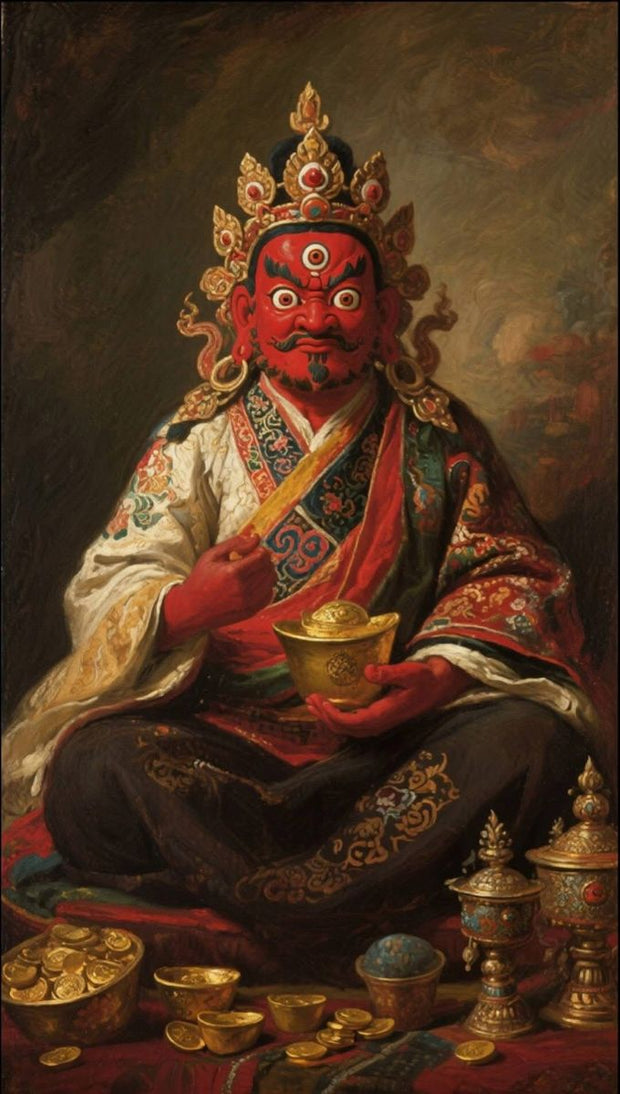
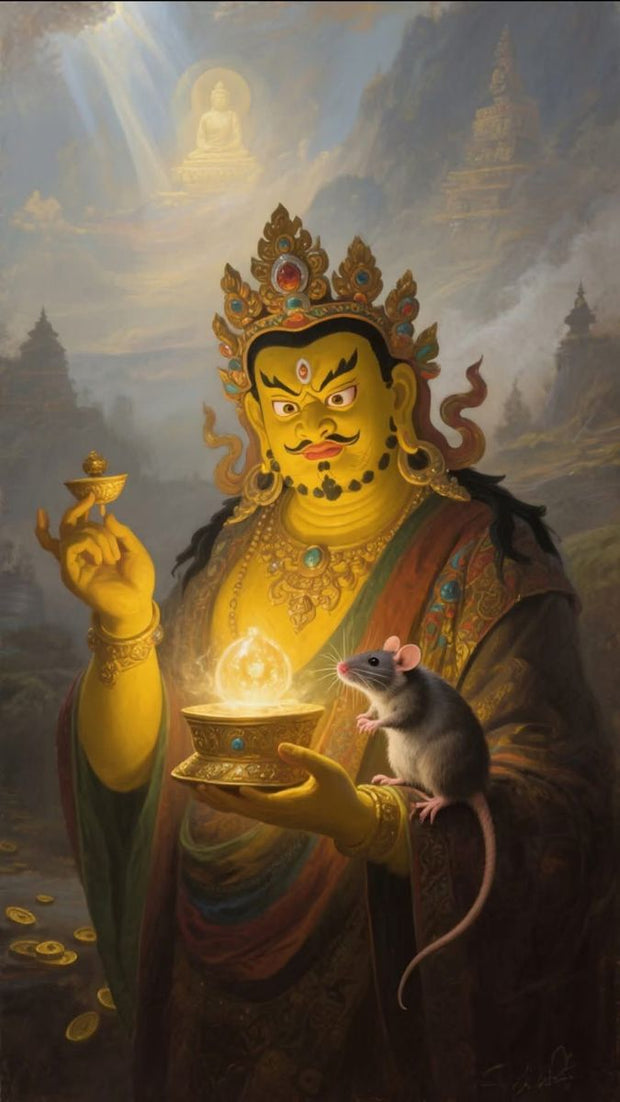
The Five Jambhalas are different expressions of enlightened wealth, each with a slightly different specialty. Yellow Jambhala is perhaps the most well-known and focuses generally on increasing prosperity and virtue. White Jambhala is an emanation of Avalokiteshvara who specifically heals sickness and purifies disease-causing karma associated with poverty. Red Jambhala has a magnetizing quality, helping you attract resources and harmonious relationships. Black Jambhala's unique power lies in his ability to forcefully eliminate and purify. He is considered especially potent for those in dire financial straits, facing heavy debt, or suffering from powerful negative influences that create persistent poverty.
How do I care for my thangka?
A thangka is a delicate work of art and a sacred object. It should never be placed in direct sunlight, as the UV rays will fade the natural pigments. Keep it away from high humidity, moisture, and any kind of smoke (like incense smoke directly wafting onto it). Never touch the painted surface with your bare hands, as the oils from your skin can cause damage over time. To clean it, gently dust the silk brocade border with a soft, dry brush. If the painted area itself requires cleaning, it is essential to consult a professional thangka restorer.
Does my thangka need to be "consecrated"? What does that mean?
Yes, for the thangka to function as a true spiritual support, it must be consecrated. Consecration, or rabney, is a vital ceremony performed by a qualified lama. Through ritual, prayer, and mantra, the lama invites the actual wisdom-mind of the deity to merge with and reside in the physical image. This process "activates" the thangka, transforming it from a mere representation into a living presence and a powerful field of blessing. An unconsecrated thangka, no matter how beautiful, lacks this essential spiritual charge.
Your Next Step on the Path to Abundance
The path of Black Jambhala is a profound journey inward. It is a recognition that true, lasting abundance is not something you chase, but something you unveil by removing the obstacles that obscure it. A consecrated thangka is far more than a piece of art; it is your guide, your focal point, and a constant reminder of the powerful, compassionate energy available to you. It is an ally in the work of transforming a mind of lack into a mind of limitless, generous potential.
Your journey to this kind of profound stability and freedom begins not with grasping, but with clearing the path. It starts with creating a sacred space and a sincere intention. If you feel called to this powerful practice, the next step is to explore the world of authentic, consecrated spiritual art. We invite you to discover the sacred implements that can support your journey toward a life of both spiritual and material well-being. You can find your own powerful support among our entire collection of sacred Tibetan arts.
Keep reading