God's Rites
Meet the Medicine Buddha: Tibet’s Healing Deity of Comp
You feel it before you can name it. A subtle hum of unease beneath the surface of a busy day. A physical ache that lingers long after the injury should have healed. It’s the kind of suffering that modern solutions don’t always touch—the dis-ease of the spirit, the fatigue of the heart, the quiet desperation for a deeper form of peace. You’ve tried everything you can think of, from mindfulness apps to weekend retreats, yet the core of the issue remains, a stubborn knot in the center of your being. This is not a failure on your part; it is a signal. It’s a call from a deeper part of yourself for a different kind of medicine, one that addresses not just the symptoms, but the very root of suffering itself. This is the realm where the Medicine Buddha, Bhaisajyaguru, resides. He is not a god of miracles, but a guide to the profound healing wisdom that already exists within you, waiting to be awakened.

What It Really Is: The Authentic Origins of Bhaisajyaguru
To truly understand the Medicine Buddha, you must look beyond modern interpretations and journey back to the source. His story is not a simple myth but is deeply rooted in Mahayana Buddhist scriptures, specifically the Sutra of the Merit and Virtue of the Past Vows of Medicine Master Vaidurya Light Tathagata. This text, translated into Chinese in the 7th century by the famed monk Xuanzang, and later into Tibetan, lays the foundation for his entire practice. It details the 12 great vows he made as a bodhisattva, long before he attained full enlightenment. These were not abstract promises; they were specific, compassionate commitments to alleviate all forms of suffering for all beings—from physical illness and poverty to spiritual ignorance and moral failings.
The practice flourished in Tibet, where the integration of spiritual and physical health is a foundational principle. The tradition found a powerful home at the Chakpori Institute of Tibetan Medicine, established in Lhasa in 1696 on the command of the Great Fifth Dalai Lama. Here, the teachings of the Medicine Buddha were not just philosophical concepts; they were the spiritual bedrock of Tibetan medicine (Sowa-Rigpa). Monks and doctors would invoke his energy and recite his mantra before diagnosing patients or preparing herbal remedies, viewing healing as a holistic act that must address mind, body, and spirit simultaneously. The deep blue color associated with him, the color of lapis lazuli, was considered a precious healing stone in ancient Tibet, believed to have purifying and strengthening properties. This connection wasn't merely symbolic; it was an integral part of the medical and spiritual worldview.
The lineage of this practice is direct and unbroken. From the great monasteries of Sera and Drepung in Tibet to the re-established Men-Tsee-Khang (Tibetan Medical and Astro-Science Institute) in Dharamshala, India, the Medicine Buddha's teachings have been meticulously preserved and passed down through generations. When you connect with the Medicine Buddha, you are not engaging with a new-age concept. You are tapping into a powerful, centuries-old stream of wisdom that has sustained and healed countless individuals. The sacred emblems of healing you see today are direct descendants of this rich, authentic history, carrying the weight and blessings of this profound lineage. It is a practice born from the compassionate vows of an enlightened being and tested in the crucible of human suffering for over a thousand years.
The Deeper Meaning: Unpacking the Symbolism of Healing
Every detail of the Medicine Buddha's iconography is a profound teaching, a visual map to the nature of healing and enlightenment. To gaze upon his form is to receive a direct transmission of wisdom, if you know how to read the language of its symbols. Understanding this language transforms a piece of art or jewelry into a powerful tool for your personal practice.
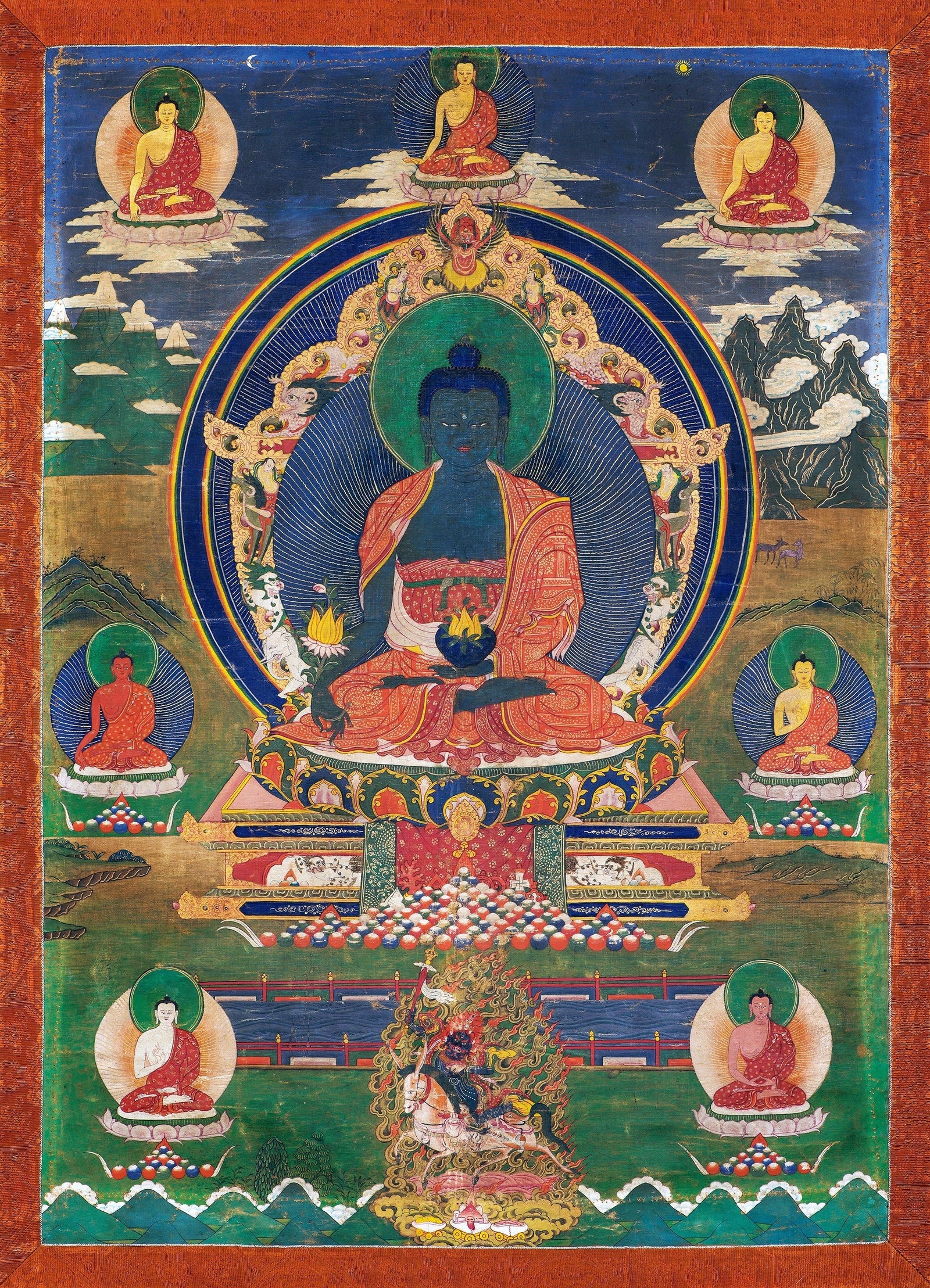
His body is a radiant, deep blue, the color of lapis lazuli. This is not an arbitrary choice. In ancient Buddhist traditions, this precious stone symbolizes purity, rarity, and the therapeutic power of the Dharma itself. The deep blue light is said to have the power to purify negative karma, pacify inner and outer obstacles, and awaken the innate healing wisdom within your own mind. When you visualize this color, you are invoking a state of mind that is as vast, deep, and clear as the sky at dawn—a mind free from the clouds of delusion and affliction.
In his right hand, extended in the mudra (hand gesture) of supreme generosity, he holds the stem of the myrobalan plant, known in Tibetan as "arura." This fruit is considered the "king of all medicines" in the traditional Tibetan medical system. It is unique because it is believed to be effective in treating all three of the root poisons of the mind: greed (attachment), hatred (aversion), and ignorance (delusion), which are seen as the ultimate source of all suffering, both mental and physical. By holding this plant, he signifies that the ultimate medicine is the Dharma—the teachings that can cure the root cause of our dis-ease, not just its symptoms.
In his left hand, resting in his lap in the mudra of meditation, he holds an alms bowl filled with medicinal nectar. This nectar represents the panacea that eliminates all sickness, suffering, and even death. It symbolizes the enlightened mind's ability to transform the poison of negative emotions into the nectar of wisdom. The meditative posture itself signifies that true healing comes from inner stability and insight. It is a reminder that you cannot find lasting peace externally; it must be cultivated through the quiet, steady practice of turning your awareness inward. Wearing a powerful Medicine Buddha amulet serves as a constant, tangible reminder of these profound truths, keeping the essence of his healing presence close to your heart throughout the day.
Real Benefits for Modern Life: Beyond Simple Stress Relief
It's easy to say that connecting with a figure like the Medicine Buddha "reduces stress." But that phrase barely scratches the surface of the profound and practical shifts this practice can bring into your life. The benefits are not about magical cures, but about fundamentally changing your relationship with your own mind, body, and the world around you. It's about cultivating a resilience that generic wellness trends can't offer.
One of the most immediate benefits is the power to work with physical pain and illness. This is not a replacement for medical treatment. Instead, it is a powerful complement. When you are sick or in pain, your mind often creates a second layer of suffering: fear, anxiety, frustration, and despair. The Medicine Buddha practice helps you dissolve this second layer. By reciting his mantra and visualizing his healing blue light pervading your body, you create a space of calm acceptance. This mental state can reduce inflammation, calm the nervous system, and create the optimal inner conditions for your body's natural healing processes to function. You learn to be with your body with compassion rather than fighting against it.
Beyond physical ailments, the practice is a direct antidote to the mental afflictions that plague modern life. For anxiety, it’s not just about deep breathing; it’s about recognizing anxiety as a manifestation of the poison of ignorance and attachment. The practice helps you see the transient, illusory nature of your fears, cutting them at the root. For feelings of burnout and depression, the Medicine Buddha’s compassionate energy helps you replenish your inner resources. It reminds you of your own innate goodness and potential for healing, providing a source of spiritual nourishment when you feel empty. This is a path to genuine mental fortitude, not just a temporary fix.
Perhaps the most profound benefit is the cultivation of calming presence for others. The Medicine Buddha’s vows were not just for his own benefit; they were for all beings. As you engage in his practice, you naturally begin to extend that healing intention outward. You can dedicate the merit of your meditation to a sick friend, a struggling family member, or even to the world at large. This act of altruistic compassion is incredibly powerful. It shifts you from a state of self-preoccupation and worry to one of expansive love and connection, which is, in itself, one of the greatest healers of the human heart. Exploring our entire collection of authentic Buddhist jewelry can help you find the specific symbol that resonates most deeply with your personal journey toward healing yourself and others.

How to Choose Authentic: A Guide to Selecting Your Amulet
When you decide to bring a representation of the Medicine Buddha into your life, whether as a statue for your altar or a pendant to wear, its authenticity matters. An authentic piece is not just a beautiful object; it is a vessel for the practice, crafted with intention and respect for the tradition. Knowing what to look for ensures you are choosing a tool that will genuinely support your spiritual journey.
First, consider the iconography. A true representation of the Medicine Buddha will have specific, consistent features. Look for the deep blue color, the right hand in the gesture of generosity holding the myrobalan plant, and the left hand in the meditation gesture holding the bowl of nectar. He should be seated in the full lotus posture on a lotus throne. Deviations from this core symbolism may indicate a piece that is more decorative than devotional, created without a deep understanding of the tradition. The details matter, as each element is a part of the teaching. When you browse our curated selection of guardian Buddha pendants, you'll notice this commitment to iconographic accuracy in every piece.
Next, examine the materials and craftsmanship. Traditionally, these objects are made from natural, precious materials like sterling silver, gold, or carved from stone. These materials are believed to be pure conductors of energy. Avoid mass-produced items made from cheap alloys or plastics, as they lack the life and spirit of a handcrafted piece. Look for signs of skilled artistry—the clarity of the lines, the serene expression on the face, the intricate details of the robes and throne. A piece made by a skilled artisan who understands the significance of their work carries an entirely different energy. It is imbued with the maker's focus and devotion, which becomes a part of the object's blessing.
Finally, trust your own connection. While technical accuracy is important, the right piece will also resonate with you on a personal level. When you look at it, you should feel a sense of peace, inspiration, or recognition. It should feel like an old friend, a guide you can trust. This intuitive connection is a vital part of the selection process. An authentic amulet is a partner in your practice. It is a focal point for your devotion and a constant reminder of the healing potential that lies within you. Choose a piece that not only meets the standards of the tradition but also speaks directly to your heart.
How to Use It: A Simple Practice to Awaken Healing
Having an authentic Medicine Buddha amulet or image is the first step. The next is to activate its potential through practice. You don't need to be an expert meditator or perform elaborate rituals. A simple, heartfelt practice done consistently can create profound shifts in your well-being. Here is a step-by-step guide to begin connecting with the Medicine Buddha's calming presence.
1. Find Your Space and Intention: Choose a quiet place where you won't be disturbed for 10-15 minutes. You can sit on a cushion on the floor or upright in a chair. Hold your Medicine Buddha pendant in your hands or place an image of him in front of you. Begin by setting a clear intention. Why are you doing this practice? Are you seeking relief from physical pain? Peace from a troubled mind? Are you dedicating this practice to a loved one who is suffering? Clarifying your motivation makes the practice focused and powerful.
2. Visualization: Close your eyes gently. Take a few deep, slow breaths to settle your mind. Now, visualize the Medicine Buddha in front of you. See his body of radiant, deep blue light. See the healing myrobalan plant in his right hand and the bowl of supreme nectar in his left. Imagine a brilliant blue light radiating from his heart, flowing out into the space around you. This light is the embodiment of pure calming presence. Feel it touching your skin, warm and soothing.
3. Mantra Recitation: Now, begin to recite his mantra, either aloud or silently to yourself. The most common form is: TADYATHA OM BHEKHANDZYE BHEKHANDZYE MAHA BHEKHANDZYE RADZA SAMUDGATE SOHA As you chant, visualize the blue light from his heart intensifying. It flows into your body through the crown of your head, filling every cell, every atom of your being. It purifies all physical illness, pain, and disease. It washes away all mental suffering—anxiety, fear, anger, and sadness. It dissolves any obstacles in your life. Don't strain; just allow the vibration of the mantra and the visualization of light to do their work. Continue for several minutes, or as long as feels right for you. If you are seeking a tangible focus for this practice, you can find a piece that resonates with you to hold during your meditation.
4. Dedication of Merit: To conclude your practice, take a final deep breath and let the visualization and mantra dissolve. Rest in the feeling of peace and clarity for a moment. Then, dedicate the positivity you've generated. You can say silently in your heart, "By the merit of this practice, may I and all beings be free from suffering and the causes of suffering. May we all experience perfect health, happiness, and ultimate peace." This final step is crucial. It expands the benefit of your practice beyond yourself, aligning your heart with the Medicine Buddha's compassionate vows.
Common Questions
Is the Medicine Buddha a real historical person?
This is a wonderful question that touches on the nature of Buddhahood itself. Unlike Shakyamuni Buddha, who was the historical figure Siddhartha Gautama, the Medicine Buddha (Bhaisajyaguru) is understood as an archetypal or celestial Buddha. He represents the fully enlightened healing aspect of the Buddha-mind. From a Tibetan Buddhist perspective, he is entirely real—not as a human who once walked the earth, but as an accessible, enlightened consciousness that one can connect with through practice. He is the manifestation of the healing potential inherent in all enlightened beings, including the historical Buddha.
Do I need to be a Buddhist to benefit from the Medicine Buddha?
Absolutely not. The principles embodied by the Medicine Buddha—compassion, purification, and the healing of suffering at its root—are universal. You do not need to adopt any religious dogma to engage with his practice. Approaching him with an open heart and a sincere desire to heal yourself and others is all that is required. His mantra can be seen as a form of sound therapy, and his visualization as a powerful mindfulness technique. The calming presence he represents is available to anyone, regardless of their spiritual background or beliefs.
Can this practice replace modern medical treatment?
No, and this is a critical point. The Medicine Buddha practice is a spiritual and psychological support system; it is not a substitute for professional medical care. It is a complementary practice that works on the mind and spirit, which can, in turn, create better conditions for physical healing. Always consult a qualified doctor for any health concerns. Think of it this way: a doctor can set a broken bone, but the Medicine Buddha practice can help you deal with the fear, pain, and impatience that arise while it heals. It addresses the layers of suffering that medicine alone cannot reach.
What is the specific meaning of his deep blue color?
The deep, radiant blue color of the Medicine Buddha is rich with symbolism. It is the color of lapis lazuli, a stone highly prized in the ancient world for its beauty and perceived healing properties. The color represents purity and the primordial wisdom mind (Dharmakaya). Just as the deep blue sky is the unchanging background for all weather phenomena, the Buddha-mind is the unchanging, pure space in which all experiences of sickness and health arise and pass away. Visualizing this color is said to have a powerful purifying effect on the mind and body, helping to clear away the "clouds" of negative karma and mental afflictions.
How is the Medicine Buddha different from Shakyamuni Buddha?
Shakyamuni Buddha is the historical founder of Buddhism in our current age. The Medicine Buddha is one of many other Buddhas who reside in different pure lands. While they are ultimately of the same enlightened nature, they are different emanations with specific functions, born from their unique vows. Shakyamuni's primary role was to turn the wheel of Dharma in our world, teaching the path to enlightenment. The Medicine Buddha's specific role, based on his 12 great vows, is to be the supreme healer, focusing on eradicating the suffering of sickness, disease, and spiritual ignorance for all beings who call upon his name or hear his mantra.
Why is he holding a myrobalan plant?
The myrobalan fruit, or "arura," is revered as the king of all medicines in the Tibetan medical tradition. It is one of the few substances believed to be able to counteract the three root poisons of the mind: attachment (symbolized by imbalances in the 'wind' humor), aversion (imbalances in 'bile'), and ignorance (imbalances in 'phlegm'). By holding this plant, the Medicine Buddha signifies that the ultimate cure for all our suffering—physical, mental, and spiritual—is the Dharma, the teachings that directly remedy these three poisons. It is a symbol that true, lasting healing addresses the cause, not just the symptom.
Your Next Step on the Path to Healing
You have now met the Medicine Buddha—not as a distant deity, but as an intimate guide and a reflection of your own potential for wholeness. You understand his origins, the deep meaning behind his form, and how to begin a personal practice that can bring profound peace and resilience into your life. The knowledge is now yours, but the true transformation begins when you put it into action.
The journey of healing is a continuous path, not a final destination. Inviting the Medicine Buddha’s presence into your daily life through a tangible symbol can serve as a powerful anchor and a constant source of inspiration. It is a reminder to be compassionate with yourself, to work with your challenges wisely, and to extend that calming presence to others. This is your invitation to take the next step. To bridge the gap between understanding and experience, explore our collection of Medicine Buddha pendants and find the sacred piece that will accompany you on your journey.
Keep reading