God's Rites
Padmasambhava: The Lotus-Born Master Who Tamed Demons w
You sit in the quiet of your room, but your mind is a raging battlefield. The deadline looms, a knot of anxiety tightening in your stomach. A past conversation replays on a loop, each word a fresh sting of regret. This is the modern landscape of demons—not horned creatures from myth, but the relentless inner forces of distraction, fear, and self-doubt that sabotage your peace and obstruct your path. You try to meditate, to find a center, but the noise is deafening. It feels as if these inner obstacles have a life of their own, actively working to keep you stuck, small, and powerless. You wish for a force powerful enough to meet this inner chaos head-on, not to destroy it, but to transform its very energy into fuel for your journey. This is not a new struggle; it is the timeless human condition. And for centuries, practitioners have turned to the potent presence of a master who specialized in this exact kind of transformation: Padmasambhava, the Lotus-Born Guru, the ultimate spiritual warrior who tamed the wild demons of the Tibetan plateau and, by extension, the untamed wilderness of the human mind.

Who Was Padmasambhava, Really? The Lotus-Born Master's Arrival in Tibet
To understand Padmasambhava, known affectionately in Tibet as Guru Rinpoche ("Precious Master"), you must travel back to the 8th century. The Tibetan Empire was a formidable military power, yet its spiritual landscape was a wild tapestry of shamanistic traditions and local deities. The Dharma had been formally invited, but it could not take root. The great Buddhist emperor Trisong Detsen had enlisted the help of the brilliant Indian scholar Shantarakshita to build the first monastery. Yet, every time they began construction, the local spirits, powerful and hostile to this new foreign teaching, would undo the work overnight. Buildings would collapse, tools would vanish, and workers would be terrorized by unseen forces. The project was a failure. Shantarakshita, a master of philosophy but not of esoteric power, advised the king that there was only one being with the spiritual force necessary to subdue these energies: the master from the land of Oddiyana, Padmasambhava.
Padmasambhava’s origin is itself a teaching in miraculous purity. He was not born of a womb but appeared, an eight-year-old child, seated upon a lotus flower in the middle of Lake Dhanakosha in the Swat Valley (modern-day Pakistan). This "Lotus-Born" manifestation signifies a being who arises from the world but is unstained by it, a pure expression of enlightened mind. He was a master of the esoteric Vajrayana teachings, possessing immense spiritual power, or *siddhi*. When King Trisong Detsen's invitation reached him, he began the arduous journey to Tibet. As he traveled, he systematically confronted the very gods, demons, and spirits that had thwarted the king's efforts. But he did not destroy them. In a display of supreme skill and compassion, he subdued them, bound them by sacred oath, and transformed them into protectors of the Dharma. He turned the greatest obstacles into the most powerful allies.
Upon his arrival at the court, he performed the sacred Vajrakilaya dance, consecrating the ground and pacifying the landscape. With the local energies now harmonized and enlisted as guardians, the construction of Samye Monastery—the very first Buddhist monastery in Tibet—proceeded without a single disruption. Samye became the heart from which the entire tradition of Tibetan Buddhism would grow. It was here that Padmasambhava, along with Shantarakshita and King Trisong Detsen, oversaw the first translations of Buddhist sutras into the Tibetan language, establishing the Nyingma, or "Ancient" school. He didn't just bring Buddhism to Tibet; he embedded it into the very soul of the land and its people, ensuring it would flourish for centuries.
The Deeper Meaning: Decoding the Symbolism of Guru Rinpoche
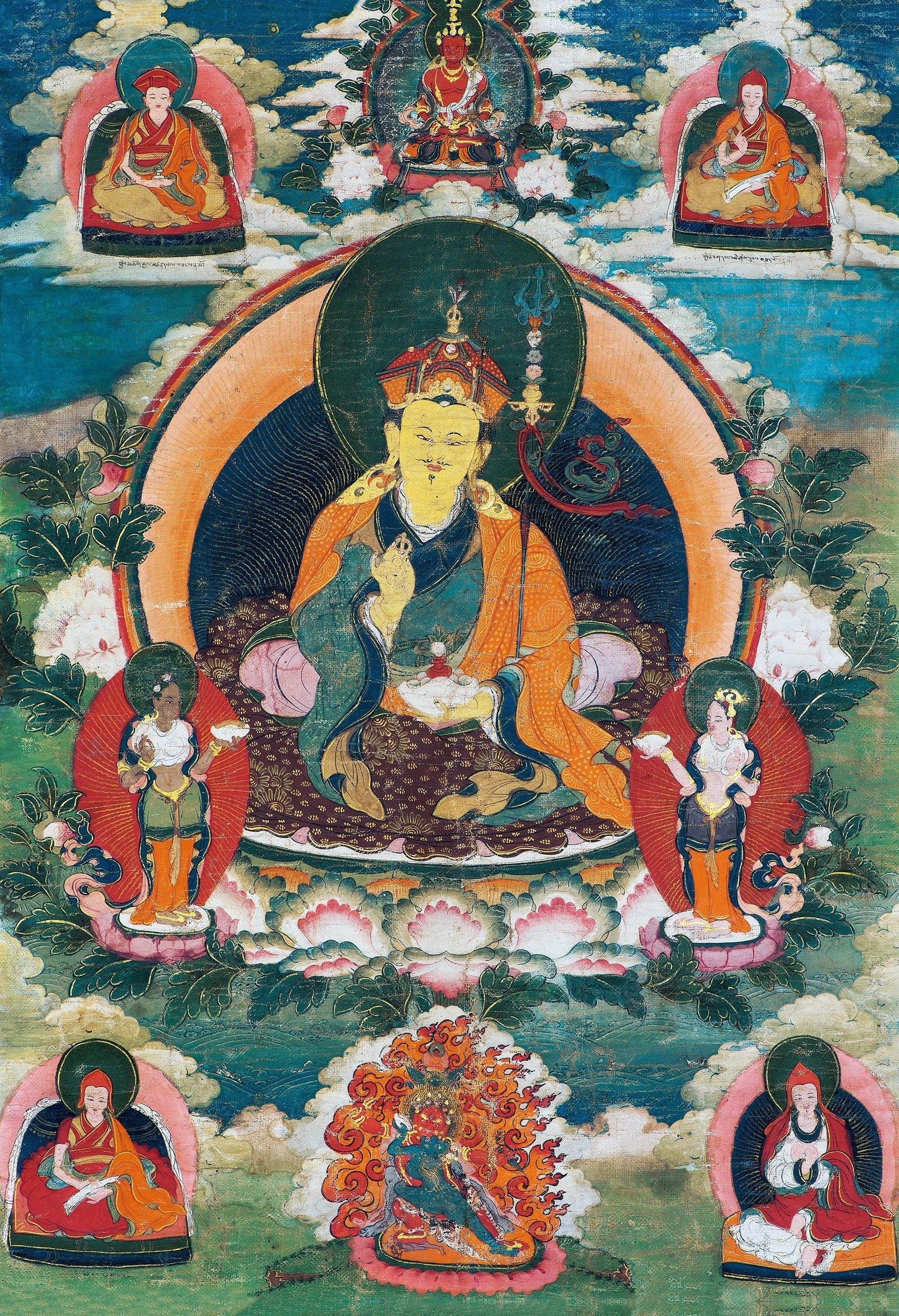
Every detail in a depiction of Padmasambhava is a profound teaching, a map of the enlightened mind. To look upon his image is to receive a direct transmission of wisdom, compassion, and power. He is not merely a historical figure but a living presence, and his sacred iconography is the language through which he communicates the path to liberation. When you see him in a thangka painting or as one of the sacred artifacts in our collection, you are witnessing a complete guide to inner transformation.
Typically, he sits in a posture of royal ease, signifying his mastery over all phenomena, both inner and outer. His face is a blend of peace and intensity, a gaze that sees through all illusion. On his head, he wears the five-petaled lotus hat, representing the five Buddha families and his mastery of their five wisdoms. The hat is topped with a vulture feather, a symbol of the highest view of Dzogchen, the ultimate, non-dual nature of reality.
In his right hand, he holds a five-pronged golden vajra to his heart. The vajra, meaning "diamond" or "thunderbolt," symbolizes the indestructible, unchanging nature of enlightenment. It is the masculine principle of skillful means (*upaya*)—the active, compassionate methods used to guide beings out of suffering. In his left hand, resting in his lap, he holds a *kapala*, a skull cup filled with the nectar of deathless wisdom. This represents the feminine principle of wisdom (*prajna*), the direct realization of emptiness. The nectar signifies the bliss that arises from this realization. The union of the vajra and the kapala signifies the non-dual union of wisdom and skillful means, the core of the Vajrayana path.
Cradled in the crook of his left arm is the *khatvanga*, a trident staff. This is one of his most complex symbols. The three prongs represent the essence, nature, and compassionate energy of the mind. They also symbolize victory over the three poisons: ignorance, attachment, and aversion. The staff is adorned with three severed heads in progressive states of decay, symbolizing his mastery over the three times—past, present, and future—and the three bodies of a Buddha (*trikaya*). The khatvanga is also the secret symbol of his divine consort, Mandarava or Yeshe Tsogyal, representing that he is never separate from the feminine wisdom principle. By understanding this rich visual language, you begin to see that Padmasambhava is not just a figure to be worshipped, but a complete system of practice embodied in a single form.
Real Benefits for Modern Life: Taming Your Inner Demons
The challenges Padmasambhava faced in 8th-century Tibet—hostile spirits, rugged terrain, and deep-seated resistance—are perfect metaphors for the obstacles you face today. Your "demons" may not be mountain gods, but they are just as real: the demon of procrastination that paralyzes your ambition, the demon of anxiety that colonizes your future, the demon of anger that poisons your relationships, and the demon of distraction that fractures your focus. Connecting with the energy of Guru Rinpoche is a direct method for transforming these very energies from obstacles into sources of power.
When you feel overwhelmed by a chaotic mind, his practice provides an unshakeable anchor. The recitation of his mantra, *Om Ah Hum Vajra Guru Padma Siddhi Hum*, is a powerful tool for cutting through mental noise. It's not about silencing your thoughts by force, but about invoking a presence so vast and stable that the chaos naturally subsides, like ripples settling on a deep lake. This is the taming of the demon of distraction. You find the clarity to focus on what truly matters, executing tasks with precision and purpose instead of being pulled in a thousand directions.
For the fiery demon of anger or resentment, Padmasambhava’s energy acts as an alchemical agent. His wrathful manifestations are not expressions of ordinary anger but of fierce compassion—the dynamic, unstoppable energy needed to sever the roots of hatred and ignorance. By visualizing his powerful presence, you learn to meet your own anger with awareness rather than suppression or indulgence. You begin to see the raw energy behind the emotion and, like him, learn to transmute it. The fiery heat of anger, once destructive, becomes the warmth of courage and the passion for compassionate action. This is the path of transformation, not repression. Many find that wearing authentic Tibetan Buddhist jewelry serves as a constant, tangible reminder of this transformative potential.
Perhaps most profoundly, his practice helps you conquer the demon of fear. Padmasambhava is the embodiment of fearless confidence. He entered a hostile land alone, confident in the power of his realization. When you are facing a major life decision, a difficult conversation, or the deep existential fear of uncertainty, invoking his presence instills a profound sense of protection and courage. You begin to trust your own innate wisdom, your "inner guru," to navigate challenges. The obstacles remain, but your relationship to them changes. They are no longer insurmountable walls but opportunities to awaken your own strength, clarity, and compassion.

How to Choose Authentic Padmasambhava Artifacts
When you decide to bring an image of Guru Rinpoche into your life, whether as a statue for your altar, a thangka for your wall, or a piece of jewelry to wear, authenticity is paramount. An authentic piece is not merely a decoration; it is a vessel for sacred presence, a support for your practice, and a connection to a living lineage. Understanding what to look for ensures you are choosing an object that carries true spiritual integrity.
First, pay close attention to the iconography. A properly crafted image will adhere to the strict symbolic proportions and details passed down through generations. Is the vajra five-pronged? Is the khatvanga staff correctly depicted with its three prongs and symbolic heads? Does his expression convey the perfect balance of peace and power? Mass-produced, generic items often miss these subtle yet crucial details, resulting in a form that lacks spiritual vitality. The artisan must know not just *how* to make the object, but *why* each element is the way it is. The intention and understanding of the creator are infused into the creation.
Second, consider the materials. In Tibetan tradition, the materials used are as important as the image itself. Statues are often crafted from copper or bronze and may be gilded with gold, each metal having its own energetic properties. The pigments in a thangka are traditionally made from ground minerals and plants, creating a vibrancy and longevity that synthetic paints cannot replicate. When you explore our curated collection of sacred artifacts, you'll notice the use of genuine turquoise, coral, and lapis lazuli—stones that are not only beautiful but are believed to hold specific healing and protective qualities deeply intertwined with Tibetan culture.
Finally, and most importantly, seek out sources that honor the tradition. An authentic piece is born from a place of reverence. It is created by artisans who are often practitioners themselves, who understand that they are not just making a product but are engaging in a sacred act. This is the profound difference between an item from a factory and a piece from a workshop where mantras may be recited as the work is done. Your intuition is a powerful guide here. A genuine artifact feels alive; it resonates with a quiet dignity and power. It supports your journey not just as a symbol, but as a blessing.
How to Use Padmasambhava's Presence in Your Practice
Inviting the energy of Guru Rinpoche into your daily life is a practical and profound way to accelerate your spiritual journey. You don't need to be an advanced practitioner to begin. The process is rooted in sincerity and repetition, creating a powerful connection that deepens over time. Here is a simple, step-by-step approach to get you started.
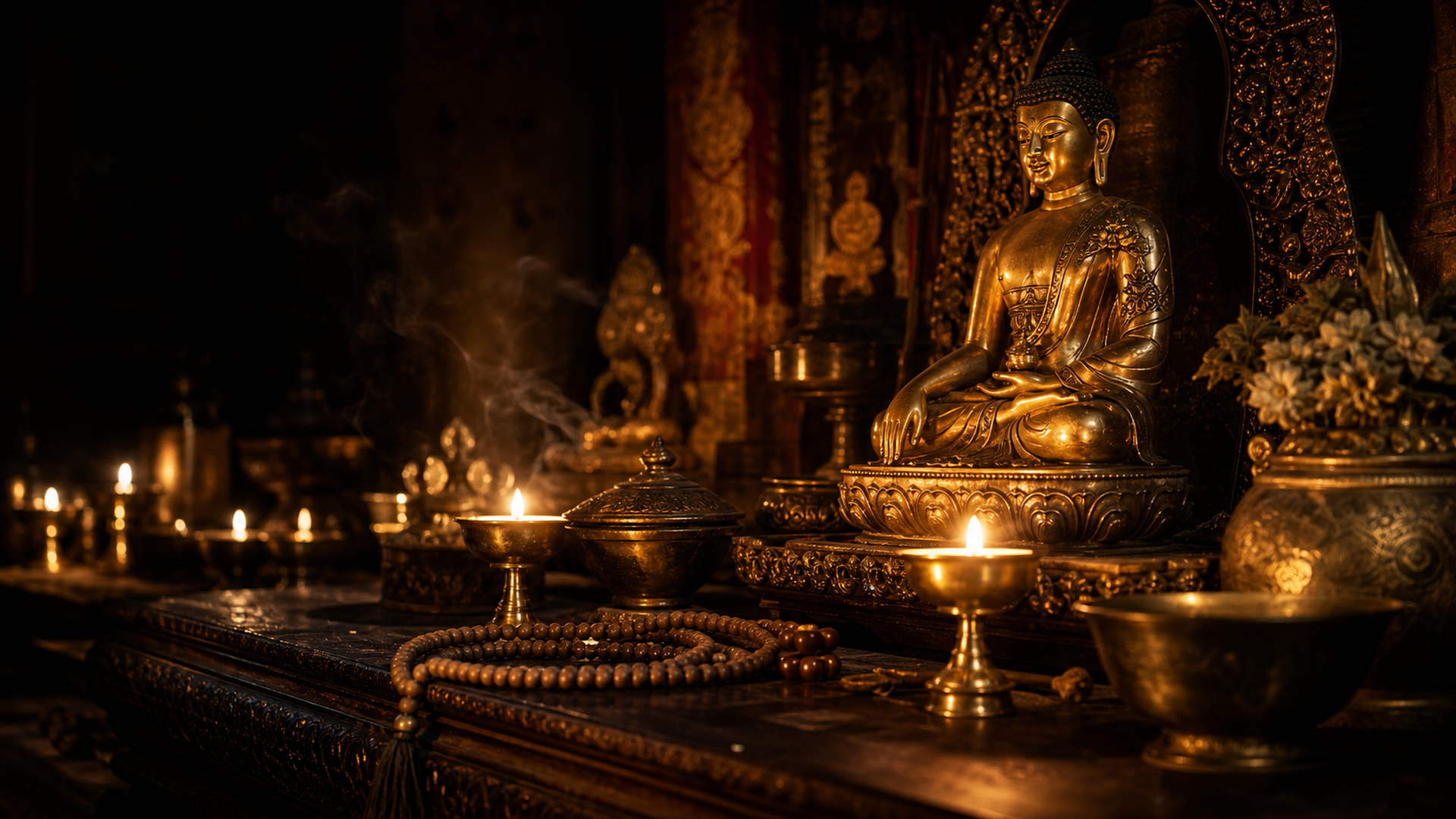
1. **Create a Sacred Space:** Designate a clean, quiet, and respectful place in your home for your practice. It can be a small table, a shelf, or a corner of a room. Place your statue, thangka, or even a framed picture of Padmasambhava here. This space becomes your focal point, a physical anchor that signals to your mind that it is time to turn inward.
2. **Learn the Vajra Guru Mantra:** The heart of Padmasambhava's practice is his mantra: **Om Ah Hum Vajra Guru Padma Siddhi Hum**. This is more than just a string of sounds; it is considered to be his essence in sonic form. * **Om Ah Hum:** Represents the body, speech, and mind of all Buddhas. * **Vajra:** The diamond-like power that cuts through ignorance. * **Guru:** The heavy, profound weight of enlightened qualities. * **Padma:** The lotus, representing purity and compassion. * **Siddhi:** The attainment of spiritual power and blessings. * **Hum:** The seed syllable of enlightened mind, integrating the blessing. Start by reciting it 108 times a day using a mala (prayer beads). As you chant, do so with focus and the intention to clear obstacles and awaken your own inner wisdom.
3. **Practice Simple Visualization:** As you recite the mantra, hold a clear image of Guru Rinpoche in your mind. See him in front of you, radiant and majestic. Imagine brilliant light—white, red, and blue—radiating from his forehead, throat, and heart, and entering your own. This light purifies all your negative karma, clears away illness, and pacifies mental disturbances. Feel his immense compassion and unshakable confidence filling your entire being. This combination of sound (mantra) and sight (visualization) is a powerful method for rewiring your consciousness.
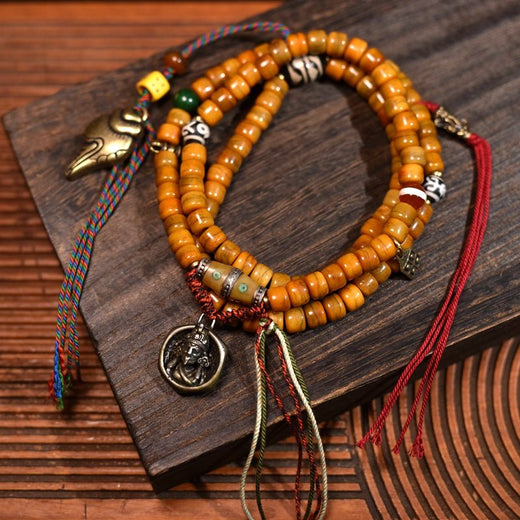
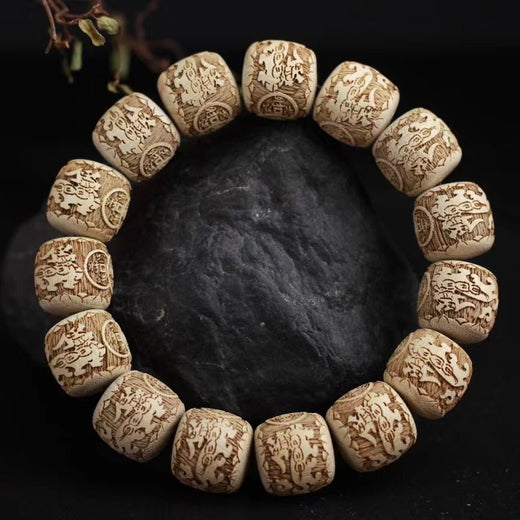
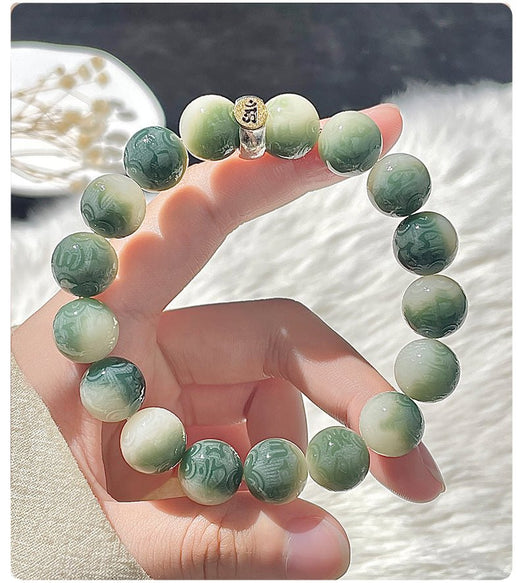
4. **Carry a Reminder:** Throughout your day, it's easy to lose this connection amidst daily responsibilities. This is where a physical object becomes an invaluable tool. Wearing a pendant or bracelet depicting his mantra or seed syllable turns a piece of jewelry into a portable sacred space. Each time you see or feel it, it serves as a gentle nudge, a reminder to return to your center, to breathe, and to recall the fearless, compassionate presence you are cultivating. It bridges the gap between formal practice and everyday life, helping you embody the qualities of the Lotus-Born Master in everything you do. Many find that these powerful symbols become indispensable allies on their path.
Common Questions About Guru Rinpoche
As you delve deeper into the profound world of Padmasambhava, certain questions naturally arise. Here are answers to some of the most common inquiries, designed to bring clarity to your understanding.
1. Is Padmasambhava a Buddha or a historical person?
He is understood as both. Historically, Padmasambhava was a powerful tantric master from the land of Oddiyana who lived in the 8th century and was instrumental in establishing Buddhism in Tibet. Spiritually, within the Tibetan tradition, he is revered as the "Second Buddha," a direct emanation of Buddha Amitabha and an embodiment of the enlightened activity of all Buddhas. He is considered a fully enlightened being who chose to appear in the world to tame its darkest energies and preserve the Vajrayana teachings.
2. What is the literal meaning of his name, "Padmasambhava"?
The name is Sanskrit and translates directly to "Lotus-Born." This refers to his miraculous birth story, where he was discovered as a child seated on a giant lotus flower in the middle of Lake Dhanakosha. This origin story is deeply symbolic, signifying his inherent purity. Just as a lotus grows from the mud but emerges completely unstained, Padmasambhava appears in the world of suffering (*samsara*) but is completely free from its defilements.
3. What are the "terma" treasures he concealed?
Understanding that future generations would face different challenges and possess different capacities, Padmasambhava and his consort Yeshe Tsogyal concealed countless teachings, sacred objects, and medicinal substances throughout the Tibetan landscape. These are known as *terma*, or "hidden treasures." They were hidden in rocks, lakes, caves, and even within the minds of future disciples. These treasures are destined to be revealed at the appropriate time by specific, prophesied masters known as *tertöns* (treasure revealers). This system ensures that the Dharma remains fresh, potent, and perfectly suited to the needs of every era.
4. Why is he sometimes depicted with a wrathful or fierce expression?
The wrathful depictions of Padmasambhava, such as Guru Drakpo, are not expressions of worldly anger. This is "compassionate wrath." It represents the dynamic, powerful, and uncompromising energy required to cut through the deepest layers of ignorance, ego-clinging, and negativity. Think of it as the fierce, focused energy of a surgeon cutting away a disease to save a patient's life. This potent energy annihilates obstacles to enlightenment that cannot be pacified by gentle means alone. It is the ultimate expression of compassionate action.
5. Can non-Buddhists connect with Padmasambhava?
Absolutely. While he is a central figure in Tibetan Buddhism, the universal principles he embodies—courage, transformation of negativity, and the overcoming of obstacles—are accessible to anyone with a sincere heart. You do not need a formal initiation to appreciate his story, recite his mantra, or draw inspiration from his fearless example. The key is your motivation. If your intention is to cultivate inner peace, wisdom, and compassion for yourself and others, his blessing and energy are available to you.
6. What makes the Vajra Guru Mantra so powerful?
The Vajra Guru Mantra (*Om Ah Hum Vajra Guru Padma Siddhi Hum*) is considered the very heart-essence of Padmasambhava. Lineage masters explain that it contains the essence of all the Buddhas, gurus, and deities. Its power lies in its comprehensive nature; it is a vehicle for purification, the accumulation of merit, the removal of obstacles, and the swift attainment of spiritual realization (*siddhi*). Chanting it with faith is said to invoke the immediate presence of Guru Rinpoche himself, making it one of the most revered and widely practiced mantras in the entire Vajrayana tradition.
Your Next Step on the Path
You’ve journeyed through the history, symbolism, and transformative power of Padmasambhava. You've seen how this 8th-century master who tamed the demons of Tibet offers a potent and practical path for taming the inner obstacles you face today. His story is not a myth of the past; it is a living teaching, an invitation to awaken the fearless, compassionate warrior within you. The journey of transformation is not about becoming someone else, but about realizing the enlightened potential that already exists within your own mind.
To walk this path is to have a powerful ally. By connecting with his presence through mantra, visualization, and sacred objects, you are never truly alone in your struggles. Let his image be a mirror reflecting your own innate wisdom. Let his mantra be the sound that cuts through confusion. Let his fearless spirit be the guide that helps you turn every obstacle into a stepping stone toward liberation. Your journey begins with a single, intentional step. We invite you to explore our handcrafted pieces, each one a testament to this profound lineage and a support for your path.

Keep reading