God's Rites
Phurba Vajra: Sacred Dagger for Transformation & Protec
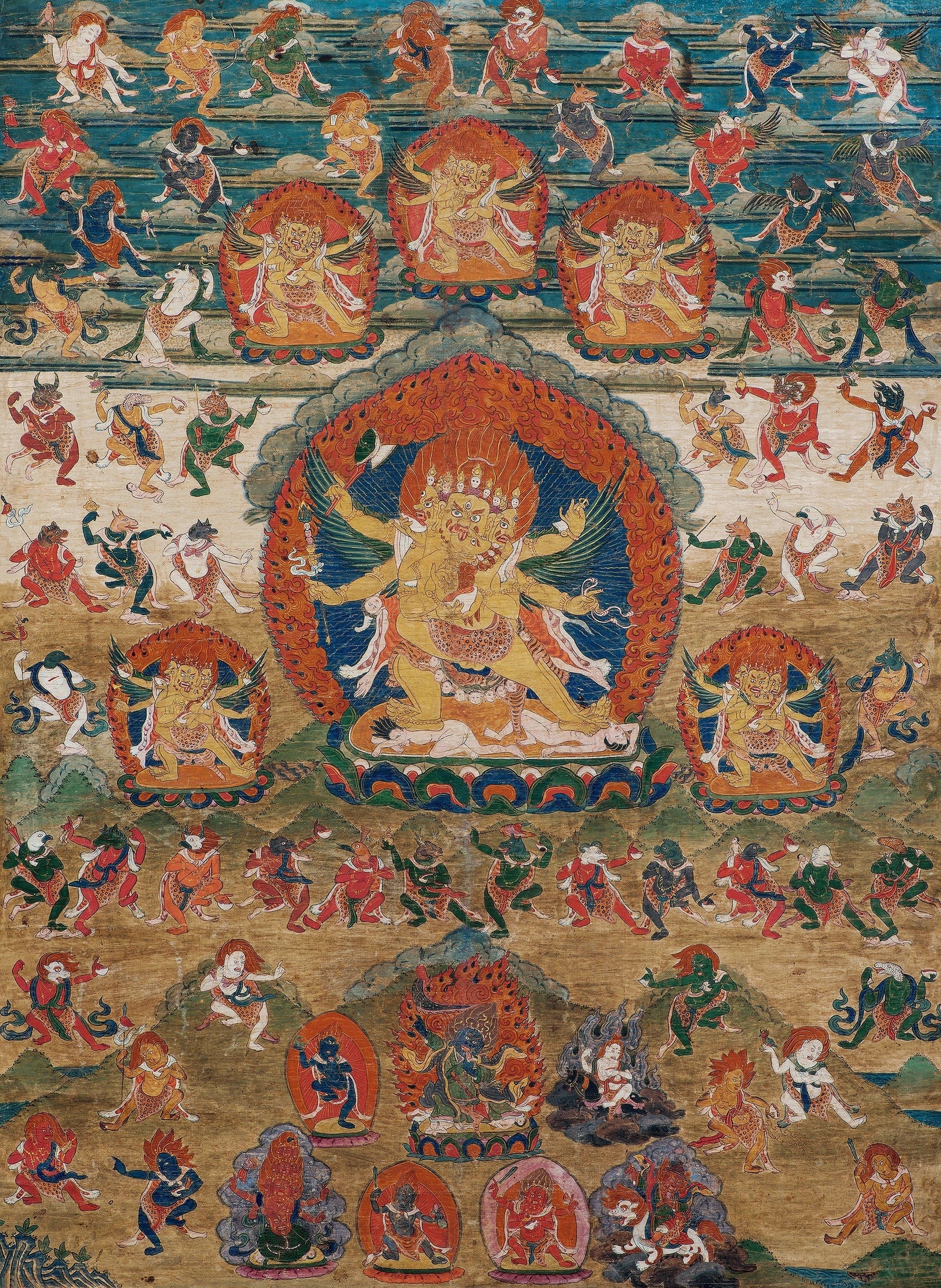
You sit for your practice, the intention clear in your mind, but a familiar static buzzes just beneath the surface. It’s not a distraction from the outside world, but an internal one—a stubborn knot of old energy, a persistent negativity that seems to defy your every effort to dissolve it. You can feel the presence of deeper levels of awareness, a more profound connection that is just out of reach, but something invisible and heavy holds you back. It’s a feeling of being spiritually stuck, tethered by unseen forces you can’t quite name. This very struggle, this sacred ground of your inner world, is precisely where the Phurba Vajra reveals its formidable power. It is not an escape from this battle, but a tool to engage with it directly, to finally name the obstacle, pin it down, and transform its very essence into fuel for your awakening.

What The Phurba Vajra Really Is: An Instrument of Enlightened Power
To truly understand the Phurba, you must journey back in time, beyond the formal monasteries and into the wild, shamanic heart of ancient Tibet. Before the arrival of Guru Padmasambhava in the 8th century, the spiritual landscape was dominated by the Bon tradition, a practice deeply connected to the spirits of the land. The original phurba was a simple, three-sided wooden stake, a ritual tool used by shamans to pin down and appease unruly earth spirits, consecrating the ground for rituals. It was a tool of demarcation, separating the sacred from the chaotic and establishing order.
When the great master Padmasambhava, also known as Guru Rinpoche, brought Vajrayana Buddhism from India to Tibet, he did not simply erase the old ways. Instead, in his profound wisdom, he subsumed and transformed them. The legend of the founding of the Samye Monastery, the very first Buddhist monastery in Tibet (founded circa 775-779 CE), is a perfect illustration. Local deities and energies resisted the construction, undoing the work each night. It was Padmasambhava who, through the ritual of the Phurba, subjugated these forces, binding them by oath to protect the Dharma rather than obstruct it. He demonstrated that the Phurba was not for destruction, but for transformation—a core principle of the Vajrayana path.
In his hands, the humble wooden stake was elevated into the Phurba Vajra. The Sanskrit word is Kila, while Phurba is its Tibetan equivalent. The addition of "Vajra" (Dorje in Tibetan) signifies its true nature: indestructible, diamond-like, and imbued with the lightning-bolt clarity of enlightened mind. The Phurba became the physical embodiment, the very manifestation, of the wrathful activity of the meditation deity Vajrakilaya (Dorje Phurba). When a practitioner wields the Phurba, they are not merely holding an object; they are connecting with the fierce, compassionate energy of Vajrakilaya himself, an energy that cuts through all delusion and obscuration without hesitation. This is why the Nyingma school, the oldest of the Tibetan Buddhist traditions which traces its lineage directly to Padmasambhava, holds the Vajrakilaya teachings and Phurba practice in such high esteem. It is a direct link to the foundational moments of Buddhism in the Himalayas, a tool born from the very earth it was meant to tame.
The Deeper Meaning: Deconstructing the Sacred Dagger
Every millimeter of a Phurba Vajra is saturated with profound symbolism. It is a spiritual technology, a complete map of the path to enlightenment compressed into a single form. To hold one in your hand is to hold a doctrine you can feel, a tangible representation of the forces at play within your own mind. Your understanding of its power deepens when you learn to read its sacred anatomy.
The most crucial element is its three-sided blade. This is no accident of design. Each of the three sharp edges represents one of the three root poisons, or kleshas, that keep us bound to the cycle of suffering: ignorance (the pig), attachment (the rooster), and aversion (the snake). The act of ritually plunging the Phurba into the ground (or a bowl of rice) is the symbolic act of transmuting these poisons. You are not destroying them; you are pinning them to the ultimate ground of reality—emptiness—and transforming their chaotic energy into the enlightened wisdom of the Three Jewels: the Buddha (enlightened potential), the Dharma (the path), and the Sangha (the community). It is a dynamic act of spiritual alchemy.
From the blade emerges the fierce mouth of a Makara, a mythical aquatic creature symbolizing unstoppable, tenacious power. The blade coming from its mouth signifies that the activity of the Phurba is potent and unyielding. Above this, you find the handle, or hilt. This central part is often crowned with three wrathful faces, which can represent the deity Vajrakilaya himself. These three faces are a mirror of the three blades below; they are the enlightened expression of the transformed poisons. They also symbolize the three Kayas, or bodies of a Buddha: the Dharmakaya (the body of truth, formless like space), the Sambhogakaya (the body of enjoyment, radiant and energetic), and the Nirmanakaya (the body of manifestation, appearing in the world out of compassion). The wrathful expression isn't anger; it is fierce, loving compassion that refuses to let you indulge in your own self-deception.
At the very top, the Phurba is often capped with a half or full Vajra, or sometimes the head of the horse-headed deity Hayagriva, who adds his own power of subjugation over the subtle realm. The Vajra on top reinforces the ultimate nature of the tool—its connection to indestructible truth and primordial purity. The intricate knots you often see, typically the endless knot, woven around the handle symbolize the interconnectedness of all things and the unending nature of the Buddha's teachings. When you grasp a Phurba, you are holding a tool that connects the highest principle (the Vajra of enlightenment) to the lowest poison (the blade of ignorance) and provides the means to unite them through transformative action.
Real Benefits for Your Modern Life: Beyond the Ritual
You might wonder how such an ancient and esoteric tool can find relevance in your contemporary life. The "demons" the Phurba was designed to subdue are not just mythical creatures in ancient texts; they are the very real, very modern obstacles that hinder your growth, peace, and clarity. The power of the Phurba lies in its ability to help you externalize, confront, and transform these inner saboteurs.
Consider the feeling of a creative or professional block. This is a modern demon. It's the voice of self-doubt, the paralysis of procrastination, the fear of failure. When you engage with a Phurba, you are given a powerful method to address this. You can define this block as the "entity" to be subdued. The ritual provides a focal point for your intention, allowing you to gather your scattered mental energy and "pin down" the inertia. It helps you cut through the mental fog and create a clear space from which to act. This is not magical thinking; it is a profound psychological and spiritual practice for reclaiming your power.
The Phurba is also an unparalleled tool for space clearing. Your home, your office, your meditation corner—these spaces can accumulate stagnant or disruptive energy. This isn't just about bad vibes; it's about the psychic residue of stress, arguments, or persistent anxiety. Using the Phurba to ritually define and purify your space helps to establish strong energetic boundaries. It creates a stable, consecrated environment where you feel safe, focused, and supported, making your spiritual practice or creative work far more effective. You are consciously claiming your space as sacred ground, impenetrable to external negativity.
Perhaps its most potent application is in working with your own negative thought patterns. We all have them: the recurring loop of anxiety, the flash of anger, the sting of jealousy. These are the three poisons in modern dress. The Phurba serves as your physical anchor and reminder. When you feel a destructive pattern arising, you can hold the Phurba, recalling its purpose. You can visualize the negativity, give it form, and perform the inner ritual of transformation. This practice helps you dis-identify from the emotion. You are no longer "angry"; you are the one who is witnessing and transforming the energy of anger. This is a direct path to emotional freedom and resilience, and many find that exploring sacred objects from the Himalayan tradition provides them with tangible allies on this path.

How to Choose an Authentic Phurba Vajra
When you decide to bring a Phurba into your life, choosing the right one is a crucial part of the journey. An authentic Phurba is more than a decorative object; it is a potent spiritual instrument. Your connection to it matters, and its quality will directly impact its energetic feel. Here are the key elements to consider in your search.
First, pay close attention to the material. Traditionally, Phurbas were crafted from materials believed to have specific potencies. The most prized is meteoric iron, known as thokcha or "sky-metal." This material is believed to carry the power of the cosmos, making it exceptionally powerful for ritual use. More commonly, you will find them skillfully made from bronze, brass, copper, or various types of wood like sandalwood. Each material has a different weight, feel, and resonance. There is no single "best" material; the right one is the one that feels correct and alive in your hand.
Next, examine the craftsmanship. A true ritual Phurba is crafted with intention by an artisan who understands its sacred geometry and symbolism. Look for clarity and precision in the details. Are the three faces on the hilt distinct and powerful? Is the Makara well-defined? Is the three-sided blade symmetrical and sharp in its form? Avoid cheaply mass-produced, molded items where the details are blurry or indistinct. The energy of the maker is imbued in the object, and you want a Phurba that has been created with meditative focus and reverence. When you discover our handcrafted spiritual tools, you can see the difference that dedicated artistry makes.
Finally, and most importantly, trust your intuition. As you look at different Phurbas, one will likely speak to you more than others. You might feel a subtle vibration, a sense of rightness, or a magnetic pull. This is your intuition guiding you to the tool that is meant for your practice. Hold it if you can. Feel its weight, its balance. Your personal connection is the final and most vital element of authenticity. The Phurba is an ally, and you should feel a sense of resonance and partnership with the one you choose.
How to Use Your Phurba: A Practice for Transformation
It is essential to approach the Phurba with respect and a clear understanding of its purpose. In the Vajrayana tradition, the full ritual use of a Phurba requires an empowerment (wang), oral transmission (lung), and specific instructions from a qualified lama. This is because its deepest power is unlocked within the context of the Vajrakilaya practice. However, you can still engage in a powerful and beneficial basic practice to clear obstacles and consecrate your space without being a formal initiate.
Begin by finding a quiet space where you will not be disturbed. Hold your Phurba in your right hand (the hand of skillful means), gripping it firmly by the hilt. Take a few deep breaths to center yourself. First, set your intention. What is the specific obstacle you wish to transform? Is it a persistent fear, a creative block, a negative habit? Be as clear as possible. Visualize this obstacle in front of you. You can see it as a dark shape, a tangled knot, or even give it a symbolic form.
Next, you can generate a sense of your own inner power. You don't need to visualize a complex deity, but you can imagine a radiant, powerful light filling your entire body, a manifestation of your own innate wisdom and compassion. Feel this energy flow down your arm and into the Phurba, making it glow with power. Raise the Phurba above your head, then bring it down with force, as if you are plunging it into the obstacle before you. You can physically thrust it downwards towards the floor or into a bowl of rice or salt, which is traditionally used to represent the earth.
As you perform this action, you can chant a mantra like OM AH HUM to purify, or the powerful syllable PHAT! (pronounced "pet") which is a sound of cutting through delusion. As the Phurba "pins" the obstacle, visualize it being utterly subdued. But this is not an act of destruction. The crucial final step is to visualize the pinned obstacle dissolving. See it transform from a dark, heavy form into pure, brilliant light. Its energy is not annihilated but liberated, transformed into wisdom, compassion, or creative power. Conclude by dedicating the merit of your practice, wishing that all beings may be free from their own inner obstacles.
Explore the Six-Armed Mahakala pendant.
Common Questions About the Phurba Vajra
Is a Phurba a weapon?
No. While it has the appearance of a dagger, a Phurba is never used to cause physical harm. It is a spiritual instrument, a ritual tool. Its "enemy" is not a person or physical being, but rather the internal enemies: ignorance, attachment, and hatred. It is a weapon against the ego and the delusions that cause suffering, not against sentient beings.
Do I need to be a Buddhist to own or use a Phurba?
You do not need to be a formal Buddhist to appreciate the Phurba's symbolism or to use it for basic practices like space clearing and setting intentions. Its power to focus the mind and work with energy is universal. However, to unlock its deepest layers of meaning and engage in the specific deity practices associated with it, such as the Vajrakilaya sadhana, requires transmission and guidance from a qualified teacher within the Tibetan Buddhist tradition.
What is the difference between a Phurba and a Vajra?
A Vajra (or Dorje) is a symbolic ritual object that represents both a thunderbolt (irresistible force) and a diamond (indestructibility, purity). It symbolizes the nature of reality itself—emptiness. A Phurba is a specific type of ritual tool that incorporates the qualities of the Vajra. You can think of the Vajra as representing the ultimate nature, and the Phurba as representing the fierce, compassionate *activity* that cuts through whatever obscures that nature. Many Phurbas are even topped with a Vajra to signify this connection.
How should I care for my Phurba?
You should always treat your Phurba with respect. When not in use, it should be kept in a clean, high place, such as on your altar or a dedicated shelf. It is traditional to wrap it in a clean cloth, often silk or cotton, to protect it. It should never be placed on the floor or in a low or unclean place. Regularly cleaning it with a soft cloth and cleansing its energy with incense smoke is a good practice.
Why is the Phurba blade always three-sided?
The three-sided blade is one of its most defining and non-negotiable features. Each side directly corresponds to one of the three root poisons (kleshas): moha (ignorance/delusion), raga (attachment/desire), and dvesha (aversion/hatred). The act of using the Phurba is a symbolic method for transforming these three fundamental causes of suffering into their enlightened wisdom counterparts.
Can I wear a Phurba as jewelry?
Yes, absolutely. Small Phurbas are often made into pendants and worn as powerful amulets. Wearing a Phurba amulet serves as a constant source of protection, warding off negative influences and inner obstacles. It also acts as a potent reminder of your own innate power to cut through delusion and transform challenges into wisdom throughout your day. It keeps the energy and intention of this sacred tool close to your heart.
Your Next Step on the Path of Transformation
The Phurba Vajra is far more than a beautiful artifact from a distant culture. It is a living symbol of your own capacity for profound transformation. It is a declaration that you are not helpless in the face of your inner obstacles—your fears, your doubts, and your destructive patterns. You have the power to meet them, to pin them down with unwavering awareness, and to liberate the powerful energy they contain for your own awakening. This sacred dagger is a reminder that the most profound spiritual work is an active, courageous, and sometimes fierce engagement with your own mind.
Your journey of transformation is deeply personal, and the right ritual tool can become a trusted companion and powerful ally. If you feel the call to invite this potent symbol of liberation into your life and practice, we invite you to explore our complete array of authentic Buddhist artifacts. Each piece in our collection is chosen not just for its beauty, but for its spiritual integrity, ready to support your path.
Keep reading