God's Rites
Meet Vajrakīlaya: Padmasambhava’s Wrathful Vajra for Tr
You sit in quiet meditation, but your mind is a storm. A project deadline looms, a difficult conversation replays on a loop, a persistent self-doubt whispers that you aren't enough. You try to let the thoughts pass like clouds, as you’ve been taught, but today they are a thick, unmoving fog. It feels less like a spiritual path and more like a battle against an invisible tide of obstacles, both internal and external. This feeling of being stuck, of being energetically and emotionally pinned down by forces you can't quite grasp, is a deeply human experience. What if you had a tool not just for passive observation, but for decisive, compassionate action? What if you could access an energy that doesn't just bypass obstacles, but utterly transforms them at their root? This is the domain of Vajrakīlaya, the wrathful embodiment of enlightened activity. He is the diamond-like, indestructible force that you can call upon to cut through the very fabric of what holds you back, turning poison into medicine.

What It Really Is: The Adamantine Dagger of Liberation
To truly understand Vajrakīlaya, you must travel back in time to 8th-century Tibet. The great master Padmasambhava, also known as Guru Rinpoche, had been invited by the Tibetan King Trisong Detsen to help establish Buddhism in the Land of Snows. The task was monumental. The local energies, deities, and demonic forces were hostile to this new spiritual path, actively obstructing the construction of the first monastery, Samye Ling. Every day, workers would build the walls, and every night, malevolent spirits would tear them down. Progress was impossible.
Recognizing that a powerful antidote was needed, Padmasambhava journeyed to the Asura Cave at Yangleshö, in present-day Pharping, Nepal. There, he engaged in intensive retreat on the tantra of Yangdak Heruka with his consort, the princess Shakyadevi. Yet, powerful demonic forces, the *gyalpo* and *senmo* spirits, continued to create obstacles, preventing him from attaining realization by causing drought, famine, and disease. Padmasambhava sent messengers to India requesting a specific text: the *Vajrakīlaya Tantras*. As soon as the sacred texts arrived at Yangleshö, the obstacles were immediately pacified. Through the practice, Padmasambhava manifested the form of Vajrakīlaya, the wrathful heruka, and subdued all negative forces, binding them by oath to protect the Dharma forever. He then traveled to Tibet, where he used this same practice to overcome the spiritual resistance and successfully establish Samye, the unshakable heart of Tibetan Buddhism.
Vajrakīlaya, therefore, is not a mere myth. In the Nyingma or "Ancient" school of Tibetan Buddhism, he is a primary *yidam*, or meditational deity. A yidam is a fully enlightened being who serves as a personal guide and a profound method for your own transformation. The practice of Vajrakīlaya belongs to the Mahayoga class of tantras, which focus on rapid and powerful transformation of consciousness. The deity is the living embodiment of the *phurba* (in Tibetan) or *kīla* (in Sanskrit)—the three-sided ritual dagger. When you see a phurba, you are not just looking at a ritual object; you are seeing the physical form, the enlightened activity, of Vajrakīlaya himself. This is the tool that Padmasambhava used to pin down and transmute the ego-clinging and negativity that stood in the way of liberation for all beings in Tibet. It is a direct lineage of power, passed down from master to student, for cutting through the deepest roots of suffering.
The Deeper Meaning: Wrathful Compassion in Action
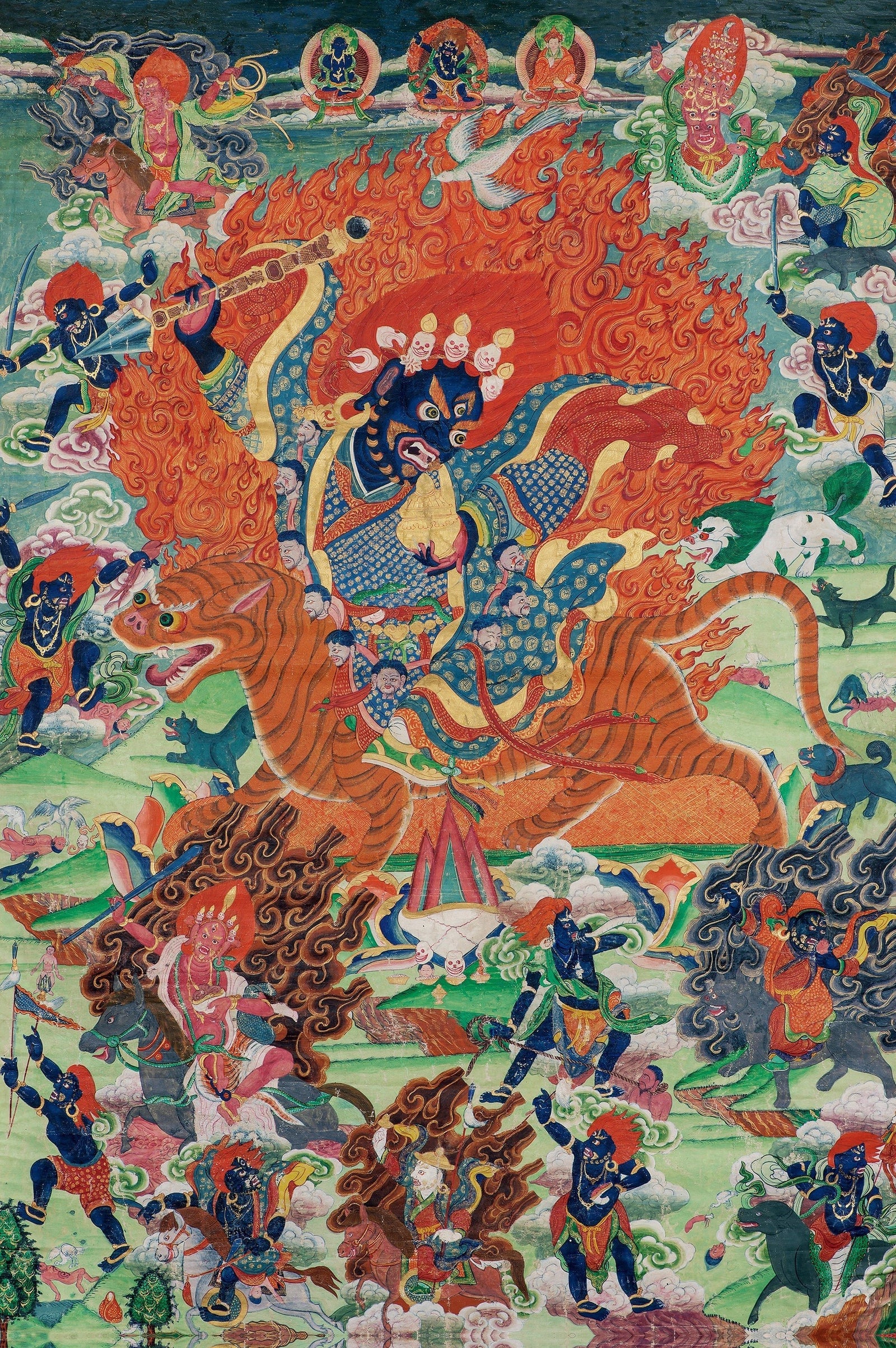
At first glance, the iconography of Vajrakīlaya can be startling. He is depicted as a fierce, powerful figure, often with a dark blue body symbolizing the unchanging nature of reality, or *dharmakaya*. He has three faces, each with three eyes, seeing through the illusions of past, present, and future. The right face is white, symbolizing the pacification of confusion. The left is red, magnetizing all enlightened qualities. The central face is blue, representing the wrathful subjugation of all obstacles. His six arms hold potent symbols: the highest pair holds a five-pronged and a nine-pronged vajra, representing the union of method and wisdom from the two primary classes of tantra. Another pair rolls the phurba, the ritual dagger that is his very essence, demonstrating his power to transfix all delusion. The final pair holds a flaming trident and a wish-fulfilling jewel. He is often depicted in union with his consort, Diptacakra, symbolizing the indivisible unity of skillful means and wisdom.
The key to understanding this imagery is the concept of "wrathful compassion." This is not the ordinary, destructive anger born of ego and frustration. It is the fierce, uncompromising, and dynamic energy of love. Imagine a loving parent who must forcefully pull a child away from a busy street. The action is swift, powerful, and may appear harsh, but its root is pure, protective compassion. Vajrakīlaya's wrath is the energy of enlightened mind that refuses to let you or any other being remain trapped in the cycle of suffering. It doesn't negotiate with your self-doubt, your addictions, or your fear. It cuts through them with the precision of a surgeon's scalpel.
The phurba itself is a universe of meaning. Its three-sided blade represents the transformation of the three root poisons (*kleshas*): ignorance, attachment, and aversion. As the blade pierces the ground (or an effigy in ritual), it symbolically pins down the ultimate source of all suffering: ego-clinging. It nails the illusion of a separate self to the ground of ultimate reality, liberating the energy trapped in that illusion. The blade emerges from the mouth of a Makara, a mythical sea creature, symbolizing unstoppable, ferocious energy. The handle is often a vajra, representing indestructible reality, or an endless knot, for interconnectedness. At the very top, you will find the three faces of Vajrakīlaya himself, the source of the phurba's power. Holding a phurba is to hold the very activity of enlightenment in your hand, a constant reminder that you have the capacity to cut through any and all confusion. Many of these powerful symbols are meticulously crafted into wearable art, serving as a constant connection to this profound meaning.
Real Benefits for Modern Life: A Spiritual Tool for Inner Obstacles
You may not be building a monastery in 8th-century Tibet, but your life is filled with its own set of "demons" and obstacles. These are not external spirits, but the internal patterns of thought and emotion that sabotage your peace and progress. This is where the energy of Vajrakīlaya becomes an intensely practical and relevant ally.
Consider the persistent voice of anxiety that paralyzes you before a major decision. Or the cycle of procrastination fueled by a deep-seated fear of failure. These are the modern-day hostile forces. The practice and symbolism of Vajrakīlaya offer you a method to stop negotiating with them and instead, to decisively cut them off at the root. By focusing on the phurba, you are engaging a powerful psychological archetype. You are externalizing the obstacle and applying a focused, unyielding intention to overcome it. It’s not about suppression; it’s about transformation. The energy tied up in your anxiety, when liberated, becomes potent, clear-sighted awareness.
This practice also helps you establish profound spiritual and emotional boundaries. In a world of constant digital noise, emotional demands, and the subtle negativity of others, it's easy to feel porous and unprotected. The energy of Vajrakīlaya is like creating an adamantine shield around your mind. It doesn't make you callous or uncaring. Instead, it gives you the stability and clarity to engage with the world from a place of strength, not reactivity. You become less susceptible to being thrown off balance by external chaos because your inner center is secure. It allows you to say a compassionate "no" to what drains you, so you can offer a powerful "yes" to what truly matters.
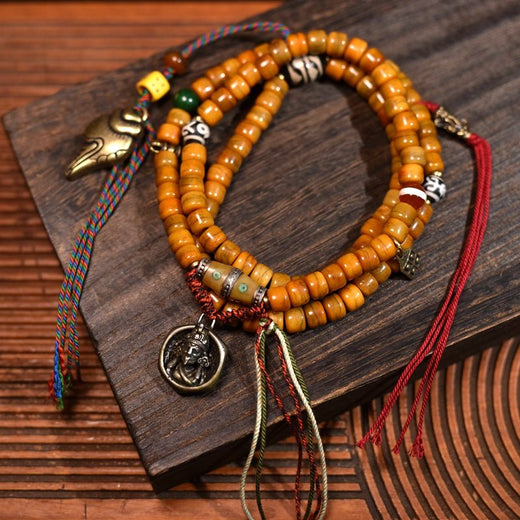
Finally, engaging with this energy helps you transmute your own anger. Most of us are taught that anger is a negative emotion to be avoided or suppressed. The Vajrayana path teaches that anger is simply powerful energy. When it is corrupted by ego, it becomes destructive. But when you purify it, that same raw power becomes the engine of compassionate action—the focused determination to change things for the better, to protect the vulnerable, and to tear down systems of injustice, both internal and external. Vajrakīlaya teaches you not to fear your own power, but to harness it with wisdom for the benefit of all. You can discover authentic Tibetan Buddhist jewelry that embodies this transformative power, serving as a daily reminder of your own innate strength.

How to Choose an Authentic Phurba
When you decide to bring a phurba into your life, whether for an altar, for meditation, or as a powerful symbolic object, choosing an authentic piece is crucial. An authentic phurba is more than a decoration; it is a spiritual instrument crafted with intention and a deep understanding of its sacred geometry and purpose. Your connection to the object is paramount, and its quality will support that connection.
First, consider the materials. Traditionally, phurbas are made from a range of substances, each with its own energetic significance. The most prized material is meteoric iron, known in Tibetan as *thokcha* or "sky iron." This metal from the heavens is believed to possess immense celestial power and protective qualities. Other traditional materials include sandalwood, known for its purifying scent and connection to divine realms, as well as various metals like bronze, copper, brass, and silver. The material should feel substantial and resonant to you.
Next, examine the craftsmanship. Look closely at the details. A genuine, artisan-crafted phurba will show a level of care and precision that mass-produced items lack. Are the three faces of Vajrakīlaya at the top clearly defined and expressive? Is the Makara head from which the blade emerges intricately carved? Is the vajra or endless knot on the handle well-proportioned? Artisans, particularly from traditional centers of craft like Patan and Bhaktapur in Nepal, carry a lineage of knowledge. They don't just replicate a shape; they understand the sacred proportions and imbue the object with spiritual intention. When you explore our curated collection of authentic ritual items, you are connecting with this unbroken lineage of craftsmanship and devotion.
Finally, trust your intuition. Hold the phurba if you can, or spend time looking at detailed images. Does it feel balanced? Does it evoke a sense of focused power and stability? An authentic phurba is a conduit for the energy of Vajrakīlaya. The right one for you will resonate with your own spiritual aspirations. It should feel less like an object you own and more like an ally you are meeting. It is this personal connection that activates its true potential as a tool for your transformation.
How to Use It: Connecting with the Energy of Transformation
It is essential to state that engaging in the full tantric practice of Vajrakīlaya requires empowerment (*wang*), scriptural transmission (*lung*), and instruction (*tri*) from a qualified and authentic lama. This is a profound and complex path that should not be entered into lightly. However, you can still form a respectful and beneficial connection with the energy of the phurba as a support for your meditation and spiritual journey, even without formal initiation.
When you first acquire your phurba, you should consecrate it. This is an act of clearing away any residual energies from its creation and transport and dedicating it to your practice. You can do this simply by passing it through the smoke of purifying incense like juniper or sandalwood while reciting a mantra such as OM AH HUM. As you do this, visualize that all impurities are cleansed and the phurba is filled with the radiant light of enlightened wisdom.
Place the phurba on your altar or in a clean, respectful place where you meditate. It can be laid flat or stood upright in a bowl of rice or grain. It serves as a powerful focal point, a constant reminder of the indestructible, compassionate energy available to cut through delusion. Before your meditation session, you can hold the phurba in your right hand. Feel its weight, its coolness, its solidity. Bring to mind a specific internal obstacle you are working with—a persistent fear, a negative habit, or a limiting belief.
Then, you can engage in a simple visualization. Imagine the obstacle as a dark, tangled knot of energy in your heart center. As you hold the phurba, see it glowing with brilliant, diamond-like blue light. Recite the Vajrakīlaya mantra: **OM BENZA KILI KILAYA SARWA BIGHANAN BAM HUNG PHAT**. Visualize the phurba's light piercing directly into the center of that tangled knot. The knot doesn't just break; it dissolves completely, its dark energy transformed into radiant, open awareness. Rest in that feeling of clarity and freedom. This practice, done consistently, can be a potent way to work with your mind and to find your own sacred tool for liberation among our offerings.
Explore the Vajrakilaya amulet.
Common Questions About Vajrakīlaya and the Phurba
1. Is Vajrakīlaya a demon or an evil deity?
Absolutely not. This is a common misunderstanding due to his wrathful appearance. Vajrakīlaya is a fully enlightened Buddha, an embodiment of the compassionate activity of all enlightened beings. His "wrath" is not ordinary anger; it is the powerful, uncompromising energy of wisdom that destroys illusion and suffering for the benefit of all. He is a protector and a guide, a fierce expression of ultimate love.
2. Do I need to be a Buddhist to own or use a phurba?
You do not need to be a formal Buddhist to appreciate the phurba as a powerful symbolic object. Anyone can use it as a focal point for meditation on overcoming obstacles and cultivating inner strength. However, to engage in the specific ritual practices and visualizations of the Vajrakīlaya tantra, it is necessary to receive teachings from a qualified teacher within the tradition. Owning one respectfully is a way to connect with this profound stream of wisdom.
3. What's the difference between a phurba and a kīla?
There is no difference in the object itself; the names simply come from two different languages. *Kīla* is the original Sanskrit term for the ritual dagger or stake. *Phurba* is the Tibetan pronunciation and the term most commonly used in the context of Tibetan Buddhism. They refer to the same sacred implement.
4. Can I wear a phurba as a pendant?
Yes, many practitioners and followers of the Dharma wear small phurbas as pendants. A phurba pendant acts as a powerful protective amulet, warding off negative energies and obstacles. It also serves as a constant, wearable reminder of your own inner capacity to cut through delusion and to remain centered in your intention. You can explore many such sacred items when you browse the full collection.
5. What is "sky iron" (thokcha) and why is it so special?
*Thokcha* is iron that has been sourced from meteorites that have fallen to earth, primarily on the Tibetan plateau. For centuries, Tibetans have considered this metal to be sacred. It literally comes from the heavens and is believed to carry the power and blessings of the cosmos. A phurba made from thokcha is considered exceptionally potent for ritual practice, combining the symbolism of the dagger with the celestial energy of its material.
6. How should I care for my phurba?
You should always treat your phurba as a sacred object, not a common tool. Store it in a clean, high place, such as on an altar or wrapped in a clean cloth like a kata (ceremonial scarf). Avoid placing it on the floor or in a dirty place. You can clean it periodically with a soft, dry cloth. More important than physical cleaning is the respect and pure intention with which you handle it, as this maintains its spiritual integrity.
Your Next Step on the Path of Transformation
Vajrakīlaya and the phurba are not relics of a distant past. They are a living stream of wisdom and power, offering you a direct method for engaging with the most stubborn obstacles on your spiritual path. This is not about waging war, but about waking up. It is the practice of fierce, unwavering compassion for yourself and others—a commitment to cut through the confusion that creates suffering. By understanding the phurba's symbolism and connecting with its energy, you are tapping into the same enlightened activity that Padmasambhava used to illuminate the Land of Snows.
This journey is about recognizing that the ultimate power to overcome all obstacles already resides within you. The phurba is the key that unlocks it. It is a reminder that your true nature is as indestructible as a diamond. We invite you to explore this profound symbolism further and find the sacred instrument that resonates with your path. Your journey of transformation awaits.
Discover the instrument of your liberation in our complete collection of authentic Tibetan treasures.
Keep reading