God's Rites
White Jambhala Thangka: Wise Wealth & Prosperity Deity
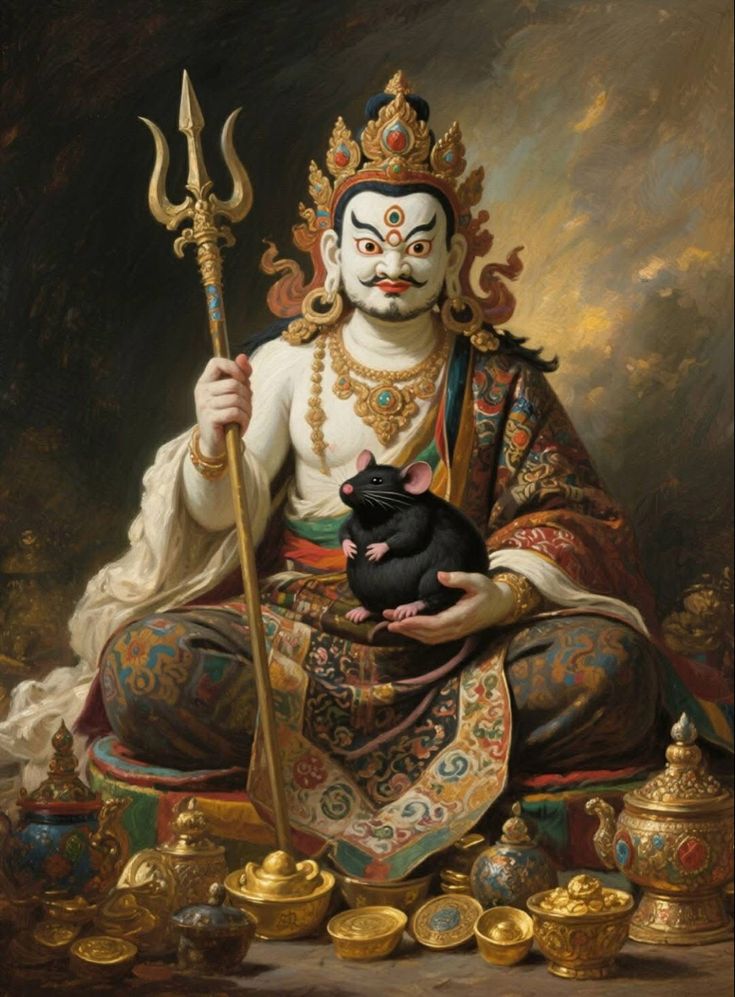
You’ve poured your heart into your work, making choices guided by integrity and a genuine desire to contribute something meaningful. Yet, a subtle but persistent friction remains. There’s the constant pressure of financial obligations, the low-grade anxiety that your material resources don’t quite match the scale of your aspirations. It can feel like a contradiction—how do you cultivate inner peace and generosity when you’re constantly worried about keeping the lights on? This isn't about a craving for luxury; it's about the fundamental need for a stable foundation from which to practice, to give, and to grow. You sense there must be a way to harmonize your spiritual values with your material reality, to transform financial struggle into a flow of effortless abundance that supports not just yourself, but others. This is the very space where the practice of White Jambhala arises, not as a deity of mere riches, but as a profound guide for healing your relationship with wealth and aligning it with the path of compassion.

What It Really Is: The Sacred Origins of a Compassionate Benefactor
To truly understand a White Jambhala thangka, you must look far beyond the surface of a beautiful painting. This is not simply a decorative item; it is a sacred technology, a portal to a specific stream of enlightened energy that has flowed through centuries of dedicated practice. The story of White Jambhala, or Jambhala Karpo in Tibetan, is deeply woven into the fabric of Mahayana and Vajrayana Buddhism. He is not a worldly god to be petitioned for lottery wins, but a powerful Bodhisattva—an enlightened being who has postponed his own complete nirvana out of immense compassion to help all sentient beings.
His origin is sublime and points directly to his ultimate purpose. According to the sutras, White Jambhala manifested from the right eye of Avalokiteshvara (Chenrezig), the Bodhisattva of Compassion. This is a critical point. His essence is not greed, but pure, active compassion. He saw that beings in this world were so afflicted by the suffering of poverty—the constant struggle for survival, the illness, the hunger—that they had no time, energy, or mental space to practice the Dharma. Their spiritual potential was being crushed by material hardship. In a profound act of compassionate will, he emanated as a wealth deity to specifically alleviate this form of suffering, creating the necessary conditions for spiritual practice to flourish.
The practice was transmitted from India to Tibet during the "second diffusion" of Buddhism, most notably through the great Indian master Atisha Dipankara (982–1054 CE). When Atisha traveled from the renowned Vikramashila Monastery in India to Tibet, he brought with him a wealth of teachings, including the potent sadhanas (meditation practices) of the Five Jambhalas. The Kadam school, which he was instrumental in founding, held these practices in high esteem. They understood that for a monastic institution or a lay community to thrive and be a beacon of the Dharma, it needed material stability. The practice of White Jambhala became a cornerstone for ensuring that resources were available to print scriptures, build temples, and support practitioners on their path. From the Kadam tradition, the practice was absorbed and amplified by all schools of Tibetan Buddhism, particularly the Gelug school, flourishing in the great monastic universities like Drepung and Sera. This is why when you engage with an authentic thangka, you are connecting to an unbroken lineage of realization stretching back over a millennium, from the heart of India to the highest plateaus of Tibet. It is a tradition grounded in history, place, and profound purpose, embodied in every sacred brushstroke of these consecrated works of spiritual art.
The Deeper Meaning: Decoding the Sacred Iconography
Every element on a White Jambhala thangka is a precise and powerful symbol, a piece of visual grammar that communicates the nature of his enlightened activity. When you learn to read this sacred imagery, the thangka transforms from a static picture into a dynamic field of wisdom and blessing. Your mind is given a direct map to connect with the qualities of abundance, generosity, and spiritual power that White Jambhala embodies.
At the center, you see his form, radiant and brilliantly white. This color is not incidental; it symbolizes the pacification of negative conditions. White is the color of purity, capable of cleansing illness, dispelling karmic obstacles, and calming the afflicted mind. His body is powerful and dynamic, signifying his active engagement with the world to alleviate suffering. While sometimes depicted with a slightly wrathful expression, this is not anger. It is the fierce, focused energy of compassion, the power required to cut through the deep-seated inner knots of scarcity and fear. He sits astride a magnificent turquoise-green dragon or, more traditionally, a snow lion. The snow lion is a mythical beast of the high Himalayas, a symbol of fearlessness and the unshakeable confidence of an enlightened mind. Its roar is said to be the sound of emptiness itself, silencing all ego-based delusion. By riding this creature, Jambhala demonstrates his complete mastery over the phenomenal world.
In his right hand, he often holds a victory banner (dhvaja), representing the complete triumph of the Dharma's wisdom over the forces of ignorance and disharmony. In his left hand, he cradles a mongoose, or nakula. This is perhaps his most famous attribute. In ancient India, the mongoose was seen as the enemy of the snake (naga), and nagas were considered the mythological guardians of subterranean treasures and wealth. The mongoose, therefore, symbolizes Jambhala’s power to subdue the nagas and command these hidden resources. As it rests in his hand, it spews forth an endless stream of wish-fulfilling jewels, representing the inexhaustible spiritual and material wealth that he bestows upon practitioners. This isn't just about gold and gems; it represents the precious treasures of the Dharma—love, compassion, wisdom, and inner peace. The wealth he provides is always "wise wealth," that which supports your highest aspirations. Surrounding him, you may see depictions of the other four Jambhalas—Yellow, Black, Red, and Green—each with their own specific function, positioning White Jambhala as a central figure in this mandala of enlightened prosperity. By meditating on these symbols, you are actively planting their meaning within your own consciousness, awakening the seeds of your own inner abundance. This sacred art invites you to look beyond surface appearances and connect with the profound spiritual tools available on your path.
Real Benefits for Modern Life: Beyond Simple Prosperity
While White Jambhala is known as a wealth deity, the true benefits of engaging with his practice extend far beyond your bank account. In fact, focusing solely on material gain misses the profound psychological and spiritual transformation that is possible. The practice is a powerful antidote to the pervasive anxieties of modern life, helping you cultivate a stable and generous mind in a world that often encourages the opposite.
One of the most immediate benefits is the power to overcome a "poverty mindset." This is the subtle, often unconscious belief that there is "not enough"—not enough money, time, opportunity, or love. This mindset breeds fear, competition, and stinginess, effectively blocking the flow of abundance into your life. By meditating on White Jambhala and reciting his mantra, you actively challenge this core belief. You visualize a source of inexhaustible, compassionate wealth, rewiring your neural pathways from a state of lack to a state of possibility. This internal shift is the true treasure; it allows you to make decisions from a place of confidence and openness, rather than fear and contraction.
This leads directly to the healing of financial anxiety. The constant stress over bills, debt, and future security creates a state of chronic mental and physical tension. The practice of White Jambhala offers a sanctuary. The act of setting up an altar, making a simple water offering, and chanting the mantra provides a structured way to calm your nervous system. It carves out a space where you can entrust your worries to a source of benevolent power, allowing your mind to quiet down. In this state of calm clarity, you are far more capable of finding creative solutions to financial problems and making wise, long-term decisions. You stop reacting to financial pressures and start responding with mindful intention.
Ultimately, the practice unlocks your innate capacity for generosity. White Jambhala provides resources for a reason: so that you can become a source of benefit for others. As your own financial situation stabilizes, you will naturally find more joy in giving. This could mean supporting your family, contributing to your community, or making offerings to support Dharma centers and teachers. This act of giving is not a loss; it is the very engine of prosperity. In Buddhist terms, it creates vast positive karma, or merit, which becomes the cause for future abundance. You begin to experience the joy of being a conduit for wealth, rather than just a destination for it. For those dedicated to their path, exploring our curated Dharma collection can be a meaningful first step in establishing such a powerful and transformative practice in your own home.

How to Choose an Authentic Thangka: A Practitioner's Guide
When you decide to bring a White Jambhala thangka into your home, you are not merely buying a piece of art. You are acquiring a sacred tool for spiritual practice. The authenticity and energetic purity of the thangka are paramount for it to function effectively as a support for your meditation. Navigating the market can be challenging, but there are clear markers of authenticity that you can look for.
First and foremost is the artist's training and lineage. A genuine thangka painter is not a self-taught artist expressing a personal vision. They are practitioners who have undergone a long and arduous apprenticeship, often lasting many years, under the guidance of a master. They learn the precise, sacred geometry (thigse) that dictates the proportions of each deity. They study the scriptures that describe the iconography in minute detail. This ensures that the final image is not an interpretation but an accurate transmission of the deity's enlightened form. Look for thangkas created by artists associated with recognized schools or studios, such as the Karma Gadri or Menri styles, which have preserved these exacting standards for centuries.
Next, consider the materials. Traditional thangkas are painted on a specially prepared cotton or silk canvas, treated with a mixture of chalk and animal hide glue, and polished until it is perfectly smooth. The paints themselves are not modern acrylics but are made from ground mineral pigments—lapis lazuli for deep blues, malachite for greens, cinnabar for reds—mixed with a binder. Gold is often used for fine details, applied as either powder mixed into paint or as delicate leaf. These natural materials are believed to hold and transmit spiritual presence more effectively than synthetic substitutes. A quick way to spot a cheap imitation is to look for the flat, uniform colors of a print, which lack the depth and subtle texture of a hand-painted mineral pigment thangka.
The most crucial element, however, is one you cannot see: consecration. An unconsecrated thangka is a beautiful but spiritually inert object. Consecration, or rabney, is a ritual performed by a qualified high lama or Rinpoche. During the ceremony, the lama invites the wisdom-being of the deity to merge with and reside within the physical image. Mantras are written on the back of the thangka, and it is blessed and empowered, transforming it from a representation into a living presence. This is what makes the thangka a true object of refuge and a powerful focal point for meditation. When you seek a thangka, always ask about its consecration. When you shop for authentic Buddhist ritual items, you are investing in an object that has been properly prepared to support your journey toward enlightenment.
How to Use Your Thangka: A Simple Practice Guide
Once you have brought a consecrated White Jambhala thangka into your space, treating it with respect and engaging with it through practice will unlock its true potential. You don't need to be an advanced practitioner to begin. A simple, consistent daily practice can create profound shifts in your inner and outer world.
First, create a sacred space for your thangka. It should be placed in a clean, quiet area of your home, preferably on a dedicated altar. The thangka should be hung high on the wall, above eye-level when you are seated in meditation, as a sign of respect. You would not place Dharma texts or sacred images on the floor or in a low place. Your altar can be simple: a small table covered with a clean cloth is perfectly sufficient. This act of setting up a special place signals your intention and creates a focal point for your spiritual presence.
Next, engage in the practice of making offerings. This is a fundamental way to cultivate generosity and create a connection with the enlightened deity. The most traditional offering for White Jambhala is pure, clean water. You can set up a row of seven small offering bowls (or even just one) in front of the thangka and fill them with fresh water each morning. As you do so, visualize that you are offering the most exquisite nectars to Jambhala and all enlightened beings. This simple act purifies your own greed and cultivates a mind of abundance. You can also offer flowers, incense, or a candle, but the water offering is particularly potent for this practice.
The heart of the practice is the recitation of the mantra. Sit comfortably in front of your thangka, gaze at the image to bring it to mind, and then begin to recite the mantra: **OM PADMA KRODHA ARYA JAMBHALA HRIDAYA HUM PHAT**. You can use a mala (a Buddhist rosary of 108 beads) to count repetitions, aiming for one full round or more each day. As you chant, engage in a simple visualization. Imagine a brilliant, radiant White Jambhala in the space before you. From the mongoose in his hand, visualize a continuous stream of luminous white light and wish-fulfilling jewels flowing out. This stream enters the crown of your head, filling your entire body, purifying all illness, negative karma, and financial obstacles. It dissolves all feelings of poverty and fear, replacing them with a sense of profound, unshakable abundance and peace. At the end of your session, dedicate the merit—the positivity generated—to the well-being and enlightenment of all beings.
Common Questions About White Jambhala Practice
Is practicing White Jambhala just about getting rich?
This is a common misconception. While the practice is renowned for improving material circumstances, its ultimate purpose is spiritual. The wealth White Jambhala provides is "wise wealth"—the resources necessary to live without the constant stress of survival, to be generous to others, and to support one's Dharma practice. The goal is not luxury for its own sake, but the creation of a stable foundation from which you can cultivate compassion and wisdom. It's about removing the obstacle of poverty so that you can focus on the path to enlightenment.
Do I need an empowerment (wang) to practice with a White Jambhala thangka?
For the deepest levels of Vajrayana practice, a formal empowerment or initiation from a qualified lama is required. However, anyone with sincere motivation can benefit from a White Jambhala thangka. You can place the thangka on your altar, make offerings, and recite the mantra with a wish to benefit all beings. This is considered a blessing and a powerful way to create a connection. Using the thangka as a support for inspiration and a reminder of generosity is open to all. If you wish to engage more deeply, seeking guidance from a genuine teacher is always the best course of action.
What is the difference between White Jambhala and other Jambhalas?
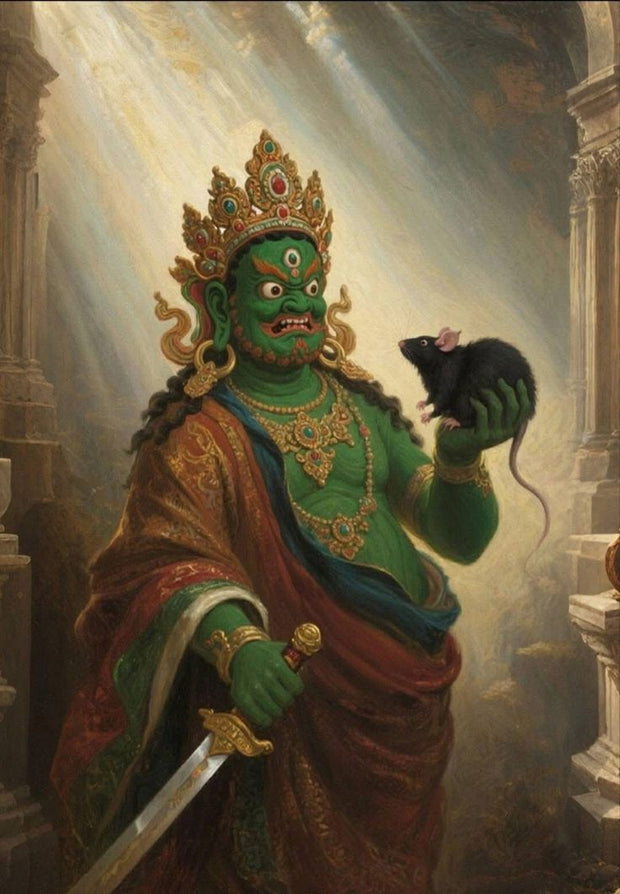
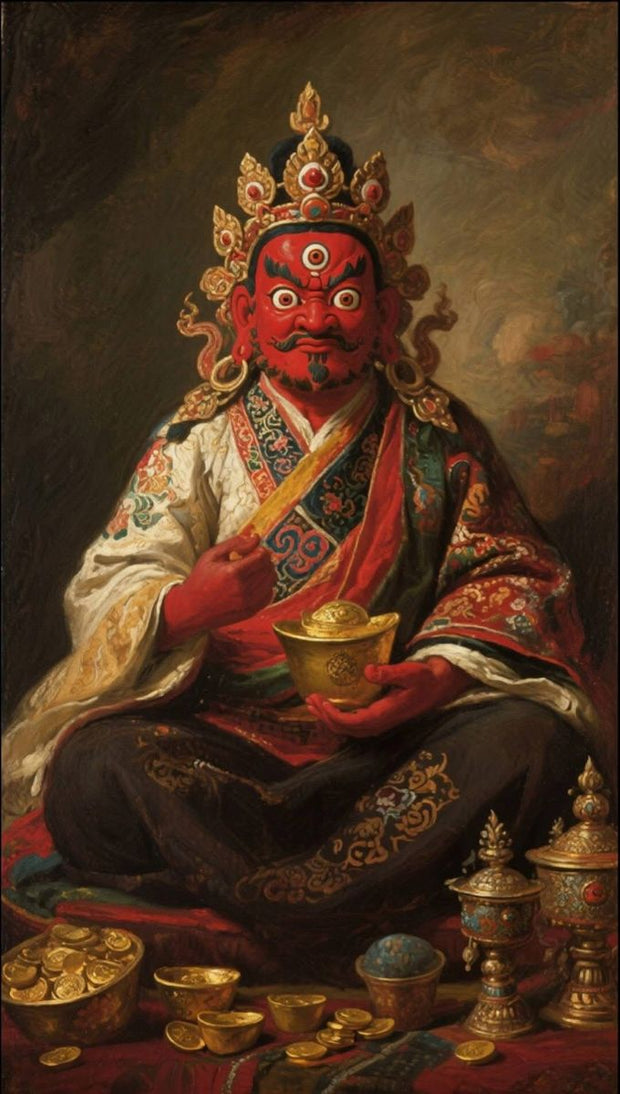
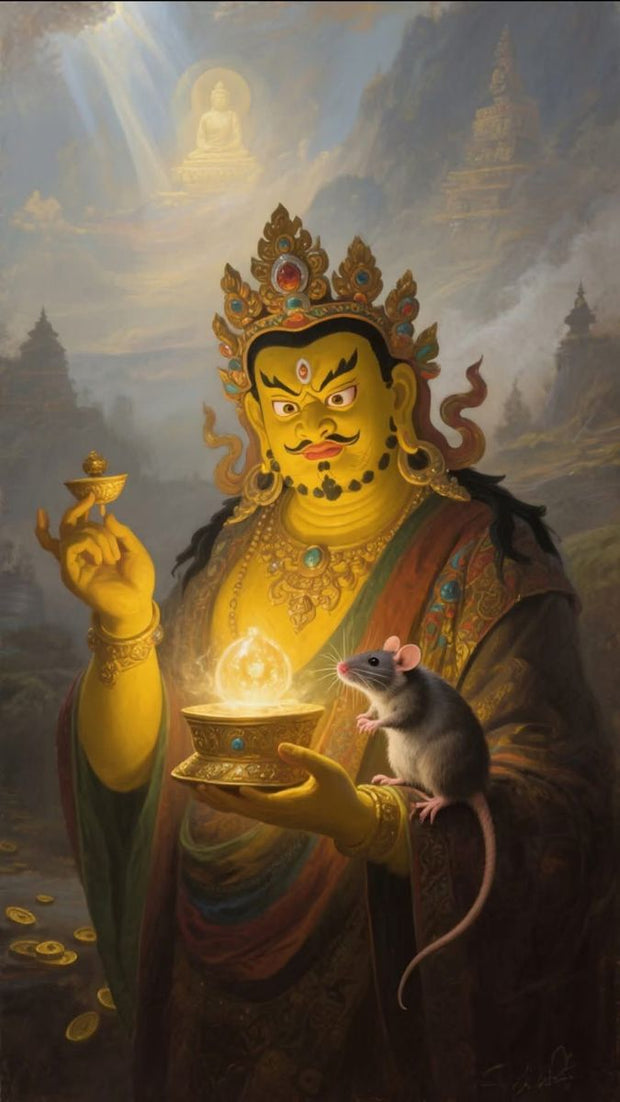
White Jambhala is one of the Five Great Jambhalas, each with a slightly different enlightened activity. Yellow Jambhala is the most widely known and focuses on increasing wealth, prosperity, and virtue. Black Jambhala has a more wrathful appearance and is powerful for forcefully removing obstacles and theft. Red Jambhala has a magnetizing quality, attracting wealth and harmonious relationships. Green Jambhala is associated with the accomplishment of activities. White Jambhala, having emanated from the compassionate Avalokiteshvara, is particularly special for healing illness and stopping the suffering of poverty with a gentle, pacifying energy.
How should I care for my thangka?
A thangka is a sacred object and should be treated with care and respect. Keep it in a dry place, away from direct sunlight, which can fade the natural pigments over time. Avoid touching the painted surface with your hands, as oils from the skin can cause damage. Traditionally, a thangka is covered with a silk veil or curtain when not being used for active meditation, both to protect it and as a sign of reverence. When you need to transport it, roll it gently from the bottom up with the painted surface facing inward, ideally with a protective covering.
Why is he riding a snow lion?
The snow lion is a potent symbol in Tibetan Buddhism. It is a mythical creature that lives in the highest, purest mountain ranges, far from the "pollution" of worldly concerns. Its presence signifies fearlessness, dominion, and the enlightened mind's ability to roam freely over the landscape of reality without obstacle. By riding the snow lion, White Jambhala demonstrates his complete control and mastery over all worldly phenomena. It shows that his power to command wealth comes from a place of ultimate wisdom and freedom, not from worldly attachment.
Can anyone, regardless of their spiritual background, benefit from a White Jambhala thangka?
Absolutely. The universal qualities that White Jambhala represents—generosity, healing the fear of scarcity, aligning material life with higher values, and compassion—are beneficial to everyone. While the practice is rooted in Tibetan Buddhism, you do not need to be a Buddhist to appreciate its meaning. For anyone who wishes to cultivate a more abundant and generous mindset, the thangka can serve as a powerful daily reminder and a beautiful focal point for that intention. Respect for the image and its origin is the only prerequisite.
Your Next Step on the Path of Wise Prosperity
You have now journeyed into the profound world of White Jambhala, understanding that his thangka is far more than a beautiful image. It is a key—a tool for transforming your relationship with wealth, healing financial anxiety, and unlocking your own innate capacity for generosity. It is a support for creating a life where your material well-being and your spiritual values are no longer in conflict, but in perfect harmony. This alignment is the foundation of true prosperity.
Reading and learning is the first step. The next is to bring this sacred presence into your daily life. Creating a space of intention and connecting with an authentic, consecrated object can anchor your practice and accelerate your progress. Your journey toward a life of abundant generosity is a sacred one. To find a consecrated thangka or other authentic practice supports that resonate with your path, we invite you to explore our thoughtfully curated collections.
Keep reading