angel-numbers
666 Angel Number Meaning: A Tibetan View on Balance (2026)
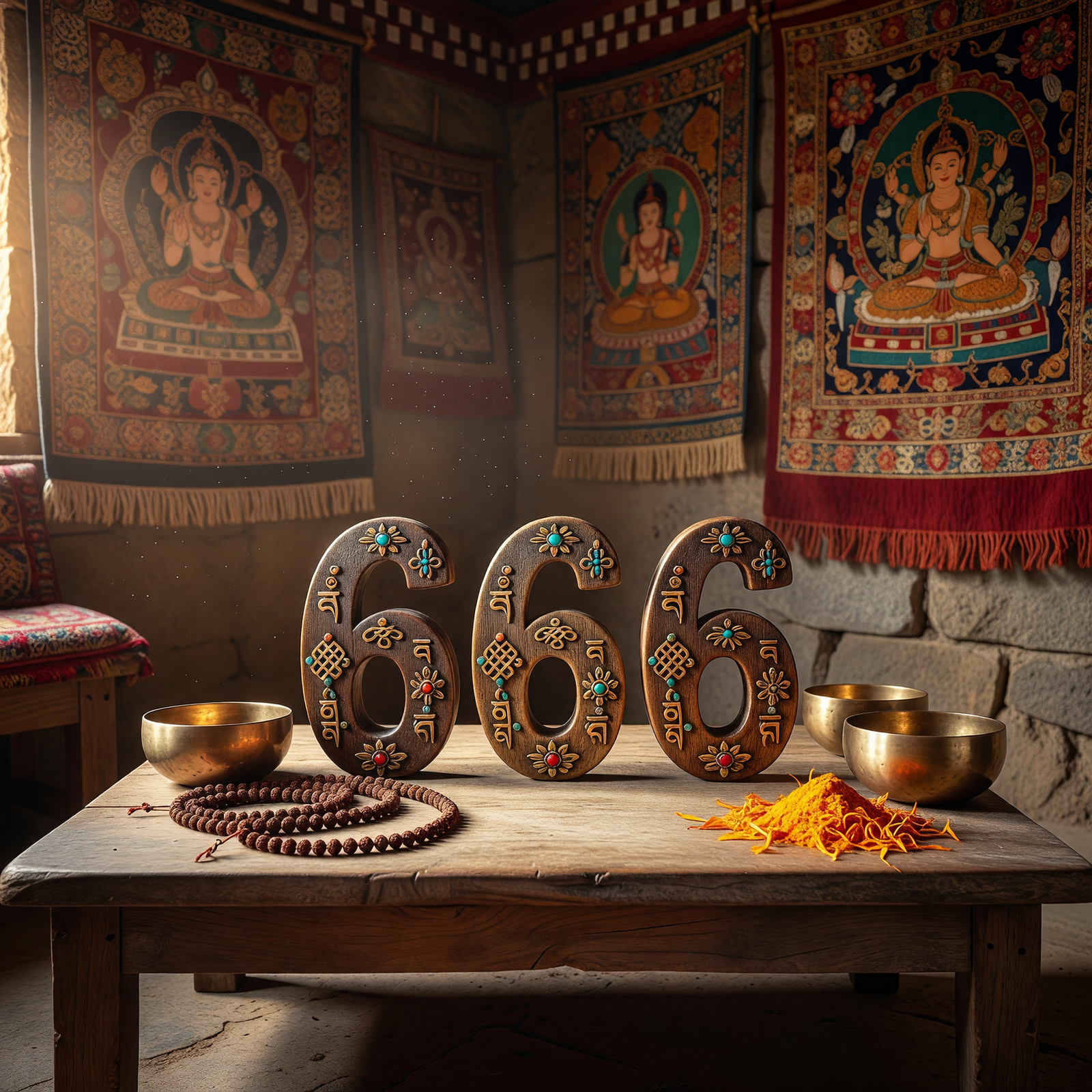
It’s 2 AM. You’ve been scrolling for an hour, your mind a mix of work deadlines and a friend’s perfect-looking vacation photos. You glance at the clock: 2:22. A small smile. Then you check your phone battery: 66%.
You open an email and see the unread count is 66. A little later, an order confirmation comes through for $66.60. Your smile fades. A flicker of unease, a cultural echo of something sinister, bubbles up.
Is this a bad sign? For those new to their spiritual path, seeing 666 can be jarring, loaded with centuries of Western interpretation. But what if that interpretation is only one part of a much larger, more compassionate story?
From the Himalayan perspective we've come to know, this number isn't a warning; it's a profound invitation. If you'd like to explore the broader context of these repeating numbers, you might find our complete guide to angel numbers a helpful starting point.
The Foundation: Why 666 is a Call to Balance, Not a Sign of Evil
Let's be direct: the fear surrounding 666 comes almost entirely from a single text, the Book of Revelation in the Christian Bible, where it's labeled the "number of the beast." This interpretation has permeated Western culture so deeply that it's become an automatic response.
But in the vast landscape of spiritual thought, particularly in Tibetan Buddhism, this number holds a completely different, and frankly, more practical meaning.
In the Tibetan tradition, the number six is fundamental to understanding the human condition. It's not about an external evil force, but about the internal landscape you navigate every single day. Think of it in these three ways:
- The Six Senses: In Buddhism, there are six senses, not five. There's sight, sound, smell, taste, touch, and the sixth sense—mind, the faculty that processes thoughts and emotions. Seeing 666 is a powerful reminder to check in with your senses. Are you overwhelmed by the noise (sound)? Are you caught in a loop of anxious thoughts (mind)? Are you numbing yourself with endless scrolling (sight)? The number is a gentle tap on the shoulder, asking, "Where is your awareness right now?"
- The Six Realms of Samsara: Tibetan cosmology describes six "realms" of existence, which are less about physical places and more about psychological states. These are the realms of gods (bliss, pride), demigods (jealousy, conflict), humans (potential for enlightenment), animals (ignorance), hungry ghosts (craving, addiction), and hell-beings (anger, paranoia). You can cycle through all of these in a single day. You feel god-like after a great workout, then plunge into the hell-world of road rage ten minutes later. Seeing 666 is a reminder of this cycle. It asks you to observe your current mental state without judgment and to aim for the balance of the human realm—the only state from which true progress can be made.
- The Six Perfections (Paramitas): This is the path out of the cycle. The Six Perfections are the core practices of a bodhisattva, an enlightened being dedicated to helping others. They are: Generosity (Dāna), Discipline (Śīla), Patience (Kṣānti), Diligence (Vīrya), Meditative Concentration (Dhyāna), and Wisdom (Prajñā). Seeing 666 can be an encouragement to practice one of these. Are you being impatient with yourself? Could you be more generous with your attention? It's a call to action, not a sign of doom.
So, when you see 666, it's not the universe sending a threat. It's sending a diagnostic tool. It's a mirror reflecting the totality of your human experience—your senses, your emotional states, and your capacity for genuine clarity and equilibrium.

Why This Matters So Much as We Look Towards 2026
You're living in a time of unprecedented sensory input. Your phone is a firehose of information, notifications, and comparisons. Your mind, the sixth sense, is working overtime just to keep up. This is the very definition of imbalance, and it's the root of the burnout and anxiety those on a path of self-inquiry feel.
The modern world is constantly pulling you into the extreme psychological realms—the fleeting bliss of a thousand likes (god realm) or the deep paranoia of online arguments (hell realm).
As we move further into this decade, this challenge will only intensify. The pressure to optimize, to perform, to curate a perfect life, creates a deep internal friction. You feel it when you compare your career progress to someone on LinkedIn.
You feel it when you wonder if you're making the "right" choices in your relationships. This is where the Tibetan understanding of 666 becomes not only interesting, but essential—a teaching that emerged from centuries of Buddhist contemplative practice in the Himalayas.
Seeing this number in 2026 is a radical call to return to the human realm. It's a message to disengage from the extremes and find your center. It asks you to:
- Reclaim Your Senses: Instead of letting your senses be hijacked by algorithms, 666 invites you to consciously use them. To actually taste your morning coffee instead of scrolling while you drink it. To listen to the birds outside your window instead of immediately putting on a podcast. To feel the texture of your favorite sweater—the weight of hand-spun wool, the warmth it holds. This is about grounding yourself in the physical reality of your life, which is the most powerful antidote to digital-induced anxiety.
- Observe Your Emotional Climate: The number encourages you to become a compassionate observer of your own mind. When you feel a surge of jealousy (demigod realm), you don't have to beat yourself up. You can simply notice it, name it, and recognize it as a temporary state passing through. This act of non-judgmental observation is the first step toward emotional freedom. You stop identifying *with* the emotion and start seeing it as a cloud passing in the sky of your awareness.
- Find Your "Middle Way": The Buddha's core teaching was the Middle Way—a path of moderation between the extremes of self-indulgence and self-mortification. In your life, this is the balance between hustle culture and giving up completely. It's the balance between obsessive self-improvement and stagnation. 666 is a signpost pointing you back to this sustainable, compassionate middle path. It's a reminder that you don't need to be perfect; you just need to be present and balanced.
In a world that profits from your distraction and emotional volatility, seeing 666 is a secret, sacred reminder to come home to yourself. As you move through 2026, let this number guide you back to what actually matters. It's not a curse; it's a compass.
The Real Benefits: How Working with 666 Can Change Your Daily Life
Understanding the symbolism is one thing. But how does this translate into real, tangible changes when you're feeling overwhelmed? When you start to see 666 as a call to balance, you can use it as a trigger for specific, grounding practices.
This isn't about abstract philosophy; it's about having tools for the moments you need them most.
1. Grounding Your Mind in the Present Moment
The primary reason for anxiety is a mind that's living in the future—worrying about what might happen. The Tibetan view of 666, with its focus on the six senses, is a perfect tool to pull your awareness back to the present.
The next time you see 666 and feel that familiar jolt of stress, try this simple "Six Sense Scan."
Pause for just 60 seconds. Notice:
- Five things you can see (the color of your screen, a crack in the ceiling, the leaves on a plant).
- Four things you can feel (the pressure of your chair, the fabric of your clothes, the temperature of the air).
- Three things you can hear (the hum of a computer, distant traffic, your own breathing).
- Two things you can smell (the faint scent of coffee, the soap on your hands).
- One thing you can taste (the lingering taste of your last meal or drink).
Finally, turn your attention to the sixth sense: your mind. Notice one thought that is present without getting attached to it. Just observe it. This simple practice, triggered by the number 666, short-circuits the anxiety loop.
It yanks your consciousness out of the abstract world of worry and plants it firmly in the reality of your body and your environment. It's a mini-meditation you can do with your eyes open, anytime, anywhere.
2. Cultivating Compassion for Your Inner States
When you see your emotions through the lens of the six realms, you stop judging yourself so harshly. You realize that feeling envious or angry doesn't make you a "bad person." It just means you're temporarily visiting the demigod or hell realm.
Seeing 666 can become a prompt for self-compassion.
Instead of saying, "I'm so anxious," try reframing it: "Ah, I'm experiencing the hungry ghost realm right now—a feeling of craving for certainty." This subtle shift in language creates distance. It allows you to offer yourself the same kindness you'd offer a friend who is struggling.
You can ask yourself, "What does this part of me need right now?" Maybe the "hell-being" part needs a walk outside. Maybe the "hungry ghost" part needs a glass of water and a few deep breaths, not another hour of scrolling.
This approach, inspired by understanding angel numbers from a Tibetan perspective, transforms 666 from a moment of fear into a moment of deep self-care and emotional intelligence.
3. Finding Balance Through Small, Intentional Actions
The Six Perfections can feel lofty, but 666 reminds you to apply them in small, everyday ways. It's a call to bring your values into alignment with your actions. When you see the number, pick one of the six perfections and find a micro-opportunity to practice it.
- Generosity: Send a quick, kind text to a friend you haven't spoken to in a while.
- Discipline: Close the 15 tabs on your browser that are stressing you out.
- Patience: Take three deep breaths before replying to a frustrating email.
- Diligence: Spend five focused minutes on a task you've been avoiding.
- Concentration: Put your phone in another room for the next 30 minutes.
- Wisdom: Ask yourself, "In the grand scheme of things, how much will this matter in a year?"
These aren't life-altering changes. They are small, deliberate course corrections. Over time, these tiny acts of balance, prompted by a number you once feared, build a more resilient and centered life—the kind of steady progress that practitioners in the Kathmandu Valley recognize as the real work of the path.

How to Choose an Authentic Reminder of Balance
When a symbol begins to hold personal meaning for you, having a physical object to anchor that intention carries real weight. It acts as a tactile reminder you can turn to throughout your day.
But choosing a piece of spiritual jewelry shouldn't add to your stress. It's about finding something that resonates with the calm and balance you seek.
When considering a piece inspired by the number 6, look for authenticity in both materials and meaning. A true reminder is more than an accessory; it's an investment piece—one you'll pass down because its significance deepens over time.
Our angel number jewelry collection is crafted with this principle at its core.
Here are a few things to consider from a Himalayan perspective:
- Materials with Meaning: Natural materials carry their own energy and story. Sandalwood is known for its calming scent, which aids in concentration (the fifth perfection). Bodhi seeds are what the Buddha sat under to attain enlightenment, representing wisdom (the sixth perfection). Turquoise is a protective stone in Tibetan culture, symbolizing the healing of the spirit. Look for pieces that combine materials thoughtfully, rather than just for aesthetics.
- Symbolism of Six: A piece doesn't need to have "666" stamped on it. The symbolism can be more subtle and elegant. Look for a mala with six marker beads that divide the 108 beads into sections. Or consider a bracelet featuring the six-syllable mantra, *Om Mani Padme Hum*—the embodiment of compassion. This mantra is a direct connection to the path of the bodhisattva and the Six Perfections.
- The Artisan's Hand: There is a real difference between a mass-produced item and one made by a skilled artisan. When a piece is crafted by hand, the maker's intention and focus are infused into it. Master Tenzin, who leads our Boudhanath workshop, often chants mantras as he works. This isn't a marketing gimmick; it's a traditional practice that imbues the object with a peaceful quality. You can feel this difference when you hold it.
- Blessing and Intention: An authentic piece is often blessed to seal its purpose. This isn't a vague "spiritual activation." It's a specific ceremony. For some of our malas, this means being part of a 49-day Guru Rinpoche puja at a monastery near Swayambhunath, where monks consecrate them with focused prayer and incense. This process transforms the object from mere jewelry into a support for your practice.
When you choose a piece of spiritual numerology jewelry, you are choosing a companion for your journey. It should feel like a quiet friend, a grounding presence on your wrist or around your neck, reminding you of your intention to find balance in a world of extremes.
How to Actually Use Your Reminder in Daily Practice
Owning a beautiful, meaningful object is wonderful. Integrating it into your life is where the real shift happens. Your piece of jewelry is a tool, and like any tool, it becomes more effective with practice.
The goal is to create a simple, repeatable ritual that connects you to the meaning of 666—balance, awareness, and compassion—whenever you see or touch your chosen piece.
Here are three simple ways to start:
- The Morning Intention Setting: Before you even look at your phone in the morning, take 60 seconds. Hold your mala or pendant in your hand. Close your eyes. Take six slow, deep breaths. As you hold the piece, set a simple intention for the day based on one of the Six Perfections. For example: "Today, I will practice patience with myself." Or, "Today, I will look for an opportunity to be generous." This small act frames your entire day, turning your jewelry into a promise you make to yourself each dawn.
- The "Six Senses" Reset Button: This is your go-to practice for moments of overwhelm. When you feel your anxiety rising at work or while stuck in traffic, touch your bracelet or necklace. Let the physical sensation—the cool stone or smooth metal against your skin—be your anchor. Use it as a trigger to perform the "Six Sense Scan" we discussed earlier. Name one thing for each of your six senses (sight, sound, touch, taste, smell, mind). This act of touching the object and engaging your senses is a powerful circuit breaker for stress. It brings you out of your head and into your body, which is always in the present moment.
- The Evening Gratitude Practice: Before you go to sleep, take off your jewelry and hold it for a moment. Reflect on your day through the lens of the six realms. Where did you experience moments of bliss (god realm)? Where did you feel frustration (hell realm)? Where did you feel connected and present (human realm)? Don't judge any of it. Simply observe the natural ebb and flow of your inner world. Then, think of one small thing you are grateful for. This practice cultivates self-awareness and ends your day on a note of gentle acceptance, the way practitioners in the Kathmandu Valley temples close their evening sessions.
Your piece of jewelry is not magic. Its power comes from the meaning and practice you imbue it with. It becomes a conditioned response; over time, the simple act of touching it will automatically bring a sense of calm and a reminder of your intention to walk the middle way.
Common Questions About the 666 Angel Number
Is seeing 666 a bad omen in Buddhism?
Absolutely not. This is perhaps the most important misconception to release. In Tibetan Buddhism, there isn't a concept of "bad omens" in the same way Western superstition understands them. Everything is seen as a intention-setting of mind and a potential teaching.
Seeing 666 is considered a particularly potent teaching. It's a direct and powerful call to examine your internal state and your relationship with the world through your six senses. It's a reminder of the Six Realms you might be cycling through and an invitation to practice the Six Perfections.
Think of it as a spiritual check-engine light, not a warning of impending doom. It's asking you to pay attention and make adjustments for a smoother, more balanced journey. When I first encountered this number during retreat in the Kathmandu Valley, my teacher explained it as a mirror—not a threat.
What's the main difference between the Christian and Buddhist view of 666?
The core difference lies in the source of the "problem." The traditional Christian interpretation points to an external source of evil—a figure or force outside of yourself that you must guard against. It's a warning about an external threat.
The Tibetan Buddhist view, on the other hand, is entirely internal. The "beast" isn't out there; the potential for imbalance is within you. The six realms of suffering—anger, greed, jealousy—are psychological states, not literal places.
Therefore, 666 is not a sign to be afraid of the world, but an invitation to cultivate wisdom and compassion for your own mind. It shifts the focus from fear to responsibility, and from damnation to the potential for liberation.
This distinction has shaped Buddhist practice since the teachings were systematized during the Tibetan Empire in the 7th century.
Do I have to be a Buddhist to appreciate this meaning of 666?
Not at all. While these concepts are articulated within a Buddhist framework, the underlying principles are universal to the human experience. Everyone has six senses. Everyone experiences fluctuating emotional states like anger, craving, and peace.
Everyone can benefit from practicing generosity, patience, and discipline. You don't need to adopt any dogma or labels to find value in this perspective. You can simply use it as a practical, psychological tool.
Seeing 666 can be your personal, non-denominational reminder to check in with yourself, ground yourself in the present moment, and act with a little more kindness toward yourself and others. It's a philosophy for living, accessible to anyone—if you sit in a monastery or a coffee shop.
How can a piece of jewelry actually help with something so deep?
A piece of jewelry is not a magic charm that solves your problems. Its power lies in its role as a physical anchor for your intention. Your mind thinks thousands of thoughts every day, and your intention to be more balanced can easily get lost in the noise.
When you wear a piece of meaningful number-themed pieces, its physical presence—the weight on your wrist, the coolness against your skin—serves as a constant, gentle nudge. It's a tactile reminder that cuts through the mental chatter.
Every time you glance at it or touch it, it reactivates the intention you set. It's a tool for mindfulness, helping you bridge the gap between wanting to be more present and actually remembering to practice it in the messy reality of daily life.
I've seen practitioners wear the same mala bracelet for years, and the worn grooves in the beads become a record of their commitment.
What if I still feel scared when I see the number 666?
That's completely okay and very normal. Cultural conditioning runs deep, and you can't simply switch it off. The key is not to fight the fear or judge yourself for having it. When you see 666 and that initial flicker of unease arises, acknowledge it with kindness.
You can say to yourself, "Ah, there's that old story. I see you." Then, gently and consciously, introduce the new story. Take a deep breath and remind yourself: "This is a call to balance.
This is a reminder of my six senses. This is an invitation to be present." By repeatedly and gently overlaying the new, compassionate meaning, you are slowly rewriting the neural pathway. You are not erasing the old fear, but you are building a new, stronger, and more helpful response next to it.
This is how genuine transformation happens—not through suppression, but through patient, repeated exposure to a different truth.
Is the 666 angel number related to money or career?
In the Tibetan Buddhist view, it's not a direct predictor of financial gain or a specific career outcome, unlike some New Age interpretations. Instead, it speaks to the *quality of your mind* while you are engaging with your money and career.
It asks: Are you approaching your work with diligence and wisdom (Six Perfections)? Or are you caught in a state of constant craving for more (hungry ghost realm) or jealousy of your colleagues (demigod realm)?
Seeing 666 is a prompt to bring balance *into* your professional life. It encourages you to find the Middle Way between burnout and apathy, and to pursue your ambitions from a place of groundedness and ethical conduct rather than desperate attachment or fear.
The merchants I met in Lhasa understood this well—their success came from integrity, not from chasing every opportunity.
Your Journey to Balance
Seeing 666 is not a final judgment or a scary omen. It is the beginning of a conversation. It's a quiet, persistent question from the universe, asking: "Where are you right now? And where would you like to be?"
As you move through the coming years, with all their beautiful and chaotic uncertainty, this number can be your steady companion. It's a personal reminder that amidst the noise, you have access to a grounded sense of balance within your own body and mind.
It's a call to tend to your inner world with the same care you give your outer life—the way a practitioner tends to their altar each morning, or adjusts their posture during meditation. It's permission to be human—to experience the full spectrum of your emotions without judgment, and to always, gently, guide yourself back to center.
This journey isn't about becoming perfect. It's about becoming whole. If you feel called to carry a physical reminder of this path, we invite you to explore our collection of meaningful number-themed pieces, each crafted by artisans in the Kathmandu Valley who understand that the true value of an object is the intention it helps you hold.

Keep reading