
Buddhabelief editorial
Mahakala Forms: Identification Guide
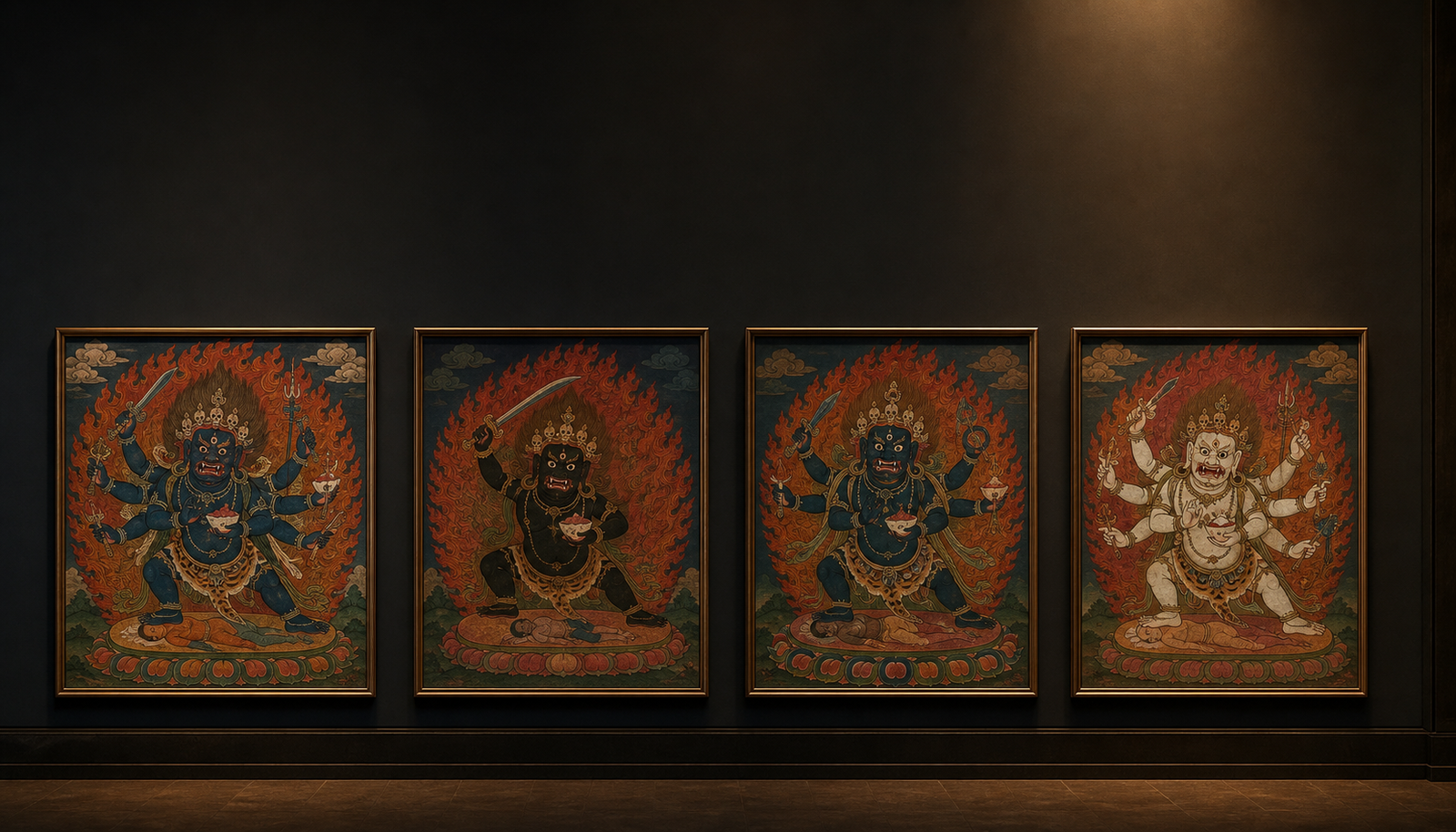

Mahakala is represented in many forms, and color or arm count alone is not enough to identify one correctly. Six-Armed Mahakala, Panjarnata Mahakala, four-armed forms and White Mahakala belong to different iconographic and practice contexts. Identification should combine the number of faces and arms, hand attributes, posture, retinue, lineage and the object's documented source.
Direct answer: Six-Armed Mahakala is recognized by six arms but occurs in multiple traditions; Panjarnata is commonly a one-faced, two-armed form associated especially with the Hevajra cycle and Sakya tradition; four-armed Mahakala is a broad iconographic group; and White Mahakala includes white forms associated in some traditions with prosperity and longevity. Confirm the specific cycle before assigning a name.
Mahakala forms comparison
| Form | Common visual starting point | Important context | Identification caution |
|---|---|---|---|
| Six-Armed Mahakala | One face, six arms, wrathful expression, blue-black or black body in many examples | Several transmission traditions exist; the Shangpa form became influential in Tibet | Six arms do not by themselves establish lineage or exact practice cycle |
| Panjarnata Mahakala | Often one face and two arms, curved knife and skull cup, compact standing posture | Special protector of the Hevajra cycle and principal protector in Sakya contexts | Do not label every two-armed black Mahakala as Panjarnata |
| Four-Armed Mahakala | One face and four arms in many depictions | Several cycles and iconographic programs use four-armed forms | “Four-armed” is a visual category, not a complete identification |
| White Mahakala | White body; a well-known form has one face and six hands | White forms include Sita Mahakala traditions, including a Shangpa Kagyu wealth-deity practice | White color does not mean peaceful appearance or one universal function |
Mahakala's wrathful appearance is interpreted within Vajrayana Buddhism as forceful enlightened activity and protection of the Dharma, not as ordinary anger. The Metropolitan Museum of Art describes a six-armed Mahakala from Mongolia as a protector who removes obstacles. Museum descriptions provide reliable object context, but they are not substitutes for practice instruction.
Why Mahakala has multiple forms
Himalayan Buddhist iconography is organized through texts, lineages, practice cycles and artistic conventions. One deity can appear in multiple manifestations, while figures that look similar may belong to different systems. The Himalayan Art Resources overview of twelve Mahakala iconographic forms includes one-faced forms with two, four or six hands as well as multi-faced forms.
This variety explains why an online caption such as “Black Mahakala” is incomplete. Black or dark blue is common; it does not tell you the arm count, attributes, lineage or practice cycle. Likewise, a product title can be a starting label, but a historical thangka requires object-level examination.
Six-Armed Mahakala: what identifies the form?
Six-Armed Mahakala, often called Shadbhuja Mahakala, is among the best-known forms. The central figure commonly has one face and six arms, a wrathful expression and a dark body. Hand attributes vary by tradition and can include a curved knife, skull cup, damaru, lasso, trident or other implements.
The Himalayan Art Resources study set on Six-Armed Mahakala traditions states that at least six traditions are known. It notes the Shangpa Kagyu transmission in Tibet and its later adoption in Gelug contexts. This matters because two six-armed paintings can share the basic silhouette while differing in lineage details.
The Metropolitan Museum's fifteenth-century Tibetan Six-Armed Mahakala sculpture is a useful object reference. Its museum record supplies date, region, medium and provenance fields that a generic social-media image often lacks.
Six arms are a filter, not a final answer
Count visible arms first, then inspect what each hand holds. Continue with attendants, ornaments, posture and inscription. Damage, repainting, tight cropping or small product photographs can hide attributes. If the source does not document a lineage, identify the object conservatively as “six-armed Mahakala imagery” rather than asserting a specific initiation cycle.
Our separate Six-Armed Mahakala meaning guide discusses this form in more depth. This page is the comparison layer used to distinguish it from other major forms.

Panjarnata Mahakala: the two-armed protector
Panjarnata Mahakala is especially important in the Sakya tradition and the Hevajra cycle. Himalayan Art Resources describes Panjarnata Mahakala as the special protector of the Hevajra cycle and principal protector of the Sakya School. The cited example has one face and two hands, holding a curved knife and skull cup.
The Sanskrit name is often connected in English with the “pavilion” or “tent” tradition, but the name should not be reverse-engineered from a decorative canopy in an image. Use the figure's attributes and a catalogued source.
Panjarnata vs other two-armed forms
Two arms, a knife and a skull cup narrow the field, but they do not finish the identification. Other Mahakala forms can share attributes. A reliable label also considers staff position, ornaments, companions, inscriptions and the tradition that commissioned or preserved the work.
Four-Armed Mahakala: why the label remains broad
Four-Armed Mahakala, or Chaturbhuja Mahakala, can be recognized initially by four arms. Yet “four-armed” remains a morphological description until the surrounding evidence identifies the particular cycle. Catalogues may distinguish forms by hand implements, body color, retinue and lineage.
Himalayan Art Resources groups Mahakala material by iconographic subject and practice tradition rather than pretending that one visual feature solves every case. Its broader Mahakala topic and video index is useful for comparing forms and terminology across objects.
How to describe an uncertain four-armed image
Use a layered description: “a dark, four-armed Mahakala-form protector, exact cycle unverified.” Then record visible attributes and the source of the image. This wording is more useful than a confident but unsupported lineage name.
White Mahakala: color, form and function
White Mahakala is not simply a peaceful version of a black image. White forms remain wrathful in appearance. Himalayan Art Resources identifies a well-known Sita Mahakala form from the Shangpa Kagyu tradition with one face and six hands, practiced as a wealth deity. The same resource also distinguishes other white forms, including white Chaturmukha and Panjarnata-related subjects.
Therefore, “White Mahakala equals wealth” is too broad. Prosperity, longevity or obstacle-removing associations depend on the form and textual tradition. They should not be converted into guaranteed financial claims for a pendant or artwork.
A separate Himalayan Art Resources set on White Six-Handed Mahakala provides comparative examples. Use museum or scholarly catalog records to compare attributes, not color-adjusted marketplace photography.
How to identify a Mahakala image step by step
- Count faces and arms. Record only what is visible; note cropped or damaged areas.
- Record body color. Distinguish black, blue-black, white and other colors without making color the sole identifier.
- List hand attributes. Curved knife, skull cup, drum, lasso, trident, staff and jewel-bearing objects are significant.
- Check posture and attendants. Standing, seated or trampling postures and the surrounding retinue can narrow the form.
- Read the object record. Date, region, inscription, lineage and collection provenance often resolve ambiguity.
- Use a conservative label. When evidence stops, state what is visible rather than guessing a practice cycle.
Choosing Mahakala art or jewelry
Begin with the form you can identify and the object you can evaluate. A Six-Armed Mahakala embroidered thangka foregrounds the six-armed iconography. A Mahakala thangka pendant translates protector imagery into a wearable format. The Mahakala men's thangka piece offers another product treatment, while the thangka pendant collection lets you compare scale, material and imagery.
Product photography can help inspect workmanship, but it cannot establish the age or ritual history of an image. Ask for dimensions, materials, source description and clear close-ups. Avoid sellers who promise invulnerability, guaranteed wealth or automatic spiritual attainment.
Common Mahakala identification mistakes
- Calling every dark wrathful figure Mahakala without checking attributes.
- Calling every six-armed image the same Shangpa or Gelug form.
- Calling every two-armed Mahakala Panjarnata.
- Assuming white color means non-wrathful or that every white form has one function.
- Using a product title as stronger evidence than an inscription or museum catalog.
For the broader deity background, read Who is Mahakala?. For mantra context and practice boundaries, continue to the Mahakala mantra meaning and practice guide.
Frequently asked questions
How many forms of Mahakala are there?
There is no single short list that covers every lineage and cycle. Major art references document numerous one-faced, multi-faced, two-armed, four-armed and six-armed forms. Name the source tradition whenever possible.
Is Six-Armed Mahakala always Gelug?
No. Multiple six-armed traditions exist. The Shangpa transmission predates its later adoption in Gelug contexts, so arm count alone does not establish school or lineage.
Is White Mahakala a wealth deity?
A well-known White Six-Handed Mahakala practice in the Shangpa Kagyu tradition is associated with wealth, but not every white form should be reduced to one function or used to promise financial results.
Can I identify Panjarnata by two arms?
Two arms are an important clue, especially with the curved knife and skull cup, but a sound identification also checks other attributes, inscriptions, retinue and documented tradition.
Sources and further reading
- Himalayan Art Resources: Twelve Mahakala iconographic forms
- Himalayan Art Resources: Six-Armed Mahakala traditions
- Himalayan Art Resources: Panjarnata Mahakala
- Himalayan Art Resources: White Mahakala forms
- The Metropolitan Museum of Art: Six-Armed Mahakala, Tibet
- The Metropolitan Museum of Art: Six-Armed Mahakala, Mongolia
- The Metropolitan Museum of Art: Wrathful Protector Mahakala
Keep reading