
Bagua
Taoist Fu vs Bagua vs Five Thunder
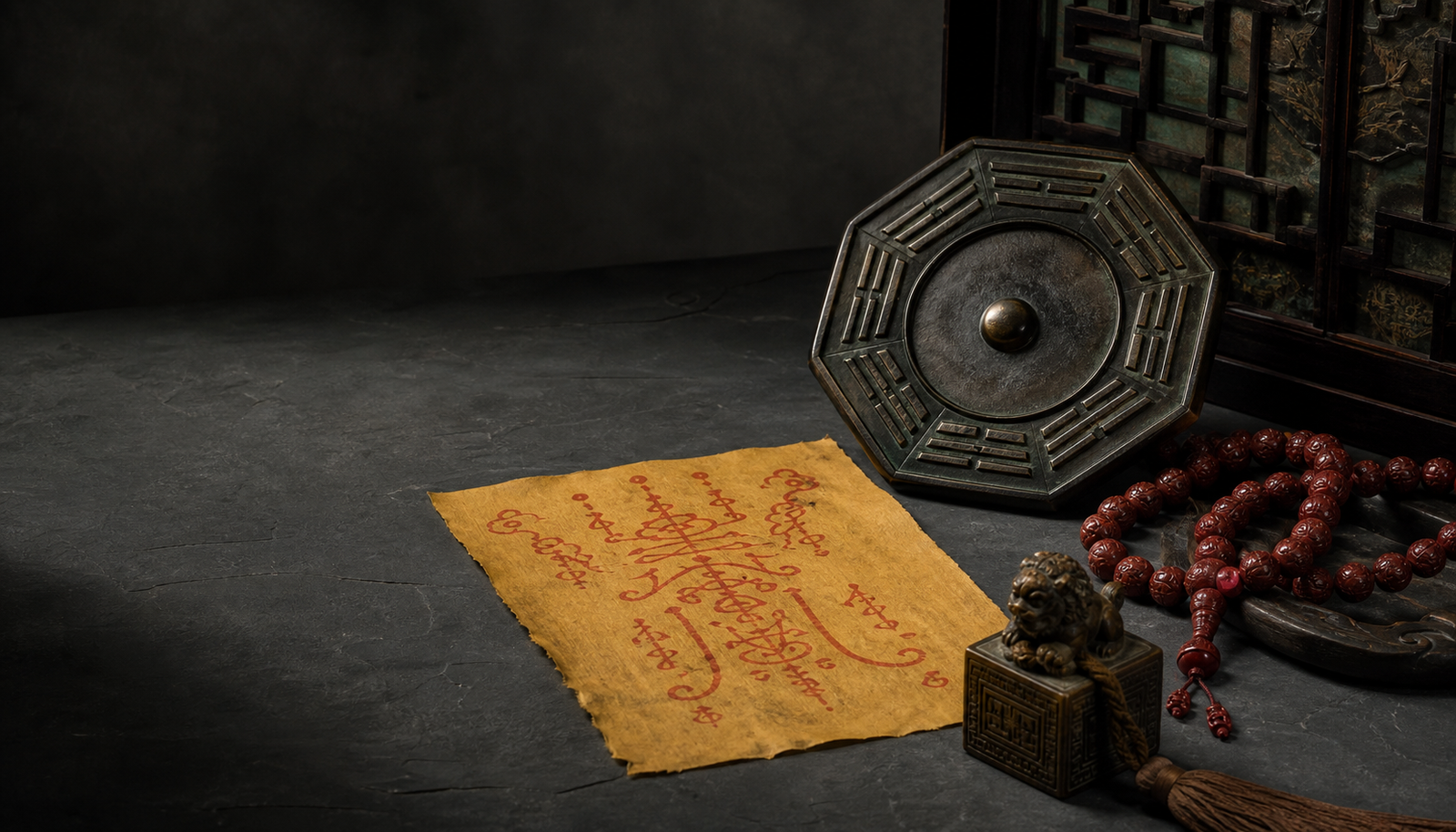

Fu, Bagua and Five Thunder are related to Taoist religious culture, but they are not three names for the same symbol. A fu is a talismanic written object or ritual form; the Bagua is an eight-trigram cosmological diagram; and Five Thunder refers to a thunder-rite complex whose talismans, seals and commands belong to particular ritual traditions.
Direct answer: choose Fu when the subject is talismanic writing, Bagua when the subject is the eight trigrams and cosmological ordering, and Five Thunder when the object explicitly belongs to a thunder-rite tradition. A piece of jewelry can quote these visual systems, but that does not make it a temple-issued or ritually empowered talisman.
Fu vs Bagua vs Five Thunder at a glance
| Term | What it is | How it is recognized | What it is not |
|---|---|---|---|
| Fu | A broad class of talismanic writing and ritual objects | Conventional strokes, graphs, seals and divine names arranged according to a tradition | One universal character that always has the same function |
| Bagua | The eight trigrams used to model patterned change and relationships in the cosmos | Eight groups of three broken or unbroken lines, often arranged around a center | A generic label for every Taoist amulet or every octagonal decoration |
| Five Thunder | A family of thunder rites, deities, registers and ritual technologies | Identification depends on inscriptions, seals, deity context and documented ritual lineage | Simply a lightning icon or any red talisman paper |
The comparison is useful because online listings often flatten all three into “protection symbols.” Historically, their categories, uses and visual languages overlap without becoming interchangeable. The Metropolitan Museum of Art's overview of Daoism and Daoist art shows how cosmology, ritual implements, divine bureaucracy and talismans developed within a much larger religious world.
What is a Taoist Fu talisman?
Fu is commonly translated as talisman. It can refer to written ritual forms that combine calligraphic components, divine names, diagrams, seals and command-like marks. The visible result may look spontaneous to an outsider, but historical examples belong to learned systems of composition and use.
A peer-reviewed Cambridge study on the evolution of Chinese religious symbols follows talismanic materials from portable apotropaic objects into formal Taoist liturgy. That history is a warning against treating every fu-like mark as a decorative logo with a single dictionary meaning.
Why a Fu cannot be identified by color alone
Yellow paper and vermilion ink are familiar in popular imagery, but color is not a sufficient identifier. Historical sources record different media, formats and ritual contexts. The relevant questions are who produced the object, which textual or ritual system it belongs to, what its inscription says, and how the source documents its use.
The recent peer-reviewed study Writing the Sacred: Fulu in Taoist Ritual Art distinguishes fu from lu, or registers, and emphasizes writing as ritual action rather than decoration. For a buyer, the practical lesson is simple: a printed pendant inspired by fu imagery should be described as symbolic jewelry unless a qualified religious source documents a more specific status.
What is the Bagua?
The Bagua consists of eight trigrams. Each trigram is made from three lines that are either unbroken or broken. The trigrams are associated with patterned relationships such as heaven and earth, thunder and wind, fire and water, mountain and lake. Their arrangement matters; different sequences are used in different intellectual, ritual and practical contexts.
The Bagua therefore works as a diagrammatic system, not as a single verbal spell. It may appear with a taiji symbol, on mirrors, in architectural settings, in divination, in martial arts culture and on jewelry. Those uses share a recognizable visual grammar but do not all carry the same religious function.
Bagua mirror vs Bagua jewelry
A traditional Bagua mirror is an object associated with spatial and protective practices. A Bagua pendant or bracelet is wearable symbolism. The two can look related while differing in scale, construction, context and intended use. Avoid claims that any octagonal pendant automatically corrects a building, repels a specific force or guarantees safety.
For the line patterns and the major trigrams, use our dedicated Bagua and Eight Trigrams guide. That page handles the diagram itself; this article focuses on the boundary between Bagua, fu and thunder-rite symbolism.

What does Five Thunder mean in Taoism?
Five Thunder is not merely the number five plus a lightning bolt. It refers to ritual traditions involving thunder deities, cosmological correspondences, registers, talismans, seals and commands. The exact interpretation depends on the source and lineage.
The historical Taoist Wang Wenqing is closely associated with thunder rites. A translation and study in the Journal of the Royal Asiatic Society situates his Discourse on the Thunders within Song-period cosmology and ritual thought. It demonstrates why “Five Thunder” should be read as a ritual-historical category, not as a generic marketing synonym for power.
A Berkeley survey of Taoist literature discusses thunder-rite talismans and their textual setting. Research by Dominic Steavu on talismans and diagrams further shows that graphic forms must be read with their paratexts and ritual frames.
How Five Thunder relates to Fu
A Five Thunder talisman can be a type of fu, but not every fu is a Five Thunder talisman. This is a category relationship: “fu” names the broader talismanic form, while “Five Thunder” identifies a more specific ritual complex. A similar distinction exists between “painting” and “portrait”; one is a broad medium, the other a subject category.
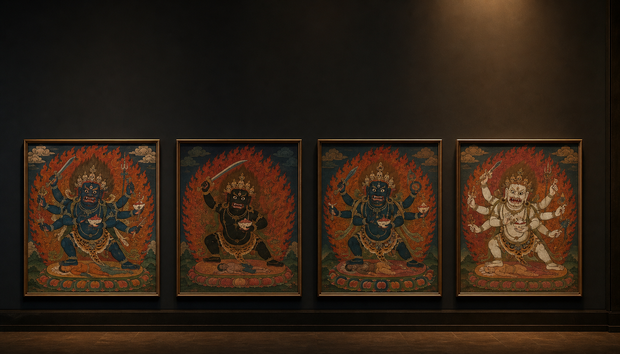
The Museum of Fine Arts, Boston presents a Thunder Marshal in the context of religious painting. Museum objects help identify iconography, but they still do not authorize a modern seller to promise supernatural outcomes for a commercial accessory.
How to identify the symbol on jewelry
- Start with geometry. Eight groups of three lines strongly suggest Bagua imagery. Confirm that the design actually has eight trigrams rather than decorative bars.
- Look for writing and seals. Dense calligraphic marks may be fu-inspired, but accurate identification requires a readable source, provenance or expert interpretation.
- Check explicit naming. A Five Thunder identification should be supported by an inscription, deity, seal, documented design source or maker explanation.
- Separate design from consecration. Mass-produced jewelry can carry meaningful imagery without being a ritually commissioned talisman.
- Reject guaranteed claims. Cultural symbolism is not proof of guaranteed wealth, protection, healing or control over events.
Which Taoist symbol should you choose?
Choose the symbol whose documented meaning and visual language fit your interest. If you value cosmological balance and the eight trigrams, explore a Taoist Eight Trigram amulet pendant or the broader Taoist jewelry collection. If your interest is specifically thunder-rite symbolism, compare the inscription and product description of the 108-bead Five Thunder necklace. For a contemporary wrist format, the Bagua and Taiji jade bracelet combines diagrammatic imagery with jewelry design.
Common identification mistakes
- Calling every octagon a Bagua without checking the eight trigram groups.
- Calling every red mark a Five Thunder command.
- Translating fu imagery as one ordinary Chinese character.
- Assuming a factory-made pendant has the same status as a ritually written talisman.
- Using “ancient Taoist symbol” without naming a source, period or tradition.
For a deeper reading of the specific thunder-rite topic, continue to Five Thunder talisman meaning. For a wider visual vocabulary, use the Taoist symbols meanings and origins guide. These pages are related, but they answer different questions.
Frequently asked questions
Is Bagua a Fu talisman?
No. Bagua is the eight-trigram diagram. It can be incorporated into talismanic or protective objects, but the diagram itself is not a synonym for all fu.
Is every Five Thunder symbol a Taoist talisman?
No. Five Thunder belongs to Taoist thunder-rite traditions, but a modern lightning motif or product name is not enough to authenticate a ritual talisman.
Can Taoist jewelry guarantee protection?
No. Jewelry can express cultural interest, remembrance or personal intention. It should not be presented as guaranteed protection, medical treatment or control over external events.
How can I verify a Fu inscription?
Ask for the design source, a clear photograph, the maker's explanation and any provenance. For a ritually significant or antique object, consult a scholar, museum specialist or qualified Taoist practitioner.
Sources and further reading
- The Metropolitan Museum of Art: Daoism and Daoist Art
- Cambridge University Press: evolution of Chinese religious symbols
- Journal of the Royal Asiatic Society: Discourse on the Thunders
- University of California, Berkeley: A Survey of Taoist Literature
- UC Santa Barbara: Talismans and Diagrams
- Museum of Fine Arts, Boston: Demons and Demon Quellers
Keep reading