buddhist-jewelry
925 Silver Ring for Men: The Practitioner's Guide (2026)
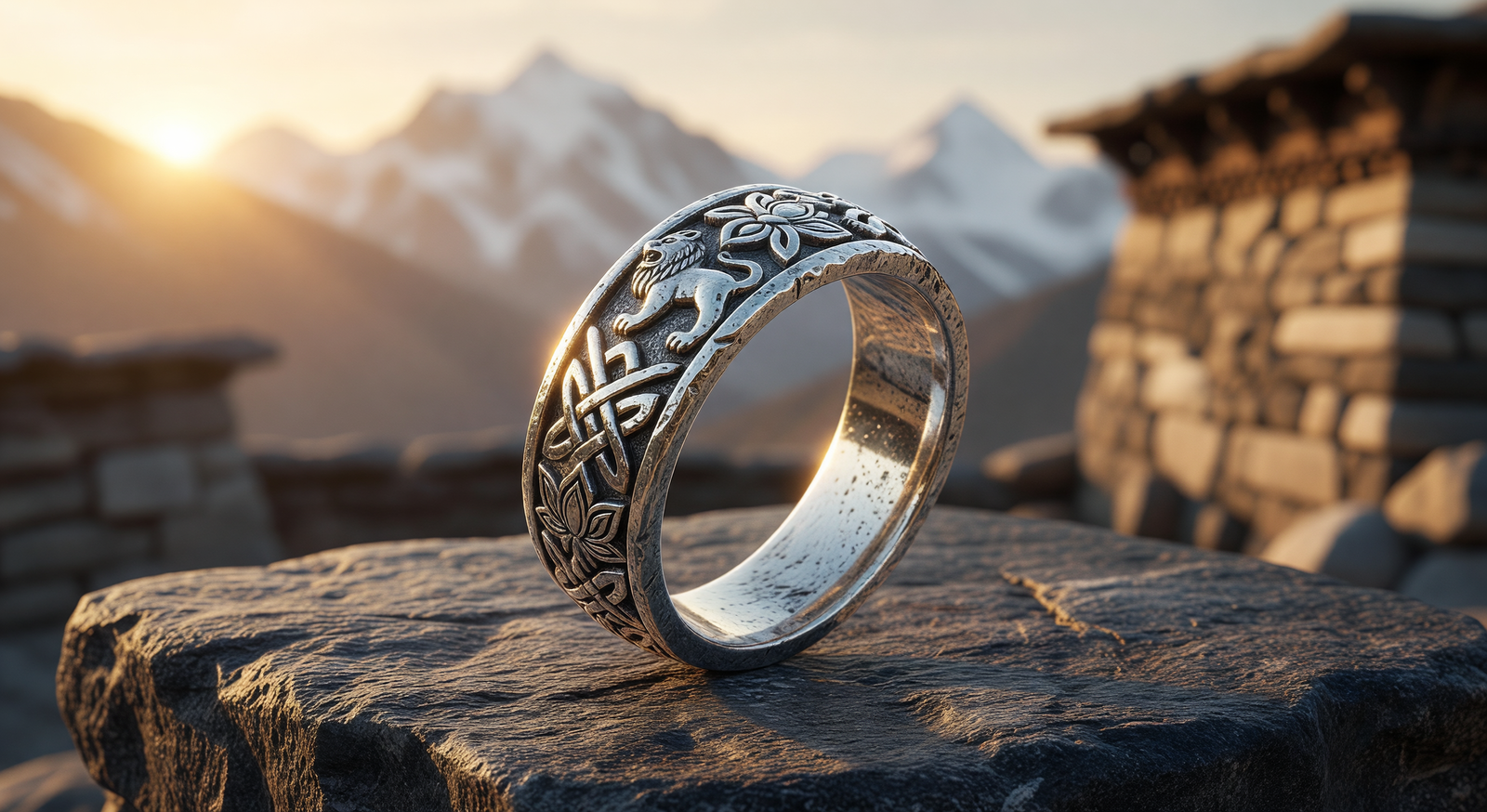
You’ve sat with the breath. You’ve read the texts. You’ve navigated the subtle shifts in your mind on and off the cushion for years. Yet, some days, the practice feels distant—a concept you understand intellectually but struggle to feel in the marrow of a busy life.
Between quarterly reports and family obligations, the thread of mindfulness can feel thin. You’re not looking for a magic talisman, but a tangible reminder. A quiet, constant anchor that brings you back to your intention.
That’s the space a well-chosen piece of silver can occupy. It’s more than metal; it’s a point of contact for your commitment, something we understand deeply in our collection of authentic men's rings.
The Foundation: What 925 Sterling Silver Really Is
You've likely seen the number "925" stamped on jewelry before. It's a hallmark of quality, a standard. But what does it actually represent, and why is it the metal of choice for meaningful, durable pieces?
The number itself is a direct statement of purity: the alloy is 92.5% pure silver, with the remaining 7.5% composed of other metals, usually copper. This brings us to a common misconception we often hear: that "pure" silver (99.9% fine silver) is inherently better or more valuable.
From a craft perspective, this isn't the case. Fine silver is extraordinarily malleable. You could easily bend a ring made of it with your bare hands. It's unsuitable for daily wear, especially for a man's ring that will endure handshakes, typing, and the general rhythm of life.
The addition of copper is what gives sterling silver its tensile strength and durability. It's a purposeful alchemy, a practical blend that allows silver's cool luster to be shaped into forms that can last for generations.
This isn't a dilution; it's an enhancement. It's the difference between a beautiful idea and a practice that can withstand the pressures of reality.
In the Himalayas, silver has never been just a decorative metal. Since the 15th century, it served as a store of wealth, a form of protection, and a medium for sacred art. Tibetan men traditionally wore silver rings, often inlaid with turquoise or coral, not only for adornment but as symbols of their lineage and spiritual commitments.
Silver was believed to have purifying properties, both physically and energetically. Ritual objects like ghantas (bells) and dorjes (vajras) are often crafted from silver alloys, their resonance and feel being integral to their function.
When our artisans in Kathmandu, led by Master Tenzin, work with 925 silver, they are continuing this lineage. They understand the metal not only by its chemical composition, but by its cultural weight and spiritual potential.
They know they aren't just making jewelry; they're crafting tools for the path.

Why This Matters in 2026: An Anchor in a World of Abstraction
Let's be honest about the nature of a committed practice in the modern world. Your meditation isn't happening in a cave. It's happening in the ten minutes before your first Zoom call, in the space between a difficult conversation with your partner and helping your kids with their homework.
Your greatest challenges aren't demons from ancient texts; they're the subtle habits of mind that arise during a performance review or while sitting in traffic.
In this context, the abstract nature of the Dharma can sometimes feel out of reach. You know the teachings on impermanence (Anicca), but the pressure to build a permanent, stable career feels all-consuming. You understand non-attachment (Anatta), but the love for your family is a powerful, grounding force.
This is the friction of the householder's path. It's where those on a path of self-inquiry hit a plateau—the initial insights have settled, and the real work of integration begins.
A physical object, like a substantive silver ring on your hand, serves as a bridge. It's a non-digital, non-demanding presence. When you glance at it during a tense negotiation, it's a silent reminder of your deeper intention: to act with integrity.
When you feel its cool weight—roughly 8 to 12 grams depending on the band width—while washing your hands, it can be a micro-meditation, a moment to return to the physical sensation and the present moment.
It doesn't solve the problem for you, but it consistently, quietly, poses the question: "How are you showing up right now?"
This is why the aesthetic of our men's collection leans toward a certain grounded, unpolished reality—what some might call a "dark aesthetic." It's not about being morbid. It's about acknowledging the whole of the path.
Symbols like the skull are not only gothic flair; they are direct reminders of impermanence, a core tenet that cuts through trivial anxieties. The Dorje (or Vajra) symbolizes the indestructible nature of enlightened mind, a potent reminder of your own inner resources when faced with external chaos.
In 2026, as life becomes increasingly mediated by screens and abstract data, having a piece of solid, meaningful, hand-worked metal on your body is a small act of rebellion. It's a way of saying, "I am here.
My practice is here. In this body, in this moment."
Real Benefits: How It Works for a Practitioner
Beyond its aesthetic appeal, a thoughtfully chosen ring becomes a functional part of your spiritual life. Its benefits are subtle yet steady, weaving themselves into the fabric of your daily awareness. It's not about expecting the ring to *do* something for you, but about how *you* can use it as a tool.
A Tangible Anchor for Mindfulness
The human mind wanders. This is a fundamental truth we all encounter on the cushion. A key instruction in mindfulness practice is to have an anchor—most commonly, the breath. But in the midst of a chaotic day, even the breath can feel elusive.
A ring provides a secondary, tactile anchor. The simple, physical sensation of it on your finger is always available. You can consciously use it as a focal point. For example, before sending a difficult email, you might pause and rotate the ring on your finger, feeling its texture and temperature—perhaps the cool smoothness of silver or the subtle warmth where it meets your skin.
This simple act breaks the chain of reactive thought, creating a precious gap of awareness. It's a circuit-breaker for habitual mental patterns, bringing you out of your head and back into your body, which is always in the present moment.
A Symbol of Your Deepest Intentions
if you've formally taken vows or simply hold a deep, personal commitment to the path, a ring can serve as a constant, physical embodiment of that intention. It's similar to a wedding band, which is not only a piece of jewelry but a public and private symbol of a lifelong commitment.
A ring bearing a mantra like "Om Mani Padme Hum" or a symbol like the Endless Knot isn't just a decoration. It's a private vow you make to yourself each morning when you put it on.
It's a reminder of your aspiration to cultivate compassion, wisdom, and patience. When you find yourself in a situation that tests these qualities, the ring is there. It doesn't preach or judge; it simply reflects your own highest intention back at you, offering a silent encouragement to align your actions with your values.
The Energetic and Cultural Significance
In Tibetan culture, certain materials are believed to have inherent properties. Silver is traditionally associated with the moon, with coolness, and with clarity. It's seen as a purifying element that helps to ward off negative influences and stabilize one's energy.
While we don't present this as a scientific fact, we honor it as a part of the living tradition from which these pieces come. When monks from the Sera Monastery bless our malas and jewelry, they are engaging with this deep stream of cultural and spiritual understanding that has been transmitted since the 11th century.
For the wearer, this adds a layer of meaning. You are not only wearing a piece of metal; you are carrying a piece of a lineage. You are connecting with a centuries-old belief in the power of intention, sacred materials, and blessings to support a practitioner on their journey.
It's an investment in an object imbued with purpose, from the hands of the artisan to the chants of the monks. — explore our Tibetan jewelry collection for authentic pieces.
How to Choose an Authentic Ring for Your Practice
Choosing a ring that will serve as a companion on your path is a personal process. It's less about fashion and more about resonance. Here are the key elements to consider to ensure you're selecting a piece that is both authentic in its make and meaningful in its purpose.
1. Verify the Hallmark: The first sign of authenticity is the hallmark. Look for a small stamp on the inside of the band that says "925" or "Sterling." This is your guarantee that you are getting genuine sterling silver, not a plated base metal that will wear off over time.
All pieces in our selection of sterling silver rings are clearly marked, ensuring you are making a lasting investment.
2. Assess the Craftsmanship: There's a world of difference between a mass-produced, machine-stamped ring and one that has been touched by human hands. Look for signs of artistry. Are the details crisp? Is there a satisfying weight to the piece?
On our rings, you might notice the subtle variations that indicate hand-finishing—the way the oxidation is applied to create depth, or the precise carving of a mantra. These aren't imperfections; they are the signature of the artisan, a a sign of the fact that a person, not only a machine, brought this object into being.
A ring completed in a Kathmandu workshop carries the deliberate marks of the silversmith's file.

3. Understand the Symbolism: A symbol is only as powerful as your connection to it. Don't choose a design simply because it looks interesting. Take the time to understand its meaning within the Tibetan Buddhist context.
- The Vajra (Dorje): Symbolizes indestructibility, clarity, and the thunderbolt of enlightenment that cuts through ignorance. A powerful symbol for those committed to a Vajrayana path or seeking to cultivate unwavering resolve.
- The Skull (Kapala): A direct and potent reminder of impermanence and the death of the ego. It encourages you to live fully and without attachment to trivial matters.
- Mantras (e.g., Om Mani Padme Hum): The mantra of compassion. Wearing it is a constant reminder to cultivate loving-kindness towards yourself and all beings.
- The Endless Knot: Represents the interconnectedness of all things and the endless cycle of cause and effect (karma). A reminder of the deep and inescapable nature of interdependence.
Choose the symbol that resonates most with your current stage of practice or the quality you most wish to cultivate.
4. Ensure the Right Fit: This is a practical but crucial step. A ring that is too tight is a constant distraction, and one that is too loose risks being lost. We recommend getting your finger professionally sized at a local jeweler.
If that's not possible, you can use online guides, but be sure to measure at the end of the day when your finger is at its largest. A proper fit ensures the ring becomes a comfortable, almost unnoticeable part of you—present without being a nuisance.
How To Use It Day To Day: Integrating Your Ring into Daily Life
Once you've chosen your ring, its journey with you truly begins. The goal is for it to become more than an accessory; it should become an active part of your practice. Here's how to mindfully integrate it into your life.
The Initial Intention: When your ring first arrives, don't just put it on. Take a few moments. Sit quietly and hold it in your hands. Feel its weight, its texture, its temperature. Set a clear intention for it.
What do you want this ring to remind you of? Perhaps it's patience during family conflicts, clarity in your professional life, or simply the commitment to return to the present moment. This small, initial ritual consecrates the ring with your own personal meaning, anchoring the blessings it may have already received through the hands that crafted it.
Daily Touchpoints: Weave the ring into your daily routines. For instance, you might make a habit of touching it or rotating it on your finger every time you sit down at your desk to begin work.
Let this be a signal to take three deep breaths before diving into your tasks. Or, perhaps you touch it every time you get into your car, as a reminder to practice mindful driving.
These aren't complex rituals; they are simple, repeated actions that build new neural pathways and associate the physical object with a state of alert presence.
Mindful Care as Practice: Over time, your sterling silver ring will develop a patina, a soft glow that comes with age and wear. It will also tarnish, especially if exposed to certain chemicals or moisture.
The act of caring for your ring can be a practice in itself. Once a month, take a few minutes to clean it. Use a soft polishing cloth and work gently across the band.
As you polish away the tarnish, reflect on the practice of purifying your own mindstream—removing the dullness of habit and revealing the clear, bright nature underneath. This transforms a simple chore into a meaningful meditation on renewal and care for the tools that support your path.
Common Questions About 925 Silver Rings
What is the real difference between 925 sterling silver and pure silver?
The primary difference is durability and practicality. Pure silver, also known as fine silver (99.9% pure), is extremely soft and malleable. While beautiful, it's not suitable for jewelry that is meant to be worn daily, as it would easily scratch, dent, and lose its shape. 925 sterling silver is an alloy made of 92.5% pure silver and 7.5% other metals, typically copper. This addition of copper dramatically increases the metal's hardness and strength without compromising its beautiful color and luster. For a practitioner seeking a ring to wear consistently as a reminder, 925 sterling silver is the superior choice because it is crafted to endure the realities of daily life, making it an investment that will last for decades.
Will my sterling silver ring tarnish, and how should I clean it?
Yes, tarnishing is a natural process for sterling silver. It occurs when the silver and copper in the alloy react with sulfur compounds in the air, creating a dark layer of silver sulfide. This is not a defect but a characteristic of the metal. To clean it, avoid harsh chemical dips. The best method is to use a soft, specialized silver polishing cloth, which is often impregnated with a gentle cleaning agent. For regular maintenance, simply rubbing the ring with the cloth will restore its shine. For heavier tarnish, you can create a paste of baking soda and water, gently rub it on with a soft cloth, rinse with warm water, and dry thoroughly. Treating this cleaning as a mindful practice of care can add another layer of meaning to your piece.
Can I wear my silver ring while I meditate?
Absolutely. Those on a committed path find that wearing their ring during meditation anchors their practice. It can serve as a physical reference point, similar to focusing on the breath. If you find your mind wandering, you can bring your awareness to the feeling of the ring on your finger—its weight, its temperature, its pressure. This simple sensory focus can be very grounding and help pull you out of discursive thought. Some practitioners also use the ring as a focal point for their intention at the beginning of a session, holding it for a moment to remember why they came to the cushion. Ultimately, it's a personal choice. If you find it distracting, you can remove it. But for most, it becomes a helpful, silent companion in their practice.
How do I find my correct ring size at home?
While the most accurate method is to be sized by a professional jeweler, you can get a reliable measurement at home. The best way is to take a ring that you already own and know fits well, and measure its internal diameter in millimeters. You can then compare this measurement to a standard international ring size chart, which is easily found online. Alternatively, you can use a thin strip of paper or a piece of string. Wrap it snugly around the base of the finger you intend to wear the ring on, mark where it overlaps, and then measure the length in millimeters. It's crucial to do this when your hands are at a normal temperature, preferably at the end of the day, as fingers can swell and shrink.
What makes a Buddhabelief ring different from one I might find on Etsy?
The difference lies in intention, authenticity, and lineage. While there are many talented artisans on platforms like Etsy, our focus is singular. We partner directly with specific workshops in the sacred city of Boudhanath, Kathmandu—places we have visited and built relationships with over many years. Our pieces are designed with a deep understanding of Tibetan Buddhist symbolism, intended for practitioners. Furthermore, many of our pieces are blessed by monks from esteemed monasteries like Sera. This isn't a marketing gimmick; it's an integral part of our process, imbuing each piece with a spiritual resonance that is hard to find elsewhere. When you choose a ring from us, you're not only buying an object; you're supporting a community of artisans and receiving a tool that has been steeped in a living spiritual tradition.
Are the materials you use ethically sourced?
This is a question we take very seriously, as right livelihood is a cornerstone of the Buddhist path. We work diligently to ensure our supply chain is as ethical and transparent as possible. Our silver is sourced from reputable suppliers who adhere to standards for responsible mining. More importantly, our primary focus is on the human element. We partner with small, family-run workshops in Nepal, not large factories. We pay our artisans, like Master Tenzin and his team, a fair, living wage that honors their exceptional skill and dedication. By building long-term, direct relationships, we ensure the creation of each piece supports the well-being of the community from which it originates. This commitment to ethical partnership is fundamental to our mission.
Your Journey Forward
By 2026 and beyond, the path won't get any simpler. The demands on your time and attention will likely grow, and the need for grounding, tangible anchors for your practice will become even more crucial.
Choosing a ring is a small act, but it carries real intention. It's a commitment to carry your practice off the cushion and into the world. It's a quiet statement that even amidst the complexity of modern life, you are dedicated to the path of awareness, compassion, and wisdom.
This is more than an adornment. It's the piece you'll still be wearing in 20 years—its 925 silver softened by time, its hand-stamped symbols a familiar touchstone worn smooth against your skin. It will bear witness to your journey, a silent companion through challenges and insights alike.
We invite you to explore the authentic men's rings in our collection and find the one that speaks to your path, ready to accompany you on the journey ahead.
Keep reading