
buddhist-jewelry
The Spiritual Significance of Green Tara Necklaces
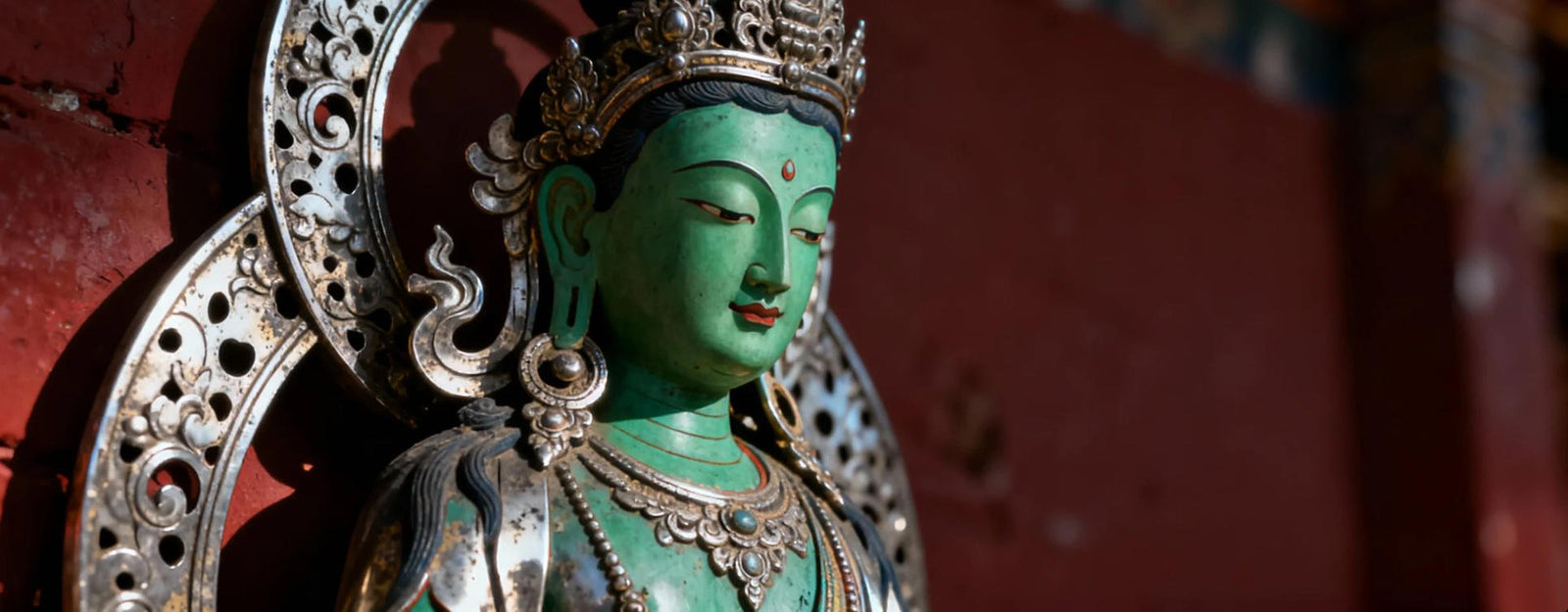
In the vast and luminous pantheon of Tibetan Buddhism, few figures are as immediately accessible and deeply beloved as Green Tara. Her presence is a beacon of hope, a promise of swift assistance, and a source of profound comfort.
Known as the "Mother of Liberation" and the embodiment of active compassion, her influence extends far beyond any single spiritual tradition, touching the hearts of those who seek protection, courage, and guidance. To wear a Green Tara necklace is to do more than adorn yourself with a beautiful object; it is to create a conscious, personal connection with her enlightened presence.
It is an invitation for her protective and loving presence to become a constant companion in your life, offering strength in times of difficulty and celebrating your moments of joy. Understanding her essence, her history, and the rich symbolism she carries can transform a piece of jewelry into a powerful tool for your spiritual journey, a daily reminder of the limitless compassion and potential that resides within you.

The Luminous Origins of Green Tara: A Tale of Compassion
To truly appreciate the significance of a Green Tara necklace, you must first understand the powerful stories that gave birth to her. Her origins are not only ancient myths; they are teaching tales that reveal the very nature of her being—compassion born from compassion itself.
The most widely known story connects her directly to Avalokiteshvara, the Bodhisattva who embodies the compassion of all Buddhas.
As the tale goes, Avalokiteshvara looked down upon the world from his celestial abode and was overcome with sorrow. He saw the immense suffering of all sentient beings, trapped in the endless cycle of birth, death, and rebirth known as samsara.
He saw their fear, their pain, their confusion, and their loneliness. Witnessing this overwhelming sea of misery, his heart broke, and a single, perfect tear fell from his right eye. From this tear, a pristine lotus flower blossomed, and from the heart of that lotus, the radiant goddess Tara appeared, vowing to help Avalokiteshvara in his noble mission.
She declared, "Lord of the world, you need not be discouraged. I will be your companion in helping sentient beings. Though they are numberless, my aspiration is greater." With this promise, she became the active expression of his compassion, ready to leap into action at a moment's notice.
Another powerful origin story casts her as a courageous human princess named Yeshe Dawa, which means "Moon of Primordial Wisdom." Living countless eons ago, she was a deeply devoted spiritual practitioner who made vast offerings to the Buddha of that era, Tonyo Drupa.
The monks, impressed by her devotion and wisdom, advised her to pray for a male rebirth in her next life to progress more easily toward enlightenment. At the time, it was a common belief that only in a male body could one achieve full Buddhahood.
Princess Yeshe Dawa, with profound insight and unwavering resolve, rejected this notion. She responded by declaring that from a ultimate perspective, there is no such thing as "male" or "female." These are just labels we attach to a temporary form.
She then made a groundbreaking vow: "There are many who desire enlightenment in a man's body, but no one works for the benefit of sentient beings in the body of a woman. Therefore, until samsara is empty, I shall work for the benefit of sentient beings in a woman's body." True to her word, she meditated for eons, attained enlightenment, and became the savioress Tara.
This story is incredibly significant, establishing Tara not only as a compassionate deity but also as one of the first spiritual feminists—a powerful role model who proves that enlightenment is beyond gender and that the female form is a perfect vessel for realizing ultimate truth.
These stories reveal why she is so revered. She is both a celestial being born from the tears of a Buddha and a relatable figure who was once human, who faced societal limitations and transcended them through her own determination.
When you wear a Green Tara necklace, you connect with both aspects: her divine, instantaneous compassion and her earthly, determined courage.
Decoding the Sacred Symbolism of Green Tara
Every detail of Green Tara's depiction is rich with meaning, a visual language that communicates her qualities and her purpose. A Green Tara necklace is a miniature representation of this profound iconography, a portable mandala that you can carry with you.
Understanding these symbols deepens your connection, turning a glance at your necklace into a moment of mindful reflection.
Her Vibrant Green Color: Green is the color of the wind, of nature, of vibrant life, and of swift action. In Tibetan Buddhism, it represents the enlightened activity of the Buddhas—the presence that gets things done.
Her green hue signifies her ability to overcome obstacles and perform enlightened deeds without delay. Just as the wind moves instantly, so too does Tara's help arrive the moment you call upon her with sincere faith.
Her color is a reminder that compassion is not a passive feeling but an active, engaged force for good in the world.
Her Poised Posture: Green Tara is almost always depicted with her left leg folded in a contemplative, meditative posture, while her right leg is extended, with her foot resting on a smaller lotus. This is not a pose of complete relaxation.
It is a posture of dynamic readiness. The folded left leg signifies her mastery of wisdom and her control over internal focus. The extended right leg symbolizes her readiness to spring into action, to step down into the world to aid those who are suffering.
She is simultaneously at peace in her enlightened nature and actively engaged with the world. This posture tells you that she is always prepared to come to your aid, bridging the gap between the spiritual and the everyday.
Her Expressive Mudras (Hand Gestures): Her hands communicate her intentions. Her right hand is extended downward, palm open, in the *Varada Mudra*—the gesture of supreme generosity and granting boons. This signifies her ability to grant your wishes, both temporal (such as health, wealth, and success) and ultimate (the realization of enlightenment).
Her left hand, held at her heart, is in the *Abhaya Mudra*—the gesture of fearlessness and protection. The thumb and ring finger are pressed together, holding the stem of a lotus flower. This gesture is a promise: "Do not be afraid.
I am here to protect you." It dispels terror and grants refuge from all dangers, internal and external.
The Utpala Lotus: The flower she holds is a blue utpala, a type of lotus that blooms at night. This is deeply symbolic. It represents her ability to bring protection and solace even in the darkest of times—during your moments of greatest fear, doubt, or despair.
The lotus stem she holds often has three blossoms: one closed bud, one partially open, and one in full bloom. These represent the Buddhas of the past, present, and future. They also symbolize that your own potential for enlightenment (the closed bud) is present right now and, with her guidance, can blossom into full realization.
When you wear a Green Tara pendant, you carry all this symbolism with you. It becomes a focal point for meditation and a constant, silent reminder of her qualities of readiness, generosity, fearlessness, and the ever-present potential for awakening.
Wearing the Green Tara Necklace: A Talisman for Modern Life
In our complex, fast-paced world, the ancient fears that Tara protects against have taken on new forms. Wearing a Green Tara necklace is not an act of superstition; it is a conscious practice of inviting a specific presence into your life to help you navigate modern challenges.
It serves as a spiritual anchor and a shield against the anxieties of daily existence.
Traditionally, Green Tara is known as the protectress from the "Eight Great Fears" or "Eight Great Dangers." These were originally literal threats: lions, elephants, fire, snakes, floods, imprisonment, thieves, and demons. However, in a spiritual context, these also represent internal obstacles:
- Lions represent pride and arrogance.
- Wild elephants represent ignorance and delusion.
- Forest fires represent hatred and anger.
- Venomous snakes represent jealousy and envy.
- Floods represent attachment and desire.
- Chains of imprisonment represent greed and miserliness.
- Thieves represent wrong views and fanaticism.
- Demons represent doubts and confusion.
Your Green Tara necklace is your personal shield against these modern obstacles. Consider these scenarios where her presence becomes profoundly relevant:
Scenario for the Professional: You are about to give a major presentation or launch a new project. The "lion of pride" might make you overconfident and careless, while the "demon of doubt" whispers that you will fail.
Touching your necklace can be a grounding gesture, a silent prayer to Tara to help you overcome both arrogance and self-doubt, allowing you to proceed with balanced, confident action.
Scenario for the Student: You are facing final exams, and the pressure is immense. The "elephant of ignorance" makes the material seem incomprehensible, and the "chains of greed" make you anxious about your final grade.
Your necklace can serve as a reminder of Tara's swift aid, helping to clear mental fog and encouraging you to focus on the process of learning rather than just the outcome.
Scenario for the Parent or Caregiver: You are feeling overwhelmed by the demands of caring for others. The "fire of anger" flares up in moments of frustration, and the "flood of attachment" makes you anxious about the well-being of your loved ones.
Holding your Green Tara necklace can be a moment of respite, a way to connect with her boundless compassion and find the strength to act from a place of love rather than exhaustion or fear.
The necklace becomes a tangible link to her protective power. It is a private signal to yourself to pause, breathe, and connect with the qualities of fearlessness and compassionate action she embodies. if you are choosing a simple pendant or a more elaborate piece from our complete collection of spiritual jewelry, the true value lies in the intention you infuse it with.
It is your personal commitment to facing life's challenges with the heart of a warrior and the grace of a mother.

Invoking Her Presence: The Power of the Green Tara Mantra
While wearing a Green Tara necklace is a powerful passive connection, actively engaging with her presence through her mantra can create a profound and transformative experience. The mantra is her essence in sound form, a sacred resonance that clears obstacles and invokes her blessings.
The most common Green Tara mantra is:
"Om Tare Tuttare Ture Soha"
Chanting this mantra is like calling her name and inviting her directly into your presence. Each syllable carries a specific layer of meaning and power, working to liberate your mind from different levels of suffering.
- Om: This sacred syllable represents the primordial sound of the universe. It signifies the enlightened body, speech, and mind of all Buddhas and Bodhisattvas. It purifies your own body, speech, and mind, aligning you with the divine.
- Tare: This means "the Liberator." It represents Tara's power to liberate you from samsara—the cycle of suffering and rebirth. It addresses the ordinary, day-to-day problems and dissatisfaction we all experience.
- Tuttare: This means "the One who Eliminates All Fears." This part of the mantra specifically liberates you from the Eight Great Fears, both internal and external. It pacifies the anxieties that hold you back and gives you courage.
- Ture: This means "the One who Grants All Success." This liberates you from the subtle obscurations of ignorance, the root cause of all suffering. It grants success in your spiritual pursuits, leading you swiftly toward the ultimate goal of enlightenment.
- Soha: This is a concluding syllable, akin to "Amen" or "so be it." It means "may the meaning of the mantra take root in my heart." It seals the blessings of the chant, grounding its power within your being.
To practice with the mantra, you don't need an elaborate setup. You can create a simple, powerful ritual:
- Find a Quiet Space: Sit comfortably where you won't be disturbed for a few minutes.
- Set Your Intention: Hold your Green Tara necklace in your hand. Bring to mind a specific obstacle you are facing or a quality you wish to cultivate. You might be seeking courage for a difficult conversation, clarity on a confusing decision, or simply a sense of peace.
- Visualize Her: Close your eyes and imagine Green Tara seated before you. See her radiant, emerald-green body, her compassionate smile, and her hands in their gestures of generosity and protection. Imagine warm, green light flowing from her heart into yours, dissolving all fear, sickness, and obstacles.
- Chant the Mantra: Begin to recite "Om Tare Tuttare Ture Soha." You can chant it aloud or silently to yourself. Let the resonance of the words fill your awareness. Traditionally, a mantra is recited 108 times, and using a set of mala beads can help you keep count without distracting your mind. As you chant, maintain the visualization of her light purifying you.
- Conclude with Gratitude: After you finish, sit in silence for a moment. Feel the peaceful, courageous presence that the practice has generated. Thank Tara for her blessings and dedicate the positivity you've created to the well-being of all beings.
This practice transforms your necklace from a symbol into an active spiritual tool, a direct line of communication to the Mother of Liberation.
Green Tara as a Guide for Personal Transformation
Beyond her role as a protector and remover of obstacles, Green Tara is a profound guide for your personal and spiritual transformation. She is not a distant deity to be worshipped from afar; she is a dynamic role model whose qualities you are encouraged to cultivate within yourself.
Wearing her image is a constant reminder of your own potential to embody active compassion, wisdom, and fearlessness.
Her presence encourages you to move beyond your self-imposed limitations. She represents the principle that enlightenment is not a passive state to be achieved in some far-off future. It is an active, engaged way of being in the world right now.
Your Green Tara necklace can serve as a catalyst for this inner shift. When you catch a glimpse of it in the mirror or feel its weight against your skin, let it prompt a question: "How can I be like Tara in this moment?"
- Embodying Active Compassion: Tara doesn't just feel compassion; she acts on it. Your necklace can inspire you to do the same. This doesn't require grand gestures. It can be as simple as offering a listening ear to a friend in distress, donating to a cause you care about, or simply offering a kind word to a stranger. It is about choosing action over apathy.
- Cultivating Fearlessness: Tara's promise of protection is also an encouragement to be brave. The necklace is a reminder that you possess an inner wellspring of courage. When you face a situation that frightens you—be it public speaking, setting a boundary, or making a major life change—you can touch your necklace and connect with her fearless presence, remembering that you have the strength to face the challenge.
- Practicing Generosity: Her boon-granting mudra is a call to cultivate generosity in your own life. This includes material generosity, but more importantly, it means being generous with your time, your patience, and your forgiveness. It's about opening your heart and giving freely without expecting anything in return.
This practice of embodying her qualities can be supported by other mindful reminders. Just as the necklace works on a visual and tactile level, many find that wearing sacred symbols like meditation bracelets offers a similar, constant touchstone throughout the day, reinforcing their commitment to their spiritual path.
Ultimately, your Green Tara necklace is a mirror, reflecting back to you the enlightened qualities that are already part of your true nature, waiting to be awakened and expressed.
Integrating Your Green Tara Necklace into Your Spiritual Practice
To fully open up the potential of your Green Tara necklace, it helps to integrate it into your life with intention and respect. Treating it not only as an accessory but as a sacred object enhances its significance and strengthens your connection to the presence it represents.
Creating a Sacred Connection: When you first receive your necklace, take a moment to form a bond with it. You can perform a simple cleansing ritual to clear any qualities it may have picked up on its journey to you.
This can be done by letting it rest in moonlight overnight, smudging it with the smoke of sage or palo santo, or placing it on a crystal like selenite. After cleansing, hold it in your hands and set a clear intention.
You might say a prayer or simply speak from the heart, dedicating the necklace to your spiritual growth, your protection, and the well-being of all. This personal consecration makes it uniquely yours.
Daily Rituals and Reminders: Weave the necklace into the fabric of your day. You might develop a small ritual of putting it on in the morning. As you clasp it, take one deep breath and state an intention for the day, such as "Today, I will act with compassion," or "Today, I will face my challenges with courage." Throughout the day, especially in moments of stress or difficulty, you can consciously touch the pendant.
Let this physical contact be an anchor that brings you back to the present moment and reconnects you with Tara's peaceful, powerful presence. It can be a secret source of strength that only you are aware of.
Using it in Meditation: Your necklace can be a wonderful focal point for meditation. During your practice, you can hold the pendant in your hand. As you meditate on the qualities of Green Tara, you can feel the physical object, making the connection more tangible.
You can also use it in a visualization practice. Imagine the Tara on your necklace coming to life, radiating brilliant green light. See this light enter your body, filling every cell, purifying all negativity, and infusing you with her blessings of health, courage, and compassion.
By treating your Green Tara necklace with this level of mindfulness, it becomes more than a symbol. It evolves into a cherished partner on your spiritual path—a source of comfort, a wellspring of inspiration, and a constant, beautiful reminder of the divine feminine presence that guides and protects you on your journey toward liberation.
Frequently Asked Questions about Green Tara Necklaces
Do I need to be a Buddhist to wear a Green Tara necklace?
No, you do not need to be a practicing Buddhist. Green Tara's qualities of compassion, protection, and swift action are universal.
Her presence is accessible to anyone who approaches with a sincere and open heart. She is seen as an embodiment of the compassionate quality of the universe, which transcends all religious labels. Wearing her image is a way to connect with these positive qualities within yourself and in the world.
How should I care for my Green Tara necklace?
Treat your necklace as a sacred object. When you are not wearing it, store it in a clean, respectful place, like a small pouch or a special box.
Avoid wearing it during activities where it could be damaged, such as heavy exercise or swimming. Clean it gently with a soft cloth. Most importantly, care for it with mindful intention, recognizing it as a symbol of your spiritual journey.
What is the main difference between Green Tara and White Tara?
While both are aspects of the same compassionate quality, they have different specialties. Green Tara, with her leg extended, represents the active, swift, and wrathful aspect of compassion—she acts immediately to protect from worldly and spiritual dangers.
She is the "doer." White Tara, often depicted with seven eyes and seated in a full meditative posture, represents the motherly, healing, and serene aspect of compassion. She is primarily invoked for longevity, health, and pacifying illness or life-threatening situations.
Can I wear my Green Tara necklace with other spiritual jewelry?
Yes, absolutely. Practitioners wear multiple pieces of spiritual jewelry that hold personal significance. The most important factor is your own intention and how the combination feels to you.
You might wear a Green Tara necklace for protection and a mala bracelet for mindfulness. Trust your intuition to create a combination of sacred adornments that supports your unique spiritual practice.
What if I don't feel an immediate connection or see results?
Building a spiritual connection is a practice, much like learning an instrument or a new skill. It requires patience and consistency. If you don't feel an immediate effect, don't be discouraged.
Continue to wear the necklace with intention. Practice her mantra, even for just a few minutes each day. Meditate on her image and read her stories. The connection is a relationship that you cultivate over time.
The subtle shifts in your mindset, courage, and compassion are often the first "results" you will notice.
Keep reading