

Bead Sizes
Mala Bead Size Guide: 6mm vs 8mm vs 10mm
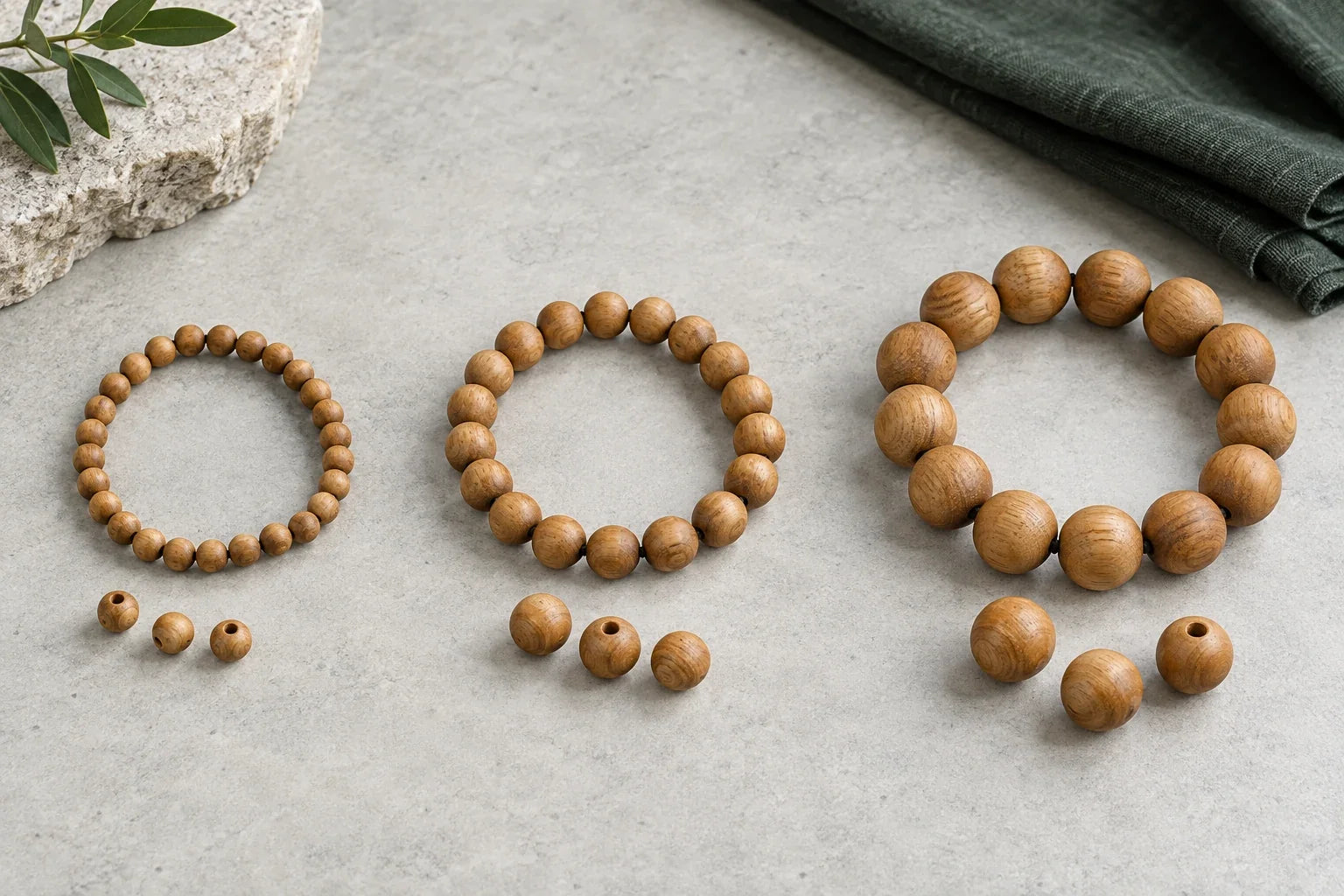
AI-generated editorial illustration; not an exact-scale size chart or a product photograph.
Short answer: choose 6mm mala beads for a fine, quiet scale, 8mm for a balanced mid-size presence, and 10mm for a bolder look with more bead surface to hold. Diameter affects appearance, handling, weight and the space a fixed bead count occupies, but it does not decide a mala's spiritual value or guarantee comfort for every person.
The useful comparison is not simply “small, medium or large.” First confirm whether the listing describes a round bead, a shaped bead with two dimensions, or the finished strand. Then compare bead diameter while keeping material, bead count and construction as consistent as possible. This guide focuses on that diameter decision; it leaves material meanings and wrist measurement to their own dedicated guides.
What mala bead size actually measures
For a round bead, a size such as 8mm usually describes the bead's diameter: the distance across the sphere through its center. It is not the circumference of your wrist, the diameter of the stringing hole, the number of beads, or the total necklace length.
That distinction matters because four separate specifications can change the result:
- Bead diameter controls the scale of each round bead.
- Bead shape changes how a stated size should be read. A seed, barrel or oval may have both length and width.
- Bead count tells you how many counting beads are present, not how large they are.
- Finished length includes the whole construction, which may involve knots, spacers, a guru bead, cord and a tassel.
A 108-bead mala made with 6mm rounds and a 108-bead mala made with 10mm rounds share a count, yet they can occupy very different amounts of space. Conversely, two strands made with 8mm beads can finish at different lengths if one has knots or spacers between beads. For an overview of counts and construction, use the mala bead counts and materials guide.
6mm vs 8mm vs 10mm mala beads at a glance
Use this table as a visual and handling comparison, not a ranking. The mass figures are mathematical ratios for solid spheres of the same material and density. They compare one bead with another; they are not promises about the weight of a finished mala.
| Round bead | Visual and handling scale | Relative mass per bead | Consider it when |
|---|---|---|---|
| 6mm | Fine-grained and understated | 1.00 reference | You prefer a discreet strand and smaller contact points |
| 8mm | Clear presence without the largest scale | About 2.37 times 6mm | You want a middle reference for comparing designs |
| 10mm | Bold, with more surface under the fingers | About 4.63 times 6mm | You favor a substantial silhouette and larger tactile steps |
At the same material and bead count, moving from 6mm to 8mm is more noticeable than the two-millimeter difference may sound. Moving from 8mm to 10mm nearly doubles the theoretical mass of each solid spherical bead: the ratio is about 1.95. Real beads have drilled holes, material variation and different finishing, so use these ratios to understand scale, not to calculate shipping weight or exact wear comfort.
How diameter changes presence, handling and length
Appearance: smaller beads create more visual detail along a given section of strand. Larger beads make each individual surface, color variation and polish more prominent. That can matter in refined jewelry styling: a 6mm strand may sit quietly beside a pendant or watch, while a 10mm strand can become the main visual element. Neither scale is inherently more formal, authentic or meaningful.
Handling: larger round beads give the fingers a wider surface and a larger step from one bead to the next. Smaller beads produce finer transitions and take less space in the hand. Preference depends on hand size, sensitivity, pace and whether the mala will be counted, worn, displayed or used in more than one way. Product photography alone cannot settle this; a ruler, dimension diagram or familiar object in the frame is more useful.
Relative weight: for geometrically similar solid spheres, volume scales with the cube of diameter. This is why a 10mm bead of the same material is not merely 67% heavier than a 6mm bead in theory; it has about 4.63 times the volume before accounting for the hole. A finished strand also includes cord, findings, feature beads and natural variation, so compare listed product weights when available.
Bead-only length: as a transparent planning estimate, 108 identical round beads touching edge to edge would span about 648mm at 6mm, 864mm at 8mm and 1,080mm at 10mm. That is approximately 25.5, 34.0 and 42.5 inches respectively. These are calculated bead runs, not finished necklace lengths or hanging drops. Knots, gaps, spacers, a guru bead, tassel construction and cord tension can all change the finished measurement.
Choose by use, proportion and design
Start with how you expect the strand to participate in your day. If it will be layered with other jewelry, compare bead scale with the chain, watch case, pendant or other bracelet rather than choosing in isolation. If it will be handled for counting, think about how distinctly you want to feel each transition. If it will often travel in a pouch, consider the total bulk of the complete design.
Then hold the other variables steady. Compare 6mm and 8mm in the same material when possible, because dense stone and light seed material can feel different even at the same diameter. Compare the same count when length matters. Compare like shapes when silhouette matters. A material choice is a separate decision; the guide to choosing mala bead materials provides that broader context without turning diameter into a symbolic rule.
Hypothetical shopping scene: imagine someone choosing a strand to wear under a shirt collar during the week and to handle occasionally at a desk. They may begin with 6mm because the scale is discreet, then compare an 8mm sample if the smaller beads feel too fine. This is a decision method, not a real customer story, and the final choice depends on the actual strand.
Hypothetical shopping scene: imagine a buyer selecting a visually substantial gift for someone who prefers one statement accessory rather than layered jewelry. A 10mm round-bead design might suit that visual brief, but the buyer should still verify finished length, product weight and return terms. This is a fictional example, not a testimonial or evidence that 10mm will be comfortable for the recipient.

Read round and shaped bead listings correctly
A single measurement such as 8mm is easiest to compare when the product clearly shows a round bead. A label such as 8x7mm describes two dimensions of a shaped bead. It should not be silently converted into an “8mm sphere,” because its profile and volume are different. Ask which dimension runs along the string and which runs across the bead if the diagram or product photography does not make that clear.
Current Buddhabelief listings illustrate three different ways size can appear. The product listed as an 8mm white crystal 108-bead strand has one 8mm size option. A rudraksha mala listing with 8mm through 11mm options lets shoppers compare several single-number sizes. By contrast, the bodhi seed strand with two-dimensional size labels currently uses 8x7mm, 9x8mm and 10x9mm options. Those bodhi labels describe shaped dimensions, not 8mm, 9mm or 10mm spheres.
Availability and variant menus can change. Treat the selector on the current product page as the purchasing source of truth, and do not infer a 6mm option when none is shown. Also separate a material label from independent material verification: the links above identify how the products are listed, not a laboratory finding. After choosing, consult the material-specific mala care guide before exposing a strand to water or cleaning products.

View the product and size options
Mala bead size FAQs
What is the most versatile mala bead size?
For shoppers who want a middle visual scale, 8mm is a useful comparison point, but versatility depends on the complete strand, material, intended use and personal preference. It is not spiritually or medically better than 6mm or 10mm.
Are 10mm mala beads too large?
No universal rule makes 10mm too large. They create a bolder silhouette and more bead surface, while the finished weight and length depend on material, count and construction. Check the actual product measurements rather than deciding from diameter alone.
Does a larger bead mean a longer mala?
If bead count, shape and spacing stay the same, larger round beads require a longer bead run. Actual finished length can still change with knots, spacers, guru beads, tassels and cord tension, so diameter is not a substitute for the listed finished measurement.
Is an 8x7mm bead the same as an 8mm bead?
No. An 8x7mm label gives two dimensions for a shaped bead, while 8mm usually refers to the diameter of a round bead. Compare the shape diagram and orientation instead of treating both labels as equivalent spheres.
Should mala bead diameter match wrist size?
No. Bead diameter describes each bead, while wrist size is a body measurement used to plan bracelet fit. For a wrist-worn design, measure the wrist separately and use the product's finished circumference or sizing instructions.
Make the final size decision
Before buying, reduce the choice to five checks: confirm the bead shape, read every stated dimension, compare the same material where possible, verify bead count and finished length separately, and review the live variant selector. If two sizes remain appealing, decide whether you want the strand to recede into an outfit or lead it visually, then consider how much surface you want to feel between your fingers.
For a bracelet, diameter is only one part of fit. Use the separate beaded bracelet wrist measurement guide to calculate fit from an actual wrist measurement. For a full mala, ask for finished dimensions whenever the listing provides only bead size.
The most informed choice is the one based on a clearly read specification. Six millimeters, eight millimeters and ten millimeters each offer a distinct scale; none carries an automatic spiritual, health or quality advantage. Choose the proportion that suits the design and your intended use, then verify the exact product rather than relying on category shorthand.
Keep reading