

Bracelets
Beaded Bracelet Size Guide: Measure Your Wrist
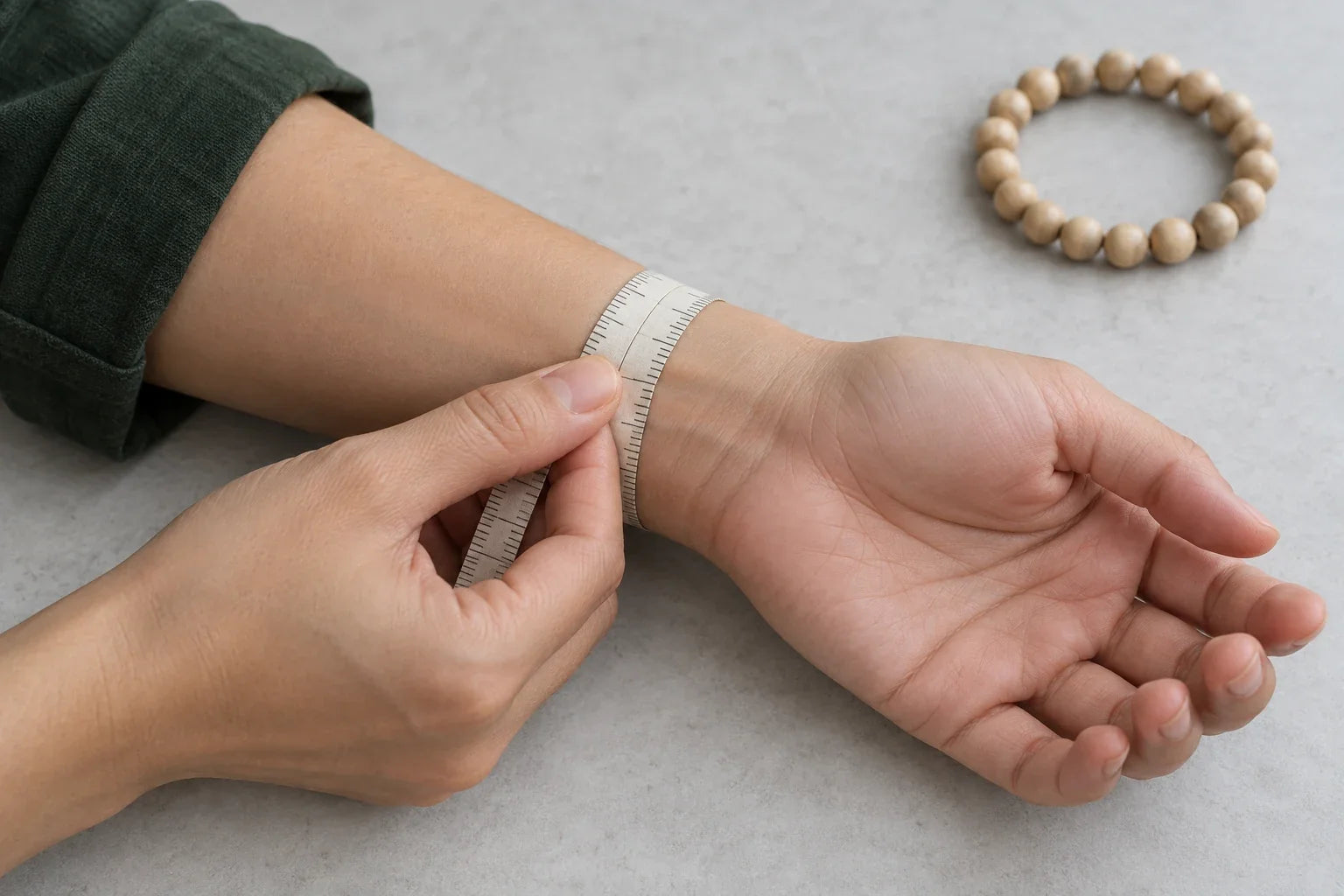
AI-generated measurement illustration; no numerical measurement can be read from this image.
To measure your wrist for a beaded bracelet, wrap a flexible tape around the exact point where you intend to wear it. Let the tape touch the skin without squeezing it, note the wrist circumference, and repeat the measurement. If you do not have a flexible tape, use non-stretch string, mark where it meets, then measure the string against a ruler.
Keep that number as your actual wrist measurement in both centimeters and inches. Do not automatically add 1 cm or assume it is the bracelet size. The right finished size depends on how close you want the bracelet to sit, the bead diameter, and whether the piece uses elastic, a sliding knot, a clasp, or a rigid bangle construction. This guide explains how to record a useful measurement and what to compare before buying.
How to Measure Your Wrist for a Beaded Bracelet
- Choose the intended wear point. Decide whether the bracelet will sit directly behind the wrist bone, slightly farther up the arm, or beside a watch. Measure that location rather than the narrowest point by habit.
- Relax your hand and arm. Keep your fingers open and your wrist in a neutral position. Clenching a fist or flexing the wrist can change how the tape sits.
- Wrap without compression. Place a flexible tailor's tape flat around the wrist. It should touch the skin all the way around but should not press into it. Read the number where the tape meets its zero point.
- Use string carefully if needed. Choose a thin, non-stretch string or narrow paper strip. Wrap it once at the intended wear point, mark the meeting point, lay it straight without pulling, and read the length on a ruler. Do not use elastic cord for this step.
- Repeat before recording. Remove the tape or string and measure again from the beginning. If the two results differ, take a third measurement. Record the repeated result, not the number you expected to see.
Write the result as "wrist circumference," along with the location and preferred feel. For example: "16.5 cm wrist, measured behind wrist bone, close but not compressive." That note is more useful than a vague label such as small or medium. If your wrist size changes noticeably during the day, measure at the time you expect to wear the bracelet and retain both readings for comparison.

Wrist Measurement Conversion: Centimeters and Inches
Use one unit consistently when comparing your measurement with a product page. If conversion is necessary, 1 inch equals 2.54 centimeters. The U.S. National Institute of Standards and Technology explains that the standard inch is exactly equivalent to 25.4 millimeters, which is 2.54 centimeters.
| Wrist circumference (cm) | Wrist circumference (in) |
|---|---|
| 14 cm | 5.51 in |
| 15 cm | 5.91 in |
| 16 cm | 6.30 in |
| 17 cm | 6.69 in |
| 18 cm | 7.09 in |
| 19 cm | 7.48 in |
| 20 cm | 7.87 in |
These values convert the same wrist circumference between units. They do not tell you which bracelet to order and do not include wearing ease. Keep any additional decimal from your own measurement rather than rounding it to the nearest row.
Wrist Circumference, Inner Circumference, and Strand Length
Three measurements that sound similar can describe different things:
- Wrist circumference is the measurement around your body at the intended wear point.
- Unstretched inner bracelet circumference is the usable opening inside a finished bracelet while it is resting, before elastic is pulled.
- Beaded strand length is the length of the constructed strand according to the seller's method. It may include beads, gaps, cord, and closure components, so it is not automatically the same as the inner opening.
Large round beads occupy more space toward the inside of the circle than small beads. When two strands have the same length measured along the bead centers, a strand made with 10 mm beads can have a smaller usable inner opening than one made with 6 mm beads. This comparison does not apply when both bracelets already have the same measured inner circumference. Centerpieces, spacers, knots, and irregular shapes can also change the usable opening. This is why "6 mm bracelet" usually describes bead diameter, not wrist size.
Ask how the seller measured the finished piece. A flat end-to-end length, a circumference traced around the bead centers, and an inner opening can produce different numbers. The measurement method should travel with the number; otherwise, a precise-looking value can still be ambiguous.
Choose Fit by Feel and Bracelet Construction
After recording your wrist circumference, decide how the bracelet should behave. A closer fit moves less but should not leave persistent pressure marks or restrict normal wrist movement. A roomier fit allows more movement and may slide toward the hand. There is no universal amount to add to every wrist measurement. Use the product's own sizing method and the wearer's preference.
A hypothetical desk-wear example shows why preference matters: someone who types all day may want a bracelet to stay behind the wrist bone, while someone who likes visible movement may prefer more room. Both can start with the same wrist circumference but choose different finished fits.
- Elastic bracelets: Elastic helps the bracelet pass over the hand, but it is not infinite sizing. Do not choose a small bracelet on the assumption that repeated stretching will make it fit. Compare the resting inner measurement and ask whether the seller's supported opening range allows it to pass over your hand. Do not force it or test the cord's breaking limit.
- Sliding-knot bracelets: Check both the smallest wearable setting and the maximum opening. The opening must pass over the hand, while the closed range must suit the wrist.
- Clasp bracelets: Confirm whether the published length includes the clasp and whether the bracelet can be fastened comfortably at the intended fit.
- Bangles: A rigid bangle often needs a hand or knuckle measurement because it must pass over the widest part of the hand. Wrist circumference alone may not be enough.
Construction-specific instructions matter. The official Trollbeads size guide, for example, explains that one double leather bracelet's chain is shorter than its indicated size because a lock completes the length. That is not a sizing rule for elastic bead strands; it is a useful example of why a seller's component and measurement method must be read before applying a number.
Compare Bead Diameter Without Mistaking It for Fit
Bead diameter helps you anticipate visual scale, weight distribution, and how much of the bracelet projects from the wrist. It does not replace a finished bracelet measurement. For a focused comparison of common bead diameters, use the separate 6 mm, 8 mm, and 10 mm mala bead size guide.
The following Buddhabelief listings illustrate the difference. They are examples to inspect, not recommendations for a particular wrist measurement:
- The white jade bracelet listing states a 6 mm bead diameter and describes the material as Qinghai Hetian white jade. That is the seller's description, not an independent laboratory report. Readers comparing the material language can also consult the white jade buying guide.
- The green jade bracelet listing states 6 mm beads and describes the material as Russian Hetian green jade. The listing itself notes that the description is not independent origin or laboratory certification.
- The black agate bracelet listing states 10 mm black agate beads and a lotus-style centerpiece. The larger beads and centerpiece can affect how the inner opening feels, so the 10 mm label should not be read as a wrist size.
For any option, compare your recorded wrist circumference with a confirmed measurement for the finished bracelet. If that measurement is absent or its method is unclear, ask before ordering rather than inferring fit from bead diameter, product photography, gender labels, or a broad small-medium-large label.

View the product and size options
Beaded Bracelet Sizing FAQ
How tight should a beaded bracelet fit?
A beaded bracelet can sit close or move more freely, depending on preference, but it should not compress the wrist, restrict movement, or rely on heavily stretched elastic. Record your bare wrist circumference first, then compare it with the seller's finished bracelet measurement and fit guidance.
Should I add 1 cm to my wrist measurement?
Do not treat adding 1 cm as a universal rule. The suitable allowance depends on bead diameter, construction, the seller's measurement method, and whether you want a close or roomier fit. Keep your true wrist circumference unchanged and apply only the guidance for the specific bracelet.
Is bead size the same as bracelet size?
No. A 6 mm or 10 mm label normally describes the diameter of an individual bead. Bracelet fit depends on the finished inner opening or another clearly defined finished measurement. Larger beads can reduce usable inner space when bead-center strand length is held constant, not when measured inner circumference is the same.
Can an elastic bracelet fit every wrist?
No. Elastic provides temporary stretch to pass over the hand, but every strand still has a resting size and a practical stretch limit. Confirm both the unstretched inner measurement and whether the seller's supported opening range accommodates your hand. Do not force the bracelet or assume repeated stretching will resize it.
How can I measure a wrist for a surprise gift?
If direct measurement would spoil the surprise, measure a bracelet the recipient already wears comfortably and record exactly how you measured it. Because that number may be a flat length rather than an inner circumference, tell the seller your method. Without a reliable reference, choose an adjustable design only after checking its full opening and closing range.
Use This Checklist Before You Order
- Measure at the intended wear point with a flexible tape or non-stretch string.
- Keep the tape in contact with the skin without compressing it.
- Repeat the measurement and record both centimeters and inches.
- State whether you prefer a close, balanced, or roomier feel.
- Check whether the seller gives inner circumference, strand length, flat length, or a construction-specific size.
- Account for bead diameter, centerpieces, closures, and the opening needed to pass over the hand.
- Do not assume elastic, a sliding knot, a clasp, and a bangle use the same sizing logic.
Once the fit details are clear, review the material-based bead care guide so the cord and beads are handled appropriately. If a product page does not state the finished measurement or how it was taken, use the contact page to send your exact wrist circumference, preferred fit, and the product link. Ask for the available fit measurement rather than requesting a generic size label.
Keep reading