buddhist-jewelry
Mala Materials Compared: Bodhi, Wood, Stone & Bone
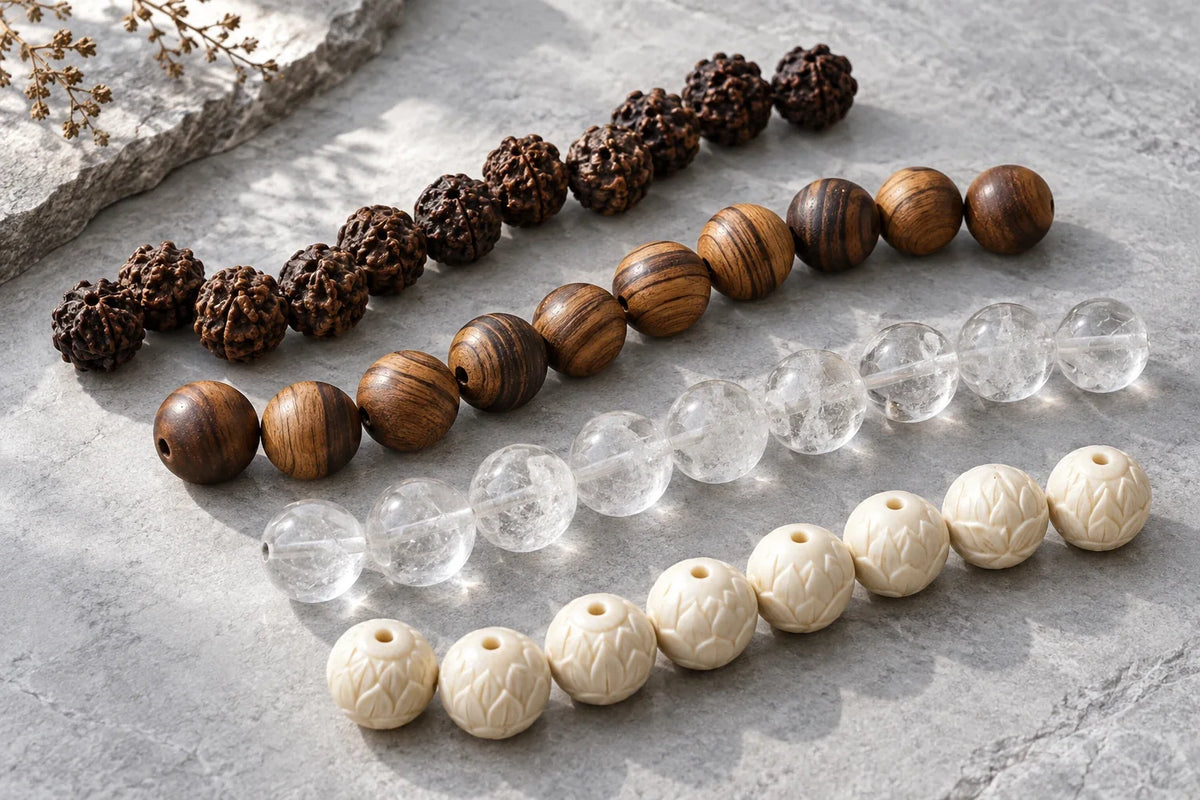
AI-generated editorial illustration of bead textures, not an exact product photograph or material identification chart.
Short answer: choose wood or seed-style beads when you want a lighter mala for longer sessions; choose stone when you prefer more weight, a cooler touch, and strong color variation; choose bone only when animal material fits your values and the listing gives enough detail for an informed decision. Material matters, but bead diameter, total weight, cord, knots, focal beads, and finished length often make a bigger difference in daily use.
A mala is handled one bead at a time, so the best material is not simply the most valuable or visually dramatic. It is the one whose weight, texture, durability, and meaning suit the way you intend to practice. A long 108-bead strand for seated recitation asks for something different from a compact wrist wrap or a decorative piece worn occasionally.
How to use mala beads in a counting practice
To use meditation beads for a simple counting exercise, hold the strand comfortably, choose one short phrase or one natural breath to count, and move to the next bead after each repetition. Begin with a few beads. You do not need to complete a full strand or buy a particular material before learning the sequence.
What mala beads do in a counting practice
A mala gives your fingers a sequence to follow so that you do not have to keep every repetition in your head. It is not a test of concentration or a promise that your thoughts will stop. Religious traditions have their own reasons for counting, ways of handling beads and instructions about particular recitations. The exercise below is a general introduction, not a substitute for those teachings.
If you already follow a teacher, use that teacher's instructions. If you are beginning with a secular exercise, count natural breaths or a simple personal phrase without claiming that the exercise belongs to a lineage you have not studied.
How to use a 108-bead mala, step by step
- Choose a suitable place. Sit somewhere stable where the loose strand will not catch on equipment or distract you from a task that needs attention. Settle into a comfortable position.
- Look at the strand. Identify its counting beads and any larger marker bead. Check the actual arrangement; not every mala has the same count or construction.
- Choose what to count. Use one natural breath or one short phrase for each bead. For a religious mantra, learn pronunciation and any practice requirements from an appropriate teacher first.
- Begin beside a marker. Hold the first counting bead gently and complete one repetition. Move to the next bead without pulling hard on the cord.
- Continue at your own pace. Count once per bead. If your attention wanders, return to the bead you are holding rather than criticizing yourself or rushing to catch up.
- Finish the round. On a strand with 108 counting beads, one repetition at each gives 108 repetitions. A separate marker is not an extra counting bead in this exercise. Traditions differ on how to continue beyond the marker, so follow your teacher for a specific practice.
- Close deliberately. Put the beads down carefully and notice that the session is finished. Record the round only if keeping a count is useful to you; there is no need to make each session longer.
For a shorter beginning, stop after a small number of beads. A brief session is still a complete exercise. Breathe normally; do not force a pace, hold your breath or continue if the exercise feels uncomfortable.
A morning practice before the day starts
Choose a familiar place and decide on a manageable stopping point before you begin. You might use a short phrase that names an intention for the day, then move one bead after each repetition. Keep the exercise separate from checking messages so that you are not repeatedly switching tasks. When you finish, store the strand somewhere it will not be pulled or tangled.
An evening practice before bed
Use the same simple sequence without setting a target for how you should feel afterward. You can count a few natural breaths and stop whenever you choose. Beads do not need to be worn in bed to be part of an evening routine. Put the strand away before sleeping, especially if its cord or fittings could catch.
Using beads during a commute
A short counting exercise may fit a seated journey when you can remain aware of your surroundings. Keep the strand contained and pause when boarding, changing stops or handling belongings. Do not use a bead exercise while driving, cycling, crossing a road or doing another activity that needs your full attention. Counting is optional; safe travel is the priority.
Choosing a strand without choosing a promise
Compare the finished length, bead diameter and construction with how you will use it. A wearable bracelet and a full counting strand serve different practical needs. Check the stated material for each product rather than assuming that all beads in a category share one composition. A product name is not proof of origin, a ritual record or a particular effect.
Browse the mala and prayer bead collection for a broader comparison, or the sandalwood bead category when you want to ask more specific questions about a wood design.
Respectful use if you are not Buddhist
Learning a counting exercise is not the same as receiving instruction in a religious practice. Take time to understand any image or inscription on your beads. Do not describe yourself as trained or initiated on the basis of a retail purchase, and do not assume that one handling rule represents all Buddhist communities. Ask a knowledgeable teacher when you want to adopt a specific practice.
Care and storage
Check the cord and fittings before use. Keep beads away from activities that could stretch or snag the strand, and follow care advice for the identified components. Water, oils, smoke and cleaning products are not suitable for every material. A symbolic cleansing custom is not automatically a safe physical cleaning method.
Questions about using mala beads
Which hand or fingers should I use?
For this general exercise, use a comfortable grip that lets you move beads without strain. Follow your teacher's handling instructions for a tradition-specific practice.
Must I say a mantra?
No. You can count natural breaths or a simple personal phrase. Seek appropriate instruction before adopting a religious recitation.
What if I lose count?
Return to the bead you are holding or begin a short sequence again. In a general introductory exercise, losing count is not a failure.
Can I wear the beads afterward?
Check that the strand is designed and sized for the way you want to wear it. Do not force a long strand into a tight wrap or assume every cord is suitable for continuous wear.
Will a complete round make me calm or help me sleep?
No particular result is promised. Use the exercise only while it feels comfortable, and do not treat beads or a counting routine as medical care.
Bodhi seed vs wood vs stone vs bone
| Material | Typical feel | Daily advantage | Main tradeoff | Best starting point |
|---|---|---|---|---|
| Bodhi-type seed or bodhi root | Light to moderate, often textured | Tactile and usually comfortable for repeated handling | The trade name may not identify a botanical species | Buy for the stated bead size, count, color, and format |
| Wood | Light, warm, and relatively quiet in the hand | Comfortable for long sessions and travel | Finish, scent, grain, and water tolerance vary | Look for a clear material description and close-up photographs |
| Stone | Cooler and usually heavier | Distinct color and a steady physical presence | A full strand can feel tiring; care depends on the mineral | Confirm stone identity, bead size, treatment, and total weight |
| Bone | Warm, firm, and lighter than many stones | Historically documented in Himalayan prayer-bead traditions | Animal material and sourcing may not suit every buyer | Choose only with a direct material statement and sufficient sourcing context |
These are tendencies, not fixed rules. A 10 mm wood strand may feel bulkier than a 6 mm stone strand, and a large guru bead or metal counter can change the balance of an otherwise light mala. Whenever possible, compare the finished weight and length rather than predicting comfort from the material name alone.
Bodhi-type beads: tactile, light, and varied
The historical Bodhi tree associated with the Buddha's awakening is Ficus religiosa, as documented by Kew Science. In contemporary jewelry, however, labels such as “bodhi seed,” “bodhi root,” and “star-and-moon bodhi” can refer to different plant materials and trade categories. The label alone does not establish that the beads came from Ficus religiosa.
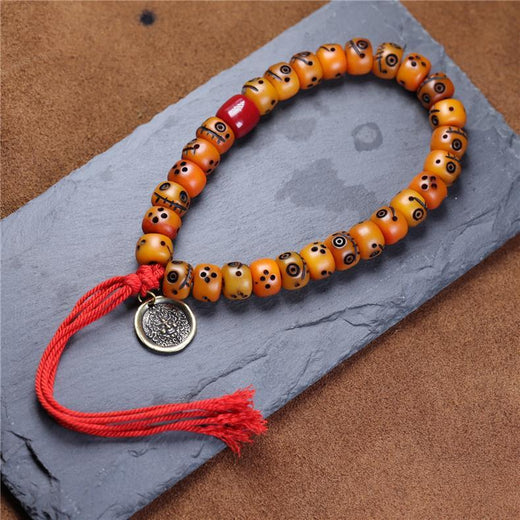
That does not make bodhi-type beads a poor choice. Many buyers like their relatively low weight and changing surface texture. Small flattened beads create a compact layered look; larger round beads give the fingers a more pronounced point of contact. Pale, dyed, or naturally patterned beads can also look very different even when they share a category name.
Choose this family when you want tactile variation without the weight of a long gemstone strand. Check whether the piece is actually a 108-count mala, a shorter handheld strand, or a decorative wrap. Those formats are not interchangeable, even when the main beads have a similar name.
Wood: the easiest all-round choice for many buyers
Wood is usually the most approachable option for long recitation, breath counting, or travel. It tends to feel warm quickly, makes little noise, and places less weight on the hands and neck than many stone designs. Visible grain can add character without requiring a large focal pendant.
The practical differences are in the details. A sealed bead may resist ordinary handling better but feel smoother and less porous. An unfinished surface may change more quickly with oils from the hands. Fragrance varies with species, age, finish, and storage, so scent should be treated as a sensory detail rather than the main reason to buy online.
Wood suits someone who wants a quiet, light strand and accepts that color and sheen may evolve. It is less suitable for regular exposure to showers, swimming pools, perfume, or hand sanitizer. When a listing uses a wood trade name, read it as the seller's material description unless a botanical species is also provided.
Stone: choose for weight, color, and a specific mineral
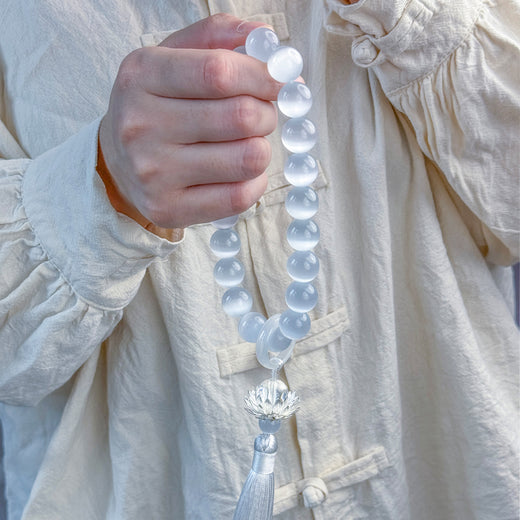
Stone beads bring a cooler first touch and more momentum as the strand moves through the fingers. Some practitioners enjoy that physical presence; others find a full 108-bead stone mala tiring around the neck or in a raised hand. Bead diameter and total weight therefore deserve equal attention.
“Gemstone” and “crystal” are broad shopping terms. Quartz, agate, jadeite, turquoise, and manufactured glass differ in hardness, porosity, treatments, and care. The GIA Gem Encyclopedia is a useful starting point once a listing names a specific material. Before buying, look for whether the beads are natural, treated, dyed, reconstructed, or manufactured when that distinction matters to you.
Choose stone when you value a substantial feel and mineral-specific appearance. For travel or long sessions, a smaller bead size or a shorter strand may be more comfortable than a large 108-bead design.
Bone: a deliberate values and material decision
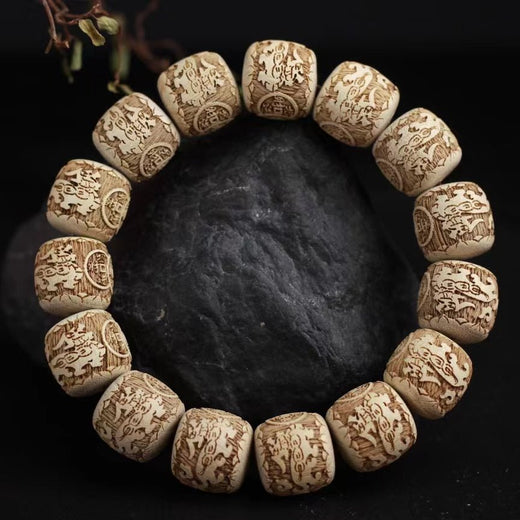
Bone prayer beads appear in documented Tibetan and Himalayan material culture; the Rubin Museum's prayer-bead overview provides historical context. That history does not determine the origin, age, species, or ritual use of a modern retail strand.
Start with a personal question: are you comfortable buying and handling animal material? If the answer is yes, look for a direct material statement, bead dimensions, and an explanation of sourcing that is specific enough to evaluate. Color alone cannot distinguish bone from resin or other imitations, and a photograph cannot establish provenance.
Bone may appeal to someone who values its traditional material context and relatively light, firm feel. It is not an automatic upgrade from wood or seed beads, and it is a poor gift choice when the recipient's views on animal materials are unknown.
Choose by how the mala will be used
For long mantra or breath-counting sessions
Prioritize low weight, smooth bead holes, secure cord, and a bead size your fingers can advance without looking. Wood and many bodhi-type beads are strong starting points. A full stone strand can still work, but check its finished weight and think about whether it will rest in the lap, hang from the hand, or be worn around the neck between sessions.
For everyday wear
First confirm that the product is designed to be worn. A handheld strand may have a tassel, focal carving, or length that catches on clothing. A wrap design needs a stated wrist range, while a necklace-length mala needs enough room to sit comfortably without being pulled or stretched. For bead-diameter tradeoffs, use the separate mala bead size guide.
For travel
A compact wood or seed-style strand is usually easier to pack than a heavy stone mala. Look for a secure pouch, modest focal elements, and construction that will not snag. If you plan to practice in public, a quiet strand with smaller beads may be less distracting than a design with metal counters or multiple pendants.
For a gift
Consider a hypothetical gift for a friend who meditates during a lunch break: a light, simple strand with clearly stated dimensions may be more useful than an ornate design chosen only for symbolism. For someone who collects mineral jewelry, a well-identified stone may be the better fit. When uncertain, avoid animal material, strong fragrance claims, and assumptions about the recipient's religious practice.
Construction can matter more than material
A beautiful material will not compensate for a format that does not suit the intended use. Before checkout, compare:
- Bead count: 108 is common for full malas, but shorter counting strands and decorative wraps serve different purposes.
- Bead dimensions: 6 mm feels very different from 10 or 12 mm over an entire strand.
- Finished length and weight: these determine how the mala sits in the hand, on the neck, or around the wrist.
- Stringing: knots between beads can improve spacing and limit bead loss, while elastic, braided cord, and wire each behave differently.
- Focal elements: guru beads, counters, rings, tassels, and pendants affect balance and snag risk.
- Surface treatment: dye, sealant, polish, fragrance, and metal plating change both appearance and care.
If counting practice is the priority, start with the bead count and construction, then choose the material. The broader mala bead count guide explains the roles of 108-, 54-, and 27-bead formats.
Illustrated formats and available options to compare

The Striped Wood 108-Bead Mala with Beaded Tails is a useful example of a full counting format: its main strand has 108 beads specified at approximately 6 mm, plus separate decorative tail beads. The product page describes the wood by a supplier trade name without assigning a botanical species or country of origin. Consider it when a light, small-bead strand is more important than a large focal pendant.

The Star and Moon Bodhi Wrap with Green Accents shows why format must be checked before category. It uses small, flattened beads in a decorative wrap and is explicitly not a traditional 108-count mala. Its product page gives a supplier wrist guidance of approximately 15 cm. It suits a buyer seeking a layered wrist design, not someone who needs a standard 108-bead counting strand.
After deciding on format and material, browse the mala beads collection to compare what is currently available.
For a purchase shortlist, compare these selected options and their listed USD prices. Shipping and tax are additional where applicable; check the selected listing before ordering.
- Star and Moon bead design - US$80.00 (selected option)
- Small Leaf mala design - US$39.00 (selected option)
- Meditation mala design - US$53.00 (selected option)
Final mala buying checklist
- Name the main use: counting, handheld practice, necklace wear, wrist wear, travel, or gifting.
- Confirm bead count, bead dimensions, finished length, and total weight.
- Read the exact material statement and any treatment or finish details.
- Check cord, knots, focal pieces, tassels, and whether wear parts can be restrung.
- Compare care needs with water, cosmetics, sweat, storage, and travel habits.
- Review current photographs, availability, shipping, and return terms before buying.
Frequently asked questions
Which mala material is best for daily meditation?
For most people, wood or bodhi-type beads are the easiest starting point because they are usually lighter than stone over a full strand. The best choice still depends on the exact bead size, total weight, cord, texture, and whether you plan to count, wear, or travel with the mala.
Are bodhi seed mala beads made from the Bodhi tree?
Not necessarily. The tree associated with the Buddha's awakening is Ficus religiosa, but sellers use “bodhi seed,” “bodhi root,” and related trade names for several plant materials. Treat the term as a product category unless the listing provides a botanical identification.
Sources
Keep reading