buddhist-jewelry
Mala Beads for Sleep: A Proven Ritual


Mala Beads For Sleep is it replays conversations, scrolls through mental to-do lists, and buzzes with a static that keeps you staring at the ceiling. Each bead is hand-knotted by Tibetan artisans at monasteries in Nepal and Tibet, following centuries-old traditions passed down through generations of craftsmen.
The Sacred Pause: From a Racing Mind to Restful Surrender
The day is over, but your mind is not. It replays conversations, scrolls through mental to-do lists, and buzzes with a static that keeps you staring at the ceiling. The physical body is exhausted, a deep ache for rest settling into your bones.
Yet, your mind refuses the invitation. You crave the sweet oblivion of sleep, but your nervous system is still on high alert, caught in the momentum of the day’s demands. It’s a state of being ‘wired and tired,’ a frustrating paradox that leaves you feeling powerless in your own bed.
In this sacred, liminal space between day and night, your mala beads can become the most powerful tool you own—not for productivity, but for surrender. This is not another task to check off a list or another goal to achieve.
Instead, this is a practice of profound release. It is an ancient, time-tested ritual for consciously unhooking from the world of doing and gently descending into the world of being. Using these sacred beads is not about accomplishing a perfect meditation; it is about giving your restless mind a loving, tactile anchor, allowing you to release the day bead by bead, breath by breath.
Imagine your mala as a bridge. On one side is the chaos, the noise, the endless stream of thoughts. On the other is the deep, restorative quiet your soul is thirsting for. This practice is how you walk across that bridge.
It is a deliberate act of choosing peace, a gentle rebellion against the tyranny of the overactive mind. It is your nightly pilgrimage back to yourself.
Why Your Mind Fights Sleep: The Science and Spirit of Letting Go
Sleep is a state of letting go. It requires a complete surrender of control, a trust in the natural cycles of your body. But a mind conditioned by constant stimulation, problem-solving, and future-planning often interprets this surrender as a threat.
It clings to the day's events, worries, and plans as a way to maintain a sense of control, even when that control is an illusion that costs you your rest.
From a neuroscientific perspective, this struggle is a battle between two parts of your autonomic nervous system. The sympathetic nervous system is your "fight or flight" response. It’s what helps you meet deadlines, navigate traffic, and handle stressful situations.
It floods your body with cortisol and adrenaline. The parasympathetic nervous system is its counterpart: the "rest and digest" system. It slows your heart rate, deepens your breath, and signals to every cell in your body that it is safe to relax and repair.
When you’ve had a demanding day, your sympathetic system can get stuck in the ‘on’ position, making it nearly impossible for the parasympathetic system to take over.
A bedtime mala practice works by giving your active mind a single, simple, and soothing job to do. It replaces the chaotic inner monologue with a rhythmic, repetitive anchor. The physical sensation of the beads slipping through your fingers, combined with slow, deep breathing, sends a direct and powerful message to your body: You are safe.
The threat has passed. The day has ended. It is time to rest. This tactile, focused activity manually downshifts your nervous system from sympathetic to parasympathetic dominance. It’s a physical intervention for a mental and energetic problem.
In Tibetan Buddhist philosophy, we might also look at this through the lens of samskaras—the deep mental imprints and habitual patterns created by our experiences. The day’s events, especially the stressful ones, create ripples in the mind.
If left unaddressed, these ripples continue to disturb the stillness needed for sleep. Your mala practice becomes a way to gently smooth these waters, acknowledging the day’s imprints without getting swept away by them, allowing the surface of your consciousness to become calm and clear.
The Ancient Roots of Bedtime Rituals: more than Beads
Using a string of beads to quiet the mind is not a modern wellness trend; it is a practice steeped in thousands of years of history and spiritual devotion. For centuries, Buddhist monks and lay practitioners in the Himalayas and beyond have used malas, or japa beads, to bookend their days.
The morning mala practice would set the intention for a day of mindfulness and compassion, while the evening practice served as a tool for purification, reflection, and release.
This evening ritual was, and is, a way of processing the day’s accumulated mental and emotional energy. It ensures that the practitioner does not carry the burdens, attachments, or agitations of the day into the vulnerable state of sleep, or into the fresh potential of the next morning.
It is a conscious cleansing of the mind, just as one would wash their face before bed. The 108 beads of the mala provided a structure for this release, a finite path to guide the mind from complexity to simplicity.
This concept of a tactile, repetitive tool for spiritual focus is nearly universal. You see it in the rosary of Catholicism, the tasbih of Islam, and the komboloi of Greek culture. This points to a fundamental human need: the need for a physical anchor to ground our intangible, often overwhelming, inner worlds.
When your thoughts are spinning out of control, the simple, predictable feeling of a bead in your hand is an anchor in the storm. It brings you out of the abstract world of worry and back into the concrete reality of your senses.
By participating in a bedtime mala ritual, you are connecting with an ancient lineage of seekers who understood that the journey to inner peace often begins with a simple, tangible object held with intention in the quiet of the night.

Crafting Your Sleep Sanctuary: Choosing a Mala for the Night
While any mala can be used for this practice, certain materials possess energies and properties that are particularly conducive to calm, rest, and release. Your nightly mala becomes a dedicated companion for this sacred time, its energy attuned specifically to the purpose of surrender.
When choosing, let your intuition guide you to the beads that feel most like a lullaby to your soul. You can explore our full range of beautiful, handcrafted mala beads to find the one that resonates with you.
Amethyst: The quintessential stone of tranquility. Amethyst is renowned for its ability to calm the mind and soothe an overactive nervous system. Its connection to the third eye and crown chakras helps to quiet anxious thoughts and invite spiritual connection, protecting you from nightmares and encouraging peaceful, insightful dreams.
The cool, smooth surface and tranquil violet hue are naturally sleep-inducing, making it a powerful ally against insomnia.
Howlite: Known as the stone of patience and calm, Howlite is a wonderful choice for those whose sleeplessness stems from frustration or a short temper. Its milky white appearance, often with delicate grey veins, is like a soft cloud against a twilight sky.
Howlite is believed to absorb anger, stress, and anxiety, teaching you to respond to internal and external stimuli with a gentle patience. It helps to empty a mind that is overflowing with agitated energy.
Lavender-Infused Lava Stone: Lava stone is born of fire and earth, making it incredibly grounding. Its porous nature makes it a perfect natural diffuser for essential oils. Before your practice, place a single drop of pure lavender, chamomile, or vetiver essential oil on one or two of the lava beads.
The heat from your hand will gently release the aroma, engaging your sense of smell and activating the profound relaxation response associated with aromatherapy. This multi-sensory approach can be especially effective for stubborn insomnia.
Many of our mala bracelets incorporate lava stone for this very purpose.
Sandalwood: The soft, woody, and subtly sweet fragrance of sandalwood has been used in spiritual ceremonies and meditation for millennia. Its scent is inherently grounding and has a cooling, calming effect on the mind and body.
Sandalwood is believed to quieten the ‘monkey mind’—the incessant internal chatter—and encourage a state of peaceful, clear awareness. Running your fingers over the smooth, lightweight wooden beads is a deeply comforting and centering experience.
Rose Quartz: If your sleepless nights are fueled by emotional turmoil, heartache, or a lack of self-compassion, Rose Quartz is your gentle companion. This stone of unconditional love resonates directly with the heart chakra.
Its soft, nurturing energy helps to soothe emotional wounds, dissolve fear and resentment, and wrap you in a blanket of self-love. Holding a Rose Quartz mala can feel like a tender embrace, assuring your heart that it is safe to soften and rest.
The Sleep Mala Ritual: A Step-by-Step Guide to Deep Surrender
Create a gentle, consistent container for this practice. This ritual is best performed in bed, with your phone silenced and out of reach, and your bedside lamp on its dimmest setting. Think of this as your sacred appointment with rest.
Step 1: The Physical Release (2-3 minutes)
Sit up or lie down in a comfortable position. Hold your chosen mala in both hands, letting it rest gently in your lap or on your chest.
Close your eyes. Take three deep, cleansing, sighing breaths. Inhale deeply through your nose, filling your belly and chest completely. Then, open your mouth and let out an audible sigh, releasing the sound and the tension with the breath.
A sigh is your body’s natural-born reset button for the nervous system. With each exhale, feel your shoulders drop away from your ears, your jaw unclench, and the weight of your body sink more deeply into the support of your bed.
Step 2: Setting the Intention (1 minute)
Bring your hands to your heart, still holding the mala. Gently touch the Guru bead—the larger, central bead from which the tassel hangs. This bead represents the wisdom and compassion within you.
With your focus on this bead, set a simple, silent intention for your practice. It could be, "I release this day with gratitude," "I welcome deep and peaceful rest," or simply, "Let go." This small act gives your practice a clear and loving purpose.
Step 3: The Mantra and the Movement (5-15 minutes)
Drape the mala over the middle finger of your right hand. Your thumb will be the finger that moves from bead to bead. Starting with the first bead next to the Guru bead, gently pull it towards you with your thumb as you repeat your chosen mantra.
With each new bead, you take a full breath cycle (inhale and exhale) and repeat the mantra. The mantra does not need to be complex. Choose words that feel soothing to you:
- For Releasing Thoughts: Inhale silently, and on the exhale, say to yourself, "Letting go."
- For Physical Tension: Use the ancient Vedic mantra "So-Hum." Inhale on the sound "So," and exhale on the sound "Hum." It means "I am that," connecting you to the universal consciousness. * For Safety and Peace: Inhale "I am safe," exhale "I am at peace."
- For a Grieving Heart: Inhale "I am loved," exhale "I am held."
- A Traditional Buddhist Mantra: "Om Mani Padme Hum." This invokes the powerful benevolent attention and blessings of Chenrezig, the embodiment of compassion.
Proceed from one bead to the next, coordinating bead, breath, and mantra. Do not rush. The point is not to finish, but to be present with each moment. If your mind wanders—and it will—gently and without judgment, guide it back to the feeling of the bead in your fingers and the sound of your mantra.
Step 4: The Guru Bead and Completion
When you have moved through all 108 beads and your thumb arrives back at the Guru bead, pause. Do not cross over the Guru bead. This is a moment of reflection.
Notice the shift in your energy. Acknowledge the quiet you have cultivated. You can offer a silent "thank you" to yourself, to your mala, and to the practice. If you still feel awake and wish to continue, simply turn the mala around and go back in the direction you came from.
Step 5: The Final Surrender
After completing your round (or as many as you need), gently place your mala on your nightstand. Turn off your light. As you settle into your final sleeping position, let go of the mantra and the counting.
Simply rest your awareness on the rhythm of your breath and the lingering feeling of peace in your body. Trust that you have done enough. You have planted the seeds of rest. Now, all that is left is to allow them to bloom.
Adapting the Ritual for Your Unique Night
Sleeplessness is not one-size-fits-all. Your nightly mala practice can be adapted to meet you exactly where you are. The key is to approach it with flexibility and self-compassion, using it as a responsive tool rather than a rigid rulebook.
Scenario 1: The Midnight Waker
You fall asleep easily, but jolt awake at 3 AM, your heart pounding and your mind instantly flooded with anxiety. The worst part is the feeling of being alone in the dark with your thoughts.
Instead of reaching for your phone, reach for your mala. You don't even need to turn on a light. Simply feel for it on your nightstand. The familiar weight and texture in your hand can be immediately grounding.
Without sitting up, begin the practice. Drape it over your hand and start moving your thumb from bead to bead, silently repeating a calming mantra like "peace" or "rest." The quiet, repetitive motion can lull your nervous system back into a state of calm, allowing you to drift back to sleep without ever fully waking your mind.
Scenario 2: The Over-Analyzer
Your mind is stuck in a loop, replaying a conversation from work or rehearsing a difficult talk you need to have tomorrow. You are trapped in the past or the future, anywhere but the present moment.
For this, the tactile nature of the mala is your greatest asset. Use a mantra specifically focused on release, such as, "This is past. I am present," or "I release this thought." Really focus on the physical sensation of each bead—its temperature, its texture, its weight.
This sensory focus helps to break the purely mental cycle, pulling your awareness out of the thought-stream and into the physical reality of your body, in your bed, right now.
Scenario 3: The Anxious Heart
Sometimes sleeplessness isn't about thoughts, but a pervasive feeling of dread, worry, or sadness that settles in your chest. For this, a heart-centered approach can be transformative. Lie on your back and place your mala directly over your heart center.
You might choose a Rose Quartz mala for this. Instead of counting, you can simply hold the mala there, breathing into the space beneath it. With each inhale, imagine you are breathing in gentle, loving presence.
With each exhale, imagine you are releasing the anxiety. Your mantra could be, "My heart is calm," or "I am held in love." This brings comfort directly to the source of the emotional distress.
No matter your challenge, our diverse collection of sacred jewelry offers a companion to support you on your journey to peaceful nights.
Caring for Your Sacred Sleep Tool
Your mala is more than a beautiful object; it is a tool that holds and transmits intention. To keep it as a clear and supportive companion, it benefits from regular care.
Cleansing: Your mala works hard to help you release the day's weight. Periodically, you will want to cleanse it. One of the safest and most effective methods is to place it in the light of a full moon overnight, either on a windowsill or outside.
You can also smudge it with the smoke of sage, palo santo, or cedar, letting the smoke waft over the beads to purify them. Placing it on a selenite charging plate for a few hours will also clear it.
Be mindful to avoid soaking most malas, as water can damage wooden beads and the string.
Charging: While moonlight and selenite can attune your mala with clear intention, the most important way you charge it is with your own intention. The second step of your nightly ritual—holding the Guru bead and setting your intention for rest—is a powerful way of attuning the mala to its purpose each and every night.
You are programming it with the presence of peace and surrender.
Storing: When not in use, treat your mala with reverence. Instead of tossing it on the nightstand, create a special place for it. This could be a small silk pouch, a carved wooden box, or a beautiful ceramic dish.
This honors its role as a sacred object and keeps it energetically clean and ready to support you when you need it most.
Your nightly ritual is a profound act of self-love. It is a declaration that your peace matters, that your rest is non-negotiable. Your mala is not a magic cure, but a faithful companion, a physical anchor that can guide you, night after night, out of the turbulent waters of the mind and onto the peaceful shores of deep, restorative sleep.
With each bead and each breath, you are not only preparing for sleep; you are reclaiming your sanctuary.
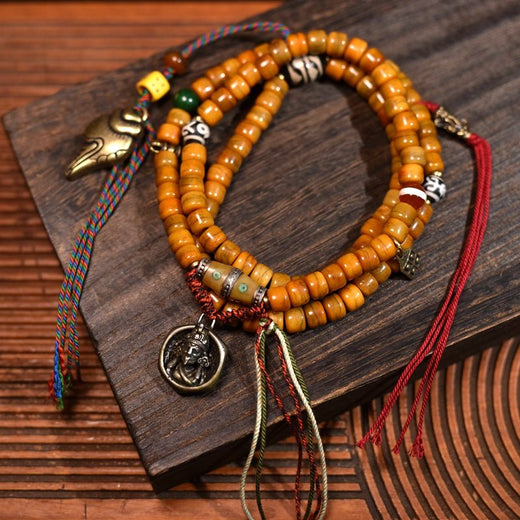
Explore our monk-blessed Yak Bone 108 mala.
Frequently Asked Questions About Using Malas for Sleep
1. What if I fall asleep before finishing all 108 beads?
This is the goal! If you fall asleep mid-practice, it means the mala has successfully done its job of calming your mind and nervous system.
It is a sign of success, not a failure to complete the ritual. Simply let it be, and know that you have found your way to the rest you were seeking.
2. Can I use my daytime meditation mala for sleep?
You certainly can. However, some people find it helpful to have a separate mala dedicated solely to their sleep ritual. This helps to create a strong energetic association; when you pick up that specific mala, your mind and body immediately get the signal that it is time to wind down and surrender.
A sleep mala becomes a key that unlocks the door to rest.
3. Is it okay to wear my mala beads to bed?
While you can, it's generally not recommended. Wearing a mala necklace to bed can be uncomfortable and risks getting it tangled or broken.
It's best to complete your practice and then place the mala on your nightstand. If you feel comforted by its proximity, keeping it on the bedside table is just as effective energetically.
4. How do I choose a mantra? Does it have to be in Sanskrit?
Absolutely not. The most powerful mantra is one that resonates deeply with you and addresses your specific need at that moment.
Simple phrases in your own language, like "I am at peace" or "Letting go," can be incredibly effective. The power comes from the intention and the feeling behind the words, not the language they are in.
5. How long will it take for this practice to work?
Like any new practice, it requires consistency. You might feel a noticeable difference on the very first night. For others, it may take a week or two of consistent practice to retrain the nervous system.
Be patient and compassionate with yourself. The goal isn't to force sleep, but to create the perfect conditions for sleep to arise naturally.

Keep reading